Alligation and Mixture is an arithmetic method based on the concept of Weighted Average. It provides a rapid shortcut to solve problems involving the blending of two or more ingredients with different values, prices, or percentage concentrations.
1. Fundamentals of Alligation and Mixture
What is a Mixture?
A mixture is produced when two or more ingredients of different qualities, prices, or concentrations are combined.
Example: Mixing cheaper rice with expensive rice, or mixing pure milk with water.
What is Alligation?
The word alligation literally means "to bind together" or "to link." In mathematics, the Rule of Alligation is a graphical shortcut derived directly from the weighted average formula. It tells you the exact ratio in which two ingredients must be mixed to achieve a desired average price or concentration.
The Mathematical Origin (Weighted Average)
Suppose you mix:
Quantity Q1 of an ingredient costing c (Cheaper value)
Quantity Q2 of an ingredient costing d (Dearer/Costlier value)
To produce a mixture of mean value m
The standard weighted average equation is:
Total Cost = (Q1 * c) + (Q2 * d)
Total Quantity = Q1 + Q2
Mean Value (m) = [(Q1 * c) + (Q2 * d)] / (Q1 + Q2)
Rearranging this equation:
m * (Q1 + Q2) = (Q1 * c) + (Q2 * d)
(m * Q1) + (m * Q2) = (c * Q1) + (d * Q2)
(m * Q1) - (c * Q1) = (d * Q2) - (m * Q2)
Q1 * (m - c) = Q2 * (d - m)
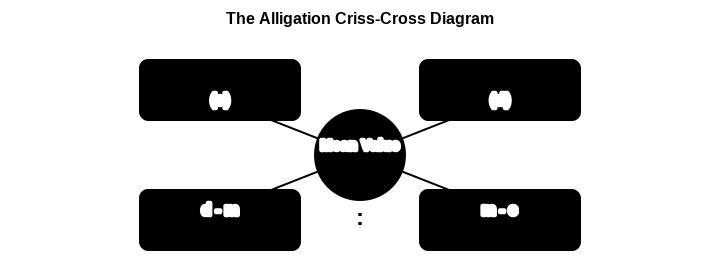
Q1 / Q2 = (d - m) / (m - c)
This leads directly to the core formula:
Quantity of Cheaper / Quantity of Dearer = (Dearer Price - Mean Price) / (Mean Price - Cheaper Price)
The Alligation Diagram (The Criss-Cross Method)
In practice, the formula is laid out in a simple criss-cross structure. Hover over the diagram below to see the connections.
Three Golden Rules to Remember
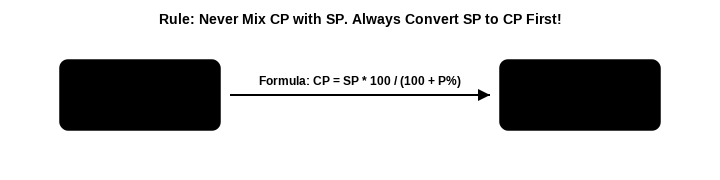
Identical Units and Reference Points: All three values (c, d, and m) must be in the exact same unit. You cannot mix a Cost Price (CP) with a Selling Price (SP). If two are Cost Prices, the Mean must also be converted to Cost Price.
Mean Position: The Mean Value m must always lie strictly between c and d (c < m < d). If m is less than c or greater than d, the problem is mathematically impossible.
Reference Base: The resulting ratio belongs to whatever is in the denominator of the rate:
Rate is Price per kg → Ratio is in kg (Quantity).
Rate is Speed in km per hour → Ratio is in hours (Time).
Rate is Profit % on Cost Price → Ratio is of Cost Prices.
2. The Four Common Problem Types
Type 1: Direct Price or Concentration Alligation
Two varieties with known prices or percentage strengths are mixed to form a target average.
Example 1.1
Problem: In what ratio must rice at Rs 40 per kg be mixed with rice at Rs 65 per kg so that the mixture is worth Rs 50 per kg?
Solution:
• Cheaper price (c) = 40
• Dearer price (d) = 65
• Mean price (m) = 50
• Ratio (Cheaper : Dearer) = (d - m) : (m - c)
• = (65 - 50) : (50 - 40)
• = 15 : 10 = 3 : 2
• Answer: The two varieties must be mixed in the ratio 3 : 2.
Example 1.2
Problem: In what ratio must a 30% alcohol solution be mixed with a 50% alcohol solution to obtain a 45% alcohol solution?
• Answer: The price of the mixture is Rs 33 per kg.
Example 1.4
Problem: How many kilograms of sugar costing Rs 45 per kg must be mixed with 60 kg of sugar costing Rs 60 per kg so that the mixture is worth Rs 54 per kg?
• Cheaper sugar corresponds to 2 parts = 2 * 20 = 40 kg
• Answer: 40 kg of cheaper sugar must be mixed.
Example 1.5
Problem: An alloy contains 85% copper and another alloy contains 92% copper. How many kg of the first alloy should be melted with 28 kg of the second alloy to obtain an alloy containing 89% copper?
Solution:
• First alloy (c) = 85%, Second alloy (d) = 92%, Mean (m) = 89%
Problem: A grocer mixes two varieties of pulses costing Rs 60 per kg and Rs 85 per kg. By selling the mixture at Rs 84 per kg, he earns a profit of 20%. In what ratio did he mix them?
Solution:
• Step 1: Find the Cost Price of the mixture:
• CP of mixture = (84 * 100) / (100 + 20) = 8400 / 120 = Rs 70 per kg
• Step 2: Apply Alligation on Cost Prices:
• c = 60, d = 85, m = 70
• Ratio = (85 - 70) : (70 - 60) = 15 : 10 = 3 : 2
• Answer: The pulses are mixed in the ratio 3 : 2.
Example 2.2
Problem: In what ratio must water be mixed with milk costing Rs 48 per liter so that by selling the mixture at Rs 40 per liter, there is a profit of 25%? (Water is assumed to be cost-free, CP = 0).
• Answer: Water and milk must be mixed in the ratio 1 : 2.
Example 2.3
Problem: A merchant has 100 kg of sugar. He sells a part of it at 10% profit and the rest at 20% profit. Overall, he gains 14% on the entire stock. Find the quantity sold at 20% profit.
Solution:
• Cheaper profit (c) = 10%
• Dearer profit (d) = 20%
• Mean profit (m) = 14%
• Ratio of quantities = (20 - 14) : (14 - 10) = 6 : 4 = 3 : 2
• Total parts = 3 + 2 = 5 parts
• 5 parts = 100 kg, so 1 part = 20 kg
• Quantity sold at 20% profit (2 parts) = 2 * 20 = 40 kg
• Answer: 40 kg was sold at 20% profit.
Example 2.4
Problem: A milkman buys pure milk at Rs 50 per liter. In what ratio must he mix water with it so that selling the mixture at the cost price (Rs 50 per liter) yields a profit of 20%?
Solution:
• SP of mixture = Rs 50, Profit = 20%
• CP of mixture = (50 * 100) / 120 = 250 / 6 = 125 / 3 per liter
• (Exam Shortcut: When pure liquid is sold at its original Cost Price by adding free water, the ratio of Water : Liquid is always equal to Profit % : 100 → 20 : 100 = 1 : 5).
• Answer: Water and milk must be mixed in the ratio 1 : 5.
Example 2.5
Problem: A trader mixes two types of cooking oil: Type A at Rs 90 per liter and Type B at Rs 120 per liter. He sells the mixture at Rs 121 per liter, making a 10% profit. If he used 40 liters of Type A, how many liters of Type B did he use?
Solution:
• Step 1: CP of mixture = (121 * 100) / 110 = Rs 110 per liter
• Step 2: Apply Alligation:
• c = 90, d = 120, m = 110
• Ratio (Type A : Type B) = (120 - 110) : (110 - 90) = 10 : 20 = 1 : 2
• Type A corresponds to 1 part = 40 liters
• Type B corresponds to 2 parts = 2 * 40 = 80 liters
• Answer: He used 80 liters of Type B oil.
Type 3: Mixing Prepared Vessels or Alloys (Ratio-Based)
Two or more vessels contain solutions of the same components (like milk and water) in different ratios. You are asked either to find the ratio in which they must be combined to form a target ratio, or to find the final composition when mixed in given proportions.
Example 3.1
Problem: Two vessels A and B contain milk and water in the ratio 7 : 3 and 3 : 2 respectively. In what ratio should liquid from both vessels be mixed to get a mixture containing milk and water in the ratio 2 : 1?
Solution:
• Express each in terms of the fraction of milk:
- Milk fraction in Vessel A = 7 / (7 + 3) = 7/10
- Milk fraction in Vessel B = 3 / (3 + 2) = 3/5 = 6/10
- Target Milk fraction = 2 / (2 + 1) = 2/3
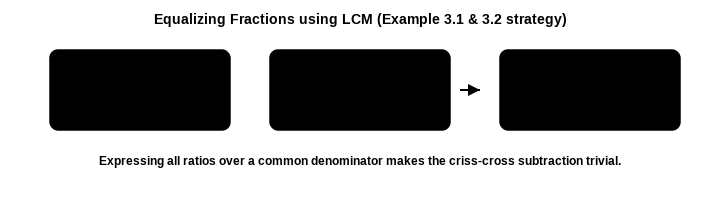
• Make common denominators (LCM of 10, 10, 3 = 30):
- Vessel A = 21/30
- Vessel B = 18/30
- Target = 20/30
• Apply Alligation:
- Ratio (Vessel A : Vessel B) = [(20/30) - (18/30)] : [(21/30) - (20/30)]
- = (2/30) : (1/30) = 2 : 1
• Answer: The contents must be mixed in the ratio 2 : 1.
Example 3.2
Problem: Container 1 contains acid and water in the ratio 3 : 1. Container 2 contains acid and water in the ratio 5 : 3. If equal quantities are taken from both containers and combined, what is the ratio of acid to water in the new mixture?
Solution:
• Sum of ratio terms: Container 1 has 3 + 1 = 4 parts; Container 2 has 5 + 3 = 8 parts.
• Equalize total volumes using the LCM of 4 and 8, which is 8:
- Container 1 (multiply by 2 to make 8 parts):
- Acid = 3 * 2 = 6, Water = 1 * 2 = 2
- Container 2 (already 8 parts):
- Acid = 5, Water = 3
• Add the quantities:
- Total Acid = 6 + 5 = 11
- Total Water = 2 + 3 = 5
• Answer: The resulting ratio of acid to water is 11 : 5.
Example 3.3
Problem: Three glasses of equal volume contain alcohol and water in the ratios 2 : 1, 3 : 2, and 4 : 1. If all three glasses are emptied into a large container, what is the final ratio of alcohol to water?
Solution:
• Sum of ratio parts:
- Glass 1 = 2 + 1 = 3 parts
- Glass 2 = 3 + 2 = 5 parts
- Glass 3 = 4 + 1 = 5 parts
• Equalize volumes using the LCM of 3, 5, and 5, which is 15:
• Answer: The final ratio of alcohol to water is 31 : 14.
Example 3.4
Problem: Vessel P contains liquids X and Y in the ratio 5 : 2, and Vessel Q contains them in the ratio 8 : 5. In what ratio must mixtures from P and Q be combined to produce a mixture containing liquids X and Y in the ratio 9 : 4?
• Answer: Liquids from P and Q must be mixed in the ratio 7 : 2.
Example 3.5
Problem: Two alloys consist of zinc and tin. Alloy 1 has zinc and tin in the ratio 4 : 5. Alloy 2 has zinc and tin in the ratio 3 : 7. If 18 kg of Alloy 1 and 20 kg of Alloy 2 are melted together, find the ratio of zinc to tin in the final alloy.
Solution:
• From Alloy 1 (Total = 4 + 5 = 9 parts):
- Total weight = 18 kg → 1 part = 18 / 9 = 2 kg
- Zinc = 4 * 2 = 8 kg
- Tin = 5 * 2 = 10 kg
• From Alloy 2 (Total = 3 + 7 = 10 parts):
- Total weight = 20 kg → 1 part = 20 / 10 = 2 kg
- Zinc = 3 * 2 = 6 kg
- Tin = 7 * 2 = 14 kg
• Combined Weights:
- Total Zinc = 8 + 6 = 14 kg
- Total Tin = 10 + 14 = 24 kg
• Ratio of Zinc to Tin = 14 : 24 = 7 : 12
• Answer: The ratio of zinc to tin is 7 : 12.
Type 4: Successive Replacement / Repeated Dilution
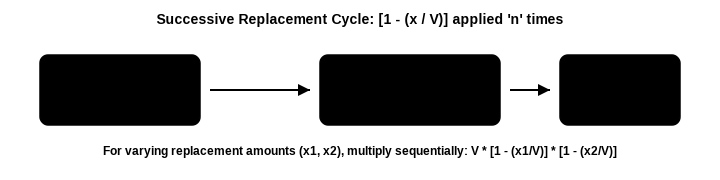
A vessel initially contains a pure liquid (total volume V). A specific quantity x is drawn out and replaced with water or another diluent. This cycle is performed n times.
The Standard Formula:
Remaining Quantity of Original Liquid = V * [1 - (x / V)]n
Fraction of Original Liquid Left = [1 - (x / V)]n
Quantity of Added Diluent = Total Volume (V) - Remaining Original Liquid
Example 4.1
Problem: A container contains 80 liters of pure milk. From this container, 8 liters of milk are taken out and replaced with water. This process is repeated one more time (total 2 operations). How much pure milk remains?
Solution:
• Initial volume (V) = 80 liters
• Quantity removed (x) = 8 liters
• Number of operations (n) = 2
• Remaining Milk = 80 * [1 - (8 / 80)]2
• = 80 * [1 - (1 / 10)]2
• = 80 * (9 / 10)2
• = 80 * (81 / 100) = 80 * 0.81 = 64.8 liters
• Answer: 64.8 liters of pure milk remains.
Example 4.2
Problem: A vessel is filled with 100 liters of pure wine. 20 liters of wine are drawn out and replaced with water. Again, 20 liters of the mixture are drawn out and replaced with water. This process is carried out a total of 3 times. What is the ratio of wine to water left in the vessel?
Solution:
• V = 100, x = 20, n = 3
• Fraction of wine remaining = [1 - (20 / 100)]3
• = [1 - (1 / 5)]3 = (4 / 5)3 = 64 / 125
• This means out of a total 125 units of volume, 64 units are wine.
• Water remaining = 125 - 64 = 61 units
• Answer: The ratio of wine to water left is 64 : 61.
Example 4.3
Problem: From a container of pure honey, 10 liters are removed and replaced with water. This operation is repeated two more times (total 3 times). The ratio of honey to water left in the container is now 343 : 169. What was the original capacity of the container?
Solution:
• Total volume units = 343 (Honey) + 169 (Water) = 512 units
• Fraction of honey left = 343 / 512
• Using the formula: [1 - (x / V)]n = Fraction Left
- [1 - (10 / V)]3 = 343 / 512
• Take the cube root of both sides:
- 1 - (10 / V) = 7 / 8
- 10 / V = 1 - (7 / 8) = 1 / 8
- V = 10 * 8 = 80 liters
• Answer: The original capacity was 80 liters.
Example 4.4
Problem: A container holds 60 liters of pure acid. 12 liters are drawn out and replaced with water. Next, 15 liters of the resulting mixture are drawn out and replaced with water. How much pure acid remains in the container?
Solution:
• When replacement quantities vary (x1, x2), each cycle multiplies the remaining fraction:
Problem: A barrel holds 50 liters of pure spirit. 10 liters of spirit are taken out and replaced with water. Then 10 liters of the mixture are drawn out and replaced with water. How many liters of water are in the barrel now?
Solution:
• V = 50, x = 10, n = 2
• Remaining Spirit = 50 * [1 - (10 / 50)]2
• = 50 * [1 - (1 / 5)]2
• = 50 * (4 / 5)2
• = 50 * (16 / 25) = 2 * 16 = 32 liters
• Amount of Water = Total Volume - Remaining Spirit
• = 50 - 32 = 18 liters
• Answer: There are 18 liters of water in the barrel.
Ready to Test Your Speed?
Put your Alligation and Mixture shortcuts, criss-cross methods, and successive replacement formulas to the test with real drills.