An average is a single central value that represents a collection of numbers by distributing the total sum equally among all individual items.
1. Fundamentals of Averages
Core Definition and Formulas
The arithmetic mean (average) is calculated by dividing the total sum of all items by the total number of items:
Average = Sum of all observations / Total number of observations
Sum of all observations = Average * Total number of observations
Total number of observations = Sum of all observations / Average
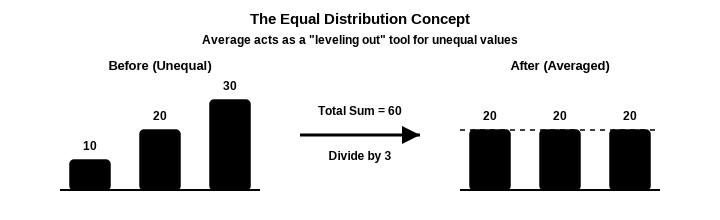
The Equal Distribution Concept
Think of an average as "leveling out" differences. If three people have 10, 20, and 30 apples:
Total apples = 10 + 20 + 30 = 60
Total people = 3
Average = 60 / 3 = 20 apples
If everyone shares equally, each person gets 20 apples. Anyone having more than 20 is giving surplus, and anyone having less than 20 is taking from that surplus.
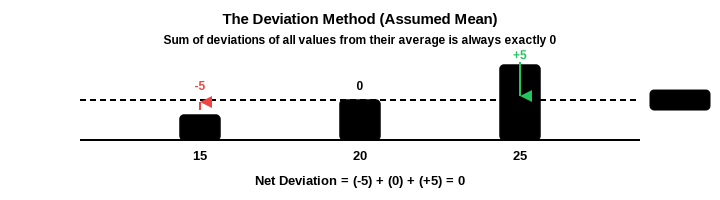
The Deviation Method (Assumed Mean)
The sum of deviations of all values from their average is always equal to 0.
Deviation = Actual Value - Average Value
Sum of all deviations = 0
Quick Check: For numbers 15, 20, 25: Average = 20 Deviations: (15 - 20) + (20 - 20) + (25 - 20) = (-5) + 0 + (+5) = 0 This principle allows you to solve large calculation problems quickly without finding the full sum.
Mathematical Properties of Averages
If a group of numbers has an average A:
Addition: If a constant value k is added to every number, the new average becomes A + k.
Subtraction: If a constant value k is subtracted from every number, the new average becomes A - k.
Multiplication: If every number is multiplied by k, the new average becomes A * k.
Division: If every number is divided by a non-zero number k, the new average becomes A / k.
Consecutive Numbers and Arithmetic Progressions (AP)
When numbers are evenly spaced (such as consecutive integers, consecutive even/odd numbers, or any arithmetic progression):
Average = (First term + Last term) / 2
• If the number of terms is odd, the average is the exact middle term.
• If the number of terms is even, the average is the mean of the two middle terms.
2. Common Problem Types in Competitive Exams
Type 1: Consecutive Numbers and Series
Core Concept: Questions in this category ask you to find the largest, smallest, or missing numbers in an evenly spaced sequence.
Example 1.1
Problem: Find the average of the first 50 natural numbers (1 to 50).
• Since the numbers 1, 2, 3, ..., 50 form an arithmetic progression:
• Average = (First term + Last term) / 2
• Average = (1 + 50) / 2 = 51 / 2 = 25.5
Example 1.2
Problem: The average of 5 consecutive odd numbers is 27. Find the largest number.
• For an odd number of consecutive terms (5 terms), the average is the exact middle (3rd) term.
• 3rd term = 27
• The 5 numbers are: 23, 25, 27, 29, 31
• Largest number = 31
Example 1.3
Problem: The average of 6 consecutive even numbers is 35. Find the smallest number.
• For an even number of terms (6 terms), the average lies directly between the 3rd and 4th terms.
• Middle terms around 35: 3rd term = 34, 4th term = 36
• Complete series: 30, 32, 34, 36, 38, 40
• Smallest number = 30
Example 1.4
Problem: Find the average of all multiples of 7 between 10 and 80.
• First multiple of 7 after 10 = 14
• Last multiple of 7 before 80 = 77
• Because all multiples of 7 are evenly spaced:
• Average = (First term + Last term) / 2 = (14 + 77) / 2 = 91 / 2 = 45.5
Example 1.5
Problem: The average of 7 consecutive numbers is 20. If the next 3 consecutive numbers are also included, what is the new average?
• Original 7 numbers have middle term = 20, so they are: 17, 18, 19, 20, 21, 22, 23.
• Adding the next 3 numbers gives: 17, 18, 19, 20, 21, 22, 23, 24, 25, 26 (10 terms in total).
• New average = (First term + Last term) / 2 = (17 + 26) / 2 = 43 / 2 = 21.5
• (Direct shortcut: Adding n consecutive numbers increases the average by n / 2. Here, 3 / 2 = 1.5. New average = 20 + 1.5 = 21.5).
Type 2: Inclusion (A New Person or Item Joins)
A new person or item enters the group, altering the count and the average.
• Value of New Member = New Average + (Old Count * Increase in Average)
• Value of New Member = New Average - (Old Count * Decrease in Average)
Example 2.1
Problem: The average age of 24 students in a class is 15 years. If the teacher's age is included, the average age increases by 1 year. Find the age of the teacher.
• Old count = 24, Old average = 15
• New count = 25, New average = 15 + 1 = 16
• Old total age = 24 * 15 = 360 years
• New total age with teacher = 25 * 16 = 400 years
• Teacher's age = 400 - 360 = 40 years
• (Shortcut: New Average + Old Count * Increase = 16 + 24 * 1 = 40 years).
Example 2.2
Problem: The average weight of 19 persons is 50 kg. A new person joins, and the average weight decreases by 0.5 kg. What is the weight of the new person?
• Old count = 19, Old average = 50 kg
• New count = 20, New average = 50 - 0.5 = 49.5 kg
• Old total weight = 19 * 50 = 950 kg
• New total weight = 20 * 49.5 = 990 kg
• Weight of new person = 990 - 950 = 40 kg
• (Shortcut: New Average - Old Count * Decrease = 49.5 - 19 * 0.5 = 49.5 - 9.5 = 40 kg).
Example 2.3
Problem: A batsman has a certain average of runs across 11 innings. In the 12th inning, he scores 90 runs, which increases his average by 5 runs. What is his new average?
• Let old average = A. New average = A + 5
• Total runs in 11 innings = 11 * A
• Total runs in 12 innings = 12 * (A + 5)
• 11 * A + 90 = 12 * A + 60
• 12 * A - 11 * A = 90 - 60
• A = 30
• New average = A + 5 = 30 + 5 = 35 runs
• (Shortcut: New Average = Score - Old Innings * Increase = 90 - 11 * 5 = 35 runs).
Example 2.4
Problem: The average salary of 15 employees is 12,000 rupees. When the manager's salary is included, the average increases by 1,000 rupees. What is the manager's salary?
Problem: The average score of 8 students in a test is 65. Two new students join with scores of 75 and 85. What is the new average score of all 10 students?
• Old total score = 8 * 65 = 520
• Sum of scores of 2 new students = 75 + 85 = 160
• New total score = 520 + 160 = 680
• Total students = 8 + 2 = 10
• New average = 680 / 10 = 68
Type 3: Exclusion (A Person or Item Leaves)
One or more items are removed, decreasing the total count.
• Value of Excluded Member = Old Average + (New Count * Decrease in Average)
• Value of Excluded Member = Old Average - (New Count * Increase in Average)
Example 3.1
Problem: The average age of 30 students and 1 teacher is 20 years. If the teacher leaves, the average age decreases by 1 year. Find the teacher's age.
• Total people initially = 31, Initial average = 20
• Remaining people = 30, New average = 19
• Total initial age = 31 * 20 = 620 years
• Total remaining age = 30 * 19 = 570 years
• Teacher's age = 620 - 570 = 50 years
• (Shortcut: Old Average + Remaining Count * Decrease = 20 + 30 * 1 = 50 years).
Example 3.2
Problem: The average weight of 6 people is 68 kg. If one person leaves the group, the average weight of the remaining people becomes 70 kg. Find the weight of the person who left.
• Total initial weight = 6 * 68 = 408 kg
• Total remaining weight = 5 * 70 = 350 kg
• Weight of person who left = 408 - 350 = 58 kg
• (Shortcut: Old Average - Remaining Count * Increase = 68 - 5 * 2 = 58 kg).
Example 3.3
Problem: The average of 5 numbers is 27. If one number is excluded, the average of the remaining numbers becomes 25. Find the excluded number.
• Initial sum = 5 * 27 = 135
• Remaining sum = 4 * 25 = 100
• Excluded number = 135 - 100 = 35
• (Shortcut: 27 + 4 * 2 = 35).
Example 3.4
Problem: The average monthly expense of a family of 4 members is 18,000 rupees. One member moves out, and the average expense of the remaining 3 members becomes 16,500 rupees. What was that member's expense?
Problem: The average weight of 10 boxes is 25 kg. Two boxes of equal weight are removed, which raises the average weight of the remaining 8 boxes to 26 kg. Find the weight of each removed box.
• Initial total weight = 10 * 25 = 250 kg
• Remaining total weight = 8 * 26 = 208 kg
• Combined weight of 2 removed boxes = 250 - 208 = 42 kg
• Weight of each box = 42 / 2 = 21 kg
Type 4: Replacement (One Value Swapped for Another)
The total count of items remains constant because an incoming item replaces an outgoing item.
• Value of Incoming Item = Replaced Value + (Total Count * Increase in Average)
• Value of Incoming Item = Replaced Value - (Total Count * Decrease in Average)
Example 4.1
Problem: The average weight of 8 men increases by 1.5 kg when one man weighing 65 kg is replaced by a new man. Find the weight of the new man.
• Number of men = 8 (constant)
• Total increase in weight = 8 * 1.5 = 12 kg
• Weight of new man = Replaced weight + Total increase
• Weight of new man = 65 + 12 = 77 kg
Example 4.2
Problem: The average age of 12 players decreases by 2 months when two players aged 21 years and 23 years are replaced by two new players. What is the average age of the two new players?
• Total drop in age = 12 * 2 months = 24 months = 2 years
• Combined age of old players = 21 + 23 = 44 years
• Combined age of new players = 44 - 2 = 42 years
• Average age of the two new players = 42 / 2 = 21 years
Example 4.3
Problem: The average score of 20 students in a test decreases by 1 mark when a student who scored 85 marks is replaced by a new student. Find the marks of the new student.
• Total reduction in marks = 20 * 1 = 20 marks
• New student's marks = Replaced marks - Total reduction
• New student's marks = 85 - 20 = 65 marks
Example 4.4
Problem: There are 10 members in a committee. When a 55-year-old member is replaced by a new member, the average age of the committee drops by 3 years. What is the age of the new member?
• Total decrease in age = 10 * 3 = 30 years
• Age of incoming member = 55 - 30 = 25 years
Example 4.5
Problem: The average weight of 15 parcels increases by 0.4 kg when an old parcel weighing 14 kg is replaced by a new parcel. What is the weight of the incoming parcel?
• Total increase in weight = 15 * 0.4 = 6 kg
• Weight of incoming parcel = 14 + 6 = 20 kg
Type 5: Error Correction (Misread / Incorrectly Entered Data)
One or more values were recorded incorrectly during data entry, requiring adjustment.
• Net Difference = Correct Value - Incorrect Value
• Correction per Item = Net Difference / Total Count
• Correct Average = Given Average + Correction per Item
Example 5.1
Problem: The average marks of 40 students was calculated as 68. Later, it was discovered that a score of 48 was wrongly recorded as 84. Find the correct average.
• Net Difference = Correct Value - Incorrect Value = 48 - 84 = -36
• Correction to average = -36 / 40 = -0.9
• Correct average = 68 - 0.9 = 67.1
Example 5.2
Problem: The average of 50 numbers is 38. If two numbers, 45 and 55, were misread as 35 and 25 respectively, find the actual average.
• Sum of correct numbers = 45 + 55 = 100
• Sum of entered numbers = 35 + 25 = 60
• Net Difference = 100 - 60 = +40
• Correction to average = +40 / 50 = +0.8
• Correct average = 38 + 0.8 = 38.8
Example 5.3
Problem: The mean of 25 observations is 36. It was later found that an observation of 72 was mistakenly read as 27. Find the correct mean.
Problem: The average weight of 20 items was calculated as 45 kg. It was later discovered that two weights of 62 kg and 31 kg were wrongly entered as 26 kg and 13 kg. What is the correct average weight?
• Correct total = 62 + 31 = 93 kg
• Incorrect total = 26 + 13 = 39 kg
• Net Difference = 93 - 39 = +54 kg
• Correction to average = +54 / 20 = +2.7 kg
• Correct average = 45 + 2.7 = 47.7 kg
Example 5.5
Problem: The average of 100 numbers was calculated as 40. Later, it was found that a number 53 was read as 83, and another number 67 was read as 97. Find the correct average.
• Correct sum = 53 + 67 = 120
• Incorrect sum = 83 + 97 = 180
• Net Difference = 120 - 180 = -60
• Correction to average = -60 / 100 = -0.6
• Correct average = 40 - 0.6 = 39.4
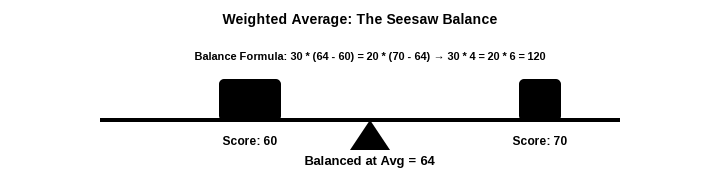
Type 6: Weighted Average and Combined Groups
Combines two or more distinct groups, each with its own size and average.
Problem: Section A has 30 students with an average score of 60 marks, and Section B has 20 students with an average score of 70 marks. Find the combined average score of both sections.
• Total score of Section A = 30 * 60 = 1800
• Total score of Section B = 20 * 70 = 1400
• Total combined score = 1800 + 1400 = 3200
• Total students = 30 + 20 = 50
• Combined average = 3200 / 50 = 64 marks
Example 6.2
Problem: The ratio of boys to girls in a school is 3 : 2. The average age of boys is 16 years, and the average age of girls is 14 years. Find the average age of all students.
• Assume 3 boys and 2 girls (total = 5 students).
• Total age of boys = 3 * 16 = 48 years
• Total age of girls = 2 * 14 = 28 years
• Total combined age = 48 + 28 = 76 years
• Combined average = 76 / 5 = 15.2 years
Example 6.3
Problem: A merchant purchases 4 kg of rice at 40 rupees/kg, 5 kg at 50 rupees/kg, and 1 kg at 60 rupees/kg. What is the average cost of rice per kg?
• Total cost = (4 * 40) + (5 * 50) + (1 * 60)
• Total cost = 160 + 250 + 60 = 470 rupees
• Total quantity = 4 + 5 + 1 = 10 kg
• Average cost = 470 / 10 = 47 rupees/kg
Example 6.4
Problem: In an office, the average salary of all 60 employees is 25,000 rupees. The average salary of 20 officers is 45,000 rupees. Find the average salary of the remaining non-officer staff.
• Total salary of all 60 employees = 60 * 25,000 = 1,500,000 rupees
• Total salary of 20 officers = 20 * 45,000 = 900,000 rupees
• Total salary of remaining 40 staff = 1,500,000 - 900,000 = 600,000 rupees
• Average salary of non-officer staff = 600,000 / 40 = 15,000 rupees
Example 6.5
Problem: A bowler has a bowling average of 12.4 runs per wicket. In his next match, he takes 5 wickets for 26 runs, which decreases his average by 0.4 runs. Find the number of wickets taken by him before this match.
• Bowling average = Total runs conceded / Total wickets taken.
• Let total wickets taken before the match = W.
• Runs conceded before the match = 12.4 * W
• In the new match: Runs = 26, Wickets = 5
• New total runs = 12.4 * W + 26
• New total wickets = W + 5
• New average = 12.4 - 0.4 = 12.0 runs per wicket
• (12.4 * W + 26) / (W + 5) = 12
• 12.4 * W + 26 = 12 * W + 60
• 12.4 * W - 12 * W = 60 - 26
• 0.4 * W = 34
• W = 34 / 0.4 = 85 wickets
Ready to Test Your Speed?
Put your average calculation shortcuts, deviation tricks, and exam formulas to the test with real drills.