Compound Interest

Compound interest is interest calculated on both the initial principal and the accumulated interest from previous periods. In simple terms, it is interest earned on interest.

1. Fundamentals of Compound Interest

Simple Interest (SI) vs. Compound Interest (CI)

  • Simple Interest: The interest is calculated only on the original principal every year. The interest amount remains the same for every cycle.
  • Compound Interest: The interest earned at the end of each period is added to the principal to form a new principal for the next period. Because the principal grows over time, the interest earned in each successive period also increases.
Compound Interest Diagram 1

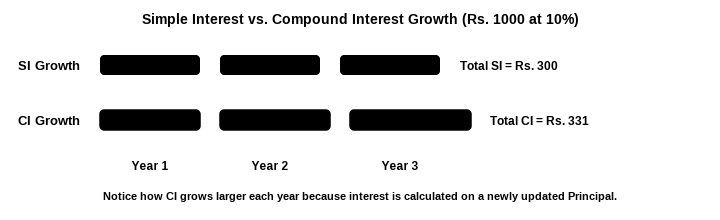
Example Comparison on Rs. 1,000 at 10% per annum for 3 years:

  • Year 1:
    • SI: 10% of 1,000 = Rs. 100
    • CI: 10% of 1,000 = Rs. 100 (For Year 1, SI and CI are always identical)
  • Year 2:
    • SI: 10% of 1,000 = Rs. 100 (Total SI so far = Rs. 200)
    • CI: New Principal = 1,000 + 100 = Rs. 1,100. Interest = 10% of 1,100 = Rs. 110 (Total CI so far = Rs. 210)
  • Year 3:
    • SI: 10% of 1,000 = Rs. 100 (Total SI after 3 years = Rs. 300)
    • CI: New Principal = 1,100 + 110 = Rs. 1,210. Interest = 10% of 1,210 = Rs. 121 (Total CI after 3 years = Rs. 331)

Core Terms and Basic Formulas

  • Principal (P): The original sum of money borrowed or invested.
  • Rate of Interest (R): The percentage rate per period or per year.
  • Time (t or n): The duration or total number of conversion periods.
  • Amount (A): The total value at the end of the term (Principal + Interest).
  • Compound Interest (CI): Amount - Principal
Formulas:

Amount (A) = P * (1 + R / 100)t
CI = Amount - Principal = P * [(1 + R / 100)t - 1]

Compounding Frequencies

Interest is not always added once a year. When compounding happens more frequently, adjust the Rate and Time:

  • Compounded Annually:
    • Rate = R%
    • Time periods = t
  • Compounded Half-Yearly (Semi-Annually):
    • Rate per period = R / 2 %
    • Total periods = 2 * t
    • A = P * (1 + (R / 2) / 100)(2 * t)
  • Compounded Quarterly (Every 3 months):
    • Rate per period = R / 4 %
    • Total periods = 4 * t
    • A = P * (1 + (R / 4) / 100)(4 * t)

Speed Techniques Used in Competitive Books

1. The Successive Percentage Formula (Effective Rate Method)

For 2 periods at rates a% and b%:

  • Net Effective Rate = a + b + (a * b) / 100 %
  • If the rate is R% each year for 2 years:
    • Effective Rate = 2 * R + (R2) / 100 %
    • Example: At 10% for 2 years: 10 + 10 + (10 * 10) / 100 = 21%.
    • CI on Rs. 5,000 = 21% of 5,000 = Rs. 1,050.

2. The Ratio / Fraction Method

Convert the percentage rate into a fraction:

  • Rate of 10% = 1 / 10.
    • Principal : Amount for 1 year = 10 : 11.
    • For 2 years: Principal : Amount = 102 : 112 = 100 : 121.
    • For 3 years: Principal : Amount = 103 : 113 = 1000 : 1331.
    • Here, CI for 2 years = 121 - 100 = 21 units.

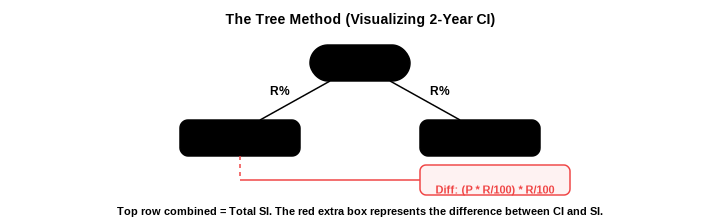
3. The Tree Method

Break the interest down step by step:

  • For 2 years:
    • Year 1: P * (R / 100)
    • Year 2: P * (R / 100) + Interest on Year 1 interest
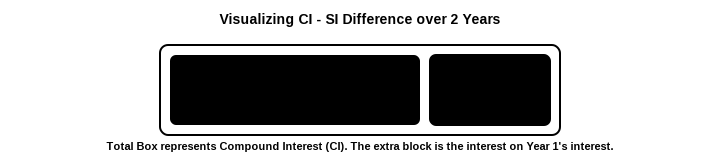
  • The top row gives Simple Interest (SI).
  • The extra branches give the difference between CI and SI.
Compound Interest Diagram 2

2. Most Common Problem Types with Examples

Type 1: Basic Calculations of Amount and CI (Annual, Half-Yearly, Quarterly)

Example 1.1: Annual Compounding for 2 Years
Question: Find the compound interest on Rs. 10,000 for 2 years at 10% per annum, compounded annually.
• Step-by-step Solution:
1. Principal (P) = 10,000, Rate (R) = 10%, Time (t) = 2 years.
2. Amount = P * (1 + R / 100)t
3. Amount = 10,000 * (1 + 10 / 100)2 = 10,000 * (11 / 10) * (11 / 10)
4. Amount = 10,000 * (121 / 100) = Rs. 12,100
5. CI = Amount - Principal = 12,100 - 10,000 = Rs. 2,100
• Answer: Rs. 2,100
Example 1.2: Annual Compounding for 3 Years
Question: What is the compound interest on Rs. 8,000 at 5% per annum for 3 years, compounded annually?
• Step-by-step Solution:
1. P = 8,000, R = 5% = 1 / 20, t = 3 years.
2. Ratio for 1 year: 20 becomes 21.
3. Ratio for 3 years: (20)3 becomes (21)3 => 8,000 becomes 9,261.
4. Since 8,000 units = Rs. 8,000, Amount = Rs. 9,261.
5. CI = 9,261 - 8,000 = Rs. 1,261.
• Answer: Rs. 1,261
Example 1.3: Compounded Half-Yearly
Question: Find the compound interest on Rs. 16,000 at 20% per annum for 1 year, compounded half-yearly.
• Step-by-step Solution:
1. Half-yearly compounding means:
  - Adjusted Rate = 20 / 2 = 10% per half-year.
  - Number of periods (n) = 1 * 2 = 2 periods.
2. Amount = 16,000 * (1 + 10 / 100)2
3. Amount = 16,000 * (11 / 10)2 = 16,000 * (121 / 100) = 160 * 121 = Rs. 19,360.
4. CI = 19,360 - 16,000 = Rs. 3,360.
• Answer: Rs. 3,360
Example 1.4: Compounded Quarterly
Question: Find the amount and compound interest on Rs. 12,000 for 9 months at 20% per annum, compounded quarterly.
• Step-by-step Solution:
1. Quarterly compounding means:
  - Adjusted Rate = 20 / 4 = 5% per quarter.
  - 9 months = 9 / 3 = 3 quarters (n = 3).
2. Amount = 12,000 * (1 + 5 / 100)3 = 12,000 * (21 / 20)3
3. Amount = 12,000 * (9,261 / 8,000) = 1.5 * 9,261 = Rs. 13,891.50.
4. CI = 13,891.50 - 12,000 = Rs. 1,891.50.
• Answer: Amount = Rs. 13,891.50, CI = Rs. 1,891.50
Example 1.5: Different Rates for Successive Years
Question: A sum of Rs. 25,000 is invested for 2 years at compound interest. The rate for the first year is 4% and for the second year is 5%. Find the compound interest.
• Step-by-step Solution:
1. Amount = P * (1 + R1 / 100) * (1 + R2 / 100)
2. Amount = 25,000 * (1 + 4 / 100) * (1 + 5 / 100)
3. Amount = 25,000 * (26 / 25) * (21 / 20)
4. Amount = 1,000 * 26 * (21 / 20) = 50 * 26 * 21 = 50 * 546 = Rs. 27,300.
5. CI = 27,300 - 25,000 = Rs. 2,300.
• Answer: Rs. 2,300

Type 2: Difference Between CI and SI (CI - SI)

Key Shortcuts:

For 2 Years: Difference (D) = P * (R / 100)2
For 3 Years: Difference (D) = P * (R / 100)2 * [3 + (R / 100)] or P * R2 * (300 + R) / (1003)
Compound Interest Diagram 3
Example 2.1: Finding Difference for 2 Years
Question: What is the difference between simple interest and compound interest on Rs. 15,000 for 2 years at 8% per annum?
• Step-by-step Solution:
1. Formula for 2 years: D = P * (R / 100)2
2. D = 15,000 * (8 / 100)2
3. D = 15,000 * (64 / 10,000) = 1.5 * 64 = Rs. 96.
• Answer: Rs. 96
Example 2.2: Finding Principal when 2-Year Difference is Given
Question: The difference between CI and SI on a certain sum of money for 2 years at 5% per annum is Rs. 25. Find the sum.
• Step-by-step Solution:
1. Formula: D = P * (R / 100)2
2. 25 = P * (5 / 100)2
3. 25 = P * (1 / 20)2 = P / 400
4. P = 25 * 400 = Rs. 10,000.
• Answer: Rs. 10,000
Example 2.3: Finding Rate of Interest when 2-Year Difference is Given
Question: On a sum of Rs. 5,000, the difference between CI and SI for 2 years is Rs. 72. Find the annual rate of interest.
• Step-by-step Solution:
1. D = P * (R / 100)2
2. 72 = 5,000 * (R / 100)2
3. 72 / 5,000 = (R / 100)2
4. Multiply numerator and denominator by 2 to get a clean base of 10,000:
  - 144 / 10,000 = (R / 100)2
5. Take square root on both sides:
  - 12 / 100 = R / 100 => R = 12%.
• Answer: 12% per annum
Example 2.4: Finding Difference for 3 Years
Question: Calculate the difference between CI and SI on Rs. 8,000 at 5% per annum for 3 years.
• Step-by-step Solution:
1. Formula: D = P * (R / 100)2 * [3 + (R / 100)]
2. P * (R / 100)2 = 8,000 * (5 / 100)2 = 8,000 * (1 / 400) = 20.
3. [3 + (R / 100)] = [3 + 5 / 100] = 3 + 1 / 20 = 61 / 20.
4. D = 20 * (61 / 20) = Rs. 61.
• Answer: Rs. 61
Example 2.5: Finding Principal when 3-Year Difference is Given
Question: The difference between CI and SI on a certain sum for 3 years at 10% per annum is Rs. 155. Find the principal sum.
• Step-by-step Solution:
1. Formula: D = P * R2 * (300 + R) / (1003)
2. 155 = P * (10)2 * (300 + 10) / (1,000,000)
3. 155 = P * 100 * 310 / 1,000,000
4. 155 = P * 31,000 / 1,000,000 = P * (31 / 1,000)
5. P = (155 * 1,000) / 31 = 5 * 1,000 = Rs. 5,000.
• Answer: Rs. 5,000

Type 3: "Sum Becomes X Times" (Geometric Progression / Multiplier Rule)

Concept: Under compound interest, money multiplies at a constant rate over equal intervals of time.

  • If a sum becomes k times in T years, it becomes km times in m * T years.
Compound Interest Diagram 4
Example 3.1: Basic Doubling
Question: A sum of money placed at compound interest doubles itself in 4 years. In how many years will it amount to 8 times itself?
• Step-by-step Solution:
1. Base multiplier: 2 times in 4 years.
2. Target multiplier: 8 times = 23 times.
3. Power m = 3.
4. Total time = m * T = 3 * 4 = 12 years.
• Answer: 12 years
Example 3.2: Tripling Principle
Question: A sum invested at compound interest triples itself (becomes 3 times) in 5 years. In how many years will it become 81 times of itself?
• Step-by-step Solution:
1. Base multiplier: 3 times in 5 years.
2. Target multiplier: 81 times = 34 times.
3. Power m = 4.
4. Total time = 4 * 5 = 20 years.
• Answer: 20 years
Example 3.3: Finding the Multiple for a Given Time
Question: A sum of money becomes 4 times in 6 years at compound interest. How many times will it become in 18 years?
• Step-by-step Solution:
1. Total time = 18 years.
2. Time factor m = 18 / 6 = 3 cycles.
3. Since it becomes 4 times in 1 cycle, after 3 cycles it will become:
  - 43 = 64 times.
• Answer: 64 times
Example 3.4: Finding the Amount after a Time Interval
Question: A sum of Rs. 2,000 amounts to Rs. 4,000 in 3 years at compound interest. What will this amount be after 9 years?
• Step-by-step Solution:
1. In 3 years, Rs. 2,000 becomes Rs. 4,000 (which is 2 times).
2. 9 years = 3 * 3 years (3 compounding intervals).
3. Growth factor = 23 = 8 times.
4. Final Amount = 2,000 * 8 = Rs. 16,000.
• Answer: Rs. 16,000
Example 3.5: Large Term Compounding
Question: A sum of Rs. 12,000 deposited at compound interest doubles after 5 years. How much will it amount to after 20 years?
• Step-by-step Solution:
1. Number of 5-year periods in 20 years = 20 / 5 = 4 periods.
2. Growth multiplier = 24 = 16 times.
3. Amount after 20 years = 12,000 * 16 = Rs. 1,92,000.
• Answer: Rs. 1,92,000

Type 4: Amounts Given for Consecutive or Non-Consecutive Years

Concept:

  • For Consecutive Years (Year t and Year t+1): The extra money earned in year t+1 is simply 1 year's simple interest on the amount of year t.
    • Rate (R) = [(Amount in year t+1 - Amount in year t) / Amount in year t] * 100
  • For Non-Consecutive Equal Gaps (e.g., Year 2 and Year 4):
    • A2 = P * x and A4 = A2 * x => P = (A2 * A2) / A4
Example 4.1: Finding Rate from Consecutive Years
Question: A sum of money amounts to Rs. 2,420 in 2 years and to Rs. 2,662 in 3 years at compound interest. Find the annual rate of interest.
• Step-by-step Solution:
1. Amount at Year 2 = Rs. 2,420
2. Amount at Year 3 = Rs. 2,662
3. Interest earned in the 3rd year = 2,662 - 2,420 = Rs. 242
4. This Rs. 242 is earned on the principal of Rs. 2,420:
  - Rate = (242 / 2,420) * 100 = 10% per annum.
• Answer: 10% per annum
Example 4.2: Finding Principal from Consecutive Years
Question: A sum of money at compound interest amounts to Rs. 2,420 in 2 years and Rs. 2,662 in 3 years. Find the original principal sum.
• Step-by-step Solution:
1. As calculated in Example 4.1, the rate R = 10% per annum.
2. Amount for 2 years: A2 = P * (1 + R / 100)2
3. 2,420 = P * (1 + 10 / 100)2 = P * (11 / 10)2 = P * (121 / 100)
4. P = (2,420 * 100) / 121 = 20 * 100 = Rs. 2,000.
• Answer: Rs. 2,000
Example 4.3: Amounts at 1 Year and 2 Years
Question: A certain sum of money amounts to Rs. 650 at the end of 1 year and to Rs. 676 at the end of 2 years at compound interest. Find the rate of interest and the principal sum.
• Step-by-step Solution:
1. Interest for Year 2 = 676 - 650 = Rs. 26.
2. Rate = (26 / 650) * 100 = (2 / 50) * 100 = 4% per annum.
3. Amount after 1 year: A1 = P * (1 + R / 100)
4. 650 = P * (1 + 4 / 100) = P * (26 / 25)
5. P = (650 * 25) / 26 = 25 * 25 = Rs. 625.
• Answer: Rate = 4% per annum, Principal = Rs. 625
Example 4.4: Non-Consecutive Years (Equal 2-Year Intervals)
Question: A sum of money amounts to Rs. 4,500 in 2 years and to Rs. 6,750 in 4 years at compound interest. Find the principal sum.
• Step-by-step Solution:
1. Amount at 2 years: A2 = P * (1 + R / 100)2 = 4,500
2. Amount at 4 years: A4 = P * (1 + R / 100)4 = 6,750
3. Divide A4 by A2:
  - A4 / A2 = (1 + R / 100)2 = 6,750 / 4,500 = 3 / 2 = 1.5
4. Substitute (1 + R / 100)2 into the A2 equation:
  - P * (3 / 2) = 4,500
  - P = 4,500 * (2 / 3) = Rs. 3,000.
• Answer: Rs. 3,000
Example 4.5: Non-Consecutive Years (Equal 4-Year Intervals)
Question: A sum of money invested at compound interest amounts to Rs. 4,800 in 4 years and to Rs. 6,000 in 8 years. Find the principal sum.
• Step-by-step Solution:
1. Gap from 0 to 4 years = 4 years. Gap from 4 to 8 years = 4 years.
2. Multiplier for 4 years = A8 / A4 = 6,000 / 4,800 = 5 / 4.
3. Therefore, the sum grows by a factor of 5 / 4 every 4 years:
  - P * (5 / 4) = A4
  - P * (5 / 4) = 4,800
  - P = (4,800 * 4) / 5 = 960 * 4 = Rs. 3,840.
• Answer: Rs. 3,840

Type 5: Equal Annual Installments (Loan Repayment)

Concept:

When a loan P is repaid in n equal annual installments of Rs. x at R% per annum compound interest:

P = [x / (1 + R / 100)] + [x / (1 + R / 100)2] + ... + [x / (1 + R / 100)n]

The fraction represents the Present Value of each future installment payment.
Compound Interest Diagram 5
Example 5.1: Finding the Installment Amount for 2 Years
Question: A loan of Rs. 2,100 is to be repaid in 2 equal annual installments at 10% per annum compound interest. Find the amount of each installment.
• Step-by-step Solution:
1. Let each installment be x.
2. R = 10% => (1 + R / 100) = 11 / 10.
3. Formula: P = x / (11 / 10) + x / (11 / 10)2
4. 2,100 = (10x / 11) + (100x / 121)
5. Take LCM = 121:
  - 2,100 = (110x + 100x) / 121
  - 2,100 = 210x / 121
6. x = (2,100 * 121) / 210 = 10 * 121 = Rs. 1,210.
• Answer: Rs. 1,210 per year
Example 5.2: Finding the Borrowed Amount (Principal)
Question: A sum borrowed is repaid in 2 equal annual installments of Rs. 1,764 each at 5% per annum compound interest. What was the total sum borrowed?
• Step-by-step Solution:
1. Installment (x) = 1,764, Rate (R) = 5% = 1 / 20 => Multiplier = 21 / 20.
2. P = x / (21 / 20) + x / (21 / 20)2
3. P = 1,764 * (20 / 21) + 1,764 * (400 / 441)
4. Calculate terms:
  - First term: (1,764 / 21) * 20 = 84 * 20 = 1,680
  - Second term: (1,764 / 441) * 400 = 4 * 400 = 1,600
5. Total P = 1,680 + 1,600 = Rs. 3,280.
• Answer: Rs. 3,280
Example 5.3: Installment at 20% Compounding
Question: A loan of Rs. 11,000 is to be returned in 2 equal annual installments at 20% per annum compound interest. Find the value of each installment.
• Step-by-step Solution:
1. R = 20% = 1 / 5 => Multiplier = 6 / 5.
2. 11,000 = x * (5 / 6) + x * (25 / 36)
3. Take LCM = 36:
  - 11,000 = x * (30 + 25) / 36
  - 11,000 = x * (55 / 36)
4. x = (11,000 * 36) / 55 = 200 * 36 = Rs. 7,200.
• Answer: Rs. 7,200
Example 5.4: Cash Value and Total Interest Paid
Question: A person buys a scooter by paying 2 equal annual installments of Rs. 16,224 each at 4% per annum compound interest. Find the cash value of the scooter and the total interest paid.
• Step-by-step Solution:
1. R = 4% = 1 / 25 => Multiplier = 26 / 25.
2. Cash Value (P) = 16,224 * (25 / 26) + 16,224 * (625 / 676)
3. Calculate terms:
  - First term: (16,224 / 26) * 25 = 624 * 25 = Rs. 15,600
  - Second term: (16,224 / 676) * 625 = 24 * 625 = Rs. 15,000
4. Cash Value (P) = 15,600 + 15,000 = Rs. 30,600.
5. Total money paid = 2 * 16,224 = Rs. 32,448.
6. Total interest paid = 32,448 - 30,600 = Rs. 1,848.
• Answer: Cash Value = Rs. 30,600; Total Interest = Rs. 1,848
Example 5.5: 3 Equal Annual Installments
Question: A loan of Rs. 2,522 is repaid in 3 equal annual installments at 5% per annum compound interest. Find the value of each installment.
• Step-by-step Solution:
1. R = 5% = 1 / 20 => Multiplier = 21 / 20.
2. P = x * (20 / 21) + x * (400 / 441) + x * (8,000 / 9,261)
3. Take LCM = 9,261:
  - Numerator = x * [(20 * 441) + (400 * 21) + (8,000 * 1)]
  - Numerator = x * [8,820 + 8,400 + 8,000] = x * 25,220
4. 2,522 = x * (25,220 / 9,261)
5. x = (2,522 * 9,261) / 25,220 = 9,261 / 10 = Rs. 926.10.
• Answer: Rs. 926.10

Ready to Test Your Speed?

Put your compound interest formulas, effective rate tricks, and fraction shortcuts to the test with real drills.