Mental Cube Roots

A cube root is the value that, when multiplied by itself three times, produces the original number. For example, the cube root of 64 is 4, because 4 x 4 x 4 = 64. Finding a cube root is much simpler than finding a square root because every digit from 0 to 9 produces a completely unique ending digit when cubed. There is never any guessing between two numbers.

Method 1: Prime Factorization (Grouping in Threes)

Break the target number into its smallest prime factors (dividing by 2, 3, 5, 7...), group identical factors into sets of three (triplets), and take one factor from each triplet.
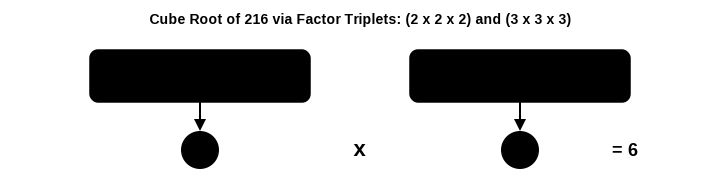
Cube root prime factorization triplet grouping diagram — Cube Root of 216 via Factor Triplets: (2 x 2 x 2) and (3 x 3 x 3).
Diagram text

Cube Root of 216 via Factor Triplets: (2 x 2 x 2) and (3 x 3 x 3) · Triplet 1: (2 x 2 x 2) · 2 · x · Triplet 2: (3 x 3 x 3) · 3 · = 6

Example 1: Cube root of 216
Step 1: Break into prime factors:
216 / 2 = 108
108 / 2 = 54
54 / 2 = 27
27 / 3 = 9
9 / 3 = 3
3 / 3 = 1
Factors: (2 x 2 x 2) x (3 x 3 x 3)
Step 2: Pick one number from each triplet: 2 x 3.
Step 3: Multiply: 2 x 3 = 6.
Answer: 6
Example 2: Cube root of 512
Step 1: Break into prime factors:
512 / 2 = 256
256 / 2 = 128
128 / 2 = 64
64 / 2 = 32
32 / 2 = 16
16 / 2 = 8
8 / 2 = 4
4 / 2 = 2
2 / 2 = 1
Factors: (2 x 2 x 2) x (2 x 2 x 2) x (2 x 2 x 2)
Step 2: Pick one number from each triplet: 2 x 2 x 2.
Step 3: Multiply: 2 x 2 x 2 = 8.
Answer: 8
Example 3: Cube root of 3,375
Step 1: Break into prime factors:
3,375 / 5 = 675
675 / 5 = 135
135 / 5 = 27
27 / 3 = 9
9 / 3 = 3
3 / 3 = 1
Factors: (5 x 5 x 5) x (3 x 3 x 3)
Step 2: Pick one number from each triplet: 5 x 3.
Step 3: Multiply: 5 x 3 = 15.
Answer: 15
Method 2: The Unit Digit and Split Shortcut (The 2-Second Exam Method)

This is the fastest method for bank and government exams. It finds the cube root of any 4-digit, 5-digit, or 6-digit perfect cube in two seconds flat.

The Last-Digit Rule:
Same Digits: 1 ends in 1, 4 ends in 4, 5 ends in 5, 6 ends in 6, 9 ends in 9, 0 ends in 0.
Friendly Pairs (Sum to 10): 2 ends in 8 and 8 ends in 2; 3 ends in 7 and 7 ends in 3.
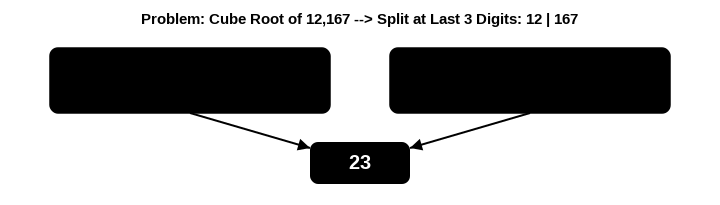
Unit digit and split shortcut diagram for cube roots — Problem: Cube Root of 12,167 --> Split at Last 3 Digits: 12 | 167.
Diagram text

Problem: Cube Root of 12,167 --> Split at Last 3 Digits: 12 | 167 · Front Group: 12 (Tens Place) · Largest cube fits: 2³ = 8 < 12 --> Tens = 2 · Last 3 Digits: 167 (Ones Place) · Last digit is 7 --> Friendly Pair 3 (3³ = 27) · 23

Example 1: Cube root of 12,167
Step 1 (Split): Separate the last 3 digits from the rest: 12 | 167.
Step 2 (Ones Place): The last digit is 7. Looking at the rule, 7 always comes from 3 (since 3 x 3 x 3 = 27). The ones digit is 3.
Step 3 (Tens Place): Look at the front number: 12. Find the largest whole cube that fits inside 12:
1 cubed = 1 (fits)
2 cubed = 8 (fits)
3 cubed = 27 (too big)
The tens digit is 2.
Combine: 23.
Answer: 23
Example 2: Cube root of 59,319
Step 1 (Split): Separate the last 3 digits: 59 | 319.
Step 2 (Ones Place): The last digit is 9. Numbers ending in 9 always give 9. The ones digit is 9.
Step 3 (Tens Place): Look at the front number: 59. Largest cube inside 59:
3 cubed = 27 (fits)
4 cubed = 64 (too big)
The tens digit is 3.
Combine: 39.
Answer: 39
Example 3: Cube root of 175,616
Step 1 (Split): Separate the last 3 digits: 175 | 616.
Step 2 (Ones Place): The last digit is 6. Numbers ending in 6 always give 6. The ones digit is 6.
Step 3 (Tens Place): Look at the front number: 175. Largest cube inside 175:
5 cubed = 125 (fits)
6 cubed = 216 (too big)
The tens digit is 5.
Combine: 56.
Answer: 56

Method 3: Approximation for Imperfect Cubes (For Banking DI & Simplification)

In competitive exams, questions frequently include non-perfect cube roots such as the cube root of 30 or 70. Use this mental formula:

Mental Formula:
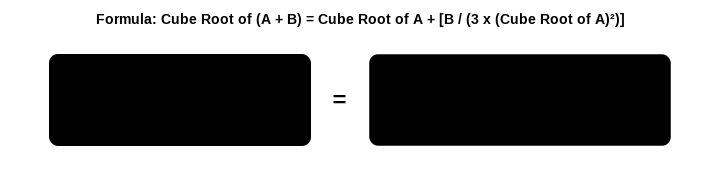
Cube Root of (A + B) = Cube Root of A + [B / (3 x (Cube Root of A)^2)]
(Where A is the nearest perfect cube, and B is the difference).
Imperfect cube root mental approximation diagram — Formula: Cube Root of (A + B) = Cube Root of A + [B / (3 x (Cube Root of A)²)].
Diagram text

Formula: Cube Root of (A + B) = Cube Root of A + [B / (3 x (Cube Root of A)²)] · Cube Root of 30 · A = 27 (Root = 3), B = +3 · = · 3 + [3 / (3 x 3²)] = 3 + (3 / 27) · = 3 + 1/9 = 3 + 0.11 = 3.11 · (Actual exact value = 3.107)

Example 1: Cube root of 30
Step 1: The nearest perfect cube is 27 (since 3 cubed = 27).
Write 30 as: 27 + 3 (A = 27, B = 3).
Step 2: The cube root of 27 is 3.
Step 3: Calculate the adjustment: 3 / [3 x (3 x 3)] = 3 / (3 x 9) = 3 / 27 = 1 / 9.
1 / 9 is approximately 0.11.
Step 4: Add to the base: 3 + 0.11 = 3.11 (Actual value: 3.107).
Answer: Approximately 3.11
Example 2: Cube root of 70
Step 1: The nearest perfect cube is 64 (since 4 cubed = 64).
Write 70 as: 64 + 6 (A = 64, B = 6).
Step 2: The cube root of 64 is 4.
Step 3: Calculate the adjustment: 6 / [3 x (4 x 4)] = 6 / (3 x 16) = 6 / 48 = 1 / 8.
1 / 8 is 0.125.
Step 4: Add to the base: 4 + 0.125 = 4.125 (or roughly 4.13) (Actual value: 4.121).
Answer: Approximately 4.13
Example 3 (Subtraction Variant): Cube root of 120
Step 1: The nearest perfect cube is 125 (since 5 cubed = 125).
Write 120 as: 125 - 5 (A = 125, B = -5).
Step 2: The cube root of 125 is 5.
Step 3: Calculate the adjustment: 5 / [3 x (5 x 5)] = 5 / (3 x 25) = 5 / 75 = 1 / 15.
1 / 15 is roughly 0.067.
Step 4: Subtract from the base: 5 - 0.067 = 4.933 (Actual value: 4.932).
Answer: Approximately 4.93

Method 4: The Long Division Method (Universal for Any Number)

This method works for every number, including decimals and non-perfect cubes. It is based on the algebraic identity: (10a + b)^3 = 1000a^3 + 300(a^2)b + 30(a)(b^2) + b^3.

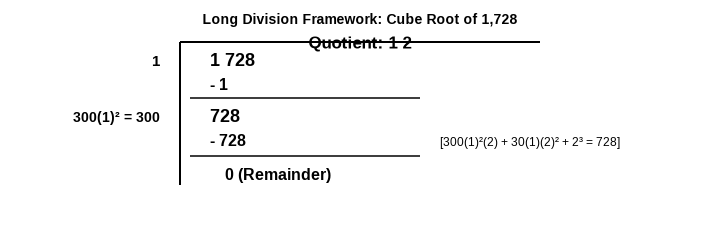
Long division cube root layout diagram — Long Division Framework: Cube Root of 1,728.
Diagram text

Long Division Framework: Cube Root of 1,728 · Quotient: 1 2 · 1 · 1 728 · - 1 · 728 · 300(1)² = 300 · - 728 · [300(1)²(2) + 30(1)(2)² + 2³ = 728] · 0 (Remainder)

Example 1: Cube root of 1,728
Step 1 (Group): Group digits into sets of three from right to left: 1 and 728.
Step 2 (First Digit): The largest cube less than or equal to 1 is 1 (1 cubed = 1). First quotient digit is 1. Remainder: 1 - 1 = 0.
Step 3 (Bring Down): Bring down the full group of three digits: 728.
Step 4 (Test the Next Digit): Use the trial divisor 300 x (first digit)^2: 300 x 1^2 = 300. 728 / 300 suggests the next digit b is 2.
Step 5 (Check Formula): [300 x (a^2) x b] + [30 x a x (b^2)] + b^3 = [300 x 1 x 2] + [30 x 1 x 4] + 8 = 600 + 120 + 8 = 728.
Subtract: 728 - 728 = 0.
Answer: 12
Example 2: Cube root of 4,096
Step 1 (Group): Group digits: 4 and 096.
Step 2 (First Digit): The largest cube less than or equal to 4 is 1 (1 cubed = 1). First quotient digit is 1. Remainder: 4 - 1 = 3.
Step 3 (Bring Down): Bring down 096 -> new balance is 3,096.
Step 4 (Trial Divisor): 300 x 1^2 = 300. 3,096 / 300 suggests b = 6.
Step 5 (Check Formula): [300 x 1^2 x 6] + [30 x 1 x 6^2] + 6^3 = [300 x 6] + [30 x 36] + 216 = 1,800 + 1,080 + 216 = 3,096.
Subtract: 3,096 - 3,096 = 0.
Answer: 16
Example 3: Cube root of 15,625
Step 1 (Group): Group digits: 15 and 625.
Step 2 (First Digit): Largest cube less than or equal to 15 is 2 (2 cubed = 8). First quotient digit is 2. Remainder: 15 - 8 = 7.
Step 3 (Bring Down): Bring down 625 -> new balance is 7,625.
Step 4 (Trial Divisor): 300 x (2^2) = 300 x 4 = 1,200. 7,625 / 1,200 suggests b = 5.
Step 5 (Check Formula): [300 x 2^2 x 5] + [30 x 2 x 5^2] + 5^3 = [1,200 x 5] + [60 x 25] + 125 = 6,000 + 1,500 + 125 = 7,625.
Subtract: 7,625 - 7,625 = 0.
Answer: 25

Ready to Test Your Speed?

Put mental cube root extraction and shortcuts into practice with timed drills.