Mental Cubes & Speed Tricks

A cube is what you get when you multiply a number by itself three times: Number x Number x Number. For example, 4 cubed is 4 x 4 x 4 = 64. In competitive exams, writing out two long multiplications is too slow. Here are six practical methods to calculate cubes mentally.

Method 1: Numbers Starting with 1 (11 to 19)

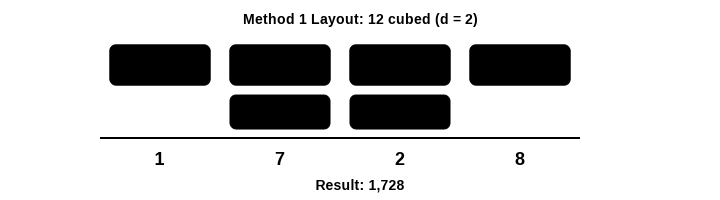
For any "teen" number, write a row of 4 values using the second digit (call it d): 1 | d | d x d | d x d x d. Double the two middle numbers, place them underneath, and add column by column from right to left (carrying over extra tens to the left).

Cubes Diagram 1
Example 1: 12 cubed (12 x 12 x 12)
The second digit is 2.
Step 1 (Row 1): Write 1 | 2 | 4 | 8 (since 2 x 2 = 4, and 2 x 2 x 2 = 8).
Step 2 (Row 2): Double the two middle numbers (2 becomes 4, 4 becomes 8):
1 2 4 8 + 4 8
Step 3 (Add right to left):
Right column: 8
Next column: 4 + 8 = 12 (write 2, carry 1)
Next column: 2 + 4 + 1 (carry) = 7
Left column: 1
Answer: 1,728
Example 2: 13 cubed (13 x 13 x 13)
The second digit is 3.
Step 1: Write 1 | 3 | 9 | 27 (powers of 3).
Step 2: Double the middle numbers (3 becomes 6, 9 becomes 18):
1 3 9 27 + 6 18
Step 3 (Add right to left):
Right column: 27 (write 7, carry 2)
Next column: 9 + 18 + 2 (carry) = 29 (write 9, carry 2)
Next column: 3 + 6 + 2 (carry) = 11 (write 1, carry 1)
Left column: 1 + 1 (carry) = 2
Answer: 2,197
Example 3: 15 cubed (15 x 15 x 15)
The second digit is 5.
Step 1: Write 1 | 5 | 25 | 125.
Step 2: Double the middle numbers (5 becomes 10, 25 becomes 50):
1 5 25 125 + 10 50
Step 3 (Add right to left):
Right column: 125 (write 5, carry 12)
Next column: 25 + 50 + 12 (carry) = 87 (write 7, carry 8)
Next column: 5 + 10 + 8 (carry) = 23 (write 3, carry 2)
Left column: 1 + 2 (carry) = 3
Answer: 3,375

Method 2: Numbers Ending with 1 (21, 31, 41, 51...)

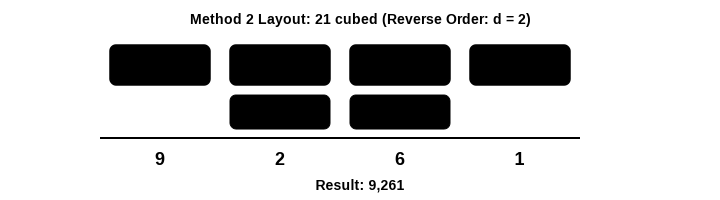
This works exactly like Method 1, but in reverse. Write the 4 numbers from left to right ending in 1 using the first digit (d): d x d x d | d x d | d | 1. Double the middle two, and add right to left.

Cubes Diagram 2
Example 1: 21 cubed (21 x 21 x 21)
The first digit is 2.
Step 1: Write 8 | 4 | 2 | 1 (since 2 cubed is 8, 2 squared is 4).
Step 2: Double the middle numbers (4 becomes 8, 2 becomes 4):
8 4 2 1 + 8 4
Step 3 (Add right to left):
Right column: 1
Next column: 2 + 4 = 6
Next column: 4 + 8 = 12 (write 2, carry 1)
Left column: 8 + 1 (carry) = 9
Answer: 9,261
Example 2: 31 cubed (31 x 31 x 31)
The first digit is 3.
Step 1: Write 27 | 9 | 3 | 1.
Step 2: Double the middle numbers (9 becomes 18, 3 becomes 6):
27 9 3 1 + 18 6
Step 3 (Add right to left):
Right column: 1
Next column: 3 + 6 = 9
Next column: 9 + 18 = 27 (write 7, carry 2)
Left column: 27 + 2 (carry) = 29
Answer: 29,791
Example 3: 41 cubed (41 x 41 x 41)
The first digit is 4.
Step 1: Write 64 | 16 | 4 | 1.
Step 2: Double the middle numbers (16 becomes 32, 4 becomes 8):
64 16 4 1 + 32 8
Step 3 (Add right to left):
Right column: 1
Next column: 4 + 8 = 12 (write 2, carry 1)
Next column: 16 + 32 + 1 (carry) = 49 (write 9, carry 4)
Left column: 64 + 4 (carry) = 68
Answer: 68,921

Method 3: Same-Digit Numbers (22, 33, 44, 55...)

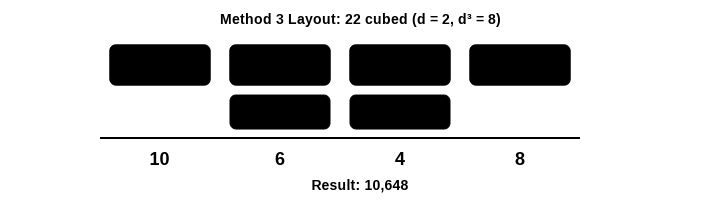
When both digits are the same (call the digit d), cube that digit and write it four times: d cubed | d cubed | d cubed | d cubed. Double the middle two numbers and add with carry-overs.

Cubes Diagram 3
Example 1: 22 cubed (22 x 22 x 22)
The digit is 2. Cube of 2 is 8 (2 x 2 x 2 = 8).
Step 1: Write 8 four times: 8 | 8 | 8 | 8.
Step 2: Double the middle numbers (8 becomes 16):
8 8 8 8 + 16 16
Step 3 (Add right to left):
Right column: 8
Next column: 8 + 16 = 24 (write 4, carry 2)
Next column: 8 + 16 + 2 (carry) = 26 (write 6, carry 2)
Left column: 8 + 2 (carry) = 10
Answer: 10,648
Example 2: 33 cubed (33 x 33 x 33)
The digit is 3. Cube of 3 is 27 (3 x 3 x 3 = 27).
Step 1: Write 27 four times: 27 | 27 | 27 | 27.
Step 2: Double the middle numbers (27 becomes 54):
27 27 27 27 + 54 54
Step 3 (Add right to left):
Right column: 27 (write 7, carry 2)
Next column: 27 + 54 + 2 (carry) = 83 (write 3, carry 8)
Next column: 27 + 54 + 8 (carry) = 89 (write 9, carry 8)
Left column: 27 + 8 (carry) = 35
Answer: 35,937
Example 3: 44 cubed (44 x 44 x 44)
The digit is 4. Cube of 4 is 64 (4 x 4 x 4 = 64).
Step 1: Write 64 four times: 64 | 64 | 64 | 64.
Step 2: Double the middle numbers (64 becomes 128):
64 64 64 64 + 128 128
Step 3 (Add right to left):
Right column: 64 (write 4, carry 6)
Next column: 64 + 128 + 6 (carry) = 198 (write 8, carry 19)
Next column: 64 + 128 + 19 (carry) = 211 (write 1, carry 21)
Left column: 64 + 21 (carry) = 85
Answer: 85,184

Method 4: The Universal 4-Step Method (Any Two-Digit Number: a b)

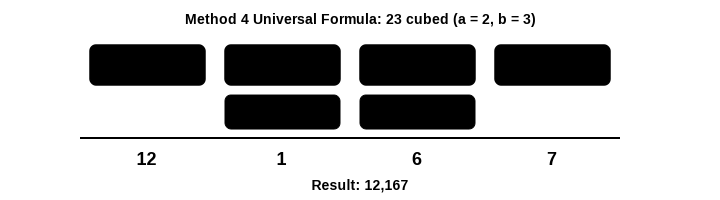
This method works for every two-digit number. For a number written as digits a b, create 4 slots: a cubed | (a x a x b) | (a x b x b) | b cubed. Double the two middle values and add column by column.

Cubes Diagram 4
Example 1: 23 cubed (23 x 23 x 23)
Here a = 2 and b = 3.
Slot 1: 2 cubed = 8
Slot 2: 2 x 2 x 3 = 12
Slot 3: 2 x 3 x 3 = 18
Slot 4: 3 cubed = 27
Step 1: Row 1 is 8 | 12 | 18 | 27.
Step 2: Double the middle slots (12 becomes 24, 18 becomes 36):
8 12 18 27 + 24 36
Step 3 (Add right to left):
Right column: 27 (write 7, carry 2)
Next column: 18 + 36 + 2 (carry) = 56 (write 6, carry 5)
Next column: 12 + 24 + 5 (carry) = 41 (write 1, carry 4)
Left column: 8 + 4 (carry) = 12
Answer: 12,167
Example 2: 32 cubed (32 x 32 x 32)
Here a = 3 and b = 2.
Slot 1: 3 cubed = 27
Slot 2: 3 x 3 x 2 = 18
Slot 3: 3 x 2 x 2 = 12
Slot 4: 2 cubed = 8
Step 1: Row 1 is 27 | 18 | 12 | 8.
Step 2: Double the middle slots (18 becomes 36, 12 becomes 24):
27 18 12 8 + 36 24
Step 3 (Add right to left):
Right column: 8
Next column: 12 + 24 = 36 (write 6, carry 3)
Next column: 18 + 36 + 3 (carry) = 57 (write 7, carry 5)
Left column: 27 + 5 (carry) = 32
Answer: 32,768
Example 3: 42 cubed (42 x 42 x 42)
Here a = 4 and b = 2.
Slot 1: 4 cubed = 64
Slot 2: 4 x 4 x 2 = 32
Slot 3: 4 x 2 x 2 = 16
Slot 4: 2 cubed = 8
Step 1: Row 1 is 64 | 32 | 16 | 8.
Step 2: Double the middle slots (32 becomes 64, 16 becomes 32):
64 32 16 8 + 64 32
Step 3 (Add right to left):
Right column: 8
Next column: 16 + 32 = 48 (write 8, carry 4)
Next column: 32 + 64 + 4 (carry) = 100 (write 0, carry 10)
Left column: 64 + 10 (carry) = 74
Answer: 74,088

Method 5: The Base-100 Trick (Numbers Near 100)

For numbers slightly larger than 100, calculate the Gap = Number - 100. Build the answer in three blocks: [Number + (2 x Gap)] | [3 x Gap x Gap] | [Gap cubed]. Each of the middle and right sections must hold exactly two digits (pad with leading zeroes if needed).

Cubes Diagram 5
Example 1: 102 cubed (102 x 102 x 102)
Gap = +2
Left Block: 102 + (2 x 2) = 102 + 4 = 106
Middle Block: 3 x (2 x 2) = 3 x 4 = 12 (2 digits)
Right Block: 2 x 2 x 2 = 8 -> write as 08 (2 digits)
Combine: 1,061,208
Answer: 1,061,208
Example 2: 103 cubed (103 x 103 x 103)
Gap = +3
Left Block: 103 + (2 x 3) = 103 + 6 = 109
Middle Block: 3 x (3 x 3) = 3 x 9 = 27 (2 digits)
Right Block: 3 x 3 x 3 = 27 (2 digits)
Combine: 1,092,727
Answer: 1,092,727
Example 3: 104 cubed (104 x 104 x 104)
Gap = +4
Left Block: 104 + (2 x 4) = 104 + 8 = 112
Middle Block: 3 x (4 x 4) = 3 x 16 = 48 (2 digits)
Right Block: 4 x 4 x 4 = 64 (2 digits)
Combine: 1,124,864
Answer: 1,124,864

Method 6: Square and Split-Multiply (Using Known Squares)

If you already know the square of a number, multiply that square by the number itself using mental split addition: Number cubed = Square x Number.

Cubes Diagram 6
Example 1: 15 cubed (15 x 15 x 15)
We know 15 squared is 225.
Now calculate: 225 x 15.
Step 1: Split 15 into 10 and 5.
Step 2: Multiply by 10: 225 x 10 = 2,250.
Step 3: Multiply by 5 (half of 2,250): 2,250 / 2 = 1,125.
Step 4: Add together: 2,250 + 1,125 = 3,375.
Answer: 3,375
Example 2: 25 cubed (25 x 25 x 25)
We know 25 squared is 625.
Now calculate: 625 x 25.
Step 1: Split 25 into 20 and 5.
Step 2: Multiply by 20: 625 x 20 = 12,500.
Step 3: Multiply by 5: 625 x 5 = 3,125.
Step 4: Add together: 12,500 + 3,125 = 15,625.
Answer: 15,625
Example 3: 16 cubed (16 x 16 x 16)
We know 16 squared is 256.
Now calculate: 256 x 16.
Step 1: Split 16 into 10 and 6.
Step 2: Multiply by 10: 256 x 10 = 2,560.
Step 3: Multiply by 6: (250 x 6) + (6 x 6) = 1,500 + 36 = 1,536.
Step 4: Add together: 2,560 + 1,536 = 4,096.
Answer: 4,096

Cubes to Learn (1 to 25)

Memorizing the cubes from 1 to 25 helps solve questions in simplification, compound interest, and volume measurement instantly.

Number Multiplication Cube Value
11 x 1 x 11
22 x 2 x 28
33 x 3 x 327
44 x 4 x 464
55 x 5 x 5125
66 x 6 x 6216
77 x 7 x 7343
88 x 8 x 8512
99 x 9 x 9729
1010 x 10 x 101,000
1111 x 11 x 111,331
1212 x 12 x 121,728
1313 x 13 x 132,197
1414 x 14 x 142,744
1515 x 15 x 153,375
1616 x 16 x 164,096
1717 x 17 x 174,913
1818 x 18 x 185,832
1919 x 19 x 196,859
2020 x 20 x 208,000
2121 x 21 x 219,261
2222 x 22 x 2210,648
2323 x 23 x 2312,167
2424 x 24 x 2413,824
2525 x 25 x 2515,625

Ready to Test Your Speed?

Put your mental cubing shortcuts into practice with timed drills and calculations.