Highest Common Factor (HCF)

Highest Common Factor (HCF), also called the Greatest Common Divisor (GCD), is the largest number that divides two or more given numbers completely without leaving any remainder.

1. Fundamentals of HCF

Core Definitions

  • Factor: A number that divides another number completely without leaving a remainder.
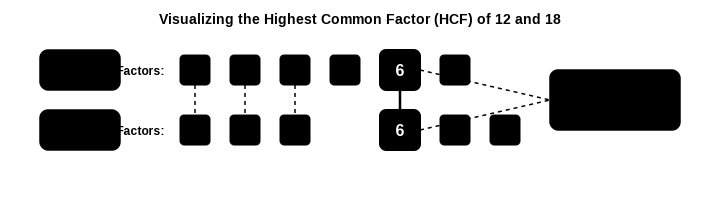
    • Factors of 12: 1, 2, 3, 4, 6, 12
    • Factors of 18: 1, 2, 3, 6, 9, 18
  • Common Factors: The factors that are common to both numbers.
    • Common factors of 12 and 18: 1, 2, 3, 6
  • Highest Common Factor (HCF): The largest number among all common factors.
    • HCF of 12 and 18 = 6
Common factors and Highest Common Factor of 12 and 18 — Visualizing the Highest Common Factor (HCF) of 12 and 18.
Diagram text

Visualizing the Highest Common Factor (HCF) of 12 and 18 · 12 · Factors: · 1 · 2 · 3 · 4 · 6 · 12 · 18

Factors: · 1 · 2 · 3 · 6 · 9 · 18 · HCF = 6 · (Largest Common)

Golden Rules and Properties of HCF

  1. Upper Limit: The HCF of two or more numbers is always less than or equal to the smallest of those numbers.
  2. Difference Principle (Crucial Shortcut): The HCF of any two numbers always divides their difference. If two numbers are A and B, their HCF must be a factor of |A - B|.
  3. Co-Prime Numbers: If two numbers have no common factor other than 1, their HCF is 1 (e.g., 8 and 15).
  4. HCF and Multiples: If a number x divides another number y, then the HCF of x and y is simply x.
  5. Product Formula: For any two numbers A and B:
    HCF * LCM = A * B
    (Note: This formula holds strictly for two numbers only, not three or more).

HCF and LCM Product formula.
Diagram text

The Golden Product Formula · HCF * LCM · = · A * B · Warning: This equality is only true for exactly TWO numbers, never for three or more.

3 Methods to Calculate HCF

  1. Prime Factorization Method:
    Write each number as a product of its prime factors. Pick the lowest power of every common prime factor.
    • Example: 24 = 23 * 31, and 36 = 22 * 32
    • Common primes with lowest powers: 22 * 31 = 4 * 3 = 12
  2. Long Division Method (Euclid's Method):
    Divide the larger number by the smaller number. Then divide the previous divisor by the remainder obtained. Continue until the remainder is 0. The last divisor is the HCF.
  3. Difference Method (The Speed Method):
    Find the difference between the two closest numbers in the given set. The HCF is either that difference itself or one of its factors.

Difference Method shortcut.
Diagram text

The Difference Method Shortcut · Finding HCF of 306, 657, and 945 · 306 · 657 · 945 · 351 · 288 · 63 · HCF must be a factor of 63. (63, 21 fail. 9 works for all!) · HCF = 9
2. Most Frequently Used HCF Problem Types

Type 1: Direct HCF, Fractions, Decimals, and Powers

Rules:

  • Fractions:
    HCF of Fractions = (HCF of Numerators) / (LCM of Denominators)
  • Powers with identical base: HCF of (am - 1) and (an - 1) = aHCF(m, n) - 1
  • Decimals: Convert all numbers to the same number of decimal places, treat them as integers, find the HCF, and place the decimal point back.
Example 1.1: HCF of Fractions
Find the HCF of 2/3, 8/9, 16/81, and 10/27.
• Step 1: Numerators are 2, 8, 16, 10.
• Common factors: 2 divides all. HCF(2, 8, 16, 10) = 2.
• Step 2: Denominators are 3, 9, 81, 27.
• LCM(3, 9, 81, 27) = 81.
• Step 3: HCF = (HCF of Numerators) / (LCM of Denominators) = 2/81.
• Answer: 2/81
Example 1.2: HCF of Algebraic Powers
Find the HCF of (324 - 1) and (336 - 1).
• Step 1: Use the property: HCF of (am - 1, an - 1) = aHCF(m, n) - 1.
• Step 2: Find the HCF of the powers 24 and 36:
  - 24 = 12 * 2
  - 36 = 12 * 3
  - HCF(24, 36) = 12
• Step 3: Apply the formula: 312 - 1.
• Answer: 312 - 1
Example 1.3: HCF of Prime Factor Groups
Find the HCF of (23 * 32 * 5 * 74), (22 * 35 * 52 * 73), and (23 * 53 * 72).
• Step 1: Identify common prime bases across all three sets:
  - 2 is present in all. Lowest power = 22.
  - 3 is not present in the third expression (30). Exclude 3.
  - 5 is present in all. Lowest power = 51.
  - 7 is present in all. Lowest power = 72.
• Step 2: Multiply the lowest powers:
• HCF = 22 * 51 * 72 = 4 * 5 * 49 = 20 * 49 = 980.
• Answer: 980
Example 1.4: HCF of Decimal Numbers
Find the HCF of 1.08, 0.36, and 0.9.
• Step 1: Equalize decimal places to two digits: 1.08, 0.36, 0.90.
• Step 2: Remove decimals to get integers: 108, 36, 90.
• Step 3: Find the HCF of 108, 36, and 90:
  - 36 = 18 * 2
  - 90 = 18 * 5
  - 108 = 18 * 6
  - HCF(108, 36, 90) = 18.
• Step 4: Reinsert two decimal places: 18 / 100 = 0.18.
• Answer: 0.18

Type 2: Finding the Greatest Divisor with Remainders

Rules:

  1. When remainders a, b, c are given:
    Find the HCF of (x - a), (y - b), and (z - c).
  2. When the same remainder r is left, and r is given:
    Find the HCF of (x - r), (y - r), and (z - r).
  3. When the same remainder is left, but the remainder is NOT given:
    Find the HCF of |x - y|, |y - z|, and |z - x|.
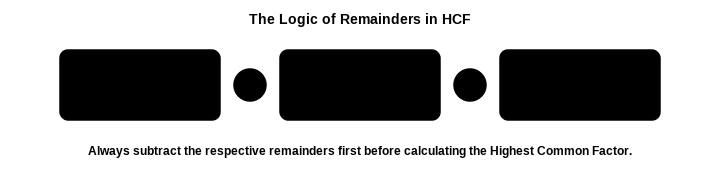
Remainders logic for HCF.
Diagram text

The Logic of Remainders in HCF · Given Number (X) · Has "extra" remainder · - · Remainder (R) · Remove the extra · = · Exact Divisible No. · Find HCF on these! · Always subtract the respective remainders first before calculating the Highest Common Factor.

Example 2.1: Different Remainders Given
Find the greatest number that will divide 148, 246, and 623 leaving remainders 4, 6, and 11 respectively.
• Step 1: Subtract the remainders from the given numbers:
  - 148 - 4 = 144
  - 246 - 6 = 240
  - 623 - 11 = 612
• Step 2: Find the HCF of 144, 240, and 612.
  - Difference between 240 and 144 = 96.
  - Factors of 96: 96, 48, 32, 24, 16, 12, 8, etc.
• Step 3: Test factors:
  - 612 / 24 = 25.5 (not completely divisible).
  - 144 / 12 = 12
  - 240 / 12 = 20
  - 612 / 12 = 51
  - Common factor among 12, 20, 51 is 1.
• Answer: 12
Example 2.4: Same Remainder, Remainder Not Given
What is the greatest number that divides 410, 751, and 1030 leaving the same remainder in each case?
• Step 1: Find the absolute differences between all pairs:
  - |751 - 410| = 341
  - |1030 - 751| = 279
  - |1030 - 410| = 620
• Step 2: Find the HCF of 341, 279, and 620:
  - Difference between 341 and 279 = 62.
  - Factors of 62: 62, 31, 2, 1.
• Step 3: Check 31:
  - 341 / 31 = 11
  - 279 / 31 = 9
  - 620 / 31 = 20
  - 31 divides all differences completely.
• Answer: 31 (Each division leaves a remainder of 7).

Type 3: Ratios, Products, and Co-Prime Pairs

Rules:

  • If the HCF of two numbers is H, the numbers can be assumed as Hx and Hy, where x and y are co-prime (meaning HCF(x, y) = 1).
  • Sum = Hx + Hy = H * (x + y)
  • Product = Hx * Hy = H2 * (x * y)
  • LCM = H * x * y
Example 3.1: Number of Possible Pairs (Sum Given)
The sum of two numbers is 216 and their HCF is 27. How many such pairs of numbers are possible?
• Step 1: Let the numbers be 27x and 27y, where HCF(x, y) = 1.
• Step 2: 27x + 27y = 216
  - 27 * (x + y) = 216
  - x + y = 216 / 27 = 8
• Step 3: Find pairs of positive integers (x, y) whose sum is 8 and are co-prime:
  - 1 + 7 = 8 → HCF(1, 7) = 1 (Valid)
  - 2 + 6 = 8 → HCF(2, 6) = 2 (Invalid, not co-prime)
  - 3 + 5 = 8 → HCF(3, 5) = 1 (Valid)
  - 4 + 4 = 8 → HCF(4, 4) = 4 (Invalid)
• Answer: 2 pairs (The actual pairs are (27, 189) and (81, 135)).
Example 3.5: Difference and LCM Given with HCF
The difference between two numbers is 42 and their HCF is 14. If their LCM is 560, find the numbers.
• Step 1: Let the numbers be 14x and 14y where x > y and HCF(x, y) = 1.
• Step 2: Difference:
  - 14x - 14y = 42
  - x - y = 42 / 14 = 3
• Step 3: LCM = 14 * x * y = 560
  - x * y = 560 / 14 = 40
• Step 4: Find two co-prime factors of 40 whose difference is 3:
  - 8 * 5 = 40 and 8 - 5 = 3.
  - HCF(8, 5) = 1 (Satisfied).
  - Therefore, x = 8 and y = 5.
• Step 5: Numbers are 14 * 8 = 112 and 14 * 5 = 70.
• Answer: 112 and 70

Type 4: Word Problems (Equal Distribution, Tiling, and Containers)

Rules:

  • Capacity/Size: Whenever a question asks for the "maximum capacity", "largest measuring vessel", "longest tape", or "largest square tile", calculate the HCF.
  • Minimum Number of Units:
    Number of units = (Total Quantity or Area) / (Size of one unit (HCF))
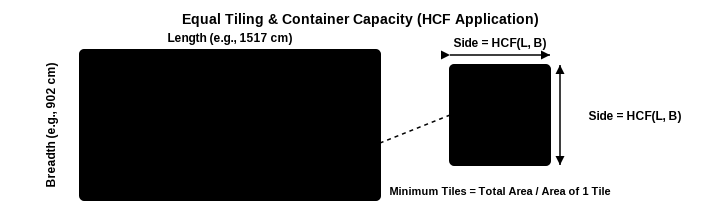
Finding the largest equal square tiles to cover a rectangular floor — Equal Tiling & Container Capacity (HCF Application).
Diagram text

Equal Tiling & Container Capacity (HCF Application) · Length (e.g., 1517 cm) · Breadth (e.g., 902 cm) · TILE · Side = HCF(L, B) · Side = HCF(L, B) · Minimum Tiles = Total Area / Area of 1 Tile

Example 4.1: Minimum Square Tiles for a Floor
A rectangular courtyard is 15 meters 17 cm long and 9 meters 2 cm broad. Find the minimum number of square tiles of uniform size required to pave the floor.
• Step 1: Convert dimensions to centimeters:
  - Length = 1517 cm
  - Breadth = 902 cm
• Step 2: The side of the largest square tile is the HCF of 1517 and 902.
  - Using division method:
    1517 = 902 * 1 + 615
    902 = 615 * 1 + 287
    615 = 287 * 2 + 41
    287 = 41 * 7 + 0
  - HCF = 41 cm. Side of each tile = 41 cm.
• Step 3: Calculate minimum number of tiles:
  - Tiles = (Total Area) / (Area of one tile) = (1517 * 902) / (41 * 41)
  - 1517 / 41 = 37
  - 902 / 41 = 22
  - Total Tiles = 37 * 22 = 814.
• Answer: 814 tiles
Example 4.4: Cutting Planks into Maximum Equal Lengths
A carpenter has three wooden planks of lengths 42 meters, 49 meters, and 63 meters. He wants to cut them into pieces of equal length without wasting any wood. What is the greatest possible length of each piece, and how many total pieces will he get?
• Step 1: Find the HCF of 42, 49, and 63:
  - 42 = 7 * 6
  - 49 = 7 * 7
  - 63 = 7 * 9
  - HCF = 7 meters.
• Step 2: Length of each piece = 7 meters.
• Step 3: Number of pieces from each plank:
  - 42 / 7 = 6
  - 49 / 7 = 7
  - 63 / 7 = 9
  - Total pieces = 6 + 7 + 9 = 22.
• Answer: Length = 7 meters; Total pieces = 22

Ready to Test Your Speed?

Put your HCF shortcut methods, remainders logic, and problem-solving tricks to the test with real exam drills.