Least Common Multiple (LCM)

Least Common Multiple (LCM) is the smallest positive number that is evenly divisible by two or more given numbers without leaving a remainder.

1. Fundamentals of LCM

Basic Terms

  • Multiple: A multiple of a number is the product of that number and any non-zero whole number.
    • Multiples of 4: 4, 8, 12, 16, 20, 24, 28, 32...
    • Multiples of 6: 6, 12, 18, 24, 30, 36...
  • Common Multiple: A number that appears as a multiple of two or more numbers.
    • Common multiples of 4 and 6: 12, 24, 36, 48...
  • Least Common Multiple (LCM): The smallest among all common multiples.
    • LCM of 4 and 6 = 12.
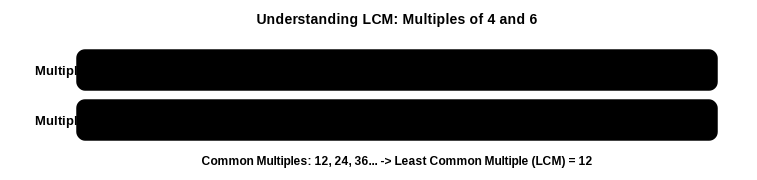
Multiples and the least common multiple — Understanding LCM: Multiples of 4 and 6.
Diagram text

Understanding LCM: Multiples of 4 and 6 · Multiples of 4 : · 4 · 8 · 12 · 16 · 20 · 24 · 28 · 32

36 · 40 · ... · Multiples of 6 : · 6 · 12 · 18 · 24 · 30 · 36

... · Common Multiples: 12, 24, 36... -> Least Common Multiple (LCM) = 12
2. Methods to Find LCM

Method A: Prime Factorization Method

  1. Break down every given number into its prime factors.
  2. Express the factors in powers (exponential form).
  3. Take the highest power of every prime factor involved across all numbers.
  4. Multiply these highest powers together.

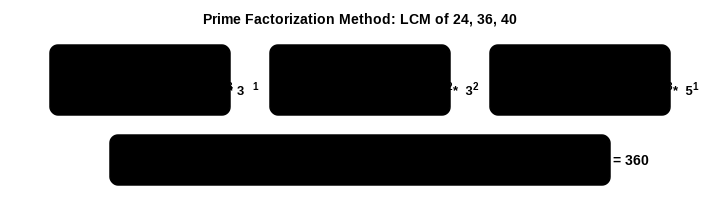
Example: Find the LCM of 24, 36, and 40.

Prime Factorization Method for LCM — Prime Factorization Method: LCM of 24, 36, 40.
Diagram text

Prime Factorization Method: LCM of 24, 36, 40 · Number 24 · 2 * 2 * 2 * 3 = 2^(3)* 3^(1) · Number 36 · 2 * 2 * 3 * 3 = 2^(2)*3^(2) · Number 40 · 2 * 2 * 2 * 5 = 2^(3)*5^(1) · LCM = Highest Powers = 2^(3)* 3^(2)* 5^(1)= 8 * 9 * 5 = 360

Method B: Common Division Method (Ladder Method)

  1. Write the numbers in a row separated by commas.
  2. Divide them by the smallest prime number that divides at least two of the given numbers.
  3. Bring down the numbers that are not divisible as they are.
  4. Continue dividing until no two numbers share a common prime factor.
  5. Multiply all the divisors and the remaining numbers at the bottom.

3. Core Rules and Properties

For Two Numbers Only: LCM * HCF = First Number * Second Number
  1. For Two Numbers Only: LCM * HCF = Product of the Two Numbers.
  2. Co-Prime Numbers: Two numbers are co-prime if their HCF is 1 (e.g., 8 and 9). The LCM of co-prime numbers is always equal to their product: LCM(a, b) = a * b.
  3. LCM of Fractions: Ensure all fractions are written in their simplest form before applying the formula:
    LCM of Fractions = (LCM of Numerators) / (HCF of Denominators)
  4. LCM of Decimals: Make the number of decimal places equal in all numbers by appending zeroes. Remove the decimal points, compute the LCM of the resulting integers, and then place the decimal point back to match the original number of decimal places (or convert them to simplified fractions first).

Most Common LCM Types Used in Exam Books

Type 1: Fractions, Decimals, and the Basic Product Formula

This model tests direct calculations involving fractions, decimals, or the relationship First Number * Second Number = LCM * HCF.

Example 1.1
Find the LCM of 2/3, 8/9, 16/81, and 10/27.
• Step 1: Identify numerators (2, 8, 16, 10) and denominators (3, 9, 81, 27).
• Step 2: Find LCM of numerators: LCM(2, 8, 16, 10) = 24 * 5 = 16 * 5 = 80.
• Step 3: Find HCF of denominators (3, 9, 81, 27): The greatest common divisor is 3.
• Step 4: Apply formula: LCM = 80 / 3.
Example 1.2
Find the LCM of 4/5, 6/25, and 8/15.
• Numerators: 4, 6, 8. Denominators: 5, 25, 15.
• LCM of numerators (4, 6, 8) = 24.
• HCF of denominators (5, 25, 15) = 5.
• Result: LCM = 24 / 5.
Example 1.3
The HCF of two numbers is 11 and their LCM is 693. If one number is 77, find the other number.
• Apply First Number * Second Number = LCM * HCF.
• 77 * Second Number = 693 * 11.
• Second Number = (693 * 11) / 77 = 693 / 7 = 99.
Example 1.4
The product of two numbers is 1500 and their HCF is 10. Find their LCM.
• LCM * HCF = Product of Numbers.
• LCM * 10 = 1500.
• LCM = 1500 / 10 = 150.
Example 1.5
Find the LCM of 1.2, 0.36, and 0.72.
• Convert to simplified fractions: 1.2 = 6/5, 0.36 = 9/25, 0.72 = 18/25.
• LCM of numerators (6, 9, 18) = 18.
• HCF of denominators (5, 25, 25) = 5.
• LCM = 18 / 5 = 3.6.

Type 2: Leaving the SAME Remainder in Each Case

The least number which when divided by x, y, and z leaves a remainder r in each case is:
Required Number = LCM(x, y, z) + r
Any higher number satisfying this condition is given by: Required Number = [k * LCM(x, y, z)] + r (where k = 1, 2, 3...)
Visualizing: Leaving the Same Remainder (r) Perfectly Divisible Part: LCM(x, y, z) + Remainder (r) The total number equals the LCM plus the extra remainder.
Example 2.1
Find the least number which when divided by 6, 8, and 12 leaves a remainder of 3 in each case.
• Find LCM(6, 8, 12) = 24.
• Add the common remainder: Required Number = 24 + 3 = 27.
Example 2.2
Find the smallest number which when divided by 12, 15, 20, and 54 leaves a remainder of 8 in each case.
• Find LCM(12, 15, 20, 54) = 540.
• Add the remainder: Required Number = 540 + 8 = 548.
Example 2.3
Find the least number which when divided by 5, 6, 7, and 8 leaves a remainder of 3 in each case, but is completely divisible by 9.
• LCM(5, 6, 7, 8) = 840.
• General form: Number = 840k + 3.
• 840 = (93 * 9) + 3. So, 840k + 3 = 9 * (93k) + (3k + 3).
• For divisibility by 9, (3k + 3) must be divisible by 9. Test k=2: 3(2)+3 = 9.
• Substitute k=2: Required Number = 840 * 2 + 3 = 1683.
Example 2.4
Find the least number which when increased by 5 is exactly divisible by 12, 18, and 24.
• Number + 5 = LCM(12, 18, 24).
• LCM(12, 18, 24) = 72.
• Number + 5 = 72 -> Number = 72 - 5 = 67.
Example 2.5
Find the least number which when reduced by 7 is divisible by 15, 20, 24, and 32.
• Number - 7 = LCM(15, 20, 24, 32).
• LCM(15, 20, 24, 32) = 480.
• Number - 7 = 480 -> Number = 480 + 7 = 487.

Type 3: Leaving DIFFERENT Remainders with a Constant Difference

Condition: When divided by divisors x, y, z, the remainders are a, b, c such that the difference between each divisor and its respective remainder is identical: x - a = y - b = z - c = d (constant difference)
Required Number = LCM(x, y, z) - d
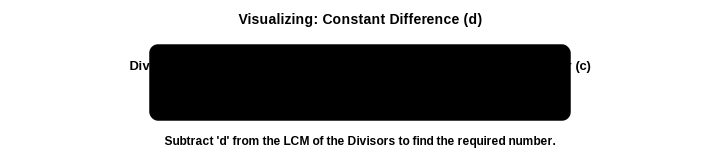
Constant difference — Visualizing: Constant Difference (d).
Diagram text

Visualizing: Constant Difference (d) · Divisor (x) - Remainder (a) · = d · Divisor (y) - Remainder (b) · = d · Divisor (z) - Remainder (c) · = d · Subtract 'd' from the LCM of the Divisors to find the required number.

Example 3.1
Find the least number which when divided by 20, 25, 35, and 40 leaves remainders 14, 19, 29, and 34 respectively.
• Check differences: 20-14 = 6, 25-19 = 6, 35-29 = 6, 40-34 = 6. Constant d = 6.
• Find LCM(20, 25, 35, 40) = 1400.
• Subtract d: Required Number = 1400 - 6 = 1394.
Example 3.2
Find the least number which when divided by 12, 16, 24, and 36 leaves remainders 7, 11, 19, and 31 respectively.
• Check differences: 12-7 = 5, 16-11 = 5, 24-19 = 5, 36-31 = 5. Constant d = 5.
• Find LCM(12, 16, 24, 36) = 144.
• Subtract d: Required Number = 144 - 5 = 139.
Example 3.3
Find the smallest number which when divided by 9, 12, and 15 leaves remainders 4, 7, and 10 respectively.
• Check differences: 9-4 = 5, 12-7 = 5, 15-10 = 5. Constant d = 5.
• Find LCM(9, 12, 15) = 180.
• Required Number = 180 - 5 = 175.
Example 3.4
Find the least number which when divided by 18, 27, and 36 leaves remainders 5, 14, and 23 respectively.
• Check differences: 18-5 = 13, 27-14 = 13, 36-23 = 13. Constant d = 13.
• Find LCM(18, 27, 36) = 108.
• Required Number = 108 - 13 = 95.
Example 3.5
Find the least number which when divided by 24, 32, and 48 leaves remainders 16, 24, and 40 respectively, and is completely divisible by 7.
• Check differences: 24-16 = 8, 32-24 = 8, 48-40 = 8. Constant d = 8.
• Find LCM(24, 32, 48) = 96. General form: 96k - 8.
• Split 96 by 7: 96 = (13 * 7) + 5. So, 96k - 8 = 7(13k) + (5k - 8).
• Test values of k: if k = 3, 5(3) - 8 = 7 (divisible by 7).
• Required Number = 96 * 3 - 8 = 288 - 8 = 280.

Type 4: Periodic / Simultaneous Coincidence (Bells, Lights, Laps)

Events that repeat at regular intervals happen together at intervals equal to the LCM of their individual cycle times. Number of times events coincide in time T (including the starting count at time 0): Total Count = (Total Time / LCM) + 1

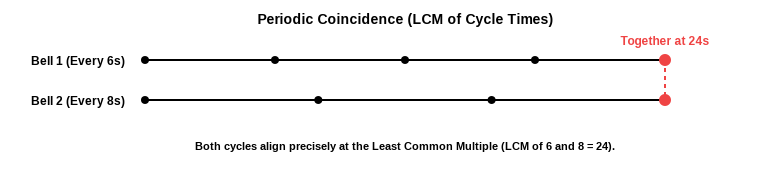
Periodic coincidence — Periodic Coincidence (LCM of Cycle Times).
Diagram text

Periodic Coincidence (LCM of Cycle Times) · Bell 1 (Every 6s) · Bell 2 (Every 8s) · Together at 24s · Both cycles align precisely at the Least Common Multiple (LCM of 6 and 8 = 24).

Example 4.1
Four bells toll at intervals of 6, 8, 12, and 18 seconds respectively. If they toll together now, after how many seconds will they toll together next?
• Find LCM(6, 8, 12, 18) = 72 seconds.
• Answer: They will toll together next after 72 seconds (or 1 minute 12 seconds).
Example 4.2
Five bells begin to toll together and toll respectively at intervals of 3, 6, 9, 12, and 15 seconds. In 30 minutes, how many times will they toll together (including the toll at the beginning)?
• LCM(3, 6, 9, 12, 15) = 180 seconds.
• Convert to minutes: 180 / 60 = 3 minutes.
• Occurrences = (30 / 3) + 1 = 10 + 1 = 11 times.
Example 4.3
Three traffic signals at three different road crossings change after every 48, 72, and 108 seconds respectively. If they all change simultaneously at 8:20:00 hours, when will they change simultaneously again?
• LCM(48, 72, 108) = 432 seconds.
• 432 seconds = 7 minutes and 12 seconds.
• Next time = 8:20:00 + 0:07:12 = 8:27:12 hours.
Example 4.4
Three runners A, B, and C start running simultaneously around a circular track of 1200 meters from the same point and in the same direction. Their speeds are 3 m/s, 4 m/s, and 6 m/s respectively. After what time will they meet again at the starting point?
• Time for A = 1200 / 3 = 400s. Time for B = 1200 / 4 = 300s. Time for C = 1200 / 6 = 200s.
• LCM(400, 300, 200) = 1200 seconds.
• Convert to minutes: 1200 / 60 = 20 minutes.
Example 4.5
A merchant packs items into boxes. If packed in groups of 12, 16, or 20, no item is left behind. What is the minimum possible total number of items?
• The total count must be the lowest common multiple of 12, 16, and 20.
• LCM(12, 16, 20) = 240 items.

Type 5: Digit Constraints (Smallest / Largest n-Digit Numbers)

  • Largest n-digit number: Start with the greatest n-digit number (e.g., 9999), divide by the LCM, and subtract the remainder.
  • Smallest n-digit number: Start with the smallest n-digit number (e.g., 1000), divide by the LCM, and add (LCM - Remainder).
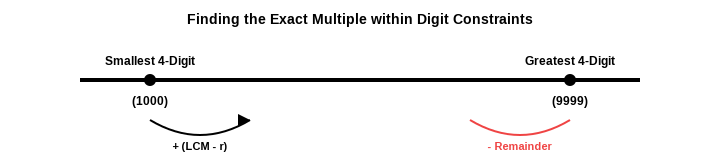
Calculating Smallest vs Largest n-digit boundaries — Finding the Exact Multiple within Digit Constraints.
Diagram text

Finding the Exact Multiple within Digit Constraints · Smallest 4-Digit · (1000) · Greatest 4-Digit · (9999) · + (LCM - r) · - Remainder

Example 5.1
Find the greatest 4-digit number which is exactly divisible by 15, 20, and 25.
• Find LCM(15, 20, 25) = 300.
• Largest 4-digit number is 9999.
• Divide: 9999 / 300 = 33 with a remainder of 99.
• Required Number = 9999 - 99 = 9900.
Example 5.2
Find the smallest 4-digit number which is exactly divisible by 12, 16, and 24.
• Find LCM(12, 16, 24) = 48.
• Smallest 4-digit number is 1000.
• Divide: 1000 / 48 = 20 with a remainder of 40.
• Required Number = 1000 + (48 - 40) = 1000 + 8 = 1008.
Example 5.3
Find the greatest 4-digit number which when divided by 12, 15, and 18 leaves a remainder of 5 in each case.
• LCM(12, 15, 18) = 180.
• Find largest 4-digit multiple of 180: 9999 / 180 leaves remainder 99. Multiple = 9999 - 99 = 9900.
• Add the required remainder (5): Required Number = 9900 + 5 = 9905.
Example 5.4
Find the smallest 5-digit number which when divided by 10, 15, and 20 leaves a remainder of 4 in each case.
• LCM(10, 15, 20) = 60.
• Smallest 5-digit number is 10000.
• Divide 10000 / 60 leaves remainder 40.
• Smallest multiple = 10000 + (60 - 40) = 10020.
• Add the required remainder (4): Required Number = 10020 + 4 = 10024.
Example 5.5
Find the greatest 4-digit number which when divided by 8, 12, and 16 leaves remainders 3, 7, and 11 respectively.
• Check differences: 8-3 = 5, 12-7 = 5, 16-11 = 5. Constant difference d = 5.
• LCM(8, 12, 16) = 48.
• Greatest 4-digit multiple of 48: 9999 / 48 leaves remainder 15. Multiple = 9999 - 15 = 9984.
• Subtract d: Required Number = 9984 - 5 = 9979.

Ready to Test Your Speed?

Put your LCM calculation shortcuts, prime factorization tricks, and exam formulas to the test with real drills.