Mensuration in two dimensions (2D) deals with measuring the perimeter, boundary length, and surface area of flat, closed geometric figures. Unlike three-dimensional shapes, 2D shapes have only length and breadth with zero height or volume.
1. Fundamentals of 2D Mensuration
Core Definitions
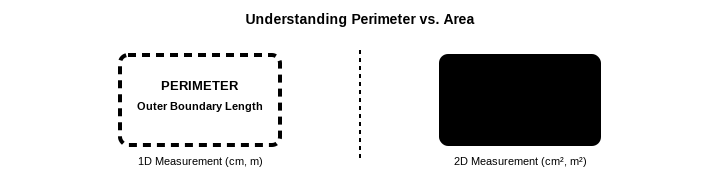
Perimeter: The total linear distance around the outside edge of a closed shape. Think of it as the length of wire needed to fence the boundary.
Measured in linear units: centimeters (cm), meters (m), or kilometers (km).
Area: The total two-dimensional space enclosed inside the boundary lines.
Measured in square units: square centimeters (sq cm or cm2), square meters (sq m or m2), or hectares.
Essential Unit Conversions
Competitive exam questions frequently mix different units in a single problem to test conversion accuracy:
Linear Conversions:
1 meter (m) = 100 centimeters (cm)
1 kilometer (km) = 1,000 meters (m)
Area Conversions:
1 sq m (m2) = 10,000 sq cm (cm2)
1 hectare = 10,000 sq m (m2)
1 are = 100 sq m (m2)
1 acre = 4,046.86 sq m (approximately 43,560 sq ft)
Crucial Geometric Principles & Shortcuts
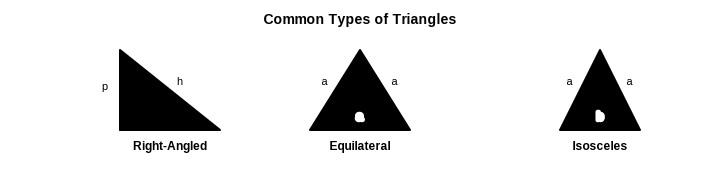
Pythagoras Theorem: For any right-angled triangle with base b, perpendicular p, and hypotenuse h:
p2 + b2 = h2
Common Pythagorean Triplets (Memorize for rapid calculation):
(3, 4, 5) and its multiples: (6, 8, 10), (9, 12, 15), (12, 16, 20)
(5, 12, 13)
(7, 24, 25)
(8, 15, 17)
(9, 40, 41)
(11, 60, 61)
(20, 21, 29)
Successive Percentage Rule for Area:
If the length changes by x% and breadth changes by y%:
Net change in area = x + y + (x * y) / 100 %
(Use negative signs for reductions/decreases).
2. Core Types in Competitive Exams
Examinations consistently categorize 2D Mensuration into five distinct problem types:
1. Triangles (Scalene, Isosceles, Equilateral, Right-Angled)
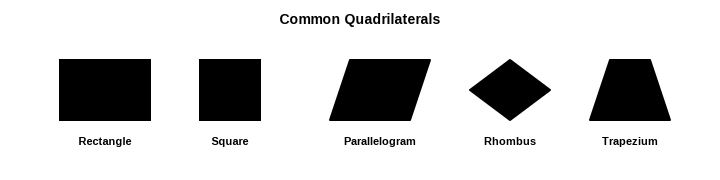
2. Quadrilaterals (Square, Rectangle, Rhombus, Parallelogram, Trapezium)
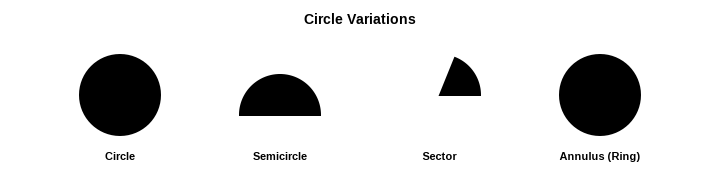
3. Circles, Semicircles, and Circular Sectors
4. Pathways, Borders, and Tracks
5. Regular Polygons and Shaded / Combined Figures
Type 1: Triangles
Formulas
General Triangle (sides a, b, c):
Perimeter = a + b + c
Semi-perimeter (s) = (a + b + c) / 2
Area (Heron's Formula) = √(s * (s - a) * (s - b) * (s - c))
General Area = 1/2 * base * height
Inradius (r) = Area / s
Circumradius (R) = (a * b * c) / (4 * Area)
Right-Angled Triangle (legs b, p and hypotenuse h):
Area = 1/2 * base * height = 1/2 * b * p
Inradius (r) = (base + height - hypotenuse) / 2
Circumradius (R) = hypotenuse / 2
Equilateral Triangle (all sides equal to a):
Perimeter = 3 * a
Height = (√(3) / 2) * a
Area = (√(3) / 4) * a2
Inradius (r) = a / (2 * √(3)) = height / 3
Circumradius (R) = a / √(3) = 2 * height / 3
Isosceles Triangle (equal sides a, base b):
Height = √(a2 - (b / 2)2)
Area = 1/2 * b * √(a2 - (b / 2)2)
Example 1.1
Find the area and inradius of a triangle whose sides are 13 cm, 14 cm, and 15 cm.
The diagonal of a square is 14 cm. Find its area and perimeter.
• Step 1: Calculate area directly from diagonal:
- Area = (diagonal2) / 2 = 142 / 2 = 196 / 2 = 98 sq cm.
• Step 2: Find side of the square:
- Side a = diagonal / √(2) = 14 / √(2) = 7 * √(2) cm.
• Step 3: Calculate perimeter:
- Perimeter = 4 * a = 4 * 7 * √(2) = 28 * √(2) cm.
Example 2.3
The perimeter of a rhombus is 40 cm, and one of its diagonals is 12 cm. Find the length of the other diagonal and the area of the rhombus.
• Step 1: Find the side of the rhombus:
- Side a = 40 / 4 = 10 cm.
• Step 2: Use the right-angled triangle formed by the half-diagonals:
- Half of first diagonal = 12 / 2 = 6 cm.
- (Half of second diagonal)2 = 102 - 62 = 100 - 36 = 64.
- Half of second diagonal = √(64) = 8 cm.
- Second diagonal d2 = 8 * 2 = 16 cm.
• Step 3: Calculate area:
- Area = 1/2 * d1 * d2 = 1/2 * 12 * 16 = 96 sq cm.
Example 2.4
The adjacent sides of a parallelogram are 15 cm and 10 cm. If the distance between the longer sides is 6 cm, find the distance between the shorter sides.
• Step 1: Area of a parallelogram is constant regardless of base chosen:
- Area = Base 1 * Height 1 = 15 * 6 = 90 sq cm.
• Step 2: Equate this area using Base 2 (shorter side):
- Base 2 * Height 2 = 90
- 10 * Height 2 = 90 => Height 2 = 9 cm.
Example 2.5
The parallel sides of a trapezium are in the ratio 3 : 5, and the perpendicular distance between them is 12 cm. If the area of the trapezium is 384 sq cm, find the lengths of the parallel sides.
• Step 1: Let parallel sides be 3x and 5x:
- Area = 1/2 * (3x + 5x) * 12 = 384
• Step 2: Simplify and solve for x:
- 6 * (8x) = 384 => 48x = 384 => x = 8.
• Step 3: Determine the sides:
- Shorter side = 3 * 8 = 24 cm.
- Longer side = 5 * 8 = 40 cm.
Type 3: Circles, Semicircles, and Sectors
Formulas (Use pi = 22/7 unless stated otherwise)
Full Circle (radius r):
Diameter = 2 * r
Circumference = 2 * pi * r
Area = pi * r2
Semicircle (radius r):
Area = 1/2 * pi * r2
Perimeter = (pi * r) + 2 * r = r * (pi + 2) = (36 / 7) * r
(Exam Note: The perimeter includes the straight diameter boundary).
Quadrant (quarter circle):
Area = 1/4 * pi * r2
Perimeter = (1/2 * pi * r) + 2 * r = r * (11 / 7 + 2) = (25 / 7) * r
Sector of a Circle (central angle theta degrees):
Length of arc (l) = (theta / 360) * 2 * pi * r
Area of sector = (theta / 360) * pi * r2 = 1/2 * l * r
Perimeter of sector = l + 2 * r
Circular Ring / Annulus (outer radius R, inner radius r):
Area = pi * (R2 - r2) = pi * (R + r) * (R - r)
Width of ring = R - r
Example 3.1
The perimeter of a semicircular field is 108 m. Find its radius and area.
• Step 1: Set up perimeter formula:
- Perimeter = r * (pi + 2) = r * (22 / 7 + 2) = r * (36 / 7) = 108
• Step 2: Solve for r:
- r = (108 * 7) / 36 = 3 * 7 = 21 m.
• Step 3: Compute area:
- Area = 1/2 * pi * r2 = 1/2 * (22 / 7) * 21 * 21 = 11 * 3 * 21 = 693 sq m.
Example 3.2
A wheel makes 1,000 revolutions in covering a total distance of 88 km. Find the radius of the wheel.
• Step 1: Convert distance into meters:
- Total distance = 88 km = 88,000 m.
• Step 2: Distance covered in 1 revolution equals circumference:
- Circumference = 88,000 / 1,000 = 88 m.
• Step 3: Solve for radius r:
- 2 * pi * r = 88 => 2 * (22 / 7) * r = 88
- (44 / 7) * r = 88 => r = (88 * 7) / 44 = 14 m.
Example 3.3
A circular wire of radius 42 cm is cut and bent into the shape of a rectangle whose sides are in the ratio 6 : 5. Find the area of the rectangle.
• Step 1: Wire length equals circumference of the circle:
- Length = 2 * pi * r = 2 * (22 / 7) * 42 = 2 * 22 * 6 = 264 cm.
• Step 2: Perimeter of rectangle equals wire length:
- Let sides be 6x and 5x:
- 2 * (6x + 5x) = 264 => 22x = 264 => x = 12.
• Step 3: Find dimensions and area:
- Length = 6 * 12 = 72 cm, Breadth = 5 * 12 = 60 cm.
- Area = 72 * 60 = 4,320 sq cm.
Example 3.4
A sector of a circle of radius 15 cm has a central angle of 84 degrees. Find its arc length and area.
• Step 2: Calculate sector area using 1/2 * l * r:
- Area = 1/2 * 22 * 15 = 165 sq cm.
Example 3.5
The area of a circular ring formed between two concentric circles is 770 sq cm. If the radius of the outer circle is 21 cm, find the radius of the inner circle.
• Step 1: Set up formula:
- pi * (R2 - r2) = 770
- (22 / 7) * (212 - r2) = 770
• Step 2: Solve for r:
- 441 - r2 = (770 * 7) / 22 = 35 * 7 = 245
- r2 = 441 - 245 = 196
- r = √(196) = 14 cm.
Type 4: Pathways, Borders, and Tracks
Formulas
Path of width w running OUTSIDE a rectangle (length L, breadth B):
Outer dimensions = (L + 2w) and (B + 2w)
Area of path = (L + 2w) * (B + 2w) - (L * B) = 2w * (L + B + 2w)
Path of width w running INSIDE a rectangle (length L, breadth B):
Inner dimensions = (L - 2w) and (B - 2w)
Area of path = (L * B) - (L - 2w) * (B - 2w) = 2w * (L + B - 2w)
Two central Crossroads of width w running parallel to sides:
Area of roads = w * (L + B - w)
Area of remaining lawn = (L - w) * (B - w)
Circular Track of width w around a circle of radius r:
Outer radius R = r + w
Area of track = pi * (R2 - r2)
Example 4.1
A rectangular lawn 60 m long and 40 m wide has a 2.5 m wide path running around its outside. Find the area of the path and the cost of gravelling it at 20 rupees per sq m.
A rectangular plot 80 m by 50 m has a 5 m wide walkway constructed along the inside perimeter. Find the area of the walkway.
• Step 1: Determine inner dimensions:
- Inner Length = 80 - 2 * 5 = 70 m.
- Inner Breadth = 50 - 2 * 5 = 40 m.
• Step 2: Calculate walkway area:
- Plot Area = 80 * 50 = 4,000 sq m.
- Inner unpaved Area = 70 * 40 = 2,800 sq m.
- Walkway Area = 4,000 - 2,800 = 1,200 sq m.
Example 4.3
Two roads, each 5 m wide, cross at the center of a rectangular park 70 m long and 40 m broad, running parallel to its sides. Find the area of the roads and the remaining area of the park.
• Step 1: Use direct crossroads formula:
- Area of roads = w * (L + B - w)
- Area = 5 * (70 + 40 - 5) = 5 * 105 = 525 sq m.
• Step 2: Find remaining park area:
- Total park area = 70 * 40 = 2,800 sq m.
- Remaining area = 2,800 - 525 = 2,275 sq m.
Example 4.4
A circular garden of radius 28 m has a 7 m wide running track around its outer edge. Find the area of the track.
A square park has a gravel path of uniform width 3 m laid inside along its boundary. If the area of the path alone is 564 sq m, find the length of the outer side of the park.
• Step 1: Let the outer side be s:
- Inner square side = s - 2 * 3 = s - 6.
• Step 2: Write equation for area of path:
- s2 - (s - 6)2 = 564
- s2 - (s2 - 12 * s + 36) = 564
- 12 * s - 36 = 564
- 12 * s = 600 => s = 50 m.
Type 5: Regular Polygons and Combined Figures
Formulas
Regular Polygon of n sides:
Sum of all interior angles = (n - 2) * 180 degrees
Four identical coins of radius 7 cm are placed on a flat table such that each coin touches two other coins. Find the area of the space enclosed between them.
• Step 1: The centers of the four circles form a square of side:
- Side = 2 * r = 2 * 7 = 14 cm.
• Step 2: The enclosed area is the square minus four 90-degree sectors (which combine to make 1 full circle):
- Direct formula = (6 / 7) * r2
• Step 3: Compute:
- Enclosed Area = (6 / 7) * 7 * 7 = 6 * 7 = 42 sq cm.
Example 5.4
A cow is tethered to one corner of a rectangular grass field measuring 30 m by 20 m by a rope 14 m long. Find the area the cow can graze, and the area left ungrazed.
• Step 1: At the corner of a rectangle, the cow grazes a quadrant of radius r = 14 m: