Mensuration - 3D deals with the measurement of three-dimensional geometric solids that occupy physical space and have three dimensions: length, breadth (width), and height (depth).
1. Fundamentals of 3D Mensuration
Every three-dimensional solid is bounded by surfaces. To master this topic from scratch, you must understand the following basic terms, principles, and conversion rules.
Core Terminology
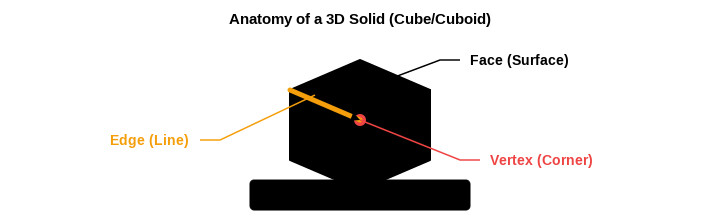
Face: Any flat or curved boundary surface of a solid.
Edge: The line segment where two boundary faces intersect.
Vertex: The corner point where three or more edges intersect.
Volume (Capacity): The total amount of three-dimensional space enclosed inside a solid. Its unit is always cubic (e.g., cm3, m3, liters).
Lateral Surface Area (LSA) / Curved Surface Area (CSA): The total area of only the side (vertical) faces of the solid, strictly excluding the top and bottom bases.
For flat-faced shapes (cube, cuboid, prism), it is called Lateral Surface Area (LSA).
For curved shapes (cylinder, cone, sphere), it is called Curved Surface Area (CSA).
Total Surface Area (TSA): The sum of all surfaces enclosing the solid.
TSA = LSA (or CSA) + Area of top base + Area of bottom base.
Space Diagonal: The longest straight line segment that connects two opposite corners inside a 3D figure.
Euler's Formula for Polyhedra: For any regular solid with flat polygon faces (cubes, cuboids, prisms, pyramids):
Faces + Vertices - Edges = 2 (F + V - E = 2).
Universal Exam Principles and Shortcuts
Principle of Conservation of Volume (Melting and Recasting): When one or more solid metal objects are melted and recast into another shape, the total volume remains constant. The surface area will change, but:
Total Volume Before Melting = Total Volume After Recasting
Cutting Solids: When a solid is sliced into smaller pieces, the total volume remains the same, but the total surface area increases because new internal cut faces are exposed to the outside.
Scaling and Proportions:
If the linear dimensions of a solid increase by a ratio of a : b, the surface area increases by a2 : b2, and the volume increases by a3 : b3.
Water Displacement (Rise in Liquid Level): When an insoluble solid is completely submerged inside a liquid container:
Volume of Submerged Solid = Base Area of Container x Rise in Liquid Height
Hollow Solids:
Volume of Material = External Volume - Internal Volume
The five primary shapes tested in competitive examination books are the Cube, Cuboid, Right Circular Cylinder, Right Circular Cone, and Sphere / Hemisphere.
Shape
Volume
Lateral / Curved Surface Area (LSA/CSA)
Total Surface Area (TSA)
Other Key Formulas
Cube (edge = a)
a3
4 x a2
6 x a2
Longest Diagonal = a x √3
Cuboid (l, b, h)
l x b x h
2 x (l + b) x h
2 x (l x b + b x h + h x l)
Longest Diagonal = √(l2 + b2 + h2)
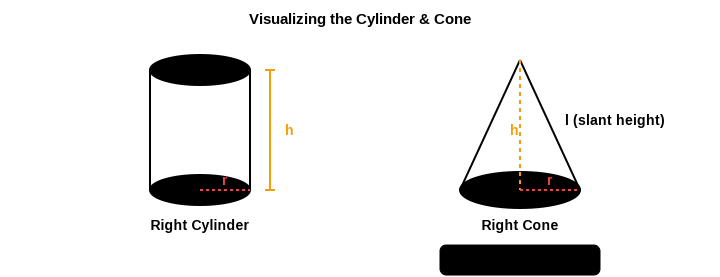
Cylinder (radius = r, height = h)
π x r2 x h
2 x π x r x h
2 x π x r x (h + r)
Hollow Volume = π x (R2 - r2) x h
Cone (radius = r, height = h)
(1/3) x π x r2 x h
π x r x l
π x r x (l + r)
Slant height l = √(r2 + h2)
Sphere (radius = r)
(4/3) x π x r3
4 x π x r2
4 x π x r2
Hemispherical TSA = 3 x π x r2
(Note: Unless specified otherwise, standard value of π = 22/7 or 3.14).
3. Type-Wise Solved Examples
Type 1: Cube
A cube is a three-dimensional box with 6 identical square faces, 12 equal edges, and 8 vertices.
Example 1.1: Longest Rod in a Cube
If the length of the longest rod that can be placed in a cubical room is 12 x √3 meters, find the volume and total surface area of the room.
• Step 1: The longest rod is the space diagonal of the cube.
- Diagonal = a x √3
- a x √3 = 12 x √3 => a = 12 meters
• Step 2: Calculate volume.
- Volume = a3 = 123 = 12 x 12 x 12 = 1,728 m3
• Step 3: Calculate total surface area.
- TSA = 6 x a2 = 6 x (122) = 6 x 144 = 864 m2
Answer: Volume = 1,728 m3; Total Surface Area = 864 m2.
Example 1.2: Melting and Recasting Cubes
Three solid metal cubes with edge lengths 3 cm, 4 cm, and 5 cm are melted together to form a single larger cube. Find the edge length and total surface area of the new cube.
Answer: Total Surface Area increases by 44%; Volume increases by 72.8%.
Example 1.4: Cutting a Solid Cube
A solid wooden cube of edge 12 cm is cut into 8 smaller identical cubes. Find the edge length of each smaller cube and the ratio of the combined surface area of all 8 small cubes to the surface area of the original cube.
• Step 1: Find the volume of one smaller cube.
- Volume original = 123 = 1,728 cm3. Volume small = 1,728 / 8 = 216 cm3.
- Edge of small cube (a) = (216)1/3 = 6 cm.
• Step 2: Calculate surface areas.
- TSA original = 6 x 144 = 864 cm2. TSA 1 small = 6 x 36 = 216 cm2.
- Combined TSA of all 8 = 8 x 216 = 1,728 cm2.
• Step 3: Form the ratio.
- Ratio = 1,728 : 864 = 2 : 1.
Answer: Edge = 6 cm; Ratio = 2 : 1.
Example 1.5: Cost of Painting and Flooring
The cost of painting the four lateral walls of a cubical room at 15 rupees per square meter is 3,840 rupees. Find the cost of flooring the room at 25 rupees per square meter.
• Step 1: LSA = Total Cost / Rate per m2 = 3,840 / 15 = 256 m2
• Step 2: Find edge length (a).
- 4 x a2 = 256 => a2 = 64 => a = 8 meters.
• Step 3: Find floor area and cost.
- Floor Area = a2 = 64 m2. Cost = 64 x 25 = 1,600 rupees.
Answer: 1,600 rupees.
Type 2: Cuboid
A cuboid (rectangular solid) has 6 rectangular faces, 12 edges, and 8 vertices, defined by distinct length (l), breadth (b), and height (h).
Example 2.1: Longest Rod in a Cuboidal Room
A hall measures 10 meters long, 8 meters wide, and 6 meters high. Find the length of the longest bamboo pole that can fit inside the hall.
A rectangular water reservoir is 15 meters long and 12 meters wide. When 500 cubical iron blocks of edge 30 cm each are completely immersed in it, find the rise in the water level of the reservoir.
• Step 1: Reservoir base = 15 x 12. Block edge = 30 cm = 0.3 m.
• Step 2: Total Vol of 500 blocks = 500 x (0.3)3 = 500 x 0.027 = 13.5 m3.
• Step 3: Volume Displaced = Base Area x h
- 13.5 = (15 x 12) x h => 13.5 = 180 x h => h = 0.075 m = 7.5 cm.
Answer: 7.5 cm.
Example 2.5: Number of Bricks Required for a Wall
A wall 8 meters long, 6 meters high, and 22.5 cm thick is to be constructed using bricks measuring 25 cm x 11.25 cm x 6 cm. If mortar occupies 10% of the volume of the wall, find the total number of bricks required.
• Step 1: Total Wall Volume = 800 x 600 x 22.5 = 10,800,000 cm3.
• Step 2: Usable volume for bricks (90%) = 0.90 x 10,800,000 = 9,720,000 cm3.
• Step 3: Volume of 1 brick = 25 x 11.25 x 6 = 1,687.5 cm3.
• Step 4: Number of bricks = 9,720,000 / 1,687.5 = 5,760 bricks.
Answer: 5,760 bricks.
Type 3: Right Circular Cylinder
A cylinder consists of two parallel, congruent circular bases connected by a curved surface.
Example 3.1: Finding Dimensions from CSA to TSA Ratio
The curved surface area of a solid cylinder is one-third of its total surface area. If the total surface area is 462 cm2, find the volume of the cylinder (use π = 22/7).
• Step 1: CSA = (1/3) x TSA => 2 x π x r x h = (1/3) x [2 x π x r x (h + r)]
- h = (h + r) / 3 => 3h = h + r => r = 2h.
• Step 2: TSA = 2 x π x r x (h + r) = 462. Substitute r = 2h:
- 2 x (22/7) x (2h) x (3h) = 462 => (264/7) x h2 = 462 => h = 3.5 cm.
• Step 3: r = 7 cm. Volume = π x r2 x h = (22/7) x 49 x 3.5 = 539 cm3.
Answer: 539 cm3.
Example 3.2: Digging a Well and Building an Embankment
A cylindrical well 7 meters in diameter is dug 20 meters deep. The earth dug out is spread evenly all around it to a width of 3.5 meters to form an embankment. Find the height of the embankment (use π = 22/7).
• Step 1: Volume of earth = π x r2 x h = (22/7) x (3.5)2 x 20 = 770 m3.
• Step 2: Embankment ring area = π x (R2 - r2). R = 3.5 + 3.5 = 7 m.
- Area = (22/7) x (49 - 12.25) = (22/7) x 36.75 = 115.5 m2.
• Step 3: Height H = 770 / 115.5 = 20 / 3 meters (approx 6.67 m).
Answer: 20/3 meters (or 6.67 meters).
Example 3.3: Rolling a Rectangular Sheet
A rectangular sheet of paper 44 cm long and 20 cm wide is rolled along its length without overlapping to form a cylinder. Find the volume of the resulting cylinder (use π = 22/7).
• Step 1: Rolling along length means Circumference = Length = 44 cm. Height h = 20 cm.
• Step 2: 2 x (22/7) x r = 44 => r = 7 cm.
• Step 3: Volume = π x r2 x h = (22/7) x 49 x 20 = 3,080 cm3.
Answer: 3,080 cm3.
Example 3.4: Simultaneous Percentage Change
If the radius of a cylinder is decreased by 20% and its height is increased by 50%, find the net percentage change in its volume.
• Step 1: Volume is proportional to r2 x h. Let initial r = 10, h = 10.
• Step 2: Initial Vol factor = 100 x 10 = 1,000.
• Step 3: New r = 8, New h = 15. New Vol factor = (82) x 15 = 64 x 15 = 960.
A hollow metal pipe is 21 cm long. Its external diameter is 10 cm and internal diameter is 6 cm. If 1 cm3 of the metal weighs 7.5 grams, find the total mass of the pipe in kilograms (use π = 22/7).
• Step 1: R = 5 cm, r = 3 cm, h = 21 cm.
• Step 2: Volume = π x (R2 - r2) x h = (22/7) x (25 - 9) x 21 = 22 x 16 x 3 = 1,056 cm3.
• Step 3: Mass = 1,056 x 7.5 = 7,920 grams = 7.92 kg.
Answer: 7.92 kg.
Type 4: Right Circular Cone
A cone has a circular base tapering smoothly to a single point called the apex or vertex. The distance along the slant surface is slant height (l), where l2 = r2 + h2.
Example 4.1: Canvas Needed for a Conical Tent
A conical tent is 12 meters high and the radius of its base is 5 meters. Find the slant height and the cost of canvas required to make it at 70 rupees per square meter (use π = 22/7).
A solid metallic cone of radius 6 cm and height 24 cm is melted and recast into a solid sphere. Find the radius of the sphere and its surface area (use π = 22/7).
• Step 1: Volume of Cone = (1/3) x π x (62) x 24 = 288 x π cm3.
• Step 2: Vol of Sphere = (4/3) x π x R3 = 288 x π => R3 = 216 => R = 6 cm.
• Step 3: Surface Area = 4 x π x R2 = 4 x (22/7) x 36 = 3,168 / 7 cm2.
Answer: Radius = 6 cm; Surface Area = 3,168/7 cm2.
Example 4.3: Cone Sliced Parallel to the Base
A cone of height 30 cm is cut into two parts by a plane parallel to its base at a distance of 10 cm from the vertex. Find the ratio of the volume of the smaller cone formed at the top to the volume of the lower frustum.
• Step 1: Ratio of heights = h / H = 10 / 30 = 1 / 3.
• Step 2: Ratio of Volumes = (h / H)3 = (1 / 3)3 = 1 / 27.
• Step 3: Vol of small cone = 1 unit. Vol of bottom frustum = 27 - 1 = 26 units.
Answer: 1 : 26.
Example 4.4: Frustum of a Cone (Bucket Capacity)
A bucket is in the form of a frustum of a cone with top radius 20 cm, bottom radius 10 cm, and vertical height 24 cm. Find its capacity in liters (use π = 3.14).
• Step 1: Volume = (1/3) x π x h x (R2 + r2 + R x r)
• Step 2: Volume = (1/3) x 3.14 x 24 x (400 + 100 + 200) = 8 x 3.14 x 700 = 17,584 cm3.
Example 4.5: Finding Height from Ratio of Radius and Slant Height
The radius and slant height of a right circular cone are in the ratio 4 : 7. If its curved surface area is 792 cm2, find its radius and vertical height (use π = 22/7).
• Step 1: Let r = 4x, l = 7x. CSA = π x r x l => 792 = (22/7) x 4x x 7x.
- 792 = 88 x x2 => x2 = 9 => x = 3.
• Step 2: r = 12 cm, l = 21 cm.
• Step 3: h = √(l2 - r2) = √(212 - 122) = √297 = 3 x √33 cm.
Answer: Radius = 12 cm; Height = 3 x √33 cm.
Type 5: Sphere and Hemisphere
A sphere is a perfectly symmetrical round solid. Slicing a solid sphere through its center produces two identical hemispheres.
Example 5.1: Slicing a Sphere into Hemispheres
A solid metallic sphere of radius 7 cm is sliced into two identical hemispheres. Find the total surface area of both hemispheres combined and the percentage increase in total surface area compared to the original sphere (use π = 22/7).
• Step 1: TSA of original sphere = 4 x π x r2 = 4 x (22/7) x 49 = 616 cm2.
• Step 2: TSA of 2 hemispheres = 2 x (3 x π x r2) = 6 x (22/7) x 49 = 924 cm2.
How many solid spherical lead shots of radius 2 cm can be manufactured by melting a single solid spherical ball of radius 10 cm?
• Step 1: Volume of large sphere = n x Volume of 1 small sphere
• Step 2: (4/3) x π x R3 = n x [(4/3) x π x r3] => R3 = n x r3
• Step 3: n = (R / r)3 = (10 / 2)3 = 53 = 125.
Answer: 125 lead shots.
Example 5.3: Water Rise in a Cylindrical Vessel
A solid lead sphere of radius 6 cm is lowered into a cylindrical vessel partly filled with water. The internal diameter of the vessel is 24 cm. If the sphere is completely submerged, find the rise in the water level.
• Step 1: Volume of submerged sphere = (4/3) x π x (63) = 288 x π cm3.
• Step 2: Cylinder radius = 12 cm. Displaced Volume = π x (122) x h.
• Step 3: 288 x π = 144 x π x h => h = 2 cm.
Answer: 2 cm.
Example 5.4: Hollow Spherical Shell
An iron spherical shell has an outer diameter of 14 cm and is 1 cm thick. Find the volume of iron contained in the shell (use π = 22/7).
• Step 1: R = 14 / 2 = 7 cm. r = 7 - 1 = 6 cm.
• Step 2: Volume = (4/3) x π x (R3 - r3) = (4/3) x (22/7) x (73 - 63).