Multiplication is fundamentally the process of repeated addition. If you have 4 groups of 5 objects, you add 5 four times (5 + 5 + 5 + 5 = 20). In mathematical terms, this is written as 4 x 5 = 20.
Three Core Properties
To master this topic for fast calculations, you must understand three core properties that make all speed math tricks possible:
Commutative Property: The order of numbers does not change the result. A × B is the exact same as B × A (e.g., 6 × 4 = 24, and 4 × 6 = 24).
Associative Property: When multiplying three or more numbers, how you group them does not matter. (A × B) × C is the same as A × (B × C).
Distributive Property: You can break a large number into smaller, easier parts, multiply each part separately, and add the results together. A × (B + C) = (A × B) + (A × C). This rule is the foundation of almost all speed math techniques.
Types of Multiplication Methods in Exam Preparation
Standard preparation books rely on specific methods to eliminate the need for writing down long columns of numbers. Here are the four primary techniques you must know.
1. The Splitting Method (Distributive Rule)
This method is used when you can easily break one of the numbers into tens and single units. It allows you to solve problems completely in your head.
The Steps: Break the second number into its place values (like 10 and 2). Multiply the first number by both parts separately, then add the two results together.
Example: 45 × 12
• Break 12 into (10 + 2).
• Multiply: 45 × 10 = 450, and 45 × 2 = 90.
• Add them: 450 + 90 = 540.
Example: 34 × 15
• Break 15 into (10 + 5).
• Multiply: 34 × 10 = 340, and 34 × 5 = 170.
• Add them: 340 + 170 = 510.
Example: 62 × 11
• Break 11 into (10 + 1).
• Multiply: 62 × 10 = 620, and 62 × 1 = 62.
• Add them: 620 + 62 = 682.
Example: 85 × 21
• Break 21 into (20 + 1).
• Multiply: 85 × 20 = 1700, and 85 × 1 = 85.
• Add them: 1700 + 85 = 1785.
Example: 120 × 14
• Break 14 into (10 + 4).
• Multiply: 120 × 10 = 1200, and 120 × 4 = 480.
• Add them: 1200 + 480 = 1680.
2. The Base Method
This method is used for numbers that are very close to a base power of 10, such as 100 or 1000. It turns heavy multiplication into simple addition and single-digit math.
The Steps (for base 100): Find out how much less or more the numbers are from 100. Cross-subtract or cross-add those differences to find the first part of your answer. Multiply the two differences together to get the last two digits of your answer.
Example: 98 × 97
• Both are near 100. 98 is -2, 97 is -3.
• Cross subtract: 98 - 3 = 95.
• Multiply differences: (-2) × (-3) = 06.
• Answer: 9506.
Example: 104 × 103
• Both are above 100. 104 is +4, 103 is +3.
• Cross add: 104 + 3 = 107.
• Multiply differences: 4 × 3 = 12.
• Answer: 10712.
Example: 95 × 92
• 95 is -5, 92 is -8.
• Cross subtract: 95 - 8 = 87.
• Multiply differences: (-5) × (-8) = 40.
• Answer: 8740.
Example: 108 × 105
• 108 is +8, 105 is +5.
• Cross add: 108 + 5 = 113.
• Multiply differences: 8 × 5 = 40.
• Answer: 11340.
Example: 99 × 94
• 99 is -1, 94 is -6.
• Cross subtract: 99 - 6 = 93.
• Multiply differences: (-1) × (-6) = 06.
• Answer: 9306.
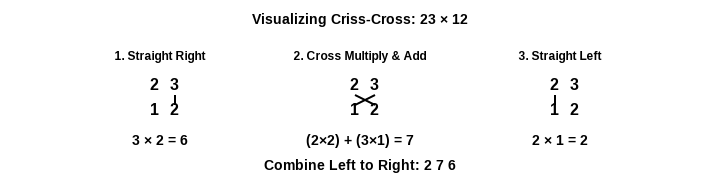
3. The Criss-Cross Method
This is a universal one-line method for multiplying any two-digit numbers. It saves time by avoiding the multiple rows of addition used in traditional school math.
The Steps:
1. Multiply the units digits straight down (this gives the final right digit).
2. Multiply diagonally across the numbers and add those two results together (this gives the middle digit).
3. Multiply the tens digits straight down (this gives the first left digit). Note: If any step gives a number larger than 9, carry the extra digit over to the next step on the left.
Certain numbers have specific patterns that let you bypass normal multiplication entirely by using division or simple addition instead.
The Steps:
• To multiply by 5, divide the number by 2 and put a zero at the end (because 5 is the same as 10 / 2).
• To multiply by 25, divide the number by 4 and put two zeros at the end.
• To multiply a two-digit number by 11, write the first and last digit on the outside, and put their sum in the middle.
Example: 84 × 5
• Divide 84 by 2 to get 42.
• Put a zero at the end.
• Answer: 420.
Example: 36 × 25
• Divide 36 by 4 to get 9.
• Put two zeros at the end.
• Answer: 900.
Example: 45 × 11
• Write 4 and 5 on the outside.
• Add 4 + 5 = 9 for the inside.
• Answer: 495.
Example: 124 × 5
• Divide 124 by 2 to get 62.
• Put a zero at the end.
• Answer: 620.
Example: 32 × 11
• Write 3 and 2 on the outside.
• Add 3 + 2 = 5 for the inside.
• Answer: 352.
Ready to Test Your Speed?
Put your new splitting, base, criss-cross, and special number shortcuts to the test with real drills.