The Number System is the mathematical framework used to express, classify, and perform operations on numbers. In arithmetic, it serves as the foundation for topics like HCF, LCM, Percentages, and Time & Work.
Fundamentals of the Number System
Every beginner must understand two core foundational concepts before solving problems: how digits carry value, and how numbers are categorized.
1. Face Value and Place Value
Face Value: The actual value of the digit itself, regardless of its position.
In the number 5,842, the face value of 8 is simply 8.
Place Value: The value of a digit based on its positional column (Units, Tens, Hundreds, Thousands, etc.).
In 5,842:
Place value of 2 = 2 x 1 = 2
Place value of 4 = 4 x 10 = 40
Place value of 8 = 8 x 100 = 800
Place value of 5 = 5 x 1000 = 5000
2. Complete Classification of Numbers
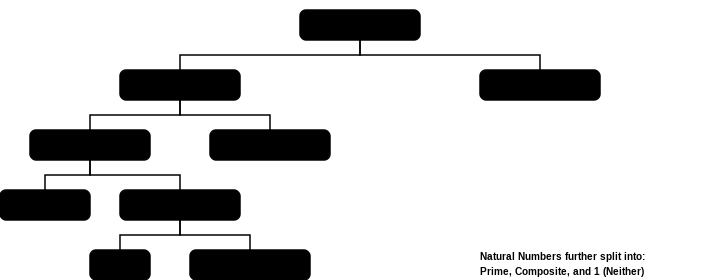
All numbers originate from Complex Numbers, which split into Real Numbers and Imaginary Numbers. In standard arithmetic, questions focus entirely on Real Numbers.
Natural Numbers (N): Counting numbers starting from 1 up to infinity: {1, 2, 3, 4, 5...}.
Integers (Z): Complete numbers without fractional parts, including negative numbers, zero, and positive numbers: {... -3, -2, -1, 0, 1, 2, 3 ...}. Zero is neither positive nor negative.
Rational Numbers (Q): Any number that can be expressed as p / q, where p and q are integers and q != 0. When converted to decimals, they are either terminating (like 0.75) or non-terminating but recurring/repeating (like 0.333...).
Irrational Numbers: Numbers that cannot be written in the form p / q. Their decimal representation is non-terminating and non-repeating (e.g., √2, √3, π).
Even and Odd Numbers:
Even numbers are divisible by 2: {... -4, -2, 0, 2, 4, 6 ...}. Form: 2n.
Odd numbers are not divisible by 2: {... -3, -1, 1, 3, 5 ...}. Form: 2n + 1 or 2n - 1.
Prime Numbers: Natural numbers greater than 1 that have exactly two distinct factors: 1 and the number itself.
2 is the smallest prime number and the only even prime number.
1 is neither prime nor composite because it has only one factor.
Composite Numbers: Natural numbers greater than 1 that have more than two factors (e.g., {4, 6, 8, 9, 10 ...}). 4 is the smallest composite number.
Co-Prime Numbers (Relative Primes): Two numbers are co-prime if their Highest Common Factor (HCF) is 1. They do not need to be prime numbers individually (e.g., 8 and 9 are co-prime because HCF(8, 9) = 1).
Twin Primes: Two prime numbers having a difference of 2 (e.g., (3, 5), (5, 7), (11, 13), (17, 19)).
Type 1: Divisibility Rules and Missing Digits
Instead of performing long division, shortcut rules determine if a number is divisible by a specific divisor:
Divisible by 2: Last digit is even (0, 2, 4, 6, 8).
Divisible by 3: Sum of all digits is a multiple of 3.
Divisible by 4: Number formed by the last two digits is divisible by 4.
Divisible by 5: Last digit is 0 or 5.
Divisible by 6: Divisible by both 2 and 3.
Divisible by 7: Double the last digit and subtract it from the remaining truncated number. If the result is a multiple of 7, the number is divisible by 7.
Divisible by 8: Number formed by the last three digits is divisible by 8.
Divisible by 9: Sum of all digits is a multiple of 9.
Divisible by 11: Difference between the sum of digits at odd places and the sum of digits at even places is either 0 or a multiple of 11.
Composite Divisors (72, 88, 99): Break into co-prime factors:
Divisible by 72 → Must satisfy rules for 8 and 9.
Divisible by 88 → Must satisfy rules for 8 and 11.
Example 1.1
If the 6-digit number 5432a7 is divisible by 9, find the digit a.
• Step 1: Add all digits: 5 + 4 + 3 + 2 + a + 7 = 21 + a.
• Step 2: For divisibility by 9, (21 + a) must be a multiple of 9.
• Step 3: The multiple of 9 immediately after 21 is 27.
• Step 4: 21 + a = 27 → a = 6.
Example 1.2
If the number 78x3945 is divisible by 11, find the value of x.
• Step 1: Sum of digits at odd positions (from right): 5 + 9 + x + 7 = 21 + x.
• Step 2: Sum of digits at even positions (from right): 4 + 3 + 8 = 15.
• Step 3: Difference = (21 + x) - 15 = 6 + x.
• Step 4: For divisibility by 11, 6 + x must equal 11 (since x is a single digit, 0 to 9).
• Step 5: 6 + x = 11 → x = 5.
Example 1.3
Find the largest single-digit value of x such that 5678x4 is divisible by 8.
• Step 1: Divisibility rule for 8 checks the last three digits: 8x4.
• Step 2: Test single-digit values for x starting from the largest (9 down to 0):
- If x = 9: 894 / 8 = 111 with remainder 6 (Not divisible).
- If x = 8: 884 / 8 = 110 with remainder 4 (Not divisible).
- If x = 7: 874 / 8 = 109 with remainder 2 (Not divisible).
- If x = 6: 864 / 8 = 108 with remainder 0 (Divisible).
• Step 3: The largest value of x is 6.
Example 1.4
Check whether 2415 is divisible by 7 using the shortcut rule.
• Step 1: Separate the last digit (5) and double it: 5 × 2 = 10.
• Step 2: Subtract from the remaining number: 241 - 10 = 231.
• Step 3: Repeat the process for 231: Last digit is 1. Double it: 1 × 2 = 2.
• Step 4: Subtract: 23 - 2 = 21.
• Step 5: Since 21 is divisible by 7 (21 / 7 = 3), 2415 is divisible by 7.
Example 1.5
If 687x29 is divisible by 9, and 25y is divisible by 4, find the maximum possible value of (x + y).
• Step 1: For 687x29 to be divisible by 9:
- Sum of digits = 6 + 8 + 7 + x + 2 + 9 = 32 + x.
- Next multiple of 9 is 36 → 32 + x = 36 → x = 4.
• Step 2: For 25y to be divisible by 4:
- The last two digits 5y must be divisible by 4.
- Multiples of 4 in the fifties are 52 and 56.
- So, y can be 2 or 6. The maximum value of y is 6.
• Step 3: Maximum value of (x + y) = 4 + 6 = 10.
Type 2: Unit Digit and Cyclicity
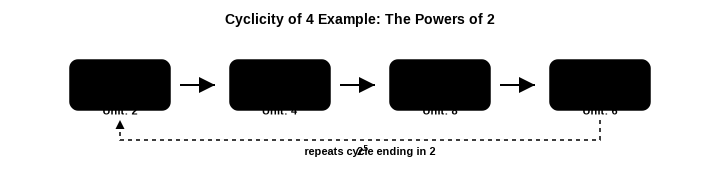
The unit digit of a number raised to a large power repeats in a fixed cycle of powers called cyclicity.
Cyclicity 1 (Digits 0, 1, 5, 6): Any positive integer power ends in the same digit.
(...0)n ends in 0, (...1)n ends in 1, (...5)n ends in 5, (...6)n ends in 6.
Cyclicity 2 (Digits 4 and 9):
4odd = 4, 4even = 6.
9odd = 9, 9even = 1.
Cyclicity 4 (Digits 2, 3, 7, 8):
Divide the power by 4 and check the remainder r:
If remainder = 1 → Unit digit is base1.
If remainder = 2 → Unit digit is base2.
If remainder = 3 → Unit digit is base3.
If remainder = 0 (completely divisible) → Unit digit is base4.
Example 2.1
Find the unit digit of 7105.
• Step 1: Base is 7, which has a cyclicity of 4.
• Step 2: Divide the exponent 105 by 4:
- 105 / 4 = 26 with a remainder of 1.
• Step 3: Unit digit = unit digit of 71 = 7.
Example 2.2
Find the unit digit of (234)102 + (234)103.
• Step 1: Base ends in 4 (cyclicity of 2).
• Step 2: For (234)102, the power 102 is even → Unit digit = 6.
• Step 3: For (234)103, the power 103 is odd → Unit digit = 4.
• Step 4: Add the unit digits: 6 + 4 = 10 → Unit digit is 0.
Example 2.3
Find the unit digit of the product (365) * (659) * (771).
• Step 2: For 659: Any power of 6 always ends in 6.
• Step 3: For 771: 71 / 4 leaves remainder 3 → 73 = 343 (unit digit is 3).
• Step 4: Multiply individual unit digits: 3 * 6 * 3 = 54 → Unit digit is 4.
Example 2.4
Find the unit digit of 298.
• Step 1: Base is 2 (cyclicity of 4).
• Step 2: Divide power by 4: 98 / 4 = 24 with a remainder of 2.
• Step 3: Unit digit = unit digit of 22 = 4.
Example 2.5
Find the unit digit of (17)1999 + (11)1999 - (7)1999.
• Step 1: (17)1999 and (7)1999 both depend solely on the base digit 7 raised to the same power 1999. Their unit digits will be identical.
• Step 2: Let unit digit of 71999 be U.
• Step 3: 111999 always ends in 1.
• Step 4: The expression's unit digit is U + 1 - U = 1.
Type 3: Remainder Theorems and Division Algorithm
The foundation rests on the Division Algorithm: Dividend = (Divisor * Quotient) + Remainder, where 0 ≤ Remainder < Divisor.
Key shortcuts:
Distributive Property:
Rem((A + B) / D) = (Rem(A / D) + Rem(B / D)) % D
Rem((A * B) / D) = (Rem(A / D) * Rem(B / D)) % D
Negative Remainder Concept: If a number is 1 less than the divisor, its remainder can be treated as -1. For example, 19 divided by 20 gives a remainder of 19, or -1. If final remainder is negative, add the divisor: -1 + 20 = 19.
Standard Forms:
(x + 1)n / x always leaves a remainder of 1.
(x - 1)n / x leaves a remainder of 1 if n is even, and x - 1 (or -1) if n is odd.
Example 3.1
Find the remainder when (6767 + 67) is divided by 68.
• Step 1: Express 67 in terms of 68: 67 = 68 - 1, giving a remainder of -1.
A number when divided successively by 4 and 5 leaves remainders 1 and 4 respectively. When the same number is divided successively by 5 and 4, find the respective remainders.
• Step 1: Reconstruct the number from the bottom up. Assume final quotient is 1.
• Step 2: Division by 5 gave remainder 4: Number before this step = 5 * 1 + 4 = 9.
• Step 3: Division by 4 gave remainder 1: Original number = 4 * 9 + 1 = 37.
Find the remainder when (17 * 19 * 23) is divided by 6.
• Step 1: Find remainders for each number individually when divided by 6:
- 17 / 6 leaves remainder 5 (or -1).
- 19 / 6 leaves remainder 1.
- 23 / 6 leaves remainder 5 (or -1).
• Step 2: Multiply the individual remainders:
- (-1) * 1 * (-1) = 1.
• Step 3: Remainder is 1.
Type 4: Factors and Multiples (Divisors)
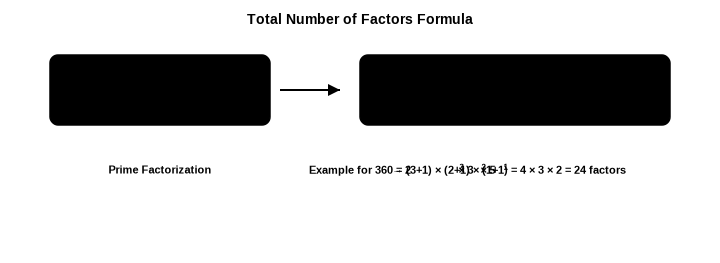
Let any composite number N be written in its prime factorized form: N = pa * qb * rc, where p, q, r are prime numbers and a, b, c are their respective powers.
Total Number of Factors: (a + 1) * (b + 1) * (c + 1)
Number of Odd Factors: Calculate total factors while ignoring the prime factor 2 completely.
Number of Even Factors: Total Factors - Odd Factors
Sum of All Factors: [ (p0 + p1 + ... + pa) * (q0 + q1 + ... + qb) * (r0 + r1 + ... + rc) ]
Number of ways to express N as a product of two factors:
• Step 3: Since 100 is a perfect square, use the formula (Total Factors + 1) / 2:
- Ways = (9 + 1) / 2 = 10 / 2 = 5 ways.
- (The pairs are: 1 x 100, 2 x 50, 4 x 25, 5 x 20, 10 x 10).
Type 5: Number of Trailing Zeroes
A trailing zero at the end of a number is created exclusively by the product of 2 and 5 (2 * 5 = 10).
In any expression, the number of trailing zeroes equals the power of 5 or 2, whichever is smaller.
In continuous natural number products or factorials (n!), factors of 2 are always more frequent than factors of 5. Therefore, trailing zeroes depend entirely on the number of times 5 divides n!.
Legendre's Formula for Factorials: Trailing zeroes in n! = [n / 5] + [n / 25] + [n / 125] + ... (where [x] denotes the integer quotient, ignoring decimals).
Example 5.1
Find the number of trailing zeroes in 100!.
• Step 1: Divide 100 by successive powers of 5:
- 100 / 5 = 20
- 20 / 5 = 4
- (Stop because 4 is less than 5).
• Step 2: Add quotients: 20 + 4 = 24.
• Step 3: 100! ends with 24 trailing zeroes.
Example 5.2
Find the number of trailing zeroes in 50!.
• Step 1: Divide 50 by successive powers of 5:
- 50 / 5 = 10
- 10 / 5 = 2
• Step 2: Add quotients: 10 + 2 = 12.
• Step 3: 50! ends with 12 trailing zeroes.
Example 5.3
Find the number of trailing zeroes in 125!.
• Step 1: Divide 125 by powers of 5:
- 125 / 5 = 25
- 25 / 5 = 5
- 5 / 5 = 1
• Step 2: Add quotients: 25 + 5 + 1 = 31.
• Step 3: 125! has 31 trailing zeroes.
Example 5.4
Find the number of trailing zeroes in the product: 15 * 35 * 40 * 25 * 16.
• Step 1: Count the total count of 2s and 5s in each number:
- 15 = 3 * 51 → (one 5)
- 35 = 7 * 51 → (one 5)
- 40 = 23 * 51 → (three 2s, one 5)
- 25 = 52 → (two 5s)
- 16 = 24 → (four 2s)
• Step 2: Total power of 5: 1 + 1 + 1 + 2 = 5 (meaning 55).
• Step 3: Total power of 2: 3 + 4 = 7 (meaning 27).
• Step 4: Number of complete pairs of (2 * 5) = min(5, 7) = 5.
• Step 5: There are 5 trailing zeroes.
Example 5.5
Find the number of trailing zeroes in 100! * 200!.
• Step 1: Trailing zeroes in 100!:
- 100 / 5 = 20
- 20 / 5 = 4
- Sum = 20 + 4 = 24.
• Step 2: Trailing zeroes in 200!:
- 200 / 5 = 40
- 40 / 5 = 8
- 8 / 5 = 1
- Sum = 40 + 8 + 1 = 49.
• Step 3: When multiplying two numbers, their trailing zeroes add together:
- Total zeroes = 24 + 49 = 73.
Ready to Test Your Speed?
Put your divisibility rules, unit digit cyclicity, remainder theorems, and factorization shortcuts to the test with real drills.