A percentage is a mathematical ratio that shows a part out of 100. The word comes from Latin: per (for each) and cent (hundred). Therefore, percent literally means "for every hundred."
The Foundation to Learn First
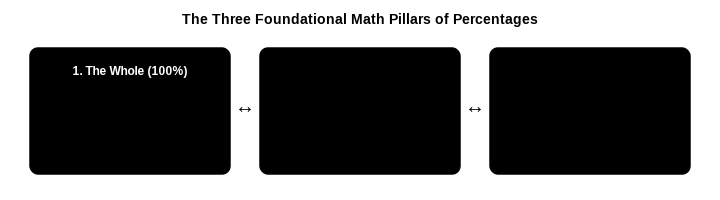
To build a proper foundation, you need to understand how percentages connect to three basic math ideas:
The Whole (100%) : Understanding that 100% represents the complete, undivided total of anything.
Fractions: Recognizing that any percentage is simply a fraction with a bottom number (denominator) of 100. For instance, 25% = 25/100
Decimals : Learning that percentages can be written in decimal form by dividing the number by 100. For instance, 25/100 = 0.25.
Now learn Converting percentages to Decimals and Fractions
Every percentage is simply a part out of 100. Converting them relies on two simple mechanical rules:
Decimal shortcut: Move the decimal point two spots to the left (e.g., 40.0% -> 0.40).
Fraction shortcut: Place the number over 100 (number/100), then divide the top and bottom numbers by their largest common divider.
10%
• Decimal: 0.1
• Fraction: 10/100 -> divide top and bottom by 10 = 1/10
10%, 0.1, and 1/10 are the same.
If someone asks you:
- What is 10% of 100?
- What is 0.1 of 100?
- What is 1/10 of 100?
The answer for all three is 10.
20%
• Decimal: 0.2
• Fraction: 20/100 -> divide top and bottom by 20 = 1/5
20%, 0.2, and 1/5 are the same.
If someone asks you:
- What is 20% of 100?
- What is 0.2 of 100?
- What is 1/5 of 100?
The answer for all three is 20.
25%
• Decimal: 0.25
• Fraction: 25/100 -> divide top and bottom by 25 = 1/4
25%, 0.25, and 1/4 are the same.
If someone asks you:
- What is 25% of 100?
- What is 0.25 of 100?
- What is 1/4 of 100?
The answer for all three is 25.
30%
• Decimal: 0.3
• Fraction: 30/100 -> divide top and bottom by 10 = 3/10
30%, 0.3, and 3/10 are the same.
If someone asks you:
- What is 30% of 100?
- What is 0.3 of 100?
- What is 3/10 of 100?
The answer for all three is 30.
40%
• Decimal: 0.4
• Fraction: 40/100 -> divide top and bottom by 20 = 2/5
40%, 0.4, and 2/5 are the same.
If someone asks you:
- What is 40% of 100?
- What is 0.4 of 100?
- What is 2/5 of 100?
The answer for all three is 40.
50%
• Decimal: 0.5
• Fraction: 50/100 -> divide top and bottom by 50 = 1/2
50%, 0.5, and 1/2 are the same.
If someone asks you:
- What is 50% of 100?
- What is 0.5 of 100?
- What is 1/2 of 100?
The answer for all three is 50.
60%
• Decimal: 0.6
• Fraction: 60/100 -> divide top and bottom by 20 = 3/5
60%, 0.6, and 3/5 are the same.
If someone asks you:
- What is 60% of 100?
- What is 0.6 of 100?
- What is 3/5 of 100?
The answer for all three is 60.
70%
• Decimal: 0.7
• Fraction: 70/100 -> divide top and bottom by 10 = 7/10
70%, 0.7, and 7/10 are the same.
If someone asks you:
- What is 70% of 100?
- What is 0.7 of 100?
- What is 7/10 of 100?
The answer for all three is 70.
75%
• Decimal: 0.75
• Fraction: 75/100 -> divide top and bottom by 25 = 3/4
75%, 0.75, and 3/4 are the same.
If someone asks you:
- What is 75% of 100?
- What is 0.75 of 100?
- What is 3/4 of 100?
The answer for all three is 75.
80%
• Decimal: 0.8
• Fraction: 80/100 -> divide top and bottom by 20 = 4/5
80%, 0.8, and 4/5 are the same.
If someone asks you:
- What is 80% of 100?
- What is 0.8 of 100?
- What is 4/5 of 100?
The answer for all three is 80.
90%
• Decimal: 0.9
• Fraction: 90/100 -> divide top and bottom by 10 = 9/10
90%, 0.9, and 9/10 are the same.
If someone asks you:
- What is 90% of 100?
- What is 0.9 of 100?
- What is 9/10 of 100?
The answer for all three is 90.
100%
• Decimal: 1.0 (or simply 1)
• Fraction: 100/100 = 1 (one whole)
100%, 1.0, and 1 (or 1/1) are the same.
If someone asks you:
- What is 100% of 100?
- What is 1.0 of 100?
- What is 1 of 100?
The answer for all three is 100.
1. Fundamentals of Percentages
Core Definition
When we say x%, it means x parts out of 100 equal parts:
x% = x / 100
20% = 20 / 100 = 1 / 5 = 0.20
Basic Conversions
Fraction to Percentage: Multiply the fraction by 100.
3 / 4 = (3 / 4) * 100% = 75%
2 / 5 = (2 / 5) * 100% = 40%
Percentage to Fraction: Divide the number by 100 and simplify.
15% = 15 / 100 = 3 / 20
62.5% = 62.5 / 100 = 5 / 8
Percentage to Decimal: Move the decimal point two places to the left.
45% = 0.45
7.5% = 0.075
Standard Fraction-to-Percentage Chart
Memorizing these standard conversions saves calculation time:
S.No.
Fraction
Percentage (Decimal)
Equivalent Mixed Fraction
1
1 / 1
100%
100%
2
1 / 2
50%
50%
3
1 / 3
33.33%
33 1/3%
4
2 / 3
66.66%
66 2/3%
5
1 / 4
25%
25%
6
3 / 4
75%
75%
7
1 / 5
20%
20%
8
4 / 5
80%
80%
9
1 / 6
16.66%
16 2/3%
10
5 / 6
83.33%
83 1/3%
11
1 / 7
14.28%
14 2/7%
12
2 / 7
28.57%
28 4/7%
13
3 / 7
42.85%
42 6/7%
14
4 / 7
57.14%
57 1/7%
15
5 / 7
71.42%
71 3/7%
16
6 / 7
85.71%
85 5/7%
17
1 / 8
12.50%
12 1/2%
18
3 / 8
37.50%
37 1/2%
19
5 / 8
62.50%
62 1/2%
20
7 / 8
87.50%
87 1/2%
21
1 / 9
11.11%
11 1/9%
22
2 / 9
22.22%
22 2/9%
23
4 / 9
44.44%
44 4/9%
24
5 / 9
55.55%
55 5/9%
25
7 / 9
77.77%
77 7/9%
26
8 / 9
88.88%
88 8/9%
27
1 / 10
10%
10%
28
3 / 10
30%
30%
29
7 / 10
70%
70%
30
9 / 10
90%
90%
31
1 / 11
9.09%
9 1/11%
32
2 / 11
18.18%
18 2/11%
33
3 / 11
27.27%
27 3/11%
34
4 / 11
36.36%
36 4/11%
35
5 / 11
45.45%
45 5/11%
36
6 / 11
54.54%
54 6/11%
37
7 / 11
63.63%
63 7/11%
38
8 / 11
72.72%
72 8/11%
39
9 / 11
81.81%
81 9/11%
40
10 / 11
90.90%
90 10/11%
41
1 / 12
8.33%
8 1/3%
42
1 / 13
7.69%
7 9/13%
43
1 / 14
7.14%
7 1/7%
44
1 / 15
6.66%
6 2/3%
45
1 / 16
6.25%
6 1/4%
46
1 / 20
5%
5%
47
1 / 25
4%
4%
Essential Rules & Properties
Reversibility Property (x% of y = y% of x):
Calculating 64% of 25 directly can be slow.
Instead, flip it: 25% of 64 = (1 / 4) * 64 = 16.
Identifying the Base Value:
In percentage comparisons, the denominator is always the value following the word "of" or "than".
"What percentage is A of B?" -> (A / B) * 100
"Percentage change from A to B" -> [(B - A) / A] * 100 (A is the starting/base value).
Multiplying Factor (MF):
An increase of r% means the new value is Initial Value * (1 + r / 100).
Example: Increase by 20% -> Multiply by 1.20 (or 6 / 5).
A decrease of r% means the new value is Initial Value * (1 - r / 100).
Example: Decrease by 15% -> Multiply by 0.85 (or 17 / 20).
2. Common Exam Problem Types and Worked Examples
Type 1: Base Comparison (A is More/Less than B)
Core Concept:
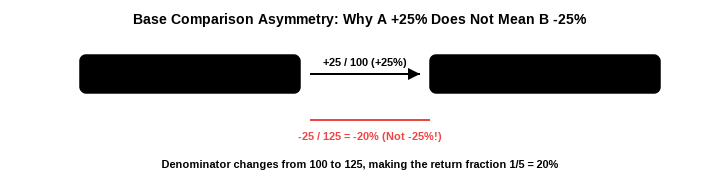
If A is R% more than B, then B is less than A by: [R / (100 + R)] * 100%
If A is R% less than B, then B is more than A by: [R / (100 - R)] * 100%
Example 1.1
If A's salary is 25% more than B's salary, by what percentage is B's salary less than A's salary?
• Let B = 100.
• A = 100 + 25 = 125.
• Difference = 125 - 100 = 25.
• Required percentage less = (Difference / A) * 100
• (25 / 125) * 100 = (1 / 5) * 100 = 20%.
Example 1.2
If X's income is 20% less than Y's income, by what percentage is Y's income more than X's income?
• Let Y = 100.
• X = 100 - 20 = 80.
• Difference = 100 - 80 = 20.
• Required percentage more = (Difference / X) * 100
• (20 / 80) * 100 = (1 / 4) * 100 = 25%.
Example 1.3
If P is 50% more than Q, then Q is what percentage less than P?
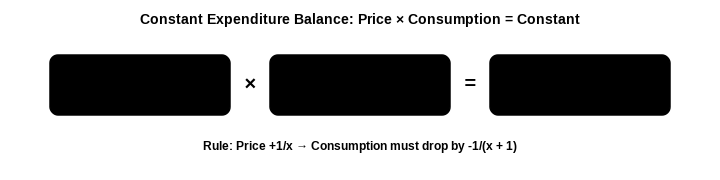
The price of cooking oil increases by 30%. By what percentage should a household reduce its consumption so that total expenditure increases by only 4%?
• Let initial Price = 100, initial Consumption = 100.
• Step 2 (combine 21% with the third 10%): 21 + 10 + (21 * 10) / 100 = 31 + 2.1 = 33.1%.
• Result: Volume increases by 33.1%.
Type 4: Exam Scores and Passing Marks
Core Concept: Form equations by setting both candidate situations equal to the standard Passing Marks:
Passing Marks = Marks Obtained + Marks Failed By = Marks Obtained - Excess Marks Above Pass
Example 4.1
A student scores 30% marks and fails by 15 marks. Another student scores 40% marks and gets 25 marks more than the passing marks. Find the maximum marks and passing marks.
• Let Maximum Marks = M.
• Passing marks = 30% of M + 15
• Passing marks = 40% of M - 25
• Equating both:
- 40% of M - 30% of M = 15 + 25
- 10% of M = 40
- M = (40 / 10) * 100 = 400 marks.
• Passing marks = 30% of 400 + 15 = 120 + 15 = 135 marks.
Example 4.2
In an exam, 35% marks are needed to pass. A candidate scores 175 marks and fails by 35 marks. Find the maximum marks.
• Passing marks required = 175 + 35 = 210.
• 35% of Maximum Marks = 210
• Maximum Marks = (210 / 35) * 100 = 6 * 100 = 600 marks.
Example 4.3
A student got 28% marks and failed by 14 marks. The passing percentage is 35%. Find the maximum marks.
• Difference in percentage = 35% - 28% = 7%.
• 7% of Maximum Marks = 14
• 1% = 2
• Maximum Marks = 2 * 100 = 200 marks.
Example 4.4
Student A scored 45% and passed by 30 marks. Student B scored 25% and failed by 50 marks. What is the passing percentage?
• Difference in marks = 30 - (-50) = 80 marks.
• Difference in percentage = 45% - 25% = 20%.
• 20% of Maximum Marks = 80
• Maximum Marks = (80 / 20) * 100 = 400 marks.
• Marks obtained by B = 25% of 400 = 100 marks.
• Passing marks = 100 + 50 = 150 marks.
• Passing percentage = (150 / 400) * 100 = 37.5%.
Example 4.5
A candidate getting 20% marks fails by 10 marks. A candidate getting 42% marks gets 12% marks more than the pass percentage. Find the maximum marks.
• Pass percentage = 42% - 12% = 30%.
• Shortfall of first candidate = 30% - 20% = 10%.
• 10% of Maximum Marks = 10 marks
• Maximum Marks = (10 / 10) * 100 = 100 marks.
Type 5: Income, Expenditure, and Remaining Balance
Core Concept:
Total Base: Direct percentages are added up (a% + b% + c%).
Remaining Base: Sequential fractions are multiplied (Remaining = Original * (1 - a/100) * (1 - b/100)).
Example 5.1
A person spends 20% of income on rent, 30% on food, and 10% on entertainment. If savings are 12000 Rupees, find total income.
• Expenses out of total income = 20% + 30% + 10% = 60%.
• Savings percentage = 100% - 60% = 40%.
• 40% of Income = 12000
• Total Income = (12000 / 40) * 100 = 30000 Rupees.
Example 5.2
A person spends 20% of his salary on house rent and 70% of the remaining on household expenses. If savings are 3600 Rupees, find total salary.
• Let total salary = S.
• Remaining after rent = 100% - 20% = 80% = 0.80 * S.
• He spends 70% of remainder, leaving 30% of remainder as savings.
• Savings = 30% of (0.80 * S) = 0.30 * 0.80 * S = 0.24 * S = 24% of S.
• 24% of S = 3600
• S = (3600 / 24) * 100 = 15000 Rupees.
Example 5.3
A man loses 20% of his money. After spending 25% of the remainder, he has 480 Rupees left. How much had he originally?
• Let initial amount = X.
• After 20% loss: 0.80 * X remains.
• After spending 25% of remainder: 0.75 * (0.80 * X) = 0.60 * X remains.
• 0.60 * X = 480
• X = 480 / 0.60 = 800 Rupees.
Example 5.4
Raman spends 50% of monthly income on household items. Out of the remainder, he spends 50% on transport, 25% on entertainment, and 10% on sports. He saves the remaining 900 Rupees. Find his monthly income.
• Expenses from remainder = 50% + 25% + 10% = 85% of remainder.
• Savings = 100% - 85% = 15% of remainder.
• Savings in units = 15% of 50 = 7.5 units.
• 7.5 units = 900 Rupees
• 1 unit = 900 / 7.5 = 120 Rupees
• Total Income (100 units) = 100 * 120 = 12000 Rupees.
Example 5.5
A person earns 50000 Rupees and spends 30000 Rupees. If income increases by 20% and expenditure increases by 10%, find the percentage increase in savings.
• Initial Income = 50000, Initial Expenditure = 30000.
• Initial Savings = 50000 - 30000 = 20000 Rupees.
• New Income = 50000 + (20% of 50000) = 50000 + 10000 = 60000 Rupees.
• New Expenditure = 30000 + (10% of 30000) = 30000 + 3000 = 33000 Rupees.
In an election between two candidates, the winner gets 65% of total votes and wins by 1500 votes. Find the total number of votes polled.
• Winner's share = 65%.
• Loser's share = 100% - 65% = 35%.
• Margin = 65% - 35% = 30% of total votes.
• 30% of Total Votes = 1500
• Total Votes = (1500 / 30) * 100 = 5000 votes.
Example 6.2
In an election, 10% voters did not vote, and 10% of cast votes were invalid. The winning candidate got 54% of valid votes and won by 1620 votes. Find the enrolled voter count.
20% voters did not vote and 120 votes were invalid. The winner got 41% of the total voters on the list and won by 200 votes. Find the total voters on the list.
In a three-candidate election, candidate A got 40% of the total votes, and candidate B got 36% of the total votes. Total votes polled were 36000. Find the votes obtained by candidate C.
The population of a town increases by 10% in year 1, increases by 20% in year 2, and decreases by 30% in year 3. If the starting population was 100000, find the population after 3 years.
• Final Population = 100000 * (1 + 10/100) * (1 + 20/100) * (1 - 30/100)
• = 100000 * (1.10) * (1.20) * (0.70)
• = 100000 * 0.924 = 92400.
Ready to Test Your Speed?
Put your percentage calculation shortcuts, decimal tricks, and exam formulas to the test with real drills.