Profit and Loss

Profit and loss is a core arithmetic topic built around buying, pricing, and selling goods. In competitive examinations, every question in this topic traces back to a few fundamental definitions, percentage relationships, and ratio concepts.

1. Fundamentals of Profit and Loss

Core Terms and Definitions
Profit Loss Diagram 1
  • Cost Price (CP): The total money spent to acquire or produce an article. This includes the initial purchase price plus all additional overhead expenses such as transportation, repairs, labor, or packaging.
    • Total CP = Purchase Price + Overhead Expenses
  • Selling Price (SP): The final price at which an article is sold to a customer.
  • Marked Price (MP) / List Price: The printed, tagged, or labeled price on an item before any discount is applied.
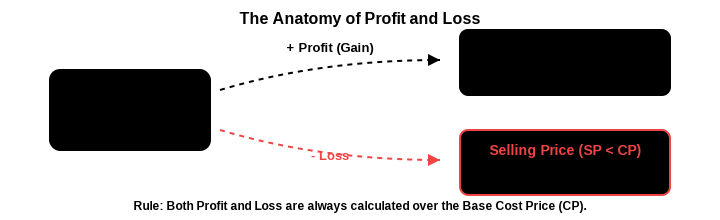
  • Profit (Gain): Occurs when the Selling Price is greater than the Cost Price (SP > CP).
    • Profit = SP - CP
  • Loss: Occurs when the Cost Price is greater than the Selling Price (CP > SP).
    • Loss = CP - SP
  • Discount: The price reduction allowed by the seller on the Marked Price.
    • Discount = Marked Price - Selling Price
  • Markup: The extra amount added to the Cost Price to arrive at the Marked Price.
    • Markup = Marked Price - Cost Price

Key Rules and Formulas
Profit Loss Diagram 2
  1. Profit and Loss percentages are always calculated on the Cost Price (CP) unless the question explicitly states otherwise:
    • Profit % = (Profit / CP) * 100
    • Loss % = (Loss / CP) * 100
  2. Discount percentage is always calculated on the Marked Price (MP):
    • Discount % = (Discount / MP) * 100
  3. Markup percentage is always calculated on the Cost Price (CP):
    • Markup % = (Markup / CP) * 100
  4. Direct Multiplying Factors (Decimal and Fractional Methods):
    • If Profit = 20%: SP = CP * (100 + 20) / 100 = 1.20 * CP (or ratio CP : SP = 5 : 6)
    • If Loss = 20%: SP = CP * (100 - 20) / 100 = 0.80 * CP (or ratio CP : SP = 5 : 4)
    • If Discount = 10%: SP = MP * (100 - 10) / 100 = 0.90 * MP (or ratio MP : SP = 10 : 9)
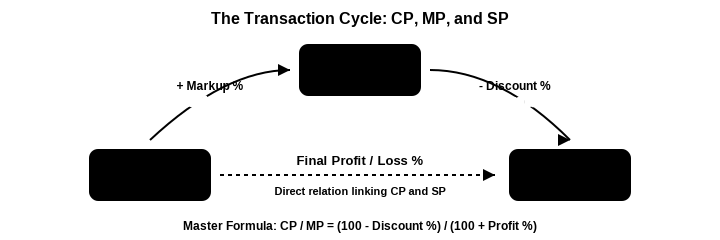
  5. Direct Relation between CP, MP, Discount %, and Profit %:
    CP / MP = (100 - Discount %) / (100 + Profit %)
    This is the most powerful shortcut for skipping long variable calculations.

2. Most Common Types of Questions in Exam Books

In standard competitive exam books, questions are grouped into five major types:

  • Type 1: Basic CP, SP, and Percentage Variations (finding values, shifting percentages, overheads).
  • Type 2: Quantity and Article Equivalence (CP of x articles = SP of y articles, rate-based transactions).
  • Type 3: Two-Article Transactions (identical selling prices, mixed profit and loss, no-profit-no-loss cases).
  • Type 4: Marked Price, Discounts, and Successive Discounts.
  • Type 5: Dishonest Merchants and Faulty Weights.

Type 1: Basic CP, SP, and Percentage Variations

Example 1.1
Problem: A merchant buys a cycle for 1,800 and spends 200 on its repairs and transport. He sells it for 2,400. Find his profit percentage.
Solution:
• Total CP = 1800 + 200 = 2,000
• SP = 2,400
• Profit = SP - CP = 2400 - 2000 = 400
• Profit % = (Profit / CP) * 100 = (400 / 2000) * 100 = 20%
Example 1.2
Problem: By selling a table for 720, a shopkeeper incurs a loss of 10%. At what price should he sell it to gain 15%?
Solution:
• SP at 10% loss represents 90% of CP.
• 90% of CP = 720
• CP = (720 / 90) * 100 = 800
• To gain 15%, the new SP must be 115% of CP:
• New SP = 800 * 1.15 = 920
Example 1.3
Problem: A person sells a watch at a profit of 12%. If he had sold it for 48 more, the profit would have been 18%. Find the cost price of the watch.
Solution:
• Initial profit = 12% of CP
• New profit = 18% of CP
• Difference in percentage = 18% - 12% = 6% of CP
• 6% of CP = 48
• CP = (48 / 6) * 100 = 800
Example 1.4
Problem: An item is sold at a loss of 8%. If it had been sold for 75 more, there would have been a gain of 7%. Find the cost price.
Solution:
• The transition is from -8% (loss) to +7% (gain).
• Total percentage change = 7% - (-8%) = 15% of CP
• 15% of CP = 75
• CP = (75 / 15) * 100 = 500
Example 1.5
Problem: A dealer buys an article for 1,200. He wants to earn a profit of 16.67% (which is 16 2/3%). What should be the selling price?
Solution:
• 16 2/3% in fraction form = 1/6
• Profit = (1 / 6) * 1200 = 200
• SP = CP + Profit = 1200 + 200 = 1,400

Type 2: Quantity and Article Equivalence

Profit Loss Diagram 3
Example 2.1
Problem: The cost price of 15 pens is equal to the selling price of 12 pens. Find the profit or loss percentage.
Solution:
• Equation: 15 * CP = 12 * SP
• Ratio: SP / CP = 15 / 12 = 5 / 4
• Let CP = 4, SP = 5. Profit = 5 - 4 = 1.
• Profit % = (1 / 4) * 100 = 25% profit
Example 2.2
Problem: The cost price of 25 books is equal to the selling price of 30 books. Find the profit or loss percentage.
Solution:
• Equation: 25 * CP = 30 * SP
• Ratio: SP / CP = 25 / 30 = 5 / 6
• Let CP = 6, SP = 5. Loss = 6 - 5 = 1.
• Loss % = (1 / 6) * 100 = 16.67% loss
Example 2.3
Problem: By selling 33 meters of cloth, a shopkeeper gains the selling price of 11 meters. Find his gain percentage.
Solution:
• Basic formula: Profit = Total SP - Total CP
• SP of 11m = SP of 33m - CP of 33m
• CP of 33m = SP of 22m (rearranging terms)
• Ratio: SP / CP = 33 / 22 = 3 / 2
• Profit % = ((3 - 2) / 2) * 100 = 50%
Example 2.4
Problem: A vendor buys lemons at the rate of 6 for 10 and sells them at the rate of 4 for 8. Find his profit percentage.
Solution:
• Take LCM of 6 and 4 = 12 lemons.
• CP of 12 lemons = 10 * 2 = 20
• SP of 12 lemons = 8 * 3 = 24
• Profit = 24 - 20 = 4
• Profit % = (4 / 20) * 100 = 20%
Example 2.5
Problem: A fruit seller buys oranges at 5 for 1 and sells them at 3 for 1. Find his profit percentage.
Solution:
• LCM of 5 and 3 = 15 oranges.
• CP of 15 oranges = 3
• SP of 15 oranges = 5
• Profit = 5 - 3 = 2
• Profit % = (2 / 3) * 100 = 66.67%

Type 3: Two-Article Transactions

Profit Loss Diagram 4
Example 3.1
Problem: A person sells two articles for 990 each. On the first, he makes a profit of 10%, and on the second, he incurs a loss of 10%. Find the overall profit or loss percentage.
Solution:
Standard Rule: When two items are sold at the same selling price, one at a gain of x% and the other at a loss of x%, there is always a net loss given by (x2 / 100)%.
• Loss % = (102 / 100)% = (100 / 100)% = 1% loss
Step-by-step verification:
• CP of first item = 990 / 1.10 = 900
• CP of second item = 990 / 0.90 = 1,100
• Total CP = 900 + 1100 = 2,000
• Total SP = 990 + 990 = 1,980
• Net Loss = 2000 - 1980 = 20 -> (20 / 2000) * 100 = 1%
Example 3.2
Problem: Two chairs are sold for 1,920 each. One chair is sold at a 20% gain and the other at a 20% loss. Find the overall gain or loss in rupees.
Solution:
• Total SP = 1920 + 1920 = 3,840
• CP of first chair = 1920 / 1.20 = 1,600
• CP of second chair = 1920 / 0.80 = 2,400
• Total CP = 1600 + 2400 = 4,000
• Total Loss = Total CP - Total SP = 4000 - 3840 = 160
Example 3.3
Problem: A trader sells two cycles for 2,400 each. On the first, he makes a profit of 20%, and on the second, he incurs a loss of 25%. Find the overall profit or loss percentage.
Solution:
• Total SP = 2400 + 2400 = 4,800
• CP of first cycle = 2400 / 1.20 = 2,000
• CP of second cycle = 2400 / 0.75 = 3,200
• Total CP = 2000 + 3200 = 5,200
• Net Loss = 5200 - 4800 = 400
• Net Loss % = (400 / 5200) * 100 = 7.69% loss (or 7 9/13%)
Example 3.4
Problem: A merchant buys two items for a total of 1,000. He sells the first item at a loss of 20% and the second at a profit of 20%. If the selling prices of both items are equal, find the cost price of each item.
Solution:
• SP of first item = 0.80 * CP1
• SP of second item = 1.20 * CP2
• Equating both: 0.80 * CP1 = 1.20 * CP2 -> CP1 / CP2 = 1.20 / 0.80 = 3 / 2
• Divide total 1000 in 3 : 2 ratio (5 parts total).
• 1 part = 200.
• CP1 = 3 * 200 = 600, CP2 = 2 * 200 = 400
Example 3.5
Problem: A shopkeeper buys two watches for 1,200. He sells one at a profit of 15% and the other at a loss of 10%. If there is no overall profit and no overall loss on the whole transaction, find the cost price of each watch.
Solution:
• Overall profit/loss = 0 implies: Profit on Watch 1 = Loss on Watch 2
• 15% of CP1 = 10% of CP2 -> CP1 / CP2 = 10 / 15 = 2 / 3
• Divide 1,200 into 2 : 3 ratio (5 parts total).
• 1 part = 240.
• CP1 = 2 * 240 = 480, CP2 = 3 * 240 = 720

Type 4: Marked Price, Discounts, and Successive Discounts

Example 4.1
Problem: An article with a marked price of 800 is sold at a discount of 15%. Find the selling price.
Solution:
• Discount = 15% of 800 = 120
• SP = 800 - 120 = 680 (Or SP = 85% of 800 = 680)
Example 4.2
Problem: Find the single discount equivalent to two successive discounts of 20% and 10%.
Solution:
• Net Discount = d1 + d2 - (d1 * d2) / 100
• = 20 + 10 - (20 * 10) / 100 = 30 - 2 = 28%
Verification: Let MP = 100 -> After 20% = 80 -> After 10% on 80 = 72. Drop = 28%.
Example 4.3
Problem: A trader marks his goods 40% above the cost price and allows a discount of 25% on the marked price. Find his net profit or loss percentage.
Solution:
• Let CP = 100. MP = 140.
• Discount = 25% of 140 = (1 / 4) * 140 = 35
• SP = 140 - 35 = 105
• Profit = 105 - 100 = 5 -> 5% profit
Example 4.4
Problem: A shopkeeper wishes to earn a profit of 20% after allowing a discount of 10% to the buyer. By what percentage above the cost price should he mark his goods?
Solution:
• CP / MP = (100 - Discount %) / (100 + Profit %)
• CP / MP = (100 - 10) / (100 + 20) = 90 / 120 = 3 / 4
• Let CP = 3 units, MP = 4 units. Markup = 1 unit.
• Markup % = (1 / 3) * 100 = 33.33%
Example 4.5
Problem: Three successive discounts of 10%, 20%, and 25% are given on an item marked at 1,000. Find the final selling price and total discount.
Solution:
• SP = 1000 * (1 - 10/100) * (1 - 20/100) * (1 - 25/100)
• SP = 1000 * (9/10) * (4/5) * (3/4)
• SP = 1000 * (27 / 50) = 20 * 27 = 540
• Total Discount = 1000 - 540 = 460

Type 5: Dishonest Merchants and Faulty Weights

Profit Loss Diagram 5
Example 5.1
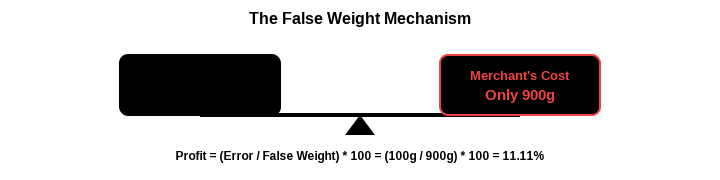
Problem: A dishonest dealer claims to sell his goods at cost price, but uses a false weight of 900 grams instead of a true weight of 1 kilogram (1000 grams). Find his profit percentage.
Solution:
• Error / Saving in weight = 1000 - 900 = 100g
• Merchant's actual investment is only 900g.
• Profit % = (Error / False Weight) * 100
• (100 / 900) * 100 = (1 / 9) * 100 = 11.11%
Example 5.2
Problem: A shopkeeper sells sugar at a profit of 10%, but uses a weight that is 20% less than the actual weight. Find his overall profit percentage.
Solution:
• Let true cost of 1000g = 100.
• SP markup: charges 10% profit -> SP = 110.
• Cheating: gives 20% less -> gives 800g. Cost incurred for 800g = 80.
• Net Profit = 110 - 80 = 30.
• Net Profit % = (30 / 80) * 100 = 37.5%
Example 5.3
Problem: A merchant claims to sell cloth at a loss of 5%, but uses a measuring scale of 90 cm instead of 1 meter (100 cm). Find his net profit or loss percentage.
Solution:
• Let cost of 100 cm = 100. Stated SP (5% loss) = 95.
• Actual cloth supplied = 90 cm. Actual cost = 90.
• Profit = 95 - 90 = 5
• Profit % = (5 / 90) * 100 = (1 / 18) * 100 = 5.56% profit (or 5 5/9%)
Example 5.4
Problem: A trader cheats by 10% while purchasing goods and cheats by 10% while selling goods using false weights. Find his profit percentage.
Solution:
(Note: Competitive exam answer keys follow one of two standard conventions)
Convention 1 (Strict Weight Logic): He gets 1100g for price of 1000g. Gives 900g for price of 1000g. SP/CP ratio = (1100 / 900) = 11 / 9. Profit = (2 / 9) * 100 = 22.22%
Convention 2 (Successive Percentage): Net % = 10 + 10 + (10 * 10) / 100 = 21%
Answer: 22.22% (or 21% depending on the exam board).
Example 5.5
Problem: A dealer professes to sell wheat at cost price. How many grams should he give instead of 1 kg (1,000 grams) to earn a profit of 25%?
Solution:
• Let weight used be w grams.
• Profit % = ((1000 - w) / w) * 100 = 25
• (1000 - w) / w = 25 / 100 = 1 / 4
• 4 * (1000 - w) = w -> 4000 - 4w = w -> 5w = 4000
• w = 800 grams

Ready to Test Your Speed?

Put your profit and loss formulas, markup shortcuts, and tricky fault-weight calculations to the test.