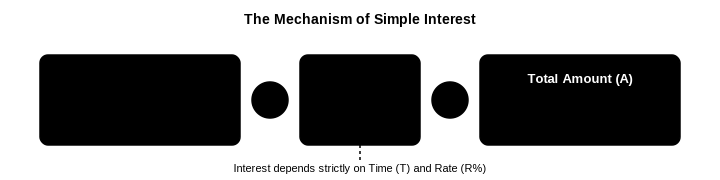
Simple Interest is a method where the fee charged for borrowing money (or earned for investing money) is calculated strictly on the original sum of money borrowed, known as the Principal. Unlike Compound Interest, the interest earned in one year is never added back to the principal to earn further interest. This means the interest amount remains identical every single year as long as the principal and rate stay constant.
1. Fundamentals of Simple Interest
Every question in this chapter relies on five fundamental terms:
Key Terms
Principal (P): The original sum of money lent, borrowed, or invested.
Rate of Interest (R): The percentage at which interest is charged or earned, usually quoted per annum (p.a., which means per year). If R = 8%, it means you pay 8 units of money for every 100 units of principal each year.
Time (T): The duration for which the money is borrowed or invested. In standard formulas, time must always be expressed in years.
If time is given in months: Convert to years by dividing by 12 (e.g., 6 months = 6 / 12 = 0.5 years).
If time is given in days: Convert to years by dividing by 365 (e.g., 73 days = 73 / 365 = 1 / 5 years).
Simple Interest (SI): The fixed extra money paid by the borrower to the lender for using the principal.
Amount (A): The total money returned to the lender at the end of the time period.
Amount = Principal + Simple Interest
A = P + SI
Core Formulas
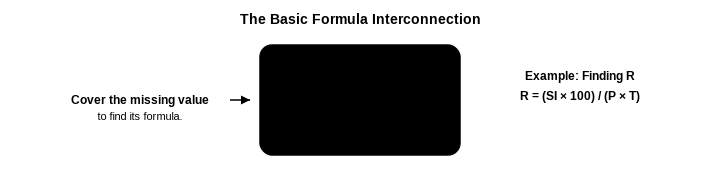
SI = (P * R * T) / 100
P = (SI * 100) / (R * T)
R = (SI * 100) / (P * T)
T = (SI * 100) / (P * R)
A = P * [1 + (R * T) / 100]
2. Common Question Types and 5 Examples for Each
Type 1: Direct Calculation of Missing Parameters (P, R, T, or SI)
In these problems, three of the four core variables (P, R, T, SI/Amount) are provided, and you find the missing value directly.
Example 1.1: Finding Simple Interest and Amount
Find the simple interest and total amount on a sum of 5,000 at 8% per annum for 3 years.
• Given: P = 5000, R = 8, T = 3
• Calculation:
- SI = (P * R * T) / 100
- SI = (5000 * 8 * 3) / 100
- SI = 120,000 / 100 = 1,200
- Amount = P + SI = 5000 + 1200 = 6,200
• Answer: SI = 1,200; Amount = 6,200
Example 1.2: Finding the Principal
A sum of money borrowed at 6% per annum earns a simple interest of 900 in 5 years. Find the principal sum.
• Given: SI = 900, R = 6, T = 5
• Calculation:
- P = (SI * 100) / (R * T)
- P = (900 * 100) / (6 * 5)
- P = 90,000 / 30 = 3,000
• Answer: Principal = 3,000
Example 1.3: Finding the Time Period
In how many years will a sum of 4,000 yield 1,200 as simple interest at 10% per annum?
• Given: P = 4000, SI = 1200, R = 10
• Calculation:
- T = (SI * 100) / (P * R)
- T = (1200 * 100) / (4000 * 10)
- T = 120,000 / 40,000 = 3 years
• Answer: 3 years
Example 1.4: Finding the Rate of Interest
At what rate percent per annum will a principal of 2,500 amount to 3,100 in 4 years?
• Given: P = 2500, A = 3100, T = 4
• Calculation:
- SI = A - P = 3100 - 2500 = 600
- R = (SI * 100) / (P * T)
- R = (600 * 100) / (2500 * 4)
- R = 60,000 / 10,000 = 6% per annum
• Answer: 6% per annum
Example 1.5: Calculation Involving Time in Days
Find the simple interest on 7,300 at 5% per annum for 219 days.
• Given: P = 7300, R = 5, T = 219 / 365 years
- Note: 219 and 365 are both divisible by 73: 219 / 365 = 3 / 5
• Calculation:
- SI = (P * R * T) / 100
- SI = [7300 * 5 * (3 / 5)] / 100
- SI = [7300 * 3] / 100 = 73 * 3 = 219
• Answer: SI = 219
Type 2: Sum Becomes 'N' Times Itself (Multiples Concept)
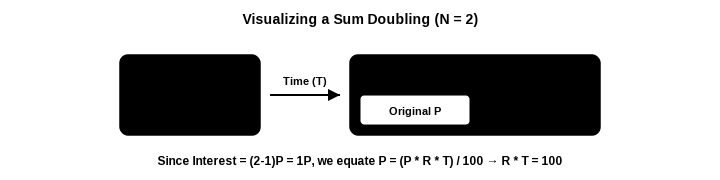
When a sum becomes N times itself, the Amount is N * P. Therefore, Interest earned (SI) = Amount - Principal = N * P - P = (N - 1) * P.
Using the formula: (N - 1) * P = (P * R * T) / 100, which simplifies to: R * T = (N - 1) * 100
If comparing two different periods for the same sum: (N1 - 1) / T1 = (N2 - 1) / T2
Example 2.1: Finding Rate when Sum Doubles
A sum of money doubles itself in 8 years at simple interest. Find the rate of interest per annum.
• Concept: Sum doubles -> N = 2, T = 8
• Calculation:
- R * T = (N - 1) * 100
- R * 8 = (2 - 1) * 100
- R * 8 = 100
- R = 100 / 8 = 12.5% per annum
• Answer: 12.5% per annum
Example 2.2: Finding Time when Sum Triples
In how many years will a sum of money triple itself at 10% per annum simple interest?
• Concept: Sum triples -> N = 3, R = 10
• Calculation:
- R * T = (N - 1) * 100
- 10 * T = (3 - 1) * 100
- 10 * T = 200
- T = 200 / 10 = 20 years
• Answer: 20 years
Example 2.3: Two-Stage Multiples Problem
A sum of money becomes 4 times of itself in 15 years at simple interest. In how many years will it become 7 times of itself at the same rate?
• Concept: (N1 - 1) / T1 = (N2 - 1) / T2
• Given: N1 = 4, T1 = 15 years, N2 = 7, T2 = ?
• Calculation:
- (4 - 1) / 15 = (7 - 1) / T2
- 3 / 15 = 6 / T2
- 1 / 5 = 6 / T2
- T2 = 6 * 5 = 30 years
• Answer: 30 years
Example 2.4: Finding Rate for a 5-fold Increase
A sum of money becomes 5 times itself in 20 years. Find the annual rate of interest.
• Concept: N = 5, T = 20
• Calculation:
- R * T = (N - 1) * 100
- R * 20 = (5 - 1) * 100
- R * 20 = 400
- R = 400 / 20 = 20% per annum
• Answer: 20% per annum
Example 2.5: Finding the Multiple after a Specified Time
A sum of money triples itself in 6 years at simple interest. How many times will it become in 18 years?
• Given: N1 = 3, T1 = 6, T2 = 18, N2 = ?
• Calculation:
- (3 - 1) / 6 = (N2 - 1) / 18
- 2 / 6 = (N2 - 1) / 18
- 1 / 3 = (N2 - 1) / 18
- N2 - 1 = 18 / 3 = 6
- N2 = 6 + 1 = 7 times
• Answer: 7 times
Type 3: Difference in Interest Due to Change in Rate, Time, or Principal
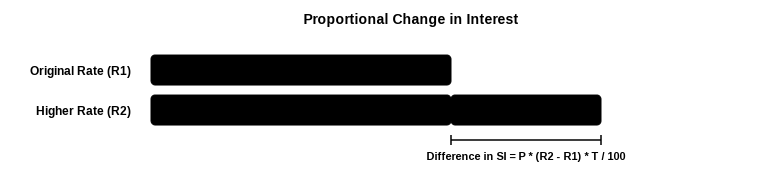
Because Simple Interest changes proportionally, any difference in interest earned is directly caused by the change in Rate or Time:
Difference in SI = [P * (Change in R) * T] / 100
Difference in SI = [P * R * (Change in T)] / 100
Example 3.1: Change in Rate
If the annual rate of simple interest increases from 8% to 11.5%, a person's yearly income from interest increases by 1,750. Find the principal invested.
• Given: Change in R = 11.5 - 8 = 3.5%, T = 1 year, Difference in SI = 1750
• Calculation:
- Difference in SI = [P * (Change in R) * T] / 100
- 1750 = (P * 3.5 * 1) / 100
- P = (1750 * 100) / 3.5 = 175,000 / 3.5 = 50,000
• Answer: Principal = 50,000
Example 3.2: Hypothetical Higher Rate
A sum was put at simple interest at a certain rate for 3 years. Had it been put at a 2% higher rate, it would have fetched 360 more. Find the sum.
• Given: Difference in SI = 360, Change in R = 2%, T = 3 years
• Calculation:
- Difference in SI = [P * (Change in R) * T] / 100
- 360 = (P * 2 * 3) / 100
- 360 = (6 * P) / 100
- P = (360 * 100) / 6 = 6,000
• Answer: Principal = 6,000
Example 3.3: Difference in Time
The simple interest on a certain sum for 4 years at 7% per annum is 280 less than the simple interest on the same sum for 5 years at the same rate. Find the sum.
• Given: Change in T = 5 - 4 = 1 year, R = 7%, Difference in SI = 280
• Calculation:
- Difference in SI = [P * R * (Change in T)] / 100
- 280 = (P * 7 * 1) / 100
- P = (280 * 100) / 7 = 4,000
• Answer: Principal = 4,000
Example 3.4: Decrease in Rate
If the annual rate of interest drops from 12% to 10%, the simple interest earned on a sum over 3 years decreases by 900. Find the principal.
• Given: Change in R = 12 - 10 = 2%, T = 3 years, Difference in SI = 900
• Calculation:
- Difference in SI = [P * (Change in R) * T] / 100
- 900 = (P * 2 * 3) / 100
- 900 = (6 * P) / 100
- P = (900 * 100) / 6 = 15,000
• Answer: Principal = 15,000
Example 3.5: Finding the Rate Difference
The simple interest on 6,000 for 3 years at rate R1 is 540 more than the interest on the same sum for 3 years at rate R2. Find the difference between the two rates (R1 - R2).
• Given: P = 6000, T = 3, Difference in SI = 540
• Calculation:
- Difference in SI = [P * (R1 - R2) * T] / 100
- 540 = [6000 * (R1 - R2) * 3] / 100
- 540 = 180 * (R1 - R2)
- R1 - R2 = 540 / 180 = 3%
• Answer: Rate difference = 3% per annum
Type 4: Sum Amounts to A1 in T1 Years and A2 in T2 Years
In this model, the principal remains the same, but you are given the total amount at two different points in time.
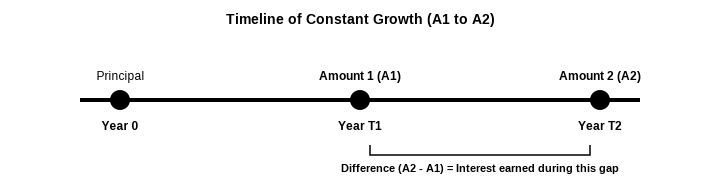
Amount in T2 years - Amount in T1 years = Simple Interest for (T2 - T1) years
From this, calculate SI for 1 year = (A2 - A1) / (T2 - T1)
Then: Principal = A1 - (SI for 1 year * T1)
Rate: R = (SI for 1 year * 100) / Principal
Example 4.1: Finding Principal and Rate
A sum of money at simple interest amounts to 2,240 in 2 years and to 2,600 in 5 years. Find the principal and the rate of interest.
• Given: Amount in 2 years = 2,240; Amount in 5 years = 2,600
• Calculation:
- SI for (5 - 2) = 3 years = 2600 - 2240 = 360
- SI for 1 year = 360 / 3 = 120
- SI for 2 years = 120 * 2 = 240
- Principal = Amount in 2 years - SI for 2 years = 2240 - 240 = 2,000
- Rate = (SI for 1 year * 100) / Principal = (120 * 100) / 2000 = 6% per annum
• Answer: Principal = 2,000; Rate = 6% per annum
Example 4.2: Finding Only the Principal
A sum amounts to 850 in 3 years and to 925 in 4 years at simple interest. Find the sum.
• Calculation:
- SI for (4 - 3) = 1 year = 925 - 850 = 75
- SI for 3 years = 75 * 3 = 225
- Principal = Amount in 3 years - SI for 3 years = 850 - 225 = 625
• Answer: Principal = 625
Example 4.3: Fractional Year Difference
A certain sum amounts to 1,008 in 2 years and to 1,164 in 3.5 years. Find the principal and the rate of interest.
• Calculation:
- Time difference = 3.5 - 2 = 1.5 years
- SI for 1.5 years = 1164 - 1008 = 156
- SI for 1 year = 156 / 1.5 = 104
- SI for 2 years = 104 * 2 = 208
- Principal = 1008 - 208 = 800
- Rate = (104 * 100) / 800 = 13% per annum
• Answer: Principal = 800; Rate = 13% per annum
Example 4.4: Successive Time Phrasing
A sum lent out at simple interest amounts to 720 after 2 years and to 1,020 after a further period of 5 years. Find the sum.
• Note: "After a further period of 5 years" means total time = 2 + 5 = 7 years.
• Calculation:
- SI for 5 years = 1020 - 720 = 300
- SI for 1 year = 300 / 5 = 60
- SI for 2 years = 60 * 2 = 120
- Principal = 720 - 120 = 600
• Answer: Principal = 600
Example 4.5: Finding the Rate of Interest
A sum amounts to 6,900 in 3 years and to 7,800 in 6 years at simple interest. Find the annual rate of interest.
• Calculation:
- SI for (6 - 3) = 3 years = 7800 - 6900 = 900
- SI for 1 year = 900 / 3 = 300
- Principal = Amount in 3 years - SI for 3 years = 6900 - 900 = 6,000
- Rate = (SI for 1 year * 100) / Principal = (300 * 100) / 6000 = 5% per annum
• Answer: Rate = 5% per annum
Type 5: Division or Distribution of a Sum into Parts
In these questions, a total sum is divided into two or more parts under different conditions (e.g., total interest is given, interests from both parts are equal, or final amounts are equal).
Example 5.1: Given Total Annual Interest
A sum of 10,000 is lent out in two parts: one at 8% per annum and the other at 10% per annum. If the total annual interest from both parts combined is 920, find the amount lent at 8%.
• Setup: Let the amount lent at 8% be x. Then the amount lent at 10% is 10,000 - x.
• Answer: Amount lent at 8% is 4,000 (and at 10% is 6,000)
Example 5.2: Simple Interests from Both Parts are Equal
A sum of 12,000 is divided into two parts such that the simple interest on the first part for 3 years at 12% per annum is equal to the simple interest on the second part for 4.5 years at 16% per annum. Find the value of both parts.
• Setup: Let the two parts be P1 and P2.
• Calculation:
- SI1 = SI2
- (P1 * 12 * 3) / 100 = (P2 * 16 * 4.5) / 100
- P1 * 36 = P2 * 72
- P1 / P2 = 72 / 36 = 2 / 1
- The ratio of P1 to P2 is 2 : 1.
- Total ratio units = 2 + 1 = 3 units
- 3 units = 12,000 -> 1 unit = 4,000
- P1 = 2 * 4000 = 8,000
- P2 = 1 * 4000 = 4,000
• Answer: First part = 8,000; Second part = 4,000
Example 5.3: Finding the Smaller Share with Equal Interests
Divide 2,600 into two parts such that the simple interest on the first part at 10% for 5 years equals the simple interest on the second part at 9% for 6 years. Find the smaller part.
• Calculation:
- (P1 * 10 * 5) / 100 = (P2 * 9 * 6) / 100
- P1 * 50 = P2 * 54
- P1 / P2 = 54 / 50 = 27 / 25
- Total ratio units = 27 + 25 = 52 units
- 52 units = 2,600 -> 1 unit = 2600 / 52 = 50
- P1 = 27 * 50 = 1,350
- P2 = 25 * 50 = 1,250
• Answer: Smaller part = 1,250
Example 5.4: Amounts from Both Parts are Equal
A sum of 18,750 is divided between two sons aged 12 and 14 years, such that when each attains the age of 18 years, they receive equal total amounts at 5% simple interest per annum. Find the share of the younger son.
• Setup:
- Younger son (age 12) invests for: 18 - 12 = 6 years (T1 = 6)
- Elder son (age 14) invests for: 18 - 14 = 4 years (T2 = 4)
A person lent 5,000 partly at 4% and partly at 5% per annum simple interest. The total interest received after 2 years was 440. How much money was lent at 4%?
• Setup: Let the amount lent at 4% be x. The amount at 5% is 5,000 - x. Time = 2 years.