Speed calculation techniques, prime factorization methods, unit digit shortcuts, and approximation strategies designed for competitive examinations.
Method 1: Repeated Subtraction of Odd Numbers
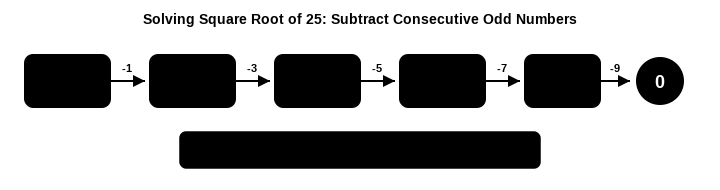
Every square number is formed by adding consecutive odd numbers starting from 1 (1, 3, 5, 7, 9, 11...). To find the square root, subtract these odd numbers one by one until you reach 0. The total number of subtractions you perform is your answer.
Example 1: Square root of 25
Step 1: 25 - 1 = 24 (Subtraction 1)
Step 2: 24 - 3 = 21 (Subtraction 2)
Step 3: 21 - 5 = 16 (Subtraction 3)
Step 4: 16 - 7 = 9 (Subtraction 4)
Step 5: 9 - 9 = 0 (Subtraction 5)
You subtracted 5 times to hit zero.
Answer: 5
Example 2: Square root of 49
Step 1: 49 - 1 = 48 (Subtraction 1)
Step 2: 48 - 3 = 45 (Subtraction 2)
Step 3: 45 - 5 = 40 (Subtraction 3)
Step 4: 40 - 7 = 33 (Subtraction 4)
Step 5: 33 - 9 = 24 (Subtraction 5)
Step 6: 24 - 11 = 13 (Subtraction 6)
Step 7: 13 - 13 = 0 (Subtraction 7)
You subtracted 7 times.
Answer: 7
Example 3: Square root of 64
Step 1: 64 - 1 = 63 (Subtraction 1)
Step 2: 63 - 3 = 60 (Subtraction 2)
Step 3: 60 - 5 = 55 (Subtraction 3)
Step 4: 55 - 7 = 48 (Subtraction 4)
Step 5: 48 - 9 = 39 (Subtraction 5)
Step 6: 39 - 11 = 28 (Subtraction 6)
Step 7: 28 - 13 = 15 (Subtraction 7)
Step 8: 15 - 15 = 0 (Subtraction 8)
You subtracted 8 times.
Answer: 8
Method 2: Prime Factorization (Pairing Factors)
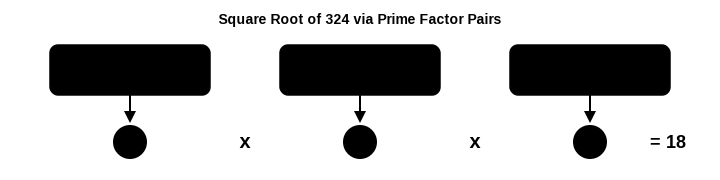
Break down the number into its prime factors (dividing by 2, 3, 5, 7...), create matching pairs of identical numbers, and take one number from each pair.
Method 3: The Unit Digit Trick (Fast Exam Shortcut)
Split the last two digits apart. Look at the last digit to find two possibilities for the unit digit, find the tens digit from the remaining front number, and multiply the tens digit by the next consecutive number to decide whether the larger or smaller option wins.
Example 1: Square root of 2,209
Step 1: Split: 22 | 09.
Step 2: Last digit is 9, so the answer must end in 3 or 7.
Step 3: Front number is 22. The largest whole square inside 22 is 4 x 4 = 16 (since 5 x 5 = 25 is too big). Tens digit is 4.
Options: 43 or 47.
Step 4: Test with the next number: 4 x 5 = 20.
Since 22 is greater than 20, choose the greater option: 47.
Answer: 47
Example 2: Square root of 4,624
Step 1: Split: 46 | 24.
Step 2: Last digit is 4, so the answer ends in 2 or 8.
Step 3: Front number is 46. Largest square inside 46 is 6 x 6 = 36. Tens digit is 6.
Options: 62 or 68.
Step 4: Test with the next number: 6 x 7 = 42.
Since 46 is greater than 42, choose the greater option: 68.
Answer: 68
Example 3: Square root of 6,724
Step 1: Split: 67 | 24.
Step 2: Last digit is 4, so the answer ends in 2 or 8.
Step 3: Front number is 67. Largest square inside 67 is 8 x 8 = 64. Tens digit is 8.
Options: 82 or 88.
Step 4: Test with the next number: 8 x 9 = 72.
Since 67 is smaller than 72, choose the smaller option: 82.
Answer: 82
Method 4: Numbers Ending in 25
Any perfect square ending in 25 has a square root ending in 5. The remaining front digits are always the product of two consecutive numbers: n x (n + 1). Pick the smaller number n.
Example 1: Square root of 2,025
Step 1: Ends in 25 -> last digit is 5.
Step 2: Look at the front number: 20.
Step 3: Find two consecutive numbers that multiply to 20: 4 x 5 = 20.
Step 4: Take the smaller number: 4.
Combine: 45.
Answer: 45
Example 2: Square root of 7,225
Step 1: Ends in 25 -> last digit is 5.
Step 2: Look at the front number: 72.
Step 3: Two consecutive numbers that multiply to 72: 8 x 9 = 72.
Step 4: Take the smaller number: 8.
Combine: 85.
Answer: 85
Example 3: Square root of 11,025
Step 1: Ends in 25 -> last digit is 5.
Step 2: Look at the front number: 110.
Step 3: Two consecutive numbers that multiply to 110: 10 x 11 = 110.
Step 4: Take the smaller number: 10.
Combine: 105.
Answer: 105
Method 5: Imperfect Squares Approximation
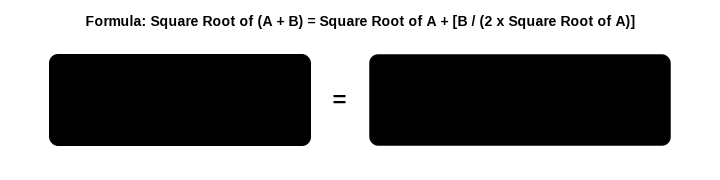
Use the formula: Square Root of (A + B) = Square Root of A + [B / (2 x Square Root of A)] (where A is the nearest perfect square, and B is the difference).
Since 1 / 9 is roughly 0.11: 9 - 0.11 = 8.89 (Actual value: 8.888).
Answer: 8.89
Method 6: The Long Division Method
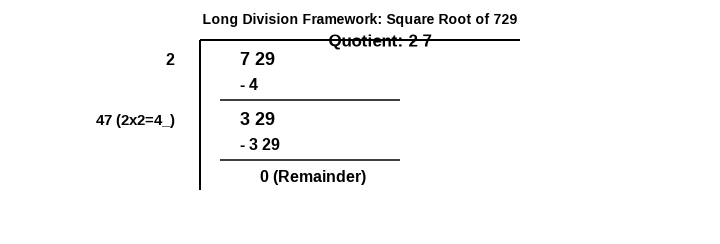
Pair digits from right to left, find the largest square for the first block, bring down the next pair, and double the quotient to find the next divisor.
Example 1: Square root of 729
Step 1: Pair digits from right: 7 and 29.
Step 2: Largest square less than or equal to 7 is 2 x 2 = 4. Quotient starts with 2. Remainder: 7 - 4 = 3.
Step 3: Bring down the pair 29 -> new number is 329.
Step 4: Double the quotient: 2 x 2 = 4. Write it as 4_.
Step 5: Find digit X such that 4X x X fits into 329: Try 7: 47 x 7 = 329. Perfect match!
Answer: 27
Example 2: Square root of 1,296
Step 1: Pair digits from right: 12 and 96.
Step 2: Largest square less than or equal to 12 is 3 x 3 = 9. Quotient starts with 3. Remainder: 12 - 9 = 3.
Step 3: Bring down the pair 96 -> new number is 396.
Step 4: Double the quotient: 3 x 2 = 6. Write it as 6_.
Step 5: Find digit X such that 6X x X fits into 396: Try 6: 66 x 6 = 396. Perfect match!
Answer: 36
Example 3: Square root of 2,304
Step 1: Pair digits from right: 23 and 04.
Step 2: Largest square less than or equal to 23 is 4 x 4 = 16. Quotient starts with 4. Remainder: 23 - 16 = 7.
Step 3: Bring down the pair 04 -> new number is 704.
Step 4: Double the quotient: 4 x 2 = 8. Write it as 8_.
Step 5: Find digit X such that 8X x X fits into 704: Try 8: 88 x 8 = 704. Perfect match!
Answer: 48
Ready to Test Your Speed?
Put your mental square root shortcuts into practice with timed drills.