Mental Squaring Shortcuts

Speed calculation techniques, base reference strategies, and pattern shortcuts designed for competitive exams.

Method 1: Numbers Ending in 5 (The 3-Second Magic)

This is the easiest squaring trick in mathematics. Any square of a number ending in 5 always finishes in 25.

The Rule: Take the digits before 5, multiply them by the very next counting number, and write 25 at the end.
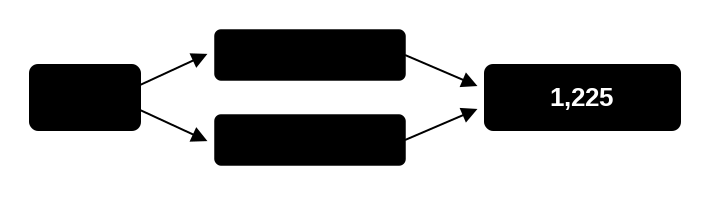
Squaring numbers ending in 5 visual formula.
Diagram text

35^(2) · Prefix: 3 x 4 = 12 · Suffix: Always 25 · 1,225

Example 1: 35 x 35
Step 1: The number before 5 is 3.
Step 2: Multiply 3 by the next number (4): 3 x 4 = 12.
Step 3: Place 25 at the end: 1,225.
Answer: 1,225
Example 2: 75 x 75
Step 1: The number before 5 is 7.
Step 2: Multiply 7 by the next number (8): 7 x 8 = 56.
Step 3: Place 25 at the end: 5,625.
Answer: 5,625
Example 3 (Three Digits): 115 x 115
Step 1: The number before 5 is 11.
Step 2: Multiply 11 by the next number (12): 11 x 12 = 132.
Step 3: Place 25 at the end: 13,225.
Answer: 13,225
Method 2: Base-50 Method (Numbers Between 40 and 60)

Whenever a number is close to 50, use 25 as your magic anchor number.

The Rule:
Find the difference between your number and 50 (call it Gap).
Left side: 25 + Gap (if above 50) OR 25 - Gap (if below 50).
Right side: Gap x Gap (always written as 2 digits).
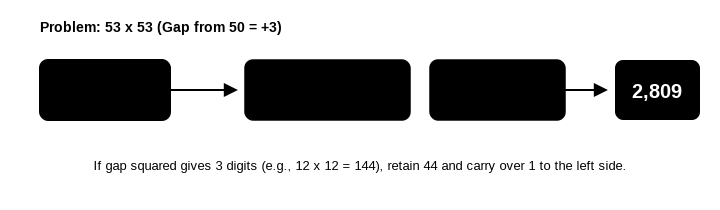
Base 50 mental squaring diagram — Problem: 53 x 53 (Gap from 50 = +3).
Diagram text

Problem: 53 x 53 (Gap from 50 = +3) · Anchor: 25 · Left: 25 + 3 · = 28 · Right: 3 x 3 · = 09 (2 digits) · 2,809 · If gap squared gives 3 digits (e.g., 12 x 12 = 144), retain 44 and carry over 1 to the left side.

Example 1 (Above 50): 53 x 53
53 is 3 more than 50 (Gap = +3).
Left Part: Add the gap to 25: 25 + 3 = 28.
Right Part: Square the gap: 3 x 3 = 9 (write as 09).
Combine: 2,809.
Answer: 2,809
Example 2 (Above 50): 57 x 57
57 is 7 more than 50 (Gap = +7).
Left Part: 25 + 7 = 32.
Right Part: 7 x 7 = 49.
Combine: 3,249.
Answer: 3,249
Example 3 (Below 50): 46 x 46
46 is 4 less than 50 (Gap = -4).
Left Part: Subtract the gap from 25: 25 - 4 = 21.
Right Part: Square the gap: 4 x 4 = 16.
Combine: 2,116.
Answer: 2,116
Example 4 (Below 50 with Carry): 38 x 38
38 is 12 less than 50 (Gap = -12).
Left Part: 25 - 12 = 13.
Right Part: 12 x 12 = 144 (keep two digits: 44, carry 1).
Add the carry: 13 + 1 = 14.
Combine: 1,444.
Answer: 1,444

Method 3: Base-100 Method (Numbers Near 100)

When numbers are close to 100, do not use 25. Modify the number itself directly.

The Rule:
Find how far the number is from 100 (call it Gap).
Left side: Add the gap directly to the number (if above 100) or subtract the gap (if below 100).
Right side: Square the gap (always keep 2 digits).
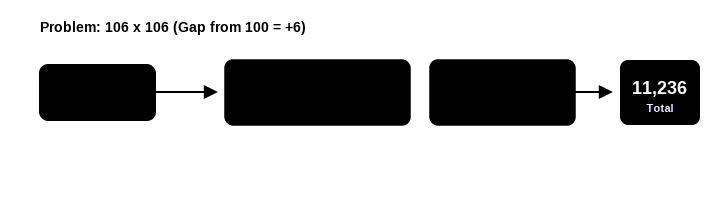
Base 100 mental squaring breakdown — Problem: 106 x 106 (Gap from 100 = +6).
Diagram text

Problem: 106 x 106 (Gap from 100 = +6) · 106 · Number + Gap · 106 + 6 = 112 · Gap Squared · 6 x 6 = 36 · 11,236 · Total

Example 1 (Above 100): 106 x 106
106 is 6 more than 100 (Gap = +6).
Left Part: Add the gap to the number: 106 + 6 = 112.
Right Part: Square the gap: 6 x 6 = 36.
Combine: 11,236.
Answer: 11,236
Example 2 (Below 100): 94 x 94
94 is 6 less than 100 (Gap = -6).
Left Part: Subtract the gap from the number: 94 - 6 = 88.
Right Part: Square the gap: 6 x 6 = 36.
Combine: 8,836.
Answer: 8,836
Example 3 (Below 100 with Carry): 88 x 88
88 is 12 less than 100 (Gap = -12).
Left Part: 88 - 12 = 76.
Right Part: 12 x 12 = 144 (keep 44, carry 1).
Add carry: 76 + 1 = 77.
Combine: 7,744.
Answer: 7,744

Method 4: The Universal 3-Step Trick (Works for ANY 2-Digit Number)

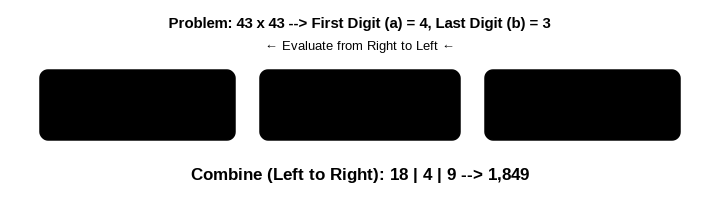
This method uses the algebraic expansion (a + b) squared = a squared + 2ab + b squared, solved from right to left in three quick steps.

Think of a two-digit number as [First Digit] [Last Digit].

Universal 3 step squaring expansion diagram — Problem: 43 x 43 --> First Digit (a) = 4, Last Digit (b) = 3.
Diagram text

Problem: 43 x 43 --> First Digit (a) = 4, Last Digit (b) = 3 · ← Evaluate from Right to Left ← · Step 3: First Digit Squared · 4 x 4 + 2 (carry) = 18 · Step 2: Double the Product · 2 x (4 x 3) = 24 (4, carry 2) · Step 1: Last Digit Squared · 3 x 3 = 9 · Combine (Left to Right): 18 | 4 | 9 --> 1,849

Problem: 43 x 43
First Digit = 4, Last Digit = 3.
Step 1 (Right): Square the last digit: 3 x 3 = 9.
Step 2 (Middle): Multiply both digits together and double: 2 x (4 x 3) = 2 x 12 = 24 (write down 4, carry 2).
Step 3 (Left): Square the first digit and add carry: (4 x 4) + 2 = 16 + 2 = 18.
Combine (Left to Right): 1,849.
Answer: 1,849
Problem: 72 x 72
First Digit = 7, Last Digit = 2.
Step 1: Last digit squared: 2 x 2 = 4.
Step 2: Double the product of the digits: 2 x (7 x 2) = 2 x 14 = 28 (write 8, carry 2).
Step 3: First digit squared + carry: (7 x 7) + 2 = 49 + 2 = 51.
Combine: 5,184.
Answer: 5,184

Method 5: The Neighbor Shortcut (From a Known Zero-Square)

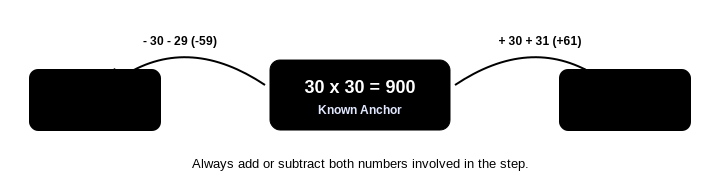
Everyone knows round squares instantly: 20 x 20 = 400, 30 x 30 = 900, 40 x 40 = 1,600, etc. You can find the square of the next or previous number using simple addition or subtraction.

Neighbor square stepping stone diagram — 30 x 30 = 900.
Diagram text

30 x 30 = 900 · Known Anchor · - 30 - 29 (-59) · 29 x 29 · = 841 · + 30 + 31 (+61) · 31 x 31 · = 961 · Always add or subtract both numbers involved in the step.

Going Up (+1): Next Square = Known Square + Known Number + Next Number
To find 31 x 31: Start with 30 x 30 = 900.
Add 30 and 31: 900 + 30 + 31 = 961.
Answer: 961
Going Down (-1): Previous Square = Known Square - Known Number - Previous Number
To find 29 x 29: Start with 30 x 30 = 900.
Subtract 30 and 29: 900 - 30 - 29 = 870 - 29 = 841.
Answer: 841

Method 6: Pattern Magic (Repetitive Digits)

Government exams (especially SSC CGL) frequently ask simplification questions using repeated digit numbers like 111 or 999. These follow visual symmetric patterns.

Repetitive digit patterns visual explanation — The Mountain Peak (1s).
Diagram text

The Mountain Peak (1s) · 1 2 3 2 1 · 111 x 111 = 12,321 · Ascend to digit count, then descend · The 9-8-0-1 Pattern (9s) · [9s] - 8 - [0s] - 1 · 999 x 999 = 998,001 · Count of 9s and 0s is (Total Digits - 1)

Squares of 1s (The Mountain Peak):
Count up to how many 1s there are, then count back down to 1.
11 x 11 = 121
111 x 111 = 12,321
1,111 x 1,111 = 1,234,321
Squares of 9s (The 9-8-0-1 Pattern):
The answer layout is: [9s] 8 [0s] 1. The count of 9s and 0s is always one less than total digits.
99 x 99 = 9,801 (one 9, one 8, one 0, one 1)
999 x 999 = 998,001 (two 9s, one 8, two 0s, one 1)
9,999 x 9,999 = 99,980,001 (three 9s, one 8, three 0s, one 1)
Squares of 3s and 6s:
33 x 33 = 1,089 --> 333 x 333 = 110,889
66 x 66 = 4,356 --> 666 x 666 = 443,556

Ready to Test Your Speed?

Put mental squaring shortcuts into practice with real-time timed drills.