Speed calculation concepts, splitting strategies, constant difference shortcuts, and worked examples.
Method 1: Left-to-Right Subtraction (Split the Number)
School teaches us to solve subtractions from right to left using carry-overs and borrows, but that slows down mental calculation. Left-to-right matches how your brain reads numbers.
Break the number you are subtracting into easy pieces: hundreds, tens, and ones. Take away the biggest chunk first, then the medium chunk, then the single digits.
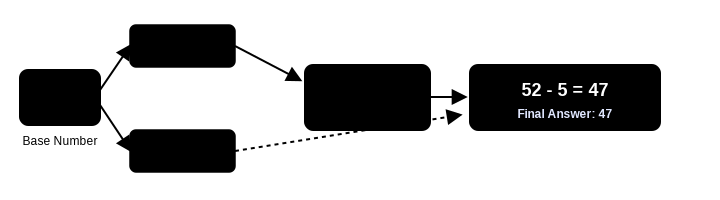
Example 1 (Two Digits): 92 - 45
Step 1: Split 45 into 40 and 5.
Step 2: Subtract the tens first: 92 - 40 = 52.
Step 3: Subtract the ones: 52 - 5 = 47.
Answer: 47
Example 2 (Three Digits minus Two Digits): 164 - 58
Step 1: Split 58 into 50 and 8.
Step 2: Take away the tens part: 164 - 50 = 114.
Step 3: Take away the single digits: 114 - 8 = 106.
Answer: 106
Example 3 (Three Digits minus Three Digits): 536 - 219
Step 1: Split 219 into 200, 10, and 9.
Step 2: Take away the hundreds: 536 - 200 = 336.
Step 3: Take away the tens: 336 - 10 = 326.
Step 4: Take away the ones: 326 - 9 = 317.
Answer: 317
Method 2: The Same-Shift Trick (Constant Difference)
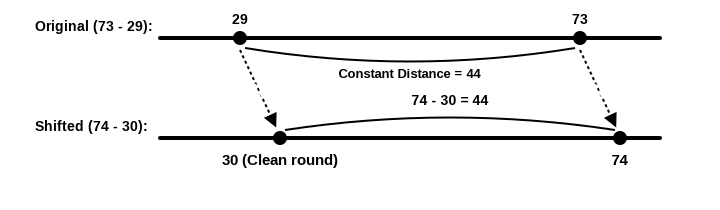
The distance between two numbers never changes if you shift both numbers by the exact same amount.
Think of two people standing on a running track. If you are standing at meter 73 and your friend is at meter 29, the distance between you is your answer. If both of you take 1 step forward, you are now at 74 and your friend is at 30. The gap between you did not change at all, but subtracting 30 is much easier than subtracting 29.
Example 1: 73 - 29
Step 1: Look at the number being subtracted (29). It needs 1 to become a clean, friendly round number: 29 + 1 = 30.
Step 2: Give that exact same +1 to the first number: 73 + 1 = 74.
Step 3: Subtract the new pair mentally: 74 - 30 = 44.
Method 3: "All from 9 and the Last from 10" (Base Numbers)
Whenever you subtract a number from 1,000, 10,000, or 100,000, do not borrow across all those zeroes. Borrowing across multiple zeroes causes mistakes under exam pressure.
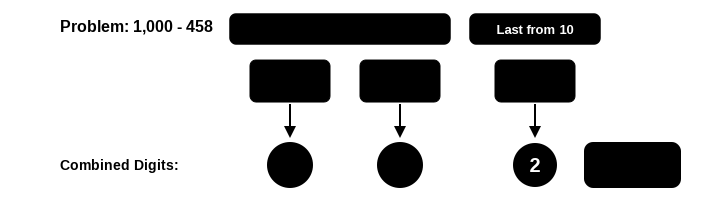
Instead, go left to right: subtract every digit from 9, and subtract the very last digit from 10.
Example 1 (From 1,000): 1,000 - 458
Step 1: First digit (4): 9 - 4 = 5
Step 2: Middle digit (5): 9 - 5 = 4
Step 3: Last digit (8): 10 - 8 = 2
Put them together: 542
Answer: 542
Example 2 (From 10,000): 10,000 - 3,842
Step 1: First digit (3): 9 - 3 = 6
Step 2: Second digit (8): 9 - 8 = 1
Step 3: Third digit (4): 9 - 4 = 5
Step 4: Last digit (2): 10 - 2 = 8
Put them together: 6,158
Answer: 6,158
Example 3 (Fewer Digits than the Base): 1,000 - 64
Teaching Tip: 1,000 has 3 zeroes, but 64 only has 2 digits. Add a zero in front of 64 so it has 3 digits: 064.
Step 1: First digit (0): 9 - 0 = 9
Step 2: Middle digit (6): 9 - 6 = 3
Step 3: Last digit (4): 10 - 4 = 6
Put them together: 936
Answer: 936
Ready to Test Your Speed?
Put your mental subtraction shortcuts into practice with timed drills.