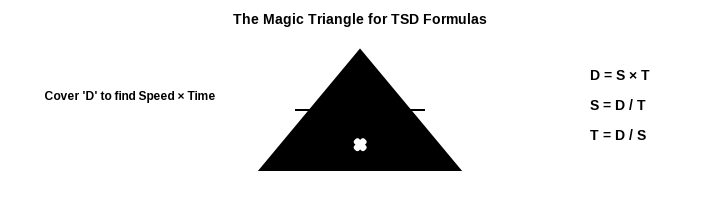
Time, Speed, and Distance (TSD) is built entirely on the relationship between how fast an object moves, how long it moves, and how far it travels.
Part 1: Fundamentals of Time, Speed, and Distance
1. The Core Definition and Basic Formulas
Speed is the distance covered in one unit of time (such as in 1 hour, 1 minute, or 1 second).
Distance is the total path length traveled.
Time is the duration taken to cover that distance.
The three core formulas are:
Speed = Distance / Time
Time = Distance / Speed
Distance = Speed * Time
2. Units and Unit Conversion
In arithmetic problems, units must always match. Distance is usually measured in kilometers (km) or meters (m). Time is usually measured in hours (h) or seconds (s).
When Distance is in km and Time is in hours, Speed is in km/h.
When Distance is in meters and Time is in seconds, Speed is in m/s.
How to Convert Between km/h and m/s:
1 kilometer = 1000 meters
1 hour = 3600 seconds
1 km/h = 1000 meters / 3600 seconds = 5/18 m/s
To convert from km/h to m/s: Multiply the speed by 5/18. Example: 72 km/h = 72 * (5/18) = 4 * 5 = 20 m/s.
To convert from m/s to km/h: Multiply the speed by 18/5. Example: 25 m/s = 25 * (18/5) = 5 * 18 = 90 km/h.
3. The Three Proportionality Rules
These three rules simplify solving exam problems without lengthy algebra:
When Distance is Constant:
Speed is inversely proportional to Time: Speed is proportional to 1 / Time.
If the ratio of speeds is a : b, then the ratio of time taken is b : a.
Meaning: If you double your speed, you take half the time to cover the same distance.
When Time is Constant:
Distance is directly proportional to Speed: Distance is proportional to Speed.
If the ratio of speeds is a : b, then the ratio of distances covered in the same time is a : b.
Meaning: A faster person covers more distance in the exact same amount of time.
When Speed is Constant:
Distance is directly proportional to Time: Distance is proportional to Time.
If the ratio of time spent is a : b, then the ratio of distances covered is a : b.
Part 2: Major Types with Step-by-Step Examples
Type 1: Average Speed
Average speed is not the simple mathematical mean of two speeds. It is always defined as:
Average Speed = Total Distance Covered / Total Time Taken
Standard Cases:
If an object covers two equal distances at speeds S1 and S2: Average Speed = (2 * S1 * S2) / (S1 + S2)
If an object travels for equal periods of time at speeds S1 and S2: Average Speed = (S1 + S2) / 2
Example 1.1: Two Equal Distances
Problem: A motorist travels from Town A to Town B at 60 km/h and returns along the same route at 40 km/h. Find his average speed for the entire journey.
• Step 1: The distance going and returning is equal. Use the formula: Average Speed = (2 * S1 * S2) / (S1 + S2).
• Step 2: Substitute the values:
- Average Speed = (2 * 60 * 40) / (60 + 40)
- Average Speed = 4800 / 100 = 48 km/h.
• Answer: 48 km/h.
Example 1.2: Three Equal Distances
Problem: A car covers three equal stretches of a road at speeds of 20 km/h, 30 km/h, and 60 km/h. What is the average speed of the car?
• Step 1: Let each equal stretch be the LCM of 20, 30, and 60, which is 60 km. Total Distance = 60 + 60 + 60 = 180 km.
• Step 2: Calculate time taken for each stretch:
- Time 1 = 60 / 20 = 3 hours.
- Time 2 = 60 / 30 = 2 hours.
- Time 3 = 60 / 60 = 1 hour.
- Total Time = 3 + 2 + 1 = 6 hours.
• Step 3: Calculate average speed = Total Distance / Total Time = 180 / 6 = 30 km/h.
• Answer: 30 km/h.
Example 1.3: Unequal Distances and Unequal Speeds
Problem: A delivery truck travels 120 km at 40 km/h, then 150 km at 50 km/h, and finally 70 km at 35 km/h. Find the average speed of the truck.
• Step 1: Calculate total distance: Total Distance = 120 + 150 + 70 = 340 km.
• Step 2: Calculate time for each segment:
- Time 1 = 120 / 40 = 3 hours.
- Time 2 = 150 / 50 = 3 hours.
- Time 3 = 70 / 35 = 2 hours.
- Total Time = 3 + 3 + 2 = 8 hours.
• Step 3: Average Speed = 340 / 8 = 42.5 km/h.
• Answer: 42.5 km/h.
Example 1.4: Equal Time Intervals
Problem: A cyclist rides for 2 hours at a speed of 15 km/h and then rides for another 2 hours at a speed of 25 km/h. Find the average speed.
• Step 1: Since the time duration for both speeds is identical (2 hours each), the average speed is the direct average of the speeds.
• Verification: Total Distance = (15 * 2) + (25 * 2) = 30 + 50 = 80 km. Total Time = 4 hours. 80 / 4 = 20 km/h.
• Answer: 20 km/h.
Example 1.5: Journey Broken into Fractions
Problem: A traveler covers 1/3 of his total journey at 20 km/h, 1/4 of the journey at 30 km/h, and the remaining portion at 50 km/h. Find the average speed for the whole journey.
• Step 1: Choose a convenient total distance divisible by 3, 4, and the speeds. Let Total Distance = 600 km.
• Step 2: Determine distances and times:
- First part = (1/3) * 600 = 200 km. Time 1 = 200 / 20 = 10 hours.
- Second part = (1/4) * 600 = 150 km. Time 2 = 150 / 30 = 5 hours.
- Remaining part = 600 - (200 + 150) = 250 km. Time 3 = 250 / 50 = 5 hours.
• Step 3: Total Time = 10 + 5 + 5 = 20 hours. Average Speed = 600 / 20 = 30 km/h.
• Answer: 30 km/h.
Type 2: Proportionality, Speed Changes, and Late/Early Cases
In these problems, the distance is typically fixed. When distance is constant:
Ratio of Speeds = S1 : S2
Ratio of Times = T2 : T1
Direct shortcut formula for finding distance when traveling at two speeds with a time difference: Distance = [ (S1 * S2) / (Difference between S1 and S2) ] * (Difference in Time in hours)
Example 2.1: Fraction of Usual Speed
Problem: Walking at 3/4 of his usual speed, a man reaches his office 20 minutes late. What is his usual time to reach the office?
• Step 2: Since distance is constant, Time Ratio (Usual : New) = 3 : 4.
• Step 3: Compare the ratio units: Difference in time = 4 units - 3 units = 1 unit. According to the question, 1 unit corresponds to 20 minutes.
• Step 4: Usual Time = 3 units = 3 * 20 = 60 minutes (1 hour).
• Answer: 60 minutes (or 1 hour).
Example 2.2: Late and Early Combination
Problem: If a student walks from his house to school at 4 km/h, he arrives 10 minutes late. If he increases his speed to 5 km/h, he arrives 5 minutes early. Find the distance between his house and school.
• Step 1: Calculate total time difference: Moving from 10 minutes late to 5 minutes early means a time saving of 10 + 5 = 15 minutes. Time Difference in hours = 15 / 60 = 1/4 hour.
Example 2.3: Finding Original Speed with a Fixed Time Saving
Problem: A driver increases his speed by 10 km/h and takes 1 hour less to cover a journey of 300 km. What was his original speed?
• Step 1: Let the original speed be S km/h. New speed = (S + 10) km/h.
• Step 2: Set up the equation using Time = Distance / Speed: [ 300 / S ] - [ 300 / (S + 10) ] = 1
• Step 3: Simplify: 300 * [ (S + 10 - S) / (S * (S + 10)) ] = 1
- 300 * 10 = S * (S + 10) -> 3000 = S * (S + 10)
• Step 4: Find two factors of 3000 that differ by 10: 50 * 60 = 3000. Therefore, S = 50 km/h.
• Answer: 50 km/h.
Example 2.4: Dual Change in Speed and Time
Problem: A car travels a certain distance. If it had traveled 6 km/h faster, it would have taken 4 hours less. If it had traveled 6 km/h slower, it would have taken 6 hours more. Find the total distance.
• Step 1: Use the general relationship: Distance D = S * (S + s1) / s1 * t1 = S * (S - s2) / s2 * t2, where S is original speed.
• Step 2: Equate both expressions: [ S * (S + 6) / 6 ] * 4 = [ S * (S - 6) / 6 ] * 6
• Step 3: Divide both sides by S / 6: 4 * (S + 6) = 6 * (S - 6) -> 4S + 24 = 6S - 36 -> 2S = 60 -> S = 30 km/h.
Example 2.5: Meeting Point and Time to Reach Opposite Ends
Problem: Two persons, P and Q, start at the same time from points A and B toward each other. After meeting on the way, P takes 4 hours to reach B, and Q takes 9 hours to reach A. If P's speed is 18 km/h, find Q's speed.
• Step 1: Use the standard Meeting Point Theorem formula: Speed of P / Speed of Q = Square Root of (Time taken by Q after meeting / Time taken by P after meeting) -> S_P / S_Q = Square Root of (T_Q / T_P)
Problem: A train 240 meters long passes a platform 360 meters long in 30 seconds. What is the speed of the train in km/h?
• Step 1: Calculate total distance to be covered: Distance = Length of Train + Length of Platform = 240 + 360 = 600 meters.
• Step 2: Calculate speed in m/s: Speed = Distance / Time = 600 / 30 = 20 m/s.
• Step 3: Convert speed to km/h: Speed = 20 * (18/5) = 4 * 18 = 72 km/h.
• Answer: 72 km/h.
Example 3.3: Two Trains Moving in Opposite Directions
Problem: Two trains of lengths 140 meters and 160 meters are running toward each other on parallel tracks at 40 km/h and 50 km/h respectively. In how many seconds will they clear each other from the moment they meet?
• Step 1: Total distance to clear each other: Distance = 140 + 160 = 300 meters.
• Step 2: Calculate relative speed (opposite direction -> add): Relative Speed = 40 + 50 = 90 km/h. In m/s = 90 * (5/18) = 5 * 5 = 25 m/s.
Example 3.4: Two Trains Moving in the Same Direction
Problem: A faster train 200 meters long traveling at 70 km/h overtakes a slower train 150 meters long traveling at 52 km/h in the same direction. How long does the complete overtaking take?
• Step 1: Total distance to pass completely: Distance = 200 + 150 = 350 meters.
• Step 2: Calculate relative speed (same direction -> subtract): Relative Speed = 70 - 52 = 18 km/h. In m/s = 18 * (5/18) = 5 m/s.
Problem: Two stations A and B are 200 km apart. Train 1 starts from station A at 7:00 AM toward B at 20 km/h. Train 2 starts from station B at 8:00 AM toward A at 25 km/h. At what time will they cross each other?
• Step 1: Equalize the departure times: Train 1 runs alone for 1 hour (from 7:00 AM to 8:00 AM). Distance covered by Train 1 in 1 hour = 20 * 1 = 20 km.
• Step 2: Find remaining distance at 8:00 AM: Remaining Distance = 200 - 20 = 180 km.
• Step 3: Both trains are moving toward each other starting at 8:00 AM: Relative Speed = 20 + 25 = 45 km/h.
• Step 4: Find time taken to cover remaining distance: Time = Remaining Distance / Relative Speed = 180 / 45 = 4 hours.
• Step 5: Determine meeting time: Meeting Time = 8:00 AM + 4 hours = 12:00 PM (Noon).
• Answer: 12:00 PM (Noon).
Type 4: Boats and Streams
When an object travels on flowing water:
Let Speed of Boat in Still Water = B
Let Speed of Stream (Current) = S
Downstream Speed (D): Moving with the current -> D = B + S
Upstream Speed (U): Moving against the current -> U = B - S
From the above two equations:
Speed of Boat in Still Water (B) = (D + U) / 2
Speed of Stream (S) = (D - U) / 2
Example 4.1: Basic Upstream and Downstream Calculation
Problem: A boat covers 36 km downstream in 3 hours and 24 km upstream in 4 hours. Find the speed of the boat in still water and the speed of the stream.
• Step 1: Calculate downstream and upstream speeds: Downstream Speed (D) = 36 / 3 = 12 km/h. Upstream Speed (U) = 24 / 4 = 6 km/h.
• Step 2: Calculate speed of boat in still water: B = (D + U) / 2 = (12 + 6) / 2 = 18 / 2 = 9 km/h.
• Step 3: Calculate speed of stream: S = (D - U) / 2 = (12 - 6) / 2 = 6 / 2 = 3 km/h.
Problem: The speed of a motorboat in still water is 15 km/h, and the speed of the current is 3 km/h. How much total time will it take to go 36 km downstream and return to the starting point?
• Step 1: Determine downstream and upstream speeds: Downstream Speed = 15 + 3 = 18 km/h. Upstream Speed = 15 - 3 = 12 km/h.
• Step 2: Calculate time for each trip: Time Downstream = 36 / 18 = 2 hours. Time Upstream = 36 / 12 = 3 hours.
• Step 3: Total Time = 2 + 3 = 5 hours.
• Answer: 5 hours.
Example 4.3: Upstream Time is a Multiple of Downstream Time
Problem: A man can row at 9 km/h in still water. If it takes him twice as long to row upstream as to row downstream for the same distance, find the speed of the stream.
• Step 1: Since distance is constant, Time is inversely proportional to Speed: (Time Upstream) / (Time Downstream) = (Downstream Speed) / (Upstream Speed)
• Step 2: Substitute the ratios and speed expressions: 2 / 1 = (9 + S) / (9 - S)
• Step 3: Cross-multiply and solve for S: 2 * (9 - S) = 1 * (9 + S) -> 18 - 2S = 9 + S -> 3S = 9 -> S = 3 km/h.
• Answer: 3 km/h.
Example 4.4: System of Simultaneous Equations
Problem: A boat travels 24 km upstream and 28 km downstream in 6 hours. In another trial, it travels 30 km upstream and 21 km downstream in 6.5 hours. Find the speed of the boat in still water.
• Step 1: Let Upstream Speed = U and Downstream Speed = D. Equation 1: (24 / U) + (28 / D) = 6. Equation 2: (30 / U) + (21 / D) = 6.5
• Step 2: Eliminate terms (multiply Eq 1 by 5, Eq 2 by 4):
• Step 3: Subtract the two new equations: (140 / D) - (84 / D) = 30 - 26 -> 56 / D = 4 => D = 56 / 4 = 14 km/h.
• Step 4: Substitute D = 14 into Equation 1: (24 / U) + (28 / 14) = 6 -> (24 / U) + 2 = 6 => 24 / U = 4 => U = 6 km/h.
• Step 5: Speed of Boat in Still Water = (D + U) / 2 = (14 + 6) / 2 = 20 / 2 = 10 km/h.
• Answer: 10 km/h.
Example 4.5: Time Difference on Equal Upstream and Downstream Runs
Problem: A boat takes 90 minutes less to travel 36 km downstream than to travel the same distance upstream. If the speed of the boat in still water is 10 km/h, what is the speed of the stream?
- Factoring: (S + 50) * (S - 2) = 0. Since speed cannot be negative, S = 2 km/h.
• Answer: 2 km/h.
Type 5: Linear Races and Games of Skill
Terminology:
"A beats B by x meters": In a race of length L, when A reaches the finish line (L meters), B has only reached (L - x) meters.
"A beats B by t seconds": A finishes the race in T seconds, while B finishes the race in (T + t) seconds.
"A gives B a head start of x meters": B starts x meters ahead of the starting line, so B needs to run only (L - x) meters to finish.
"A gives B a head start of t seconds": B starts running t seconds before A starts.
Example 5.1: Head Start in Distance and Defeat by Time
Problem: In a 100-meter race, A runs at 8 km/h. A gives B a start of 4 meters and still beats him by 15 seconds. What is the running speed of B?
• Step 1: Convert A's speed to m/s: Speed of A = 8 * (5/18) = 40/18 = 20/9 m/s.
• Step 2: Calculate time taken by A to complete the 100 m race: Time taken by A = 100 / (20/9) = (100 * 9) / 20 = 45 seconds.
• Step 3: Determine distance and time for B: B runs 4 meters less = 100 - 4 = 96 meters. B takes 15 seconds more than A = 45 + 15 = 60 seconds.
• Step 4: Calculate B's speed = 96 / 60 = 1.6 m/s. In km/h = 1.6 * (18/5) = 28.8 / 5 = 5.76 km/h.
• Answer: 1.6 m/s (or 5.76 km/h).
Example 5.2: Three-Way Race Comparison
Problem: In a 1000 m race, A beats B by 100 m, and in another 1000 m race, B beats C by 100 m. By how many meters does A beat C in a 1000 m race?
• Step 1: Write the distance ratios: When A covers 1000 m, B covers 900 m -> Ratio A : B = 1000 : 900 = 10 : 9. When B covers 1000 m, C covers 900 m -> Ratio B : C = 1000 : 900 = 10 : 9.
• Step 2: Combine ratios to find A : C: A / C = (A / B) * (B / C) = (10 / 9) * (10 / 9) = 100 / 81.
• Step 3: Scale up to 1000 m: When A covers 100 * 10 = 1000 m, C covers 81 * 10 = 810 m.
• Step 4: Calculate the margin of defeat = 1000 - 810 = 190 meters.
• Answer: 190 meters.
Example 5.3: Determining the Winner with a Head Start
Problem: In a 500 m race, the ratio of speeds of two runners X and Y is 3 : 4. If X is given a start of 140 m, who wins the race, and by what distance?
• Step 1: Determine the total distance each needs to run: Distance for X = 500 - 140 = 360 meters. Distance for Y = 500 meters.
• Step 2: Calculate time ratio using Time = Distance / Speed: Time for X = 360 / 3 = 120 units. Time for Y = 500 / 4 = 125 units.
• Step 3: Identify the winner: X takes less time (120 units vs 125 units), so X wins.
• Step 4: Find where Y is when X finishes (at 120 units of time): Distance covered by Y in 120 units = Speed * Time = 4 * 120 = 480 meters. Y is short by = 500 - 480 = 20 meters.
• Answer: X wins by 20 meters.
Example 5.4: Successive Margins in 100 m Race
Problem: In a 100 m race, A beats B by 20 m and B beats C by 20 m. By how many meters does A beat C in the same race?
• Step 1: Establish distance ratios: A : B = 100 : 80 = 5 : 4. B : C = 100 : 80 = 5 : 4.
• Step 2: Find ratio of A : C: A / C = (5 / 4) * (5 / 4) = 25 / 16.
• Step 3: Scale up to 100 meters: When A covers 25 * 4 = 100 m, C covers 16 * 4 = 64 m.
Example 5.5: Transferring Margin to a Different Race Distance
Problem: In a 200 m race, A can beat B by 31 m and C by 18 m. In a race of 350 m, by how many meters will C beat B?
• Step 1: Determine distances covered by B and C when A finishes 200 m: A = 200 m. B = 200 - 31 = 169 m. C = 200 - 18 = 182 m.
• Step 2: Find ratio of distances of B and C: B / C = 169 / 182. Dividing numerator and denominator by 13: 169 / 13 = 13, 182 / 13 = 14. Ratio B : C = 13 : 14.
• Step 3: Calculate distance run by B when C runs a full 350 m race: Distance of B = (13 / 14) * 350 = 13 * 25 = 325 meters.
• Step 4: Calculate winning margin for C = 350 - 325 = 25 meters.
• Answer: 25 meters.
Ready to Test Your Speed?
Put your Time, Speed, and Distance formulas, relative speed shortcuts, and race logic to the test with real drills.