Time and Work is built on one simple rule: the relationship between the total amount of work to be done, the speed (efficiency) at which it is done, and the time taken to finish it.
1. Fundamentals of Time and Work
The Core Formula
The foundation of every problem is based on three core derivations:
• Total Work = Efficiency * Time
• Time = Total Work / Efficiency
• Efficiency = Total Work / Time
What is Efficiency?
Efficiency is the amount of work a person can do in one single unit of time (such as 1 day or 1 hour).
If a person takes fewer days to finish a task, their efficiency is higher.
If a person takes more days, their efficiency is lower.
Therefore, Time and Efficiency are inversely proportional:
Time Ratio = A : B &implies; Efficiency Ratio = B : A
(For example, if the ratio of time taken by A and B is 2 : 3, the ratio of their daily work speeds is 3 : 2).
The Two Ways to Solve Problems
Method 1: The Unitary (Fractional) Method
In school arithmetic, the total work is considered as 1 whole unit.
If A finishes a work in 10 days, A's 1-day work = 1/10.
If B finishes in 15 days, B's 1-day work = 1/15.
Together in 1 day = 1/10 + 1/15 = (3 + 2)/30 = 5/30 = 1/6.
Time taken = 1 / (1/6) = 6 days.
Drawback: Dealing with fractions takes more time and increases calculation mistakes.
Method 2: The LCM Method (Best for Quick Solving)
Instead of assuming work as 1, assume the total work is the LCM (Least Common Multiple) of the days given. This turns all fractional calculations into simple whole numbers.
A takes 10 days, B takes 15 days.
Total Work = LCM of 10 and 15 = 30 units.
A's Efficiency = 30 / 10 = 3 units/day.
B's Efficiency = 30 / 15 = 2 units/day.
Combined Efficiency = 3 + 2 = 5 units/day.
Time taken = 30 / 5 = 6 days.
The Chain Rule Formula (For Groups)
When multiple people work for specific hours over several days to produce an output, use the standard proportion equation:
A and B together can do a piece of work in 8 days. A alone can do it in 12 days. In how many days can B alone complete the work?
• Step 1: Total Work = LCM(8, 12) = 24 units.
• Step 2: Combined efficiency (A + B) = 24 / 8 = 3 units/day.
• Step 3: A's efficiency = 24 / 12 = 2 units/day.
• Step 4: B's efficiency = (A + B) - A = 3 - 2 = 1 unit/day.
• Step 5: Time taken by B alone = 24 / 1 = 24 days.
Example 1.4
(A + B) can finish a work in 12 days, (B + C) in 15 days, and (C + A) in 20 days. How long will all three take working together?
• Step 1: Total Work = LCM(12, 15, 20) = 60 units.
• Step 2: Pair efficiencies:
- A + B = 60 / 12 = 5 units/day.
- B + C = 60 / 15 = 4 units/day.
- C + A = 60 / 20 = 3 units/day.
• Step 3: Add all three pairs:
- (A + B) + (B + C) + (C + A) = 5 + 4 + 3
- 2 * (A + B + C) = 12 units/day.
- A + B + C = 12 / 2 = 6 units/day.
• Step 4: Time taken together = 60 / 6 = 10 days.
Example 1.5
A can complete a work in 24 days and B in 36 days. With the help of C, all three together complete the work in 8 days. In how many days can C alone complete it?
• Step 4: Time taken by C alone = 72 / 4 = 18 days.
Type 2: Leaving or Joining Mid-Way
In these questions, a worker leaves after a few days from the start, leaves a few days before the finish, or joins in between.
Example 2.1 (Leaving after starting)
A can do a work in 14 days and B in 21 days. They begin together, but after 3 days, A leaves. In how many days will B finish the remaining work?
• Step 1: Total Work = LCM(14, 21) = 42 units.
• Step 2: Efficiencies: A = 42 / 14 = 3 units/day; B = 42 / 21 = 2 units/day.
• Step 3: Work done together in first 3 days = (3 + 2) * 3 = 5 * 3 = 15 units.
• Step 4: Remaining work = 42 - 15 = 27 units.
• Step 5: Time taken by B for remaining work = 27 / 2 = 13.5 days (or 13 1/2 days).
Example 2.2 (Leaving before completion)
A and B can do a job in 20 days and 30 days respectively. They start together, but B leaves 5 days before the work is completed. What is the total time taken to finish the work?
• Step 1: Total Work = LCM(20, 30) = 60 units.
• Step 2: Efficiencies: A = 60 / 20 = 3 units/day; B = 60 / 30 = 2 units/day.
• Step 3: In the last 5 days, only A worked: Work done by A = 3 * 5 = 15 units.
• Step 4: Work done by (A + B) together = 60 - 15 = 45 units.
• Step 5: Days worked together = 45 / (3 + 2) = 45 / 5 = 9 days.
• Step 6: Total time = 9 days (together) + 5 days (A alone) = 14 days.
Example 2.3 (One leaves after starting, one leaves before ending)
A, B, and C can complete a work in 10, 20, and 30 days respectively. They start together. A leaves after 4 days from the start, and B leaves 3 days before the completion of the work. Find the total number of days taken to finish the work.
• Step 1: Total Work = LCM(10, 20, 30) = 60 units.
• Step 2: Efficiencies: A = 6, B = 3, C = 2 units/day.
• Step 3: Let the total days taken = T.
- A worked for 4 days: Work done by A = 4 * 6 = 24 units.
- B worked for (T - 3) days: Work done by B = 3 * (T - 3) units.
- C worked for all T days: Work done by C = 2 * T units.
• Step 4: Set up the total work equation:
- 24 + 3 * (T - 3) + 2 * T = 60
- 24 + 3T - 9 + 2T = 60
- 15 + 5 * T = 60
- 5 * T = 45
- T = 45 / 5 = 9 days.
Example 2.4 (Joining mid-way)
A can complete a work in 16 days and B in 24 days. A starts working alone. After 4 days, B joins him. How many days will they take together to finish the remaining work?
• Step 1: Total Work = LCM(16, 24) = 48 units.
• Step 2: Efficiencies: A = 48 / 16 = 3 units/day; B = 48 / 24 = 2 units/day.
• Step 3: Work done by A alone in first 4 days = 3 * 4 = 12 units.
• Step 6: Time taken for remaining work = 36 / 5 = 7.2 days (or 7 1/5 days).
Example 2.5 (Leaving before completion with three workers)
A, B, and C can complete a work in 12, 18, and 36 days respectively. They start working together, but A leaves 2 days before the work is completed. In how many days is the total work completed?
• Step 1: Total Work = LCM(12, 18, 36) = 36 units.
• Step 2: Efficiencies: A = 36 / 12 = 3; B = 36 / 18 = 2; C = 36 / 36 = 1 unit/day.
• Step 3: Let total time = T days.
- A worked for (T - 2) days.
- B and C worked for all T days.
• Step 4: Total work equation:
- 3 * (T - 2) + 2 * T + 1 * T = 36
- 3T - 6 + 3T = 36
- 6 * T = 42
- T = 42 / 6 = 7 days.
Type 3: Alternate Days Work
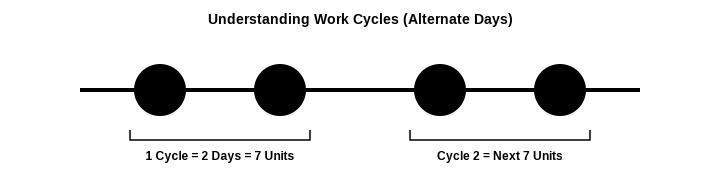
In these problems, workers do not work simultaneously. Instead, they work turn-by-turn on alternate days. Group their work into complete cycles.
Example 3.1
A can do a work in 12 days and B in 16 days. They work on alternate days starting with A. In how many days will the work be completed?
• Step 1: Total Work = LCM(12, 16) = 48 units.
• Step 2: Efficiencies: A = 48 / 12 = 4 units/day; B = 48 / 16 = 3 units/day.
• Step 3: 1 Cycle = 2 days (Day 1: A, Day 2: B).
- Work done in 1 cycle = 4 + 3 = 7 units.
• Step 4: Find number of full cycles: 48 / 7 = 6 full cycles with 6 units remaining (since 6 * 7 = 42 units).
- Time for 6 cycles = 6 * 2 = 12 days.
• Step 5: Remaining work = 48 - 42 = 6 units.
- On Day 13 (A's turn): A completes 4 units. Remaining work = 6 - 4 = 2 units.
- On Day 14 (B's turn): B needs to do 2 units. Time taken = 2 / 3 day.
• Step 6: Total time = 12 + 1 + 2/3 = 13 2/3 days.
Example 3.2
A and B can do a work in 9 days and 12 days respectively. If they work on alternate days starting with A, how many days will the work take?
• Step 1: Total Work = LCM(9, 12) = 36 units.
• Step 2: Efficiencies: A = 4 units/day; B = 3 units/day.
• Step 3: 1 Cycle = 2 days = 4 + 3 = 7 units.
• Step 4: In 5 full cycles (10 days), work done = 5 * 7 = 35 units.
• Step 5: Remaining work = 36 - 35 = 1 unit.
• Step 6: On Day 11, it is A's turn. Time taken = 1 / 4 day.
• Step 7: Total time = 10 + 1/4 = 10 1/4 days (or 10.25 days).
Example 3.3
In Example 3.2 (A in 9 days, B in 12 days), how many days will it take if B starts the work on Day 1?
• Step 1: Total Work = 36 units. Efficiencies: B = 3 units/day; A = 4 units/day.
• Step 2: 1 Cycle = 2 days (Day 1: B, Day 2: A) = 3 + 4 = 7 units.
• Step 3: In 5 full cycles (10 days), work done = 5 * 7 = 35 units.
• Step 4: Remaining work = 36 - 35 = 1 unit.
• Step 5: On Day 11, it is B's turn. Time taken by B = 1 / 3 day.
• Step 6: Total time = 10 + 1/3 = 10 1/3 days.
Example 3.4 (Three people on alternate days)
A, B, and C can complete a job in 12, 15, and 20 days respectively. If they work on alternate days in the order A (Day 1), B (Day 2), and C (Day 3), how many days will it take?
• Step 1: Total Work = LCM(12, 15, 20) = 60 units.
• Step 2: Efficiencies: A = 5, B = 4, C = 3 units/day.
• Step 3: 1 Cycle = 3 days (A + B + C) = 5 + 4 + 3 = 12 units.
• Step 5: Total time = 5 cycles * 3 days/cycle = 15 days.
Example 3.5 (Assisted on specific days)
A can complete a work in 20 days, B in 30 days, and C in 60 days. A works continuously every day, but he is assisted by B and C together on every third day. In how many days will the work be completed?
• Step 1: Total Work = LCM(20, 30, 60) = 60 units.
• Step 2: Efficiencies: A = 3, B = 2, C = 1 unit/day.
• Step 3: Calculate 3-day cycle:
- Day 1: A alone = 3 units.
- Day 2: A alone = 3 units.
- Day 3: A + B + C = 3 + 2 + 1 = 6 units.
- Total work in 1 cycle (3 days) = 3 + 3 + 6 = 12 units.
• Step 4: Number of cycles = 60 / 12 = 5 cycles.
• Step 5: Total time = 5 * 3 = 15 days.
Type 4: Efficiency, Ratio, and Wage-Based Problems
These problems compare the working speeds of individuals or divide money based on work done. Remember: Wages are distributed strictly in the ratio of the total work done by each person.
Example 4.1
A is twice as efficient as B. Together they finish a work in 14 days. In how many days can A alone finish the work?
• Step 3: Efficiency Ratio (A : B) = 160 : 100 = 8 : 5.
• Step 4: Total Work = B's efficiency * B's days = 5 * 40 = 200 units.
• Step 5: Time taken by A alone = 200 / 8 = 25 days.
Example 4.3
A takes twice as much time as B or thrice as much time as C to complete a piece of work. Working together, they finish the work in 2 days. In how many days can B alone complete the work?
• Step 1: Let the time taken by A = 6 units of time.
- Time taken by B = 6 / 2 = 3 units of time.
- Time taken by C = 6 / 3 = 2 units of time.
- Time Ratio (A : B : C) = 6 : 3 : 2.
• Step 2: Efficiency is inversely proportional to time:
A and B undertake a piece of work for Rs 600. A alone can do it in 6 days and B alone in 8 days. With the help of C, they finish it in 3 days. What is C's share of the money?
4 men or 6 women can complete a work in 16 days. In how many days can 2 men and 9 women together complete the same work?
• Step 1: Convert Men to Women (or find efficiency ratio):
- Work of 4 Men = Work of 6 Women
- 4M = 6W => M / W = 6 / 4 = 3 / 2.
- Efficiency of 1 Man = 3 units/day; 1 Woman = 2 units/day.
• Step 2: Total Work = 6 Women * 16 days * 2 units/day = 192 units.
• Step 3: Combined daily work of (2 Men + 9 Women):
- (2 * 3) + (9 * 2) = 6 + 18 = 24 units/day.
• Step 4: Time taken = 192 / 24 = 8 days.
Example 5.3 ("AND" Mixed Group Equivalence)
2 men and 3 boys can do a piece of work in 10 days, while 3 men and 2 boys can do the same work in 8 days. In how many days can 2 men and 1 boy do the work?
A garrison of 120 soldiers had food provisions for 45 days. After 15 days, 30 soldiers left the fort. For how many more days will the remaining food last?
• Step 1: Calculate remaining food supply:
- After 15 days, the remaining food is enough for the original 120 soldiers for (45 - 15) = 30 days.