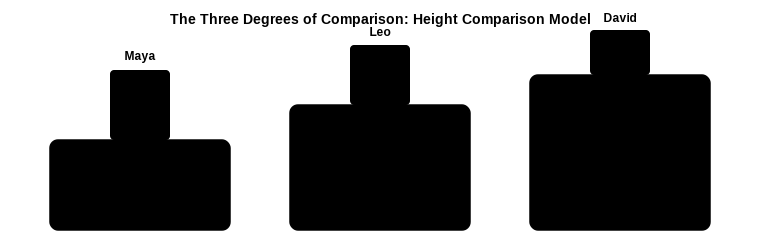
Degrees of comparison are forms of adjectives and adverbs used to compare the qualities of people, places, things, or actions. There are three degrees: Positive Degree (no comparison or equal comparison), Comparative Degree (comparing two items), and Superlative Degree (comparing three or more items to show the highest or lowest limit).
The Three Degrees Explained
An adjective or adverb modifies its form to express varying intensities of a characteristic:
Degree
What It Does
Key Keywords
Example Sentence
Positive
States a quality as it is, or shows equal comparison between two items.
as...as, so...as
Maya is tall. / Sam is as tall as Maya.
Comparative
Compares a quality between exactly two people or things.
-er, more, than
Leo is taller than Sam.
Superlative
Compares three or more items to identify the extreme (highest or lowest).
the, -est, most, of all
David is the tallest boy in class.
Rules for Forming Degrees of Comparison
The spelling changes required to build comparative and superlative forms depend strictly on word length, syllable structure, and consonant endings.
1. One-Syllable Adjectives (Add "-er" and "-est")
Most short, one-syllable adjectives simply append -er for comparative and -est for superlative:
Tall → Taller → Tallest
Fast → Faster → Fastest
Cold → Colder → Coldest
Small → Smaller → Smallest
2. Adjectives Ending in "-e" (Add "-r" and "-st")
If the root word already terminates in the vowel e, do not add another e. Just append -r and -st:
Brave → Braver → Bravest
Large → Larger → Largest
Simple → Simpler → Simplest
Wise → Wiser → Wisest
3. CVC Rule (Double the Final Consonant)
When a short, one-syllable adjective ends with a single vowel sandwiched before a single consonant, double the consonant before adding -er or -est:
Big → Bigger → Biggest
Hot → Hotter → Hottest
Thin → Thinner → Thinnest
Fat → Fatter → Fattest
4. Adjectives Ending in Consonant + "y" (Change "y" to "i")
When an adjective ends in a consonant followed by y, drop the y and add -ier and -iest:
Happy → Happier → Happiest
Heavy → Heavier → Heaviest
Easy → Easier → Easiest
Busy → Busier → Busiest
5. Long Adjectives (Two or More Syllables: Use "More" and "Most")
Multi-syllable adjectives sound awkward with suffix attachments. Instead, prepend more and most:
Beautiful → More beautiful → Most beautiful
Difficult → More difficult → Most difficult
Honest → More honest → Most honest
Intelligent → More intelligent → Most intelligent
6. Irregular Adjectives (Completely Change Form)
These adjectives follow unique historical etymologies and must be committed to memory:
Positive Degree
Comparative Degree
Superlative Degree
Good / Well
Better
Best
Bad / Ill
Worse
Worst
Little (amount)
Less / Lesser
Least
Much / Many
More
Most
Far (distance)
Farther
Farthest
Far (extent / addition)
Further
Furthest
Old (people / things)
Older
Oldest
Old (family members)
Elder
Eldest
How to Transform Degrees Without Changing Meaning
In competitive exams, students must rewrite sentences between Positive, Comparative, and Superlative degrees while strictly preserving the underlying meaning.
Pattern 1: The Absolute Best ("The + Superlative")
Applied when an entity is unequaled at the very peak of its category:
Superlative
Mount Everest is the highest mountain in the world.
Comparative
Mount Everest is higher than any other mountain in the world.
Positive
No other mountain in the world is as high as Mount Everest.
Pattern 2: One Among the Top Group ("One of the + Superlative")
Applied when the entity is not solitary at the peak, but belongs to an elite top cohort:
Superlative
Iron is one of the most useful metals.
Comparative
Iron is more useful than most other metals.
Positive
Very few metals are as useful as iron.
Pattern 3: Comparing Only Two Items (No Superlative Possible)
When comparing exactly two individual items, a superlative form cannot exist. Swap between comparative and positive. Note that an affirmative statement switches into a negative one to preserve truth:
Example A (Comparative to Positive):
Comparative
A train runs faster than a bus.
Positive
A bus does not run as fast as a train.
Example B (Positive to Comparative):
Positive
Rita is as smart as Geeta.
Comparative
Geeta is not smarter than Rita.
5 Critical Rules & Common Errors
Examiners frequently design sentence-correction and error-spotting questions around these five recurring grammatical traps:
1. Never Use Double Comparatives or Superlatives
Do not combine more with -er, or most with -est.
✗ He is more taller than his brother.
✓ He is taller than his brother.
✗ This is the most sharpest knife.
✓ This is the sharpest knife.
2. Latin Adjectives Take "To", Not "Than"
Adjectives terminating in -ior (plus preferable) pair exclusively with to: Senior, Junior, Superior, Inferior, Prior, Preferable.
✗ She is senior than me.
✓ She is senior to me.
✗ Coffee is preferable than tea.
✓ Coffee is preferable to tea.
3. Always Compare Like with Like ("That of" / "Those of")
Comparisons must match parallel categories. Do not compare an attribute of one item to an entire second entity.
✗ The streets of Delhi are wider than Mumbai. (Compares streets to an entire city)
✓ The streets of Delhi are wider than those of Mumbai.
4. Use "Any Other" in Comparative Sentences
When comparing an item against the remaining members of its own group, include other to exclude the item from comparing with itself.
✗ Diamond is harder than any substance on Earth. (Diamond is itself a substance)
✓ Diamond is harder than any other substance on Earth.
5. Non-Comparable "Absolute" Adjectives
Certain words indicate an absolute limit that cannot exist in degrees: Unique, Perfect, Dead, Round, Square, Empty, Impossible, Universal, Final.
✗ This is a more unique idea.
✓ This is a unique idea.
Ready to Test Your Comparison Skills?
Put your knowledge of Positive, Comparative, and Superlative degrees into practice with interactive timed drills.