Greetings — Explained in Simple English

A greeting is something we say or do when we meet someone. We use greetings to:

  • show that we notice the other person
  • be friendly and polite
  • start a conversation
  • show respect
  • create a good feeling between people

Common examples include: Hello! Hi! Good morning! How are you? Greetings can be formal, informal, written, or physical.

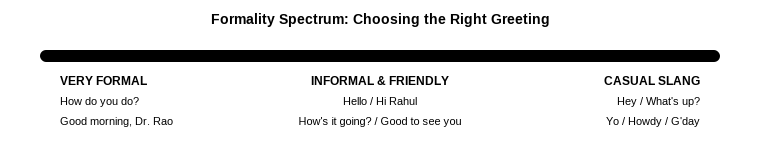
Greetings Diagram 1

1. Formal Greetings

Formal greetings are used when we want to be polite and respectful. We commonly use them at work, in offices, in schools, in interviews, with customers, teachers, and people we do not know well.

Common Formal Greetings

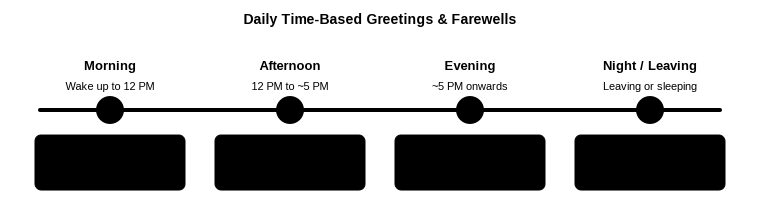
Good morning

Used in the morning. Example: "Good morning, Sir."

Good afternoon

Used after 12:00 PM during the day. Example: "Good afternoon, Mr. Rao."

Good evening

Used when meeting in the evening or night. Example: "Good evening, Madam."

Hello + Title + Last Name

Polite and formal. Example: "Hello, Dr. Rao."

How do you do?

Very formal and traditional greeting. Response is also: "How do you do?"

Pleased / A pleasure to meet you

Polite way to speak when meeting someone for the first time.

Welcome to...

Used upon arrival. Example: "Welcome to Hyderabad."

Tone of Formal Greetings: Should always sound polite, respectful, calm, and professional.
Greetings Diagram 2

2. Informal and Casual Greetings

Informal greetings are used with friends, siblings, relatives, classmates, and close colleagues.

Hi / Hello / Hey

Everyday friendly greetings. "Hey, Amit!"

How's it going?

Means "How are you?". Natural reply: "Good, thanks!"
What's up?

Casual expression. Natural reply: "Not much. You?"

How have you been?

Used when you haven't seen someone for some time.

Good to see you!

Expresses happiness when running into someone.

What are you up to?

Means "What are you doing?". Reply: "Just studying."

3. Slang and Regional Greetings

Some greetings belong to specific regions or cultural groups:

  • Howdy: Used in parts of the United States (means Hello).
  • G'day: Common in Australia ("G'day, mate!").
  • Alright?: Common in British English (means "How are you?").
  • Cheers: In the UK, often used for thanks or goodbye.
  • What's the crack (craic)?: Very informal Irish greeting meaning "What's new?".
  • Yo / What's good?: Casual street slang.
✗ Yo, Mr. Sharma! (Too casual for office)
✓ Good morning, Mr. Sharma. (Appropriate)

4. Greetings in Emails and Writing (Salutations)

A salutation is the opening greeting of an email or letter.

High Formal

Dear Mr. Sharma, / Dear Dr. Rao,

Name Unknown

Dear Hiring Manager, / Dear Admissions Team,

Standard Work Email

Hello Rahul, / Good morning, Priya,

Team & Coworkers

Hi team, / Morning all,

5. Non-Verbal Greetings

Greetings Diagram 3

Body movements and physical actions also serve as polite greetings:

  • Handshake: Common in professional and formal meetings.
  • Namaste: Placing palms together near the chest; shows deep respect in India.
  • Bow: Bending head or upper body forward; traditional in Japan and South Korea.
  • Cheek Kisses: Common among close relations in France, Southern Europe, and Latin America.
  • Wave / Head Nod: Visual greetings from across a room or distance.
  • Fist Bump / High-Five: Casual gestures celebrating excitement or peer friendship.

6. Common Greeting Questions & Natural Responses

Greeting questions are social conventions—people usually expect a brief, polite reply rather than a medical report!

Greeting Question Natural Responses
"How do you do?" "How do you do?" (Formal standard return)
"How are you?" "I'm doing well, thank you." / "Fine, thanks. And you?"
"How's it going?" "Good, thanks!" / "Pretty good." / "Can't complain."
"What's up?" "Not much." / "Nothing much. You?" / "Just studying."
"Nice to meet you." "Nice to meet you too."

7. Important Mistakes to Avoid

Mistake 1: "Good night" is not a greeting

Good evening is used when you meet someone at night. Good night is only used when leaving or going to sleep.

You meet at 8 PM → "Good evening!" ✓
You leave at 10 PM → "Good night!" ✓

Mistake 2: Confusing "How do you do?" with "How are you?"

"How do you do?" is a formal greeting, not a personal inquiry. The traditional answer is simply "How do you do?"

Mistake 3: Title + First Name

Name Rule: How to Use Titles Correctly ✗ Title + First Name (Incorrect) "Mr. John" / "Dr. Rahul" ✓ Title + Last Name (Correct) "Mr. Smith" / "Dr. Rao" (or just "Rahul")

Always pair titles with the person's last name (surname):

✗ Mr. Rahul
✓ Mr. Sharma (or simply Rahul)

8. Farewells (Saying Goodbye)

While greetings happen upon arrival, farewells are spoken when parting ways.

Formal Farewells Informal Farewells
Goodbye. Bye! / Bye-bye!
Have a pleasant evening. See you later! / See you soon!
It was a pleasure meeting you. Take care!
I look forward to our next meeting. Catch you later! / Have a good one!

Written Sign-Offs (End of Emails)

Place these at the conclusion of your written message: Sincerely, Best regards, Kind regards, Warmly.

Ready to Test Your Greetings Knowledge?

Practice greetings, responses, and farewells with interactive drills.