Alpha-Numeric Puzzle

An Alpha-Numeric Puzzle tests your ability to process a mixed string of alphabets (letters), numeric digits (numbers), and special characters (symbols). In exams like IBPS PO/Clerk, SBI PO/Clerk, RRB, and SSC CGL, these questions appear in sets of 3 to 5 questions and offer guaranteed, high-speed marks once you master the foundational patterns.

Alpha Numeric Puzzle Diagram 1

1. Fundamentals Every Beginner Must Know

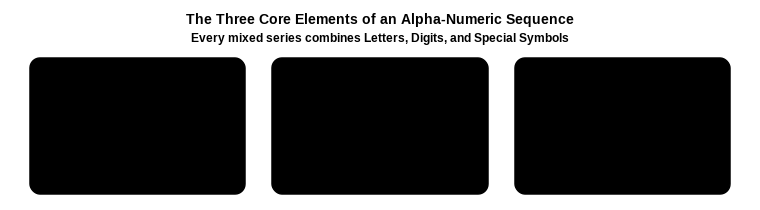
A. The Three Elements

A typical sequence contains three types of characters:

  • Letters / Alphabets: A to Z (Consonants and Vowels).
    • Vowels: A, E, I, O, U (5 letters).
    • Consonants: All remaining 21 letters.
  • Numbers / Digits: 0, 1, 2, 3, 4, 5, 6, 7, 8, 9.
    • Even Numbers: 0, 2, 4, 6, 8.
    • Odd Numbers: 1, 3, 5, 7, 9.
    • Prime Numbers: 2, 3, 5, 7 (Note: 1 is neither prime nor composite. 2 is the only even prime number).
  • Symbols: Special characters such as @, #, $, %, &, *, ©, δ, ?.

B. Alphabet Positions and Memory Shortcuts

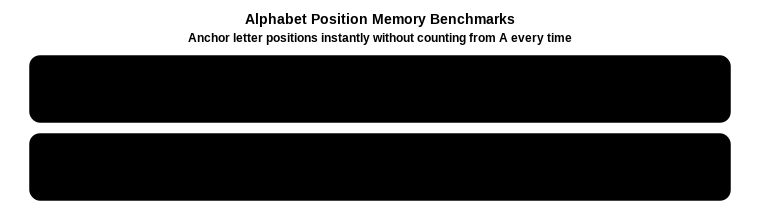
Memorizing the forward and backward numerical positions of the 26 letters saves critical seconds:

  • The "EJOTY" Rule (Multiples of 5):
    • E = 5
    • J = 10
    • O = 15
    • T = 20
    • Y = 25
  • The "CFILORUX" Rule (Multiples of 3):
    • C = 3, F = 6, I = 9, L = 12, O = 15, R = 18, U = 21, X = 24.
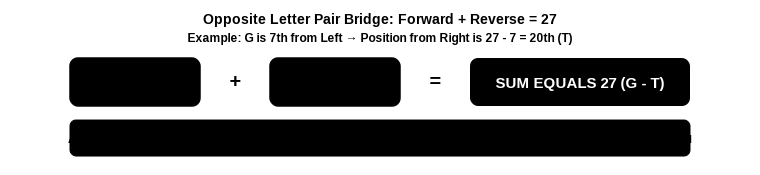
  • Reverse Position Formula:
Reverse Position = 27 - Forward Position
  • Example: The letter G is 7th from the left. From the right end, its position is 27 - 7 = 20th.
Alpha Numeric Puzzle Diagram 2

Opposite Letter Pairs (Sum equals 27):

  • A - Z (AZad)
  • B - Y (BoY)
  • C - X (CruX)
  • D - W (DeW)
  • E - V (EVen)
  • F - U (FUn)
  • G - T (GT Road)
  • H - S (High School)
  • I - R (Indian Railway)
  • J - Q (Jungle Queen)
  • K - P (KanPur)
  • L - O (LOve)
  • M - N (MAN)
Alpha Numeric Puzzle Diagram 3

C. The Most Important Vocabulary: "Preceded By" vs. "Followed By"

This single distinction causes the majority of beginner errors:

Term Meaning Visual Order
A is immediately preceded by B B comes immediately before A [ B ] [ A ]
A is immediately followed by C C comes immediately after A [ A ] [ C ]
A is preceded by B and followed by C B comes before A, and C comes after A [ B ] [ A ] [ C ]
Alpha Numeric Puzzle Diagram 4
Memory Trick:
• Preceded starts with P → Think Previous (comes before).
• Followed starts with F → Think Forward / Following behind (comes after).

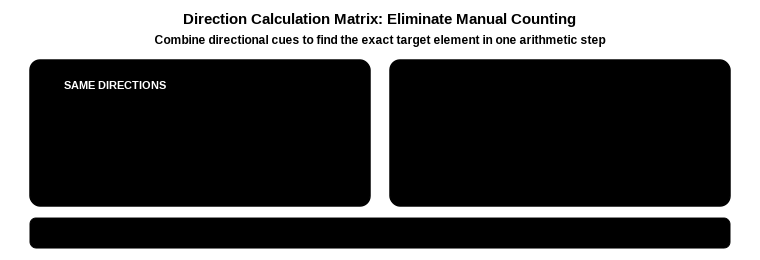
D. The Direction Shortcut Rule

When a question asks you to find an element relative to both ends, use this arithmetic shortcut instead of manual counting back and forth:

  • Same Directions → SUBTRACT (-)
    • Left of Left = Subtract
    • Right of Right = Subtract
  • Opposite Directions → ADD (+)
    • Right of Left = Add
    • Left of Right = Add

Rule of Thumb: Always count your final result from the end mentioned after the word "from the...".

Alpha Numeric Puzzle Diagram 5
  • Example 1: Find the 4th element to the left of the 14th element from the left end.
    • Direction pair: Left + Left → Subtract: 14 - 4 = 10th from the left end.
  • Example 2: Find the 5th element to the right of the 8th element from the left end.
    • Direction pair: Right + Left → Add: 8 + 5 = 13th from the left end.

2. Five Comprehensive Examples with Step-by-Step Solutions

Example 1: The "Preceded and Followed By" Condition

Given Sequence:

R 4 # M 9 @ K 2 $ E 7 % A 3 * T 8 B 5 & W

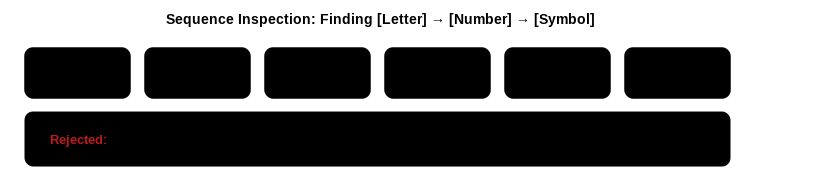
Question: How many numbers are there in the given arrangement, each of which is immediately preceded by a letter and immediately followed by a symbol?

Step-by-step Solution:

  1. Break down the target pattern: [Letter] → [Number] → [Symbol].
  2. Scan through all the numbers in the series:
    • 4: Preceded by R (Letter), Followed by # (Symbol) → Match 1: R 4 #
    • 9: Preceded by M (Letter), Followed by @ (Symbol) → Match 2: M 9 @
    • 2: Preceded by K (Letter), Followed by $ (Symbol) → Match 3: K 2 $
    • 7: Preceded by E (Letter), Followed by % (Symbol) → Match 4: E 7 %
    • 3: Preceded by A (Letter), Followed by * (Symbol) → Match 5: A 3 *
    • 8: Preceded by T (Letter), Followed by B (Letter, not a symbol) → No
    • 5: Preceded by B (Letter), Followed by & (Symbol) → Match 6: B 5 &
  3. Count of matching numbers = 6.
Alpha Numeric Puzzle Diagram 6

Example 2: The Left-Right Direction Calculation

Given Sequence:

F 8 @ K 1 # D 9 % J 4 * B 7 $ M 2 E 6 & U 3

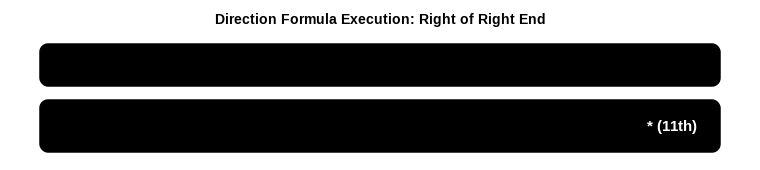
Question: Which element is 5th to the right of the 16th element from the right end?

Step-by-step Solution:

  1. Identify the given positions:
    • Direction 1: 5th to the right
    • Direction 2: 16th from the right end
  2. Apply the shortcut rule:
    • Both are "Right" (Same direction) → Subtract: 16 - 5 = 11th element from the right end.
  3. Count 11 places starting from the right end (3):
    • 1st = 3, 2nd = U, 3rd = &, 4th = 6, 5th = E, 6th = 2, 7th = M, 8th = $, 9th = 7, 10th = B, 11th = *
  4. The required element is *.
Alpha Numeric Puzzle Diagram 7

Example 3: Dropping Elements (Modification Pattern)

Given Sequence:

P 7 % K 4 # N 9 @ T 2 $ W 6 & H 8 * Q 5

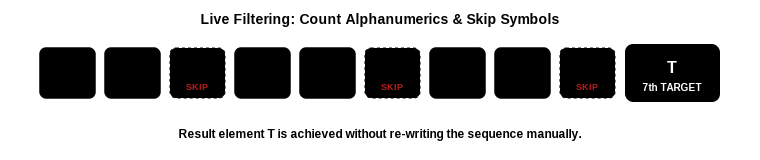
Question: If all the symbols are dropped from the arrangement, which element will be 7th from the left end?

Step-by-step Solution:

Exam Shortcut: Do not waste time rewriting the sequence on rough paper. Simply count from the left end, skipping every symbol you encounter.
  1. Count non-symbol elements from the left:
    • 1st: P
    • 2nd: 7
    • Skip %
    • 3rd: K
    • 4th: 4
    • Skip #
    • 5th: N
    • 6th: 9
    • Skip @
    • 7th: T
  2. The 7th element after dropping symbols is T.
Alpha Numeric Puzzle Diagram 8

Example 4: Three-Digit Number Set Puzzle

Given Set of Numbers:

582   437   916   653   824

Question: If 1 is subtracted from the first digit of every number and 1 is added to the third digit of every number, which number will become the second lowest?

Step-by-step Solution:

  1. Apply the operation to each number:
    • 582 → (5 - 1) 8 (2 + 1) → 483
    • 437 → (4 - 1) 3 (7 + 1) → 338
    • 916 → (9 - 1) 1 (6 + 1) → 817
    • 653 → (6 - 1) 5 (3 + 1) → 554
    • 824 → (8 - 1) 2 (4 + 1) → 725
  2. Arrange the new values in ascending order (lowest to highest):
    • 338 < 483 < 554 < 725 < 817
  3. The lowest is 338, and the second lowest is 483.
  4. 483 was formed from the original number 582.
Pro-Tip for Speed: The relative magnitude of a 3-digit number depends almost entirely on its first digit. Since all original first digits are distinct (5, 4, 9, 6, 8) and each is decreased by the same value (1), their relative ranking does not change. The second smallest starting digit was 5 (from 582), so 582 must become the second lowest number.
Alpha Numeric Puzzle Diagram 9

Example 5: Two-Row Conditional Puzzle (Mains Level)

Set of Rules:

  • Rule 1: If an even number is followed by an odd number, multiply both numbers.
  • Rule 2: If an even number is followed by an even number, add both numbers.
  • Rule 3: If an odd number is followed by an even number, subtract the smaller number from the larger number.

Given Rows:

Row 1: 6   3   8
Row 2: 14   k   9

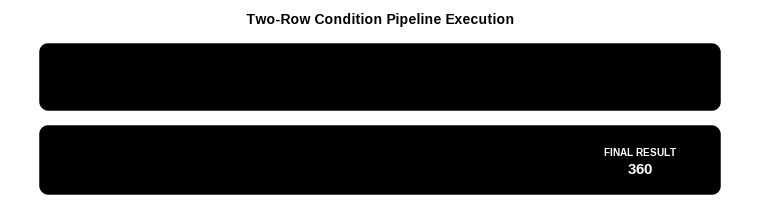
Question: If the resultant of Row 1 is k, find the resultant of Row 2.

Step-by-step Solution:

  1. Solve Row 1 (6 3 8):
    • Take the first two numbers: 6 and 3.
      • 6 is even, 3 is odd.
      • Apply Rule 1 (Even followed by Odd → Multiply): 6 * 3 = 18.
    • Take the outcome 18 with the next number 8:
      • 18 is even, 8 is even.
      • Apply Rule 2 (Even followed by Even → Add): 18 + 8 = 26.
    • Therefore, resultant of Row 1 is 26, which means k = 26.
  2. Substitute k into Row 2 (14 26 9):
    • Take the first two numbers: 14 and 26.
      • 14 is even, 26 is even.
      • Apply Rule 2 (Even followed by Even → Add): 14 + 26 = 40.
    • Take the outcome 40 with the next number 9:
      • 40 is even, 9 is odd.
      • Apply Rule 1 (Even followed by Odd → Multiply): 40 * 9 = 360.
    • The final resultant of Row 2 is 360.
Alpha Numeric Puzzle Diagram 10

Ready to Test Your Speed?

Put your Alpha-Numeric Puzzle identification skills and direction shortcuts to the test with real exam drills.