The Alphabet Test is a core branch of Verbal Reasoning that evaluates your understanding of the English alphabet, the sequential positions of letters from both directions, letter patterns, and word arrangements.
1. Fundamentals of Alphabet Test
To solve any alphabet reasoning problem quickly, you must master four core building blocks: forward positions, reverse positions, opposite letter pairs, and direction movement rules.
A. The English Alphabet Structure
Total Letters: 26 letters (A to Z).
Vowels (5): A, E, I, O, U.
Consonants (21): The remaining 21 letters.
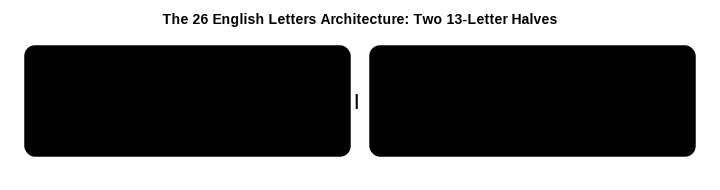
Two Halves:
First Half: A to M (Letters 1 to 13)
Second Half: N to Z (Letters 14 to 26)
B. Forward Positional Values (Left to Right: A = 1 to Z = 26)
In standard sequence, counting begins from A (Position 1) and ends at Z (Position 26). The left end is A, and the right end is Z.
A B C D E F G H I J K L M N O P Q R S T U V W X Y Z
1 2 3 4 5 6 7 8 9 10 11 12 13 14 15 16 17 18 19 20 21 22 23 24 25 26
Memory Tools to Remember Forward Ranks:
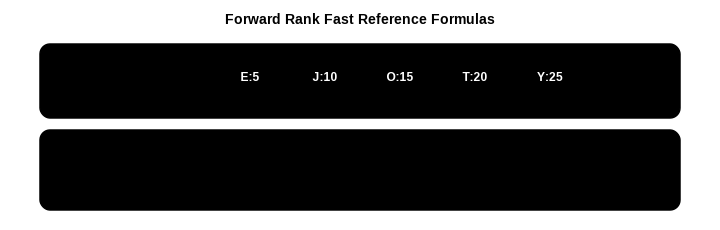
The EJOTY Formula (Multiples of 5):
E = 5
J = 10
O = 15
T = 20
Y = 25
How to use: To find the position of R, recall T = 20. Since R is two letters before T, R = 20 - 2 = 18.
The CFILORUX Formula (Multiples of 3):
C = 3, F = 6, I = 9, L = 12, O = 15, R = 18, U = 21, X = 24.
Visual Shape Associations:
G: Contains the digit 7 in its tail (G = 7).
H: Connecting the top and bottom makes an 8 (H = 8).
I: Cursive I looks like the digit 9 (I = 9).
K: Has 2 straight lines, or think "Kings XI Punjab" (K = 11).
M & W: Both resemble 3 turned sideways (M = 13, W = 23).
T: T-20 cricket format (T = 20).
C. Backward Positional Values (Right to Left: Z = 1 to A = 26)
When counting from the right end of the alphabet, Z becomes 1, Y becomes 2, and A becomes 26.
Z Y X W V U T S R Q P O N M L K J I H G F E D C B A
1 2 3 4 5 6 7 8 9 10 11 12 13 14 15 16 17 18 19 20 21 22 23 24 25 26
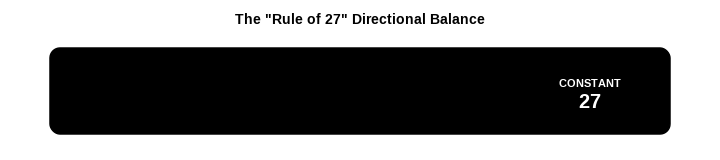
The "Rule of 27":
The sum of the forward position and backward position of any given letter is always 27.
Backward Position = 27 - Forward Position
Forward Position = 27 - Backward Position
Example: To find the position of letter H from the right end:
Forward position of H = 8.
Backward position of H = 27 - 8 = 19.
D. Opposite Letter Pairs
Two letters are called "opposite" when their forward positions add up to 27 (i.e., one is at rank n from the left and the other is at rank n from the right).
Letter Pair
Sum of Positions
Simple Mnemonic Keyword
A - Z
1 + 26 = 27
Azad or Amazon
B - Y
2 + 25 = 27
Boy or Bye
C - X
3 + 24 = 27
Crux or Crackers
D - W
4 + 23 = 27
Dew or Down
E - V
5 + 22 = 27
EVen or Electric Vehicle
F - U
6 + 21 = 27
FUll or FUn
G - T
7 + 20 = 27
GT Road
H - S
8 + 19 = 27
High School
I - R
9 + 18 = 27
Indian Railway
J - Q
10 + 17 = 27
Jungle Queen or Jack-Queen
K - P
11 + 16 = 27
Kanpur or PK movie
L - O
12 + 15 = 27
LOve
M - N
13 + 14 = 27
Man or Moon
E. Direction and Movement Rules
When questions say "to the left of..." or "to the right of...", use these standard arithmetic rules instead of manual counting:
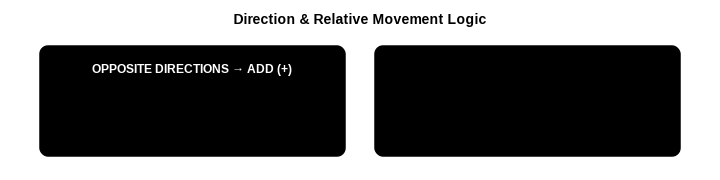
Opposite Directions ADD (+):
nth to the Right of mth from Left = (m + n) from the Left end.
nth to the Left of mth from Right = (m + n) from the Right end.
Same Directions SUBTRACT (-):
nth to the Left of mth from Left = (m - n) from the Left end.
nth to the Right of mth from Right = (m - n) from the Right end.
Rule of Thumb: Always calculate the final position from the reference end mentioned after the word "from".
2. Major Question Types and Worked Examples
Type 1: Positional & Directional Series Problems
These questions test letter positions in standard order, reverse order, or modified series (such as reversing one half).
Example 1.1
Question: Which letter is 7th to the right of the 12th letter from the left end in the standard English alphabet?
Step 1: Reference point = 12th from the left end.
Step 2: Direction to move = 7th to the right (opposite directions: Left + Right).
Step 3: Final position = 12 + 7 = 19th letter from the left end.
Step 4: From standard forward positions, the 19th letter is S.
Answer: S
Example 1.2
Question: Which letter is 5th to the left of the 18th letter from the left end in the standard English alphabet?
Step 1: Reference point = 18th from the left end.
Step 2: Direction to move = 5th to the left (same directions: Left - Left).
Step 3: Final position = 18 - 5 = 13th letter from the left end.
Step 4: The 13th letter from the left end is M.
Answer: M
Example 1.3
Question: Which letter is 6th to the left of the 10th letter from the right end in the standard English alphabet?
Step 1: Reference point = 10th from the right end.
Step 2: Direction to move = 6th to the left (opposite directions: Right + Left).
Step 3: Final position = 10 + 6 = 16th letter from the right end.
Step 4: Convert position from right to left using the Rule of 27: Position from left = 27 - 16 = 11th from left.
Step 5: The 11th letter from the left end is K.
Answer: K
Example 1.4
Question: Which letter is exactly midway between the 7th letter from the left end and the 19th letter from the left end?
Step 1: Both positions are from the left end: 7th (G) and 19th (S).
Step 2: Midpoint position = (7 + 19) / 2 = 26 / 2 = 13th letter from the left end.
Step 3: The 13th letter from the left end is M.
Answer: M
Example 1.5
Question: If the first half of the English alphabet (A to M) is written in reverse order while the second half (N to Z) remains unchanged, which letter will be the 9th letter from the left end?
Step 1: The first half consists of 13 letters. Reversing it produces: M, L, K, J, I, H, G, F, E, D, C, B, A.
Step 2: The 9th letter falls within this reversed first half (since 9 is less than or equal to 13).
Step 3: In a reversed segment of length 13, the letter at position k corresponds to original position (14 - k).
Step 4: Original position = 14 - 9 = 5th letter of the standard alphabet, which is E.
These questions ask you to find how many pairs of letters in a given word have as many letters between them as they do in the standard English alphabet. Unless explicitly restricted, always check in both forward and backward directions.
Example 2.1
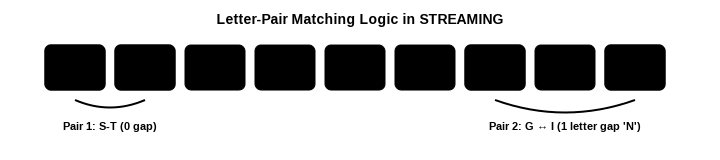
Question: How many such pairs of letters are there in the word STREAMING, each of which has as many letters between them in the word as in the English alphabet?
Assign numerical forward values to each letter in order: S(19), T(20), R(18), E(5), A(1), M(13), I(9), N(14), G(7).
Forward counting: From S (19): The very next letter is T (20). In the alphabet, S and T have 0 letters between them; in the word, they have 0 letters between them. Pair 1: (S, T). Checking all other forward letters yields no other matches.
Backward counting: From G (7): Count up: G(7), H(8 - at N), I(9 - at I). In the word, G and I have 1 letter between them (N). In the alphabet, G and I have 1 letter between them (H). Pair 2: (G, I). Checking N, I, M, A, E, R, T backward yields no other matches.
Answer: 2 pairs: (S, T) and (G, I)
Example 2.2
Question: How many such pairs of letters are there in the word BRISK?
Letters and positions: B(2), R(18), I(9), S(19), K(11).
Forward counting: From B(2): C, D, E, F (No match). From R(18): S is at position 4, but diff in word is 2, while in alphabet diff is 1 (No match). From I(9): I(9), J(10 - at S), K(11 - at K). In the word, there is 1 letter (S) between I and K. In the alphabet, there is 1 letter (J) between I and K. Pair 1: (I, K). From S(19): T (No match).
Backward counting: From K(11): L, M, N, O (No match). From S(19): T, U, V (No match). From I(9), R(18): No matches.
Answer: 1 pair: (I, K)
Example 2.3
Question: How many such pairs of letters are there in the word CREDIT?
Letters and positions: C(3), R(18), E(5), D(4), I(9), T(20).
Forward counting: From C(3): D(at R), E(at E, position 3). In the alphabet, C and E have 1 letter (D) between them. In CREDIT, they have 1 letter (R) between them. Pair 1: (C, E). From R, E, D, I: No forward matches.
Backward counting: From T(20), I(9): No matches. From D(4): Next letter in backward direction is E(5) at position 3. They are adjacent in the word and adjacent in the alphabet. Pair 2: (D, E). From E, R: No matches.
Answer: 2 pairs: (C, E) and (D, E)
Example 2.4
Question: How many such pairs of letters are there in the word ENGLISH?
Letters and positions: E(5), N(14), G(7), L(12), I(9), S(19), H(8).
Forward counting: From E(5): E(5), F(at N), G(at G, position 3). Gap = 1 letter. Pair 1: (E, G). Continue from E: H(at L), I(at I, position 5). Gap = 3 letters (N, G, L). In alphabet, gap is 3 letters (F, G, H). Pair 2: (E, I). From G(7): G(7), H(at L), I(at I, position 5). Gap = 1 letter. Pair 3: (G, I). From N, L, I, S: No matches.
Backward counting: From H, S, I: No matches. From L(12): L(12), M(at G), N(at N, position 2). In alphabet: L, M, N (1 letter gap). In word: L, G, N (1 letter gap). Pair 4: (L, N).
Question: How many such pairs of letters are there in the word PRISON?
Letters and positions: P(16), R(18), I(9), S(19), O(15), N(14).
Forward counting: From P(16): Q(at R), R(at I), S(at S, position 4). Gap = 2 letters. In alphabet: P, Q, R, S (2 letters). Pair 1: (P, S). From R, I, S, O: No forward matches.
Backward counting: From N(14): Next letter is O(15) at position 5. Adjacent in both word and alphabet. Pair 2: (N, O). Continue from N(14): P(at S), Q(at I), R(at R, position 2). Gap = 3 letters (O, S, I). In alphabet: N, O, P, Q, R (3 letters). Pair 3: (N, R). From O(15): P(at S), Q(at I), R(at R, position 2). Gap = 2 letters (S, I). In alphabet: O, P, Q, R (2 letters). Pair 4: (O, R).
Type 3: Dictionary Order & Alphabetical Arrangement
These questions require comparing words letter by letter from left to right, exactly as words are ordered in a dictionary.
Example 3.1
Question: Arrange the following five words in alphabetical dictionary order: 1. Temple, 2. Temper, 3. Temperature, 4. Tempest, 5. Temporary
Step 1: All five words share the first four letters: T-E-M-P.
Step 2: Compare the 5th letter of each word: Temple (l), Temper (e), Temperature (e), Tempest (e), Temporary (o).
Step 3: Words with 'e' come first (Temper, Temperature, Tempest): Compare their 6th letters: Temper (r), Temperature (r), Tempest (s). 'r' comes before 's', so Tempest is 3rd among these. Between Temper (6 letters, ends) and Temperature (7th letter 'a'), the shorter complete root comes first: 1st is Temper, 2nd is Temperature, 3rd is Tempest.
Step 4: Next comes 5th letter 'l': 4th is Temple.
Step 5: Next comes 5th letter 'o': 5th is Temporary.
Step 3: Arranging by 4th letter (c, d, m, n, s): 1st: Glacier, 2nd: Glade, 3rd: Glamour, 4th: Glance, 5th: Glass.
Answer: Glamour
Example 3.3
Question: Which of the following words will come fourth when arranged in dictionary order? 1. Miracle, 2. Ministry, 3. Minor, 4. Mineral, 5. Minimum
Step 1: Compare 3rd letter: Miracle has 'r', while the other four words have 'n'. Since 'n' comes before 'r', Miracle is 5th (last).
Step 2: Compare the remaining four words starting with M-I-N: Mineral (4th: e), Minimum (4th: i, 5th: m), Ministry (4th: i, 5th: s), Minor (4th: o).
Step 3: Sequence of 4th letters: 1st: Mineral ('e'). Between Minimum and Ministry ('i'): 'm' precedes 's', so 2nd is Minimum, 3rd is Ministry. 4th: Minor ('o'). 5th: Miracle.
Answer: Minor
Example 3.4
Question: Arrange the given words in reverse dictionary order (descending): 1. Pageant, 2. Palace, 3. Palette, 4. Palpable, 5. Palpitate
Step 1: All start with P-A. Compare 3rd letter: Pageant has 'g', so it comes first in standard order. The remaining four words have 'l' as the 3rd letter: Palace (4th: 'a'), Palette (4th: 'e'), Palpable (4th: 'p', 5th: 'a'), Palpitate (4th: 'p', 5th: 'i').
Step 2: The word ORANGE requires the letter N. REFRIGERATOR contains no letter 'N'.
Answer: (D) ORANGE
Example 4.3
Question: Which of the following words can be formed using the letters of the word DETERMINATION? (A) TERMINAL, (B) NATIONAL, (C) REMINDER, (D) MENTION
Step 2: (A) TERMINAL requires 'L' (Not present). (B) NATIONAL requires 'L' (Not present). (C) REMINDER requires two 'R's (DETERMINATION only has one 'R'). (D) MENTION requires M:1, E:1, N:2, T:1, I:1, O:1 (Every letter is available in sufficient quantity).
Answer: (D) MENTION
Example 4.4
Question: Which of the following words cannot be formed using the letters of the word INTELLIGENCE? (A) GENTLE, (B) CLIENT, (C) TENNIS, (D) ELECT
Step 2: The word GARBAGE requires: G:2, A:2, R:1, B:1, E:1. BIODEGRADABLE contains the letter 'G' only once; it cannot supply two 'G's.
Answer: (C) GARBAGE
Type 5: Meaningful Word Formation from Specified Positions
These questions give you a word, specify certain letter positions (e.g., 1st, 3rd, 5th, 8th), and ask if a meaningful English word can be constructed using each letter only once.
Example 5.1
Question: If it is possible to make only one meaningful English word with the 2nd, 5th, 6th, and 8th letters of the word EDUCATION, which word is formed?
Step 1: Identify specified letters: 2nd = D, 5th = A, 6th = T, 8th = O.
Step 2: Available letter set: {D, A, T, O}.
Step 3: Test combinations: The only valid standard English dictionary word formed from these four letters is TOAD.
Answer: TOAD
Example 5.2
Question: How many meaningful English words can be formed using the 3rd, 6th, 7th, and 8th letters of the word LEMONADE?
Step 1: Identify specified letters: 3rd = M, 6th = A, 7th = D, 8th = E.
Step 2: Available letter set: {M, A, D, E}.
Step 3: Check meaningful anagrams: Word 1: MADE, Word 2: DAME.
Answer: 2 words (MADE, DAME)
Example 5.3
Question: If a meaningful word can be formed using the 1st, 2nd, 4th, and 6th letters of the word BACKGROUND, what is that word?
Step 1: Identify specified letters: 1st = B, 2nd = A, 4th = K, 6th = R.
Step 2: Available letter set: {B, A, K, R}.
Step 3: The only standard meaningful English word formed using all four letters is BARK.
Answer: BARK
Example 5.4
Question: How many meaningful English words can be formed using the 1st, 3rd, 5th, and 6th letters of the word TELEPHONE?
Step 3: All four letters are consonants. No meaningful standard English word can be formed.
Answer: 0 words (None can be formed)
Example 5.5
Question: How many meaningful English words can be formed using the 3rd, 4th, 8th, and 9th letters of the word BREAKFAST?
Step 1: Identify specified letters: 3rd = E, 4th = A, 8th = S, 9th = T.
Step 2: Available letter set: {E, A, S, T}.
Step 3: Check meaningful anagrams: Word 1: EAST (Direction), Word 2: SEAT (Chair / place to sit), Word 3: EATS (Present tense of eat), Word 4: TEAS (Plural of tea).
Answer: 4 words (EAST, SEAT, EATS, TEAS)
Type 6: Letter Operations & Substitutions in Words
A frequent variety in modern reasoning sections tests step-by-step rule execution on letter strings.
Typical Rule: Each vowel is replaced with its next letter in alphabetical order (+1), and each consonant is replaced with its preceding letter (-1).
Speed Tip: Convert consonants and vowels separately to avoid miscounting.
Example Walkthrough: If the word is BANK:
B (Consonant) → A
A (Vowel) → B
N (Consonant) → M
K (Consonant) → J
Resulting string: ABMJ
These questions ask you to modify the letters of a single word using specific rules (such as shifting vowels forward, consonants backward, or rearranging letters) and then determine the new status of the letters.
Example 6.1
Question: If each vowel in the word PACKET is replaced by the next letter in the English alphabet (+1) and each consonant is replaced by the previous letter (-1), and the resulting letters are arranged alphabetically from left to right, which letter will be 3rd from the right end?
Step 1: Identify vowels and consonants in PACKET: Consonants: P, C, K, T; Vowels: A, E.
Step 2: Apply rules: P - 1 = O, A + 1 = B, C - 1 = B, K - 1 = J, E + 1 = F, T - 1 = S.
Step 3: Resulting group of letters: O, B, B, J, F, S.
Step 4: Arrange alphabetically: B, B, F, J, O, S.
Step 5: Count from right end: 1st: S, 2nd: O, 3rd: J.
Answer: J
Example 6.2
Question: If each vowel in the word COMPLEX is replaced by its preceding letter in the English alphabet and each consonant is replaced by its following letter, how many vowels will be present in the newly formed word?
Step 1: Identify letters in COMPLEX: Consonants: C, M, P, L, X; Vowels: O, E.
Step 2: Vowels replaced by preceding letter (-1): O - 1 = N (Consonant), E - 1 = D (Consonant).
Step 3: Consonants replaced by following letter (+1): C + 1 = D, M + 1 = N, P + 1 = Q, L + 1 = M, X + 1 = Y.
Step 4: New word formed: D N Q N D M Y.
Step 5: Check for vowels: None of the letters are vowels.
Answer: 0 (None)
Example 6.3
Question: How many letters in the word SPLENDOR remain in the same position when the letters are arranged in alphabetical order from left to right?
Step 1: Original word: S - P - L - E - N - D - O - R (8 letters).
Step 2: Arrange alphabetically: D, E, L, N, O, P, R, S.
Step 3: Compare original vs alphabetical: Pos 1: S vs D, Pos 2: P vs E, Pos 3: L vs L (Unchanged), Pos 4: E vs N, Pos 5: N vs O, Pos 6: D vs P, Pos 7: O vs R, Pos 8: R vs S.
Answer: 1 letter (L)
Example 6.4
Question: In the word WONDERFUL, if all letters at odd positions (1st, 3rd, 5th, etc., from the left) are substituted by the immediately preceding letter and all letters at even positions are substituted by the immediately following letter, which letter will be 5th from the left end?
Step 1: List letters and positions: 1st: W (Odd), 2nd: O (Even), 3rd: N (Odd), 4th: D (Even), 5th: E (Odd), 6th: R (Even), 7th: F (Odd), 8th: U (Even), 9th: L (Odd).
Step 2: We only need the letter at the 5th position from the left end. The 5th letter is E (odd position).
Step 3: Rule for odd-positioned letters: Substitute with the immediately preceding letter (-1): E - 1 = D.
Step 4: (Full transformed word for reference: V - P - M - E - D - S - E - V - K).
Answer: D
Example 6.5
Question: If the 1st and 2nd letters in the word REPRESENTATION are interchanged, the 3rd and 4th letters are interchanged, the 5th and 6th are interchanged, and so on, which letter will be 7th from the right end?
Step 1: The word REPRESENTATION contains 14 letters. Group adjacent pairs: (R, E), (P, R), (E, S), (E, N), (T, A), (T, I), (O, N).
Step 2: Swap pairs: E-R, R-P, S-E, N-E, A-T, I-T, N-O. Sequence: E R R P S E N E A T I T N O.
Step 3: Count 7 letters backward from right end: 1st: O, 2nd: N, 3rd: T, 4th: I, 5th: T, 6th: A, 7th: E.
Step 4: (Quick Formula: In a 14-letter word, 7th from right is (14 - 7 + 1) = 8th from left. Original pair at positions 7-8 was E-N; after interchanging, position 8 is E).
Answer: E
Type 7: Three-Letter Word Sets
In this type, you are given a set of four or five 3-letter words. You must perform specific manipulations (adding a letter, swapping positions, replacing vowels/consonants) across all words and count how many words meet a given criterion.
Example 7.1
Given Words: TIP MUG BAR FED SUN
Question: If the second letter of each word is replaced by the next letter in the English alphabet, how many words will contain more than one consonant?
Step 1: TIP: Middle letter I → J. New word: TJP (3 consonants).
Step 2: MUG: Middle letter U → V. New word: MVG (3 consonants).
Step 3: BAR: Middle letter A → B. New word: BBR (3 consonants).
Step 4: FED: Middle letter E → F. New word: FFD (3 consonants).
Step 5: SUN: Middle letter U → V. New word: SVN (3 consonants).
Answer: 5 words
Example 7.2
Given Words: CAR ROW PEN ILL OIL
Question: If the letter S is added to the beginning (before the first letter) of each word, how many meaningful English words can be formed?
Step 1: S + CAR = SCAR (Meaningful: a mark left on the skin).
Step 2: S + ROW = SROW (Not meaningful).
Step 3: S + PEN = SPEN (Not meaningful).
Step 4: S + ILL = SILL (Meaningful: a windowsill).
Step 5: S + OIL = SOIL (Meaningful: earth or dirt).
Answer: 3 words
Example 7.3
Given Words: LAP NET BOX CUP FOR
Question: If the letters within each word are rearranged in alphabetical order from left to right, how many words will begin with a vowel?
Step 1: LAP → ALP (Begins with A, a vowel).
Step 2: NET → ENT (Begins with E, a vowel).
Step 3: BOX → BOX (Begins with B, a consonant).
Step 4: CUP → CPU (Begins with C, a consonant).
Step 5: FOR → FOR (Begins with F, a consonant).
Answer: 2 words
Example 7.4
Given Words: NOT TUB PIN DAY LEG
Question: If the first and third letters of each word are interchanged, how many meaningful English words will be formed?
Step 1: NOT → TON (Meaningful: a unit of weight).
Step 2: TUB → BUT (Meaningful: a conjunction).
Step 3: PIN → NIP (Meaningful: to pinch lightly).
Step 4: DAY → YAD (Not meaningful).
Step 5: LEG → GEL (Meaningful: a jelly-like substance).
Answer: 4 words
Example 7.5
Given Words: MAN WAR RED BOY HIT
Question: If all the words are arranged from left to right in the order they appear in a standard dictionary, which word will be second from the right end?
Step 1: First letters: MAN (M), WAR (W), RED (R), BOY (B), HIT (H).
Step 4: The 2nd word from the right end is the 4th word from the left end, which is RED.
Answer: RED
Type 8: Alphanumeric-Symbol Sequence
In this type, you are provided with a long, continuous series consisting of letters, digits, and symbols. You must find elements based on positional conditions.
Two Critical Terms:
Preceded by: Comes immediately before (to the left of) the item.
"A preceded by B" means B A.
Followed by: Comes immediately after (to the right of) the item.
"A followed by C" means A C.
"A preceded by B and followed by C" means B A C.
Reference Sequence for Examples 8.1 to 8.5:
7 # P 4 K * E 8 @ M 2 T % 9 W & A 3 Q ! 6 D
Example 8.1
Question: How many consonants in the given sequence are immediately preceded by a symbol and immediately followed by a number?
Step 1: Required pattern: Symbol → Consonant → Number.
Step 2: Symbol #: Next item is P (Consonant), followed by 4 (Number). Pattern # P 4 matches! (Match 1)
Step 3: Symbol *: Next item is E (Vowel, not a consonant). Does not match.
Step 4: Symbol @: Next item is M (Consonant), followed by 2 (Number). Pattern @ M 2 matches! (Match 2)
Step 5: Symbol %: Next item is 9 (Number). Does not match. Symbol &: Next item is A (Vowel). Does not match. Symbol !: Next item is 6 (Number). Does not match.
Answer: 2 consonants (P and M)
Example 8.2
Question: Which element is 4th to the right of the 11th element from the left end in the given sequence?
Step 1: Reference point = 11th from the left end.
Step 2: Movement = 4th to the right (Left + Right = Add).
Step 3: Final position = 11 + 4 = 15th element from the left end.
Step 4: Count 15 elements from left: 1: 7, 2: #, 3: P, 4: 4, 5: K, 6: *, 7: E, 8: 8, 9: @, 10: M, 11: 2, 12: T, 13: %, 14: 9, 15: W.
Answer: W
Example 8.3
Question: If all the numbers are removed (dropped) from the given sequence, which element will be 8th from the left end?
Step 1: Numbers in sequence: 7, 4, 8, 2, 9, 3, 6.
Step 2: Sequence without numbers: # P K * E @ M T % W & A Q ! D.
Step 3: Count to the 8th element from left: 1st: #, 2nd: P, 3rd: K, 4th: *, 5th: E, 6th: @, 7th: M, 8th: T.
Answer: T
Example 8.4
Question: How many vowels in the sequence are immediately preceded by a number?
Step 1: Required pattern: Number → Vowel.
Step 2: Identify vowels: E (preceded by *, which is a symbol - No match), A (preceded by &, which is a symbol - No match).
Step 3: None of the vowels are preceded by a number.
Answer: 0 (None)
Example 8.5
Question: Four of the following five groups are alike based on their positions in the sequence and form a group. Which one does not belong to that group? (A) #4P (B) *8E (C) @2M (D) %9W (E) &3A
Step 1: Check relative positions within the main sequence:
# P 4: # is followed by 4 (+2 steps) then back to P (-1 step). Pattern: First → (+2) → (-1).
* E 8: * → 8 (+2 steps) → E (-1 step). Matches pattern.
@ M 2: @ → 2 (+2 steps) → M (-1 step). Matches pattern.
& A 3: & → 3 (+2 steps) → A (-1 step). Matches pattern.
% 9 W: Here, 9 is just one step forward (+1), not two steps forward. Breaks the pattern.
Answer: % 9 W
Ready to Test Your Speed?
Put your alphabet ranking, letter-pair counting, and series navigation skills to the test with real exam drills.