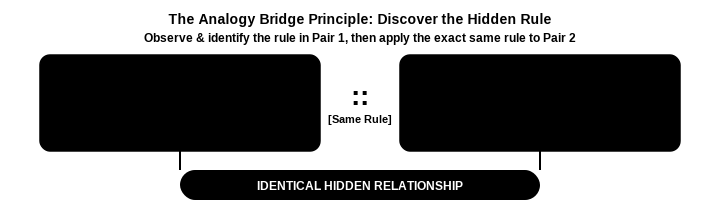
An analogy is a comparison between two different things to show how they are connected or share a specific relationship. In reasoning and problem-solving, an analogy gives you a first pair of items that follow a clear rule, and your job is to find or complete a second pair that follows that exact same rule. For instance, if the first pair links a tool to its job, the second pair must also link a tool to its job. It works like a relationship puzzle: you observe how the first two items relate, name the hidden connection between them, and use that identical logic to complete the next pair.
Word Analogies
Word analogies compare two pairs of words based on their meanings, functions, categories, or real-world connections.
Cat : Kitten :: Dog : Puppy
Relationship: Animal and its baby. A baby cat is a kitten, just as a baby dog is a puppy.
Hot : Cold :: Up : Down
Relationship: Opposites (antonyms). Hot is the opposite of cold, just as up is the opposite of down.
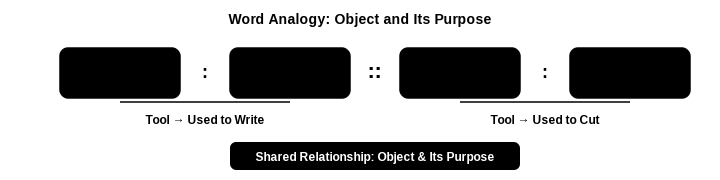
Pen : Write :: Knife : Cut
Relationship: Object and its purpose. A pen is used to write, just as a knife is used to cut.
Eye : See :: Ear : Hear
Relationship: Body part and its sense. You use your eyes to see, just as you use your ears to hear.
Doctor : Hospital :: Teacher : School
Relationship: Worker and workplace. A doctor works in a hospital, just as a teacher works in a school.
Number Analogies
Number analogies compare two pairs of numbers based on simple mathematical rules like addition, subtraction, multiplication, or division.
2 : 4 :: 5 : 10
Relationship: Multiply by 2. The first number is multiplied by 2 (2 x 2 = 4), so the same rule gives 5 x 2 = 10.
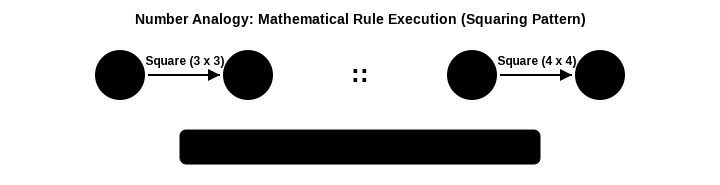
3 : 9 :: 4 : 16
Relationship: Multiply the number by itself (square). 3 x 3 = 9, so 4 x 4 = 16.
10 : 5 :: 20 : 10
Relationship: Divide by 2 (half). 10 / 2 = 5, so 20 / 2 = 10.
7 : 8 :: 12 : 13
Relationship: Add 1 (the next number). 7 + 1 = 8, so 12 + 1 = 13.
9 : 8 :: 15 : 14
Relationship: Subtract 1 (the previous number). 9 - 1 = 8, so 15 - 1 = 14.
Note :
Because you only get one pair of numbers (A and B) to figure out the rule, multiple simple patterns can seem to fit. Test-makers rarely use basic rules like "just add 5." Instead, they test your ability to spot structural relationships like multiples, powers, and sequences.
Common Relationships Explained Simply
Multiples / Division
One number is multiplied or divided by a whole number.
Example: 6 : 42 (Rule: 6 x 7 = 42)
Squares or Square Roots
One number is squared (x2) or the square root (root x).
Example: 7 : 49 (72 = 49) or 81 : 9 (root 81 = 9)
Cubes or Cube Roots
One number is cubed (x3) or the cube root (cube root of 125 = 5).
Example: 4 : 64 (43 = 64) or 125 : 5 (cube root of 125 = 5)
Squares of Related Numbers
Both numbers are squares of numbers with a link (such as consecutive, even, or odd numbers).
Example: 25 : 36 (These are 52 and 62, which are consecutive integers)
Example: 16 : 36 (These are 42 and 62, consecutive even integers)
Squares/Cubes minus a constant
Square or cube a base number, then subtract a fixed amount.
Number Properties (Consecutive, Primes, Odds, Evens)
The numbers share a set identity rather than a formula.
Example: 11 : 13 (Consecutive prime numbers)
Example: 17 : 19 (Consecutive odd prime numbers)
Key Strategy: Check Common Patterns First
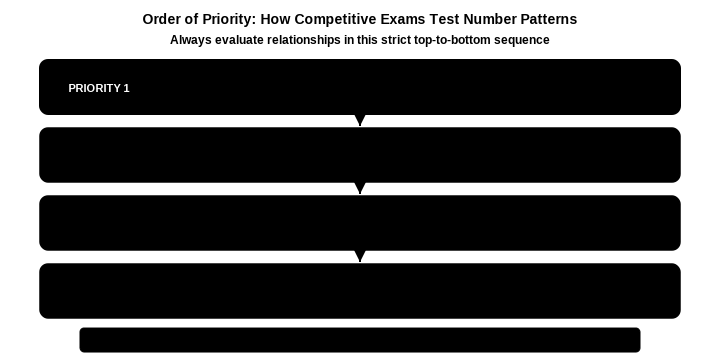
When solving analogies, check operations in this order of priority:
Prime numbers (Check if both numbers are consecutive primes)
Cubes / Squares (x3 ± k or x2 ± k)
Multiplication / Division (x x n ± k)
Addition / Subtraction (Only as a last resort if options don't match higher-order rules)
Letter Analogies
Letter analogies compare letters or groups of letters based on their order in the alphabet, case, or spelling patterns.
A : B :: P : Q
Relationship: Next alphabet letter. B comes right after A, just as Q comes right after P.
a : A :: b : B
Relationship: Small letter to capital letter. Lowercase 'a' becomes uppercase 'A', so lowercase 'b' becomes uppercase 'B'.
AB : BA :: ON : NO
Relationship: Reverse order. The two letters flip their positions.
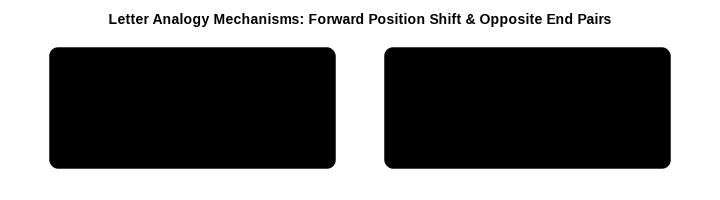
A : C :: D : F
Relationship: Skip one letter forward (+2 positions). After A, you skip B to reach C. Similarly, after D, you skip E to reach F.
A : Z :: B : Y
Relationship: Opposite ends of the alphabet. A is the 1st letter from the start and Z is the 1st from the end; B is the 2nd from the start and Y is the 2nd from the end.
Ready to Test Your Speed?
Put your analogy identification skills and speed shortcuts to the test with real exam drills.