Analytical Reasoning is the method of analyzing a given set of conditions, rules, relationships, or constraints to logically deduce the exact order, placement, pairing, or selection of entities. Instead of relying on learned formulas, it tests your ability to break down unstructured clues into an organized, step-by-step framework.
Fundamentals of Analytical Reasoning for Beginners
1. The Three Types of Clues
Every analytical puzzle provides a combination of three types of statements:
Definite Clues (Anchor Points): Direct facts that establish an exact position or relationship immediately. Example: "Arun sits at the extreme left end," or "Box C is placed on Floor 3." Strategy: Always mark definite clues first to anchor your diagram.
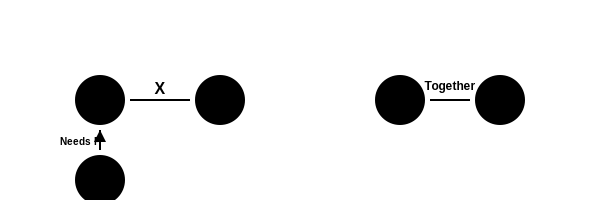
Relative Clues (Linking Statements): Clues that connect two or more entities without giving their absolute position. Example: "P sits second to the right of Q," or "There are two floors between R and S." Strategy: Connect relative clues to your anchor points. If no anchor exists yet, note them in symbolic shorthand on the side.
Negative Clues (Elimination Constraints): Statements specifying what cannot happen. Example: "M does not like Red," or "K does not sit next to L." Strategy: Write negative clues directly under or beside the respective position with a cross mark (e.g., Position 2 != K) to avoid accidentally placing them there.
2. Shorthand Notation (Symbolic Coding)
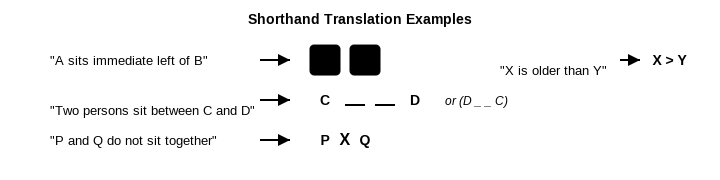
Reading a long paragraph repeatedly wastes time. Expert solvers translate sentences into short symbols instantly:
"A sits to the immediate left of B" becomes: A B
"Two persons sit between C and D" becomes: C _ _ D or D _ _ C
"P and Q do not sit together" becomes: P Q (with a slash through)
"X is older than Y" becomes: X > Y
3. The Multi-Case Approach (Branching)
When a clue creates two possible arrangements and cannot be placed definitively, never guess. Draw both possibilities side-by-side as Case 1 and Case 2. As you add further clues, one case will violate a condition and get eliminated, leaving the correct solution standing.
4. Directional Orientations
Facing North (or upward): Your right hand is their right; your left hand is their left.
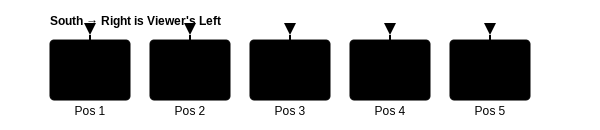
Facing South (or downward): Directions reverse. Your right hand is their left; your left hand is their right.
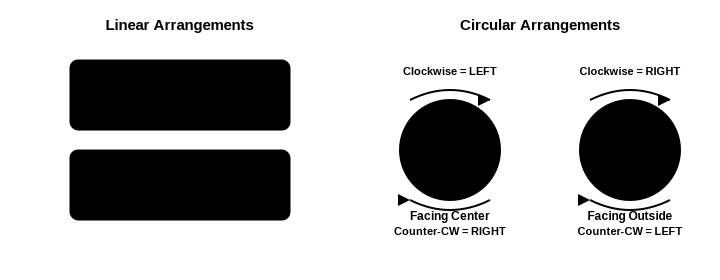
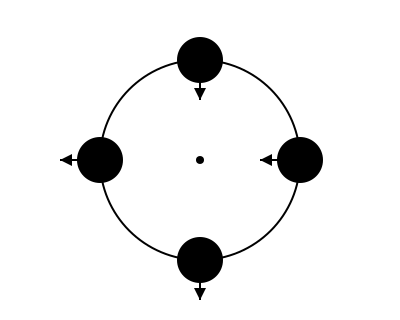
Facing Center (Circular): Clockwise movement is to the Left; Counter-clockwise movement is to the Right.
Facing Outside (Circular): Clockwise movement is to the Right; Counter-clockwise movement is to the Left.
Type 1: Linear Arrangement
Entities are arranged in a straight row or two parallel rows based on positions (ends, neighbors, gaps) and directional facing.
Example 1.1: Basic Single Row (Facing North)
Problem: Five friends (A, B, C, D, E) sit in a straight line facing North. C sits in the exact middle. A sits at the extreme left end. B sits to the immediate right of C. E does not sit at an extreme end. Determine the complete order from left to right.
1: Draw 5 spots: [1] [2] [3] [4] [5].
2: Clue 1: C is in the middle → Position 3 = C.
3: Clue 2: A sits at the extreme left end → Position 1 = A.
4: Clue 3: B is immediate right of C → Position 4 = B.
5: Clue 4: E cannot be at an extreme end (Position 5), so E must be at Position 2.
6: Remaining person D takes Position 5.
Final Order: A - E - C - B - D
Example 1.2: Six Persons with Gap Clues (Facing North)
Problem: Six people (P, Q, R, S, T, U) sit in a row facing North. S sits third to the right of P. Neither P nor S sits at any extreme end. Q sits to the immediate left of S. R sits at the extreme right end. T sits somewhere to the left of U. Find the order.
1: 6 spots: [1] [2] [3] [4] [5] [6].
2: S is third to the right of P means there are two spots between them: P _ _ S.
3: Neither is at an end, so P cannot be at 1, and S cannot be at 6. The only valid positions are Position 2 for P and Position 5 for S.
4: Q sits to the immediate left of S → Position 4 = Q.
5: R sits at the extreme right end → Position 6 = R.
6: Empty spots are 1 and 3. Since T sits to the left of U, Position 1 = T, and Position 3 = U.
Final Order: T - P - U - Q - S - R
Example 1.3: Facing South (Inverted Left/Right)
Problem: Five students (V, W, X, Y, Z) sit in a row facing South. Z sits at the extreme right end (viewer's left). W sits second to the left of Z. Y sits to the immediate left of W. X does not sit next to Z. Find the order from viewer's left to right.
1: For persons facing South, their "Left" is towards the viewer's right, and their "Right" is towards the viewer's left.
2: 5 spots: [1] [2] [3] [4] [5].
3: Z sits at the extreme right end of the row → Position 1 = Z.
4: W sits second to the left of Z → moving two spots to the left gives Position 3 = W.
5: Y sits to the immediate left of W → Position 4 = Y.
6: X does not sit next to Z (Position 2), so X must be at Position 5.
7: Remaining person V takes Position 2.
Final Order (Positions 1 to 5): Z - V - W - Y - X
Example 1.4: Parallel Rows Facing Each Other
Problem: Six persons sit in two parallel rows. Row 1 faces South: A, B, C. Row 2 faces North: D, E, F. Each person in Row 1 faces a person in Row 2. B sits in the middle of Row 1. E sits opposite B. A sits to the right of B. D sits to the immediate right of E. Find the opposite pairs.
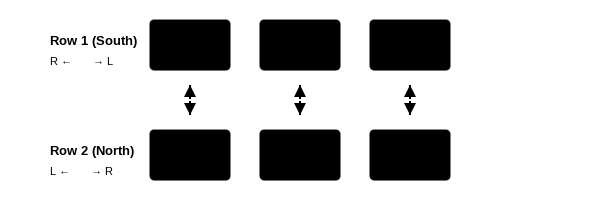
1: Row 1 (South): Spots 1, 2, 3 (viewer's left to right). Facing South, spot 1 is Right and spot 3 is Left.
2: Row 2 (North): Spots 1, 2, 3 (viewer's left to right). Facing North, spot 1 is Left and spot 3 is Right.
3: Row 1 middle is B (Position 2). E faces B, so Row 2 middle is E (Position 2).
4: A sits to the right of B in Row 1 → Position 1 = A. Remaining spot 3 in Row 1 = C.
5: In Row 2, D is to the immediate right of E → Position 3 = D. Remaining spot 1 in Row 2 = F.
Final Pairs: A faces F, B faces E, C faces D.
Example 1.5: Linear Row with an Attribute
Problem: Four friends (K, L, M, N) sit facing North wearing caps of different colors (Blue, Red, Green, Yellow). The person wearing Blue sits at the extreme left end. M sits second to the right of the person in Blue. L sits to the immediate right of M and wears Yellow. K wears Red. Which color does M wear, and who wears Blue?
1: Spots: [1] [2] [3] [4].
2: Clue 1: Position 1 cap = Blue.
3: Clue 2: M sits second to the right of Position 1 → Position 3 = M.
4: Clue 3: L sits to the immediate right of M (Position 4 = L) and wears Yellow.
5: Clue 4: K wears Red. Position 1 is already Blue, so K cannot be at 1. Thus, Position 2 = K (Red).
6: Remaining person N takes Position 1 (Blue). Remaining cap color for M is Green.
Final Result: N wears Blue; M wears Green. Order: N(Blue) - K(Red) - M(Green) - L(Yellow).
Type 2: Circular and Closed-Loop Arrangement
Entities sit around a circular, square, or rectangular table facing either inward toward the center, outward, or a combination of both.
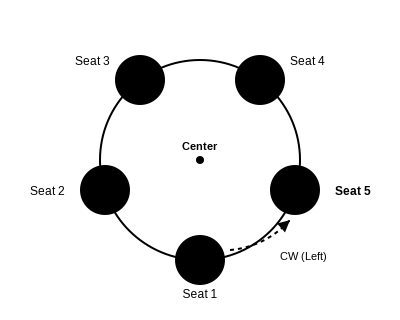
Example 2.1: Five Persons Facing Center
Problem: A, B, C, D, and E sit around a circular table facing the center. A sits second to the left of B. C sits to the immediate left of A. D sits second to the right of C. Where does E sit?
1: Draw a circle with 5 equidistant seats numbered 1 to 5 clockwise. Facing center: Clockwise is Left, Counter-clockwise is Right.
2: Fix B at Seat 1.
3: A is second to the left (clockwise) of B: Seat 1 → 2 → Seat 3 = A.
4: C is to the immediate left (clockwise) of A: Seat 3 → Seat 4 = C.
5: D sits second to the right (counter-clockwise) of C: From Seat 4, go counter-clockwise: Seat 4 → 3 → Seat 2 = D.
6: Seat 5 is left for E.
Final Arrangement (Clockwise from B): B (Seat 1), D (Seat 2), A (Seat 3), C (Seat 4), E (Seat 5). E sits between C and B.
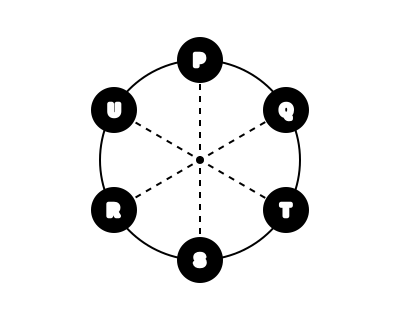
Example 2.2: Six Persons Facing Center
Problem: Six people (P, Q, R, S, T, U) sit around a circular table facing the center. P sits opposite S. Q sits to the immediate left of P. R sits to the immediate left of S. T sits between Q and S. Who sits opposite Q?
3: Facing center, Left is clockwise. Immediate left of P (Seat 1) is Seat 2 = Q.
4: Immediate left of S (Seat 4) is Seat 5 = R.
5: T sits between Q (Seat 2) and S (Seat 4) → Seat 3 = T.
6: Remaining Seat 6 = U.
Final Result: Seat 2 (Q) is directly opposite Seat 5 (R). R sits opposite Q.
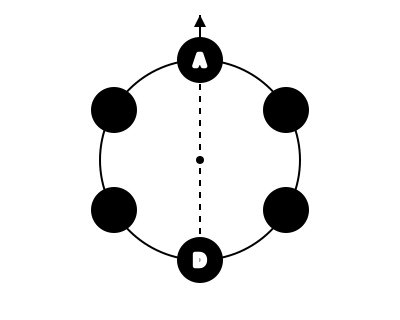
Example 2.3: Six Persons Facing Outside
Problem: Six people (A, B, C, D, E, F) sit around a circular table facing away from the center. A sits opposite D. E sits to the immediate right of A. B sits to the immediate right of E. C sits to the immediate right of D. F sits between C and A. Who sits to the immediate left of D?
1: Facing outside reverses movement: Clockwise is Right, Counter-clockwise is Left.
2: Let Seat 1 = A. Opposite is Seat 4 = D.
3: E is to the immediate right (clockwise) of A → Seat 2 = E.
4: B is to the immediate right (clockwise) of E → Seat 3 = B.
5: C is to the immediate right (clockwise) of D (Seat 4) → Seat 5 = C.
6: F sits between C (Seat 5) and A (Seat 1) → Seat 6 = F.
7: Immediate left of D (Seat 4) is counter-clockwise → Seat 3 = B.
Final Result: B sits to the immediate left of D.
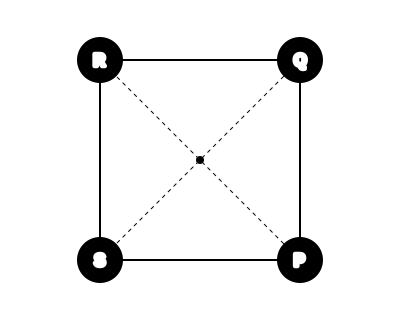
Example 2.4: Square Table
Problem: Four friends (P, Q, R, S) sit at the four corners of a square table facing the center. P sits to the immediate right of S. R sits diagonally opposite P. Where does Q sit relative to R?
1: Four corners: NW, NE, SE, SW. Facing center: Clockwise is Left, Counter-clockwise is Right.
2: Place S at SW. The corner to the immediate right (counter-clockwise) of SW is SE. So SE = P.
3: R sits diagonally opposite P (SE) → NW = R.
4: The remaining corner NE must be Q.
5: Relative to R (NW): Counter-clockwise is SW (S), Clockwise (Left) is NE (Q).
Final Result: Q sits to the immediate left of R (or diagonally opposite S).
Example 2.5: Mixed Directions
Problem: Four people (A, B, C, D) sit around a circle. Two face the center, and two face outward. A faces the center and sits opposite C. C faces outward. D sits to the immediate left of C. B sits to the immediate right of A. Which direction does D face if B faces outward?
2: Place A at Seat 1 (North), facing Center (Southward).
3: C is opposite A → Seat 3 (South), facing Outward (Southward).
4: For C at South facing outward, Left is towards East (Seat 2). Thus, Seat 2 = D.
5: Remaining Seat 4 = B.
6: We know C faces outward, and B faces outward (total 2 outward). Therefore, the remaining two (A and D) must face the center.
Final Result: D faces the center.
Type 3: Tabulation & Matrix Matching
Matching distinct categories (e.g., person, profession, city, color) using a two-dimensional grid or elimination table.
Example 3.1: Three Persons, Three Professions, Three Cities
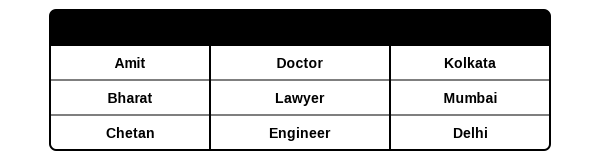
Problem: Three professionals—Amit, Bharat, and Chetan—work as a Doctor, Engineer, and Lawyer, living in Delhi, Mumbai, and Kolkata. Amit is not a Lawyer and does not live in Mumbai. The Doctor lives in Kolkata. Chetan lives in Delhi. The Lawyer does not live in Delhi. Find each person's profession and city.
1: Chetan = Delhi. Doctor = Kolkata. Since Chetan is in Delhi, he is NOT the Doctor.
2: Lawyer != Delhi. Since Chetan is in Delhi, he is NOT the Lawyer. Thus, Chetan = Engineer.
3: Amit is NOT Lawyer → Amit = Doctor. Since Doctor = Kolkata, Amit = Kolkata.
4: Remaining: Bharat = Lawyer, City = Mumbai.
Example 3.2: Four Friends and Favorite Colors
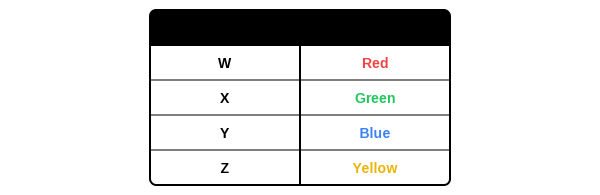
Problem: Four friends (W, X, Y, Z) each like a unique color (Red, Blue, Green, Yellow). W likes neither Blue nor Yellow. X likes Green. Y does not like Yellow. Which color does Z like?
1: X likes Green (Fixed). Colors left for W, Y, Z: Red, Blue, Yellow.
2: W does not like Blue or Yellow, so W must like Red. Colors left for Y and Z: Blue, Yellow.
3: Y does not like Yellow, so Y must like Blue.
4: The only remaining color for Z is Yellow.
Final Result: Z likes Yellow.
Example 3.3: Students, Hobbies, and Instruments
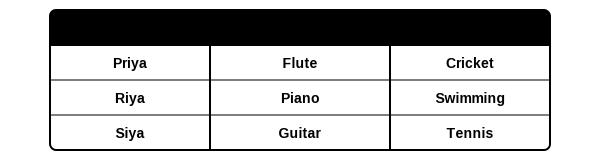
Problem: Three students (Priya, Riya, Siya) play one instrument (Guitar, Piano, Flute) and one sport (Cricket, Tennis, Swimming). Priya plays Flute but not Tennis. The person who plays Piano swims. Siya plays Tennis. Find Riya's instrument and sport.
1: Priya plays Flute. Because the Piano player swims, Priya cannot be the swimmer.
2: Priya does not play Tennis and does not swim, so Priya must play Cricket.
3: Siya plays Tennis, leaving Swimming for Riya.
4: Since the swimmer plays Piano, Riya plays Piano (and swims), and Siya plays Guitar.
Final Output: Riya plays the Piano and practices Swimming.
Example 3.4: Four Cars, Colors, and Owners
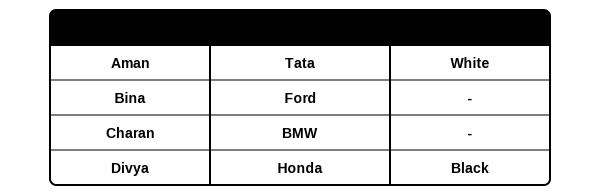
Problem: Four people (Aman, Bina, Charan, Divya) own cars (Tata, Honda, Ford, BMW) in colors (White, Black, Silver, Red). Aman owns a White car. Bina owns a Ford, which is not Silver. Charan owns a BMW. The Honda car is Black. Which car brand and color does Divya own?
1: Fixed brand assignments: Bina owns Ford, and Charan owns BMW. The two remaining brands are Tata and Honda.
2: The Honda is Black, while Aman's car is White, so Aman cannot own the Honda.
3: Therefore, Aman must own the White Tata.
4: That leaves the remaining brand, Honda, for Divya. Because the Honda is Black, Divya owns a Black Honda.
Final Result: Divya owns a Black Honda.
Example 3.5: Multi-Variable Department Puzzle
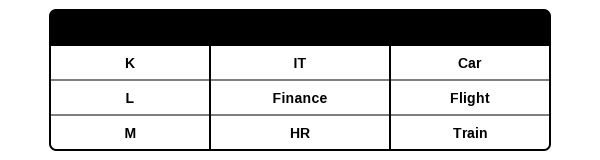
Problem: Three managers (K, L, M) lead HR, Finance, and IT. They travel using Train, Flight, and Car. The HR manager does not travel by Car. L is the Finance manager and travels by Flight. K does not lead HR. How does the IT manager travel?
1: L = Finance, Flight. Managers left: K and M. Departments left: HR and IT.
2: K does not lead HR → K = IT. Therefore, M = HR.
3: Travel modes left: Train and Car. HR manager (M) does not travel by Car → M travels by Train.
4: The remaining travel mode for K (IT manager) is Car.
Final Result: The IT manager (K) travels by Car.
Type 4: Scheduling, Floor, and Box Puzzles
Entities are placed in strict sequential levels, chronological order, or vertical stacks based on rank or time constraints.
Example 4.1: Five Days of the Week (Scheduling)
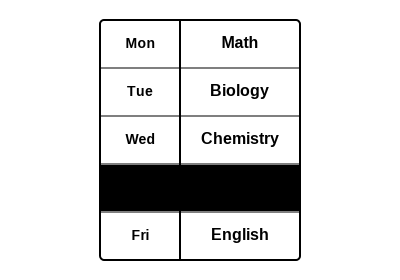
Problem: Five lectures (Math, Physics, Chemistry, English, Biology) are scheduled from Monday to Friday. Chemistry is held on Wednesday. Exactly one lecture is held between Chemistry and English, and English is held after Chemistry. Math is held on the day immediately before Biology. On which day is Physics scheduled?
Problem: 5 persons (P,Q,R,S,T) on 5 floors (1 is bottom). R is on an odd floor. Exactly two persons between R and T, where T is above R. P lives immediately above S. Q lives on the topmost floor. Find Floor 1.
1: Q is on topmost → Floor 5 = Q.
2: R is odd. If R=3, T is two above → Floor 6 (Impossible). So R must be Floor 1.
3: Two floors between R(1) and T → Floor 4 = T.
4: P immediately above S. Only consecutive vacant spots are 3 and 2. Floor 3 = P, Floor 2 = S.
Final Result: R lives on Floor 1.
Example 4.3: Vertical Box Stacking
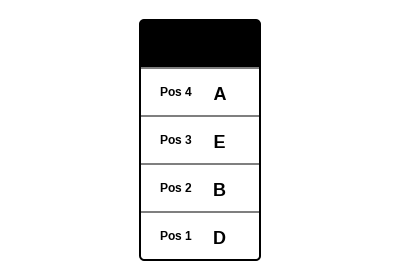
Problem: Five boxes (A, B, C, D, E) are stacked one above another. Box C is kept immediately above Box A. Exactly two boxes are kept between Box A and Box D. Box D is kept at the bottom of the stack (Position 1). Box E is kept above Box B. Which box is kept at the very top (Position 5)?
1: Stack numbered 1 (bottom) to 5 (top). Clue 3: Position 1 = Box D.
2: Clue 2: Two boxes between D and A → Position 4 = Box A.
3: Clue 1: C is immediately above A → Position 5 = Box C.
4: Empty spots are 2 and 3. Clue 4 says Box E is kept above Box B → Position 3 = Box E, Position 2 = Box B.
Final Result: Box C is at the top. Stack from top to bottom: C - A - E - B - D.
Example 4.4: Month-Based Scheduling
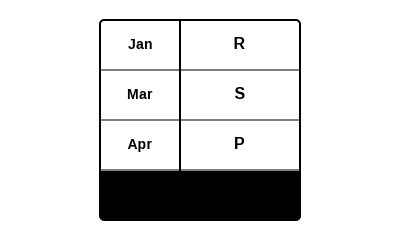
Problem: Four seminars (P, Q, R, S) are held in four different months of the same year: January, March, April, and June. Seminar P is held in a 30-day month and immediately before Seminar Q. Seminar R is held immediately before Seminar S. In which month is Seminar Q held?
1: Month lengths: Jan (31), Mar (31), Apr (30), Jun (30). Seminar P is in a 30-day month (April or June).
2: Because P is immediately before Q, P cannot be in June (the last month). Thus, P = April and Q = June.
3: The two remaining consecutive months are January and March. Since R is immediately before S, R = January and S = March.
Final Result: Seminar Q is held in June (Schedule: Jan: R, Mar: S, Apr: P, Jun: Q).
Example 4.5: Six-Floor Building with Gaps
Problem: Six people (A, B, C, D, E, F) live on Floors 1 to 6 (Floor 6 is the top floor). A lives on Floor 6. Three people live between A and B. C lives immediately above D on Floors 5 and 4. F lives on the bottom floor (Floor 1). Find who lives on Floor 3.
1: Floor 6 = A. Three people live between A and B (Floors 5, 4, and 3), so Floor 2 = B.
2: C lives immediately above D on Floors 5 and 4, so Floor 5 = C and Floor 4 = D.
3: F lives on the bottom floor, so Floor 1 = F.
4: The only remaining floor is Floor 3, which must belong to E (an odd-numbered floor).
Final Result: E lives on Floor 3 (Top to bottom: F6: A, F5: C, F4: D, F3: E, F2: B, F1: F).
Type 5: Selection and Conditional Grouping
Selecting a valid sub-group or committee from a larger pool based on mutual inclusion, mutual exclusion, or quota rules.
Example 5.1: Committee of Three
Problem: A committee of 3 members must be selected from 5 candidates: A, B, C, D, E. If A is selected, B cannot be selected. Exactly one between C and D must be selected. E must be selected. Who are the members of the committee?
1: Total needed = 3 members. By Clue 3, E is definitely selected (1 member chosen: E; 2 needed).
2: By Clue 2, exactly one from {C, D} is chosen (1 more chosen; 1 needed).
3: The third member must come from {A, B}. Clue 1 states: "If A is selected, B cannot be selected." This allows selecting A alone, or B alone.
4: If an additional condition says "B is rejected due to age," then A must be selected.
Final Team: {A, E, and either C or D}.
Example 5.2: Gender-Balanced Team
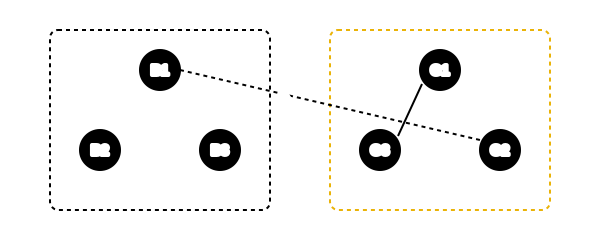
Problem: A team of 4 people is to be chosen from 3 boys (B1, B2, B3) and 3 girls (G1, G2, G3). The team must have exactly 2 boys and 2 girls. B1 refuses to work if G2 is on the team. G1 and G3 must always be selected together. If G1 is selected, who are the four members?
1: Total team = 2 boys and 2 girls. It is given that G1 is selected.
2: By Clue 3, G1 and G3 must be together → G3 is also selected. We now have our 2 girls: {G1, G3}. (G2 is therefore excluded).
3: We now need 2 boys from {B1, B2, B3}. Clue 2 says B1 refuses to work if G2 is selected. Since G2 is NOT selected, B1 has no conflict and can be selected.
4: Any 2 boys can be picked from {B1, B2, B3}. If a rule specifies "B2 cannot be with B3," then B1 must be selected alongside either B2 or B3.
Final Team: {G1, G3, B1, and B2} or {G1, G3, B1, and B3}.
Example 5.3: Conditional Project Team
Problem: A panel of 3 experts is to be chosen from P, Q, R, S, T. P and Q cannot be together. R and S must always be together. T cannot be chosen unless P is chosen. Can R and S be chosen together?
1: Suppose we choose R and S (2 members). We need 1 more member from {P, Q, T}.
2: Can we choose T? Clue 3 says T cannot be chosen unless P is chosen. If we pick T, P must also come, making 4 members (R, S, T, P), but the panel size is strictly 3. So T cannot be picked.
3: We can pick P (without T). The team becomes {R, S, P}. Check Clue 1: P and Q cannot be together (satisfied, Q is not chosen).
4: Alternatively, we can pick Q. The team becomes {R, S, Q}. Check Clue 1: satisfied.
Final Answer: Yes, R and S can form a valid team with either P or Q: {R, S, P} or {R, S, Q}.
Example 5.4: Department Task Force
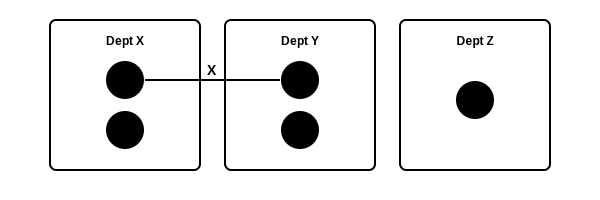
Problem: Choose 3 representatives from Depts X (X1, X2), Y (Y1, Y2), and Z (Z1). At least two departments must be represented. If X1 is selected, Y1 cannot be selected. Z1 must be selected. If X1 is selected, who is the third member?
1: Total needed = 3 members. Selected so far: Z1 (Clue 3) and X1 (Given). That is 2 members.
2: We need 1 more member from {X2, Y1, Y2}. Clue 2: If X1 is selected, Y1 cannot be selected. So Y1 is eliminated.
3: Choices for the 3rd member: X2 or Y2. Check Clue 1: "At least two departments must be represented." Since X1 (Dept X) and Z1 (Dept Z) are already selected, two departments are already represented. Therefore, either X2 or Y2 can be the third member.
Final Possible Teams: {Z1, X1, X2} or {Z1, X1, Y2}.
Example 5.5: Mutual Inclusion and Exclusion
Problem: A travel group of 3 is formed from A, B, C, D. A and B are mutually inclusive. C and D are mutually exclusive. How many different combinations of 3 members can be formed?
1: Case 1: Both A and B are selected. We need 1 more person from {C, D}. If we pick C: Team is {A, B, C}. If we pick D: Team is {A, B, D}. This gives 2 valid teams.
2: Case 2: Neither A nor B is selected. We would need 3 members from the remaining pool {C, D}, which only has 2 people. Impossible.
3: Case 3: Exactly one of A or B is selected. Violates Clue 1 (they must go together).
Final Answer: Exactly 2 combinations are possible: {A, B, C} and {A, B, D}.
Strategy Summary for Quick Solving
Read the Full Constraint Block First: Never start drawing on clue 1 alone. Skim all rules to identify the primary anchor points.
Set Up a Fixed Frame: Draw the exact empty boxes for rows, floors, or tables before assigning names.
Fill Anchors First: Place the 100% certain positions directly into your frame.
Use Parallel Branches: Create Case 1 and Case 2 if a clue is ambiguous. Do not guess mentally.
Re-check Every Constraint: Test the final arrangement against all rules to ensure zero contradictions.
Ready to Test Your Analytical Speed?
Put your deduction skills to the test with structured reasoning puzzles and constraint challenges.