Assertion and Reason

Assertion and Reason is a critical reasoning topic designed to test two distinct skills simultaneously: factual knowledge (whether you know the facts) and logical deduction (whether you understand the causal link between two statements).
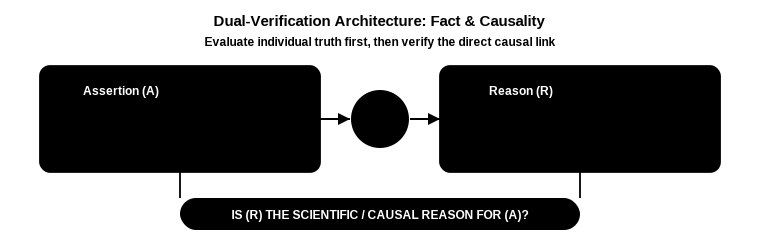
The fundamental Assertion and Reason verification architecture — Dual-Verification Architecture: Fact & Causality.
Diagram text

Dual-Verification Architecture: Fact & Causality · Evaluate individual truth first, then verify the direct causal link

Assertion (A) · Fact • Observation • Claim · Evaluated for Truth Independently

BECAUSE · TEST

Reason (R) · Principle • Cause • Explanation · Evaluated for Truth Independently

IS (R) THE SCIENTIFIC / CAUSAL REASON FOR (A)?

Fundamentals of Assertion and Reason

In every question, you are given two statements:

1. Assertion (A): A statement that asserts a fact, claim, observation, or conclusion.
2. Reason (R): A statement that provides a cause, scientific explanation, principle, or justification.

Your job is not simply to read them as a paragraph, but to evaluate their individual truth and their logical relationship.

The 4 Standard Response Options

Most competitive examination questions provide four standardized options:

Option A: Both Assertion (A) and Reason (R) are true, and Reason (R) is the correct explanation of Assertion (A).
Option B: Both Assertion (A) and Reason (R) are true, but Reason (R) is NOT the correct explanation of Assertion (A).
Option C: Assertion (A) is true, but Reason (R) is false.
Option D: Assertion (A) is false, but Reason (R) is true.

(Occasionally, tests include a fifth option: Option E: Both Assertion (A) and Reason (R) are false).
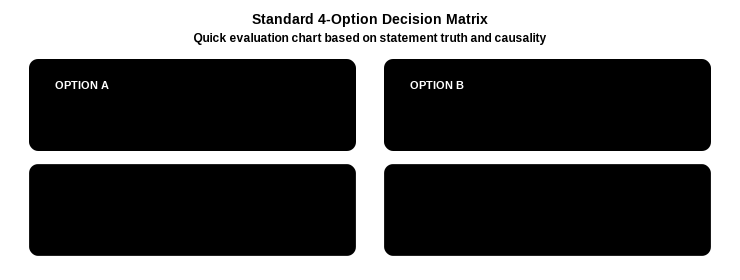
The 4 Standard Response Options Decision Matrix.
Diagram text

Standard 4-Option Decision Matrix · Quick evaluation chart based on statement truth and causality

OPTION A · A is True • R is True · R is the correct causal explanation of A

OPTION B · A is True • R is True · R is NOT the explanation of A (No causal link)

OPTION C · A is True • R is False · Work finishes instantly once R is proved false

OPTION D · A is False • R is True · Work finishes instantly once A is proved false

The 3-Step Solving Technique (The "Because" Test)

To solve any question accurately without falling into traps, follow this fixed order:

Step 1: Check the Truth of Assertion (A) independently.
Read statement (A) as if statement (R) does not exist. Is (A) true or false based on established facts, science, or logic?
Step 2: Check the Truth of Reason (R) independently.
Read statement (R) as if statement (A) does not exist. Is (R) true or false on its own merits?
Shortcut Rule: If either statement is false, your work is finished. If (A) is true and (R) is false, pick Option C. If (A) is false and (R) is true, pick Option D.
Step 3: Test the Logical Connection (Apply the "Because" Test).
If both statements are true, you must determine whether to pick Option A or Option B.
Join them into a single sentence by inserting the word "BECAUSE" between them:
[Assertion (A)] because [Reason (R)]
  • If the combined sentence makes direct, logical, causal sense, choose Option A.
  • If both statements are completely true facts, but the reason fails to explain why the assertion happens, choose Option B.
The 3-step solving technique flowchart.
Diagram text

Step-by-Step Solving Flowchart

STEP 1 · Check (A) Truth · Is Assertion true · on its own?

STEP 2 · Check (R) Truth · Is Reason true · on its own?

STEP 3 · The "Because" Test · Connect with 'because': · Pick Option A or B

Shortcut: If either is False → Stop immediately at Step 2 (Choose C or D)

Core Types Used in Reasoning

Competitive reasoning question banks categorize Assertion and Reason problems into five primary types:
1. Scientific and Physical Laws (Core science, physics, chemistry, biology)
2. Cause and Practical Effect (Real-life phenomena, actions, and direct consequences)
3. Social Sciences and Facts (Geography, history, polity, economics)
4. Independent True Facts (Designed specifically to trap students into confusing Option A with Option B)
5. Mathematical and Quantitative Principles (Numbers, formulas, geometric properties)
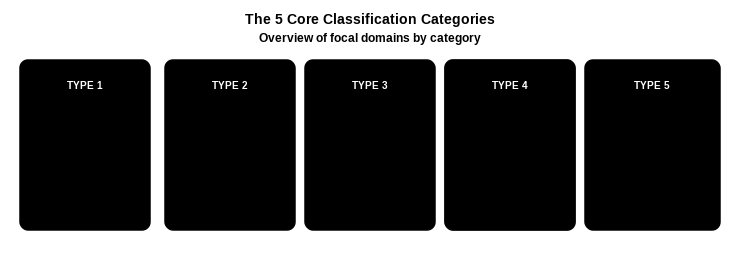
The 5 Core Types of Assertion and Reason Questions — The 5 Core Classification Categories.
Diagram text

The 5 Core Classification Categories · Overview of focal domains by category

TYPE 1 · Scientific · Laws · Physics, Chem, · & Biology

TYPE 2 · Cause & · Effect · Real life & · Safety drills

TYPE 3 · Social · Sciences · Polity, History, · & Geography

TYPE 4 · Parallel · Facts · Option B Trap · (No causality)

TYPE 5 · Quantitative · Rules · Geometry & · Arithmetic

Type 1: Scientific and Physical Laws

These questions deal with universal laws of nature, physics, chemistry, and biology where the reason is the governing principle behind the physical phenomenon.

Example 1 Answer: (A)
Assertion (A): An iron needle sinks in water, but a large ship made of iron floats.
Reason (R): The average density of a ship is less than that of water, whereas the density of an iron needle is greater than that of water.
  • (A) Both A and R are true, and R is the correct explanation of A.
  • (B) Both A and R are true, but R is not the correct explanation of A.
  • (C) A is true, but R is false.
  • (D) A is false, but R is true.
Explanation:
Step 1: (A) is a true physical fact.
Step 2: (R) is factually correct according to Archimedes' principle.
Step 3: Test with "because": A ship floats because its hollow shape makes its average density lower than water. Thus, R correctly explains A.
Example 2 Answer: (A)
Assertion (A): The sky appears blue during a clear, sunny day.
Reason (R): Blue light has a shorter wavelength and is scattered more by atmospheric molecules than red light.
  • (A) Both A and R are true, and R is the correct explanation of A.
  • (B) Both A and R are true, but R is not the correct explanation of A.
  • (C) A is true, but R is false.
  • (D) A is false, but R is true.
Explanation:
Step 1: (A) is true.
Step 2: (R) is true (Rayleigh scattering law).
Step 3: The scattering of shorter wavelengths directly causes the sky to appear blue. R is the correct scientific explanation.
Example 3 Answer: (A)
Assertion (A): Water boils at a lower temperature on top of high mountains than at sea level.
Reason (R): Atmospheric pressure decreases as altitude increases.
  • (A) Both A and R are true, and R is the correct explanation of A.
  • (B) Both A and R are true, but R is not the correct explanation of A.
  • (C) A is true, but R is false.
  • (D) A is false, but R is true.
Explanation:
Boiling happens when vapor pressure equals external atmospheric pressure. Lower pressure at high altitudes means less heat is needed for water to boil. Both are true, and R directly explains A.
Example 4 Answer: (C)
Assertion (A): Human blood appears red.
Reason (R): Hemoglobin is a copper-containing pigment found inside white blood cells.
  • (A) Both A and R are true, and R is the correct explanation of A.
  • (B) Both A and R are true, but R is not the correct explanation of A.
  • (C) A is true, but R is false.
  • (D) A is false, but R is true.
Explanation:
Step 1: (A) is true (blood is red).
Step 2: (R) is false. Hemoglobin contains iron (not copper) and is present in red blood cells (erythrocytes), not white blood cells. Since R is false, the answer is directly C.
Example 5 Answer: (D)
Assertion (A): Sound waves travel faster in a complete vacuum than in air.
Reason (R): Sound waves require a material medium to propagate.
  • (A) Both A and R are true, and R is the correct explanation of A.
  • (B) Both A and R are true, but R is not the correct explanation of A.
  • (C) A is true, but R is false.
  • (D) A is false, but R is true.
Explanation:
Step 1: (A) is false. Sound is a mechanical wave and cannot travel through a vacuum at all.
Step 2: (R) is a true scientific fact. Since A is false and R is true, the answer is D.

Type 2: Cause and Practical Effect

These questions focus on human habits, everyday observations, safety mechanisms, or real-life engineering solutions.

Example 1 Answer: (A)
Assertion (A): Electric telephone wires strung between poles are allowed to sag slightly during summer installation.
Reason (R): Metal wires contract during winter cold, and tightly strung wires could snap under excessive tension.
  • (A) Both A and R are true, and R is the correct explanation of A.
  • (B) Both A and R are true, but R is not the correct explanation of A.
  • (C) A is true, but R is false.
  • (D) A is false, but R is true.
Explanation:
Both statements are true. Leaving slack in summer accounts for thermal contraction in winter. R explains the practical purpose of A.
Example 2 Answer: (A)
Assertion (A): Drivers and passengers are legally mandated to wear seatbelts in moving vehicles.
Reason (R): A seatbelt prevents the body from being thrown forward due to inertia during sudden braking.
  • (A) Both A and R are true, and R is the correct explanation of A.
  • (B) Both A and R are true, but R is not the correct explanation of A.
  • (C) A is true, but R is false.
  • (D) A is false, but R is true.
Explanation:
Both statements are true. Inertia of motion keeps the upper body moving forward when brakes are applied. The seatbelt counters this force, making R the exact explanation for A.
Example 3 Answer: (C)
Assertion (A): Salt is spread on icy roads in freezing winter climates.
Reason (R): Spreading salt raises the freezing point of water above 0 degrees Celsius.
  • (A) Both A and R are true, and R is the correct explanation of A.
  • (B) Both A and R are true, but R is not the correct explanation of A.
  • (C) A is true, but R is false.
  • (D) A is false, but R is true.
Explanation:
(A) is true (salt is used to melt ice on roads).
(R) is false. Adding salt lowers (depresses) the freezing point of water below 0 degrees Celsius, preventing ice from reforming at standard freezing temperatures. Therefore, A is true, but R is false.
Example 4 Answer: (A)
Assertion (A): Athletes run some distance before taking a long jump.
Reason (R): Running helps the athlete gain inertia of motion, which carries them further through the air.
  • (A) Both A and R are true, and R is the correct explanation of A.
  • (B) Both A and R are true, but R is not the correct explanation of A.
  • (C) A is true, but R is false.
  • (D) A is false, but R is true.
Explanation:
Both statements are true. Gaining forward horizontal velocity prior to takeoff increases horizontal range. R provides the underlying physical reason for A.
Example 5 Answer: (A)
Assertion (A): A person gets a backward jolt on their shoulder when firing a rifle.
Reason (R): According to Newton's third law of motion, every action has an equal and opposite reaction.
  • (A) Both A and R are true, and R is the correct explanation of A.
  • (B) Both A and R are true, but R is not the correct explanation of A.
  • (C) A is true, but R is false.
  • (D) A is false, but R is true.
Explanation:
Both statements are true. As the bullet is pushed forward, the rifle recoils backward with equal force. R explains A.

Type 3: Social Sciences (History, Polity, and Geography)

These questions test structured academic facts across geography, governance, constitutions, and historical events.

Example 1 Answer: (A)
Assertion (A): The Western coastal plains of India receive significantly higher rainfall during the southwest monsoon than the interior Deccan plateau.
Reason (R): The Western Ghats act as a physical barrier that forces moisture-laden Arabian Sea winds to rise and produce orographic rainfall.
  • (A) Both A and R are true, and R is the correct explanation of A.
  • (B) Both A and R are true, but R is not the correct explanation of A.
  • (C) A is true, but R is false.
  • (D) A is false, but R is true.
Explanation:
Both statements are geographically accurate. The windward side of the Western Ghats receives relief/orographic rain, leaving the Deccan plateau in the rain shadow. R correctly explains A.
Example 2 Answer: (A)
Assertion (A): The Rajya Sabha is known as a permanent house of Parliament.
Reason (R): It cannot be dissolved by the President, and one-third of its members retire every two years.
  • (A) Both A and R are true, and R is the correct explanation of A.
  • (B) Both A and R are true, but R is not the correct explanation of A.
  • (C) A is true, but R is false.
  • (D) A is false, but R is true.
Explanation:
Both statements are true under constitutional provisions. The staggered retirement ensures continuity, which is precisely why it is termed a permanent body.
Example 3 Answer: (A)
Assertion (A): The Harappan (Indus Valley) civilization is recognized as an urban civilization.
Reason (R): Excavated Harappan cities show planned street grids, burnt-brick houses, and covered underground drainage systems.
  • (A) Both A and R are true, and R is the correct explanation of A.
  • (B) Both A and R are true, but R is not the correct explanation of A.
  • (C) A is true, but R is false.
  • (D) A is false, but R is true.
Explanation:
Both are true historical facts. Advanced civic architecture and municipal sanitation define urban planning in antiquity. R explains A.
Example 4 Answer: (C)
Assertion (A): The President of India can declare a Financial Emergency under Article 360 of the Constitution.
Reason (R): A Financial Emergency has been declared in India four times since independence.
  • (A) Both A and R are true, and R is the correct explanation of A.
  • (B) Both A and R are true, but R is not the correct explanation of A.
  • (C) A is true, but R is false.
  • (D) A is false, but R is true.
Explanation:
(A) is true (Article 360 empowers the President to declare a Financial Emergency).
(R) is false. A Financial Emergency has never been declared in India so far. Therefore, A is true, but R is false.
Example 5 Answer: (A)
Assertion (A): Tropical rainforests are characterized by dense vegetation and multi-layered tree canopies.
Reason (R): These regions receive high temperatures and abundant rainfall distributed throughout the year.
  • (A) Both A and R are true, and R is the correct explanation of A.
  • (B) Both A and R are true, but R is not the correct explanation of A.
  • (C) A is true, but R is false.
  • (D) A is false, but R is true.
Explanation:
Both statements are true. Continuous moisture and high heat support year-round plant growth without shedding seasons. R directly explains A.

Type 4: Independent True Facts (The "Option B" Trap)

In this type, test makers present two statements that are both 100% true, but they describe unrelated facts. Beginners frequently pick Option A simply because both sound correct. This type trains you to detect the absence of a causal link.

Comparing Option A Causal Link with Option B Parallel Facts.
Diagram text

Option A (Causal Link) vs. Option B (Parallel Facts)

OPTION A: Direct Causality · Fact A [True] · Caused by · Fact R [True] · ✓ "Because" makes perfect sense

OPTION B: The "Parallel Fact" Trap · Fact A [True] · ✗ · Fact R [True] · ✗ No cause-effect relationship

Example 1 Answer: (B)
Assertion (A): Photosynthesis occurs primarily in the leaves of green plants.
Reason (R): The Earth revolves around the Sun in an elliptical orbit once every 365.25 days.
  • (A) Both A and R are true, and R is the correct explanation of A.
  • (B) Both A and R are true, but R is not the correct explanation of A.
  • (C) A is true, but R is false.
  • (D) A is false, but R is true.
Explanation:
Step 1: (A) is true.
Step 2: (R) is true.
Step 3: Run the "because" test: "Photosynthesis occurs in leaves because Earth revolves around the Sun." This makes no sense; chlorophyll and sunlight absorption explain photosynthesis, not planetary orbital mechanics. Both are true, but R does not explain A.
Example 2 Answer: (B)
Assertion (A): Diamond is an extremely hard, naturally occurring substance.
Reason (R): Gold is highly ductile and can be drawn into very thin wires.
  • (A) Both A and R are true, and R is the correct explanation of A.
  • (B) Both A and R are true, but R is not the correct explanation of A.
  • (C) A is true, but R is false.
  • (D) A is false, but R is true.
Explanation:
Diamond is hard due to its rigid 3D tetrahedral carbon lattice. Gold's ductility is a metallic property. Both statements are true, but R has zero relation to diamond's hardness.
Example 3 Answer: (B)
Assertion (A): Deficiency of Vitamin C causes the disease called scurvy.
Reason (R): Human skin synthesizes Vitamin D when exposed to ultraviolet rays of sunlight.
  • (A) Both A and R are true, and R is the correct explanation of A.
  • (B) Both A and R are true, but R is not the correct explanation of A.
  • (C) A is true, but R is false.
  • (D) A is false, but R is true.
Explanation:
Both statements are scientifically true facts about human nutrition. However, the production of Vitamin D has nothing to do with why a lack of Vitamin C leads to scurvy.
Example 4 Answer: (B)
Assertion (A): New Delhi is the national capital of India.
Reason (R): The Indian Rupee is the legal currency used across India.
  • (A) Both A and R are true, and R is the correct explanation of A.
  • (B) Both A and R are true, but R is not the correct explanation of A.
  • (C) A is true, but R is false.
  • (D) A is false, but R is true.
Explanation:
Both statements are true, but the currency system does not explain why Delhi was chosen as the capital territory.
Example 5 Answer: (B)
Assertion (A): Mount Everest is the highest mountain peak above sea level in the world.
Reason (R): The Nile is widely recognized as the longest river on Earth.
  • (A) Both A and R are true, and R is the correct explanation of A.
  • (B) Both A and R are true, but R is not the correct explanation of A.
  • (C) A is true, but R is false.
  • (D) A is false, but R is true.
Explanation:
Both are undisputed geographical truths, but a river's length does not explain a mountain's elevation.

Type 5: Mathematical and Quantitative Principles

These questions test definitions, theorems, arithmetic rules, and geometric formulas. Accuracy in calculations is essential.

Example 1 Answer: (A)
Assertion (A): The sum of all three interior angles of any triangle is always 180 degrees.
Reason (R): For any polygon with n sides, the sum of its interior angles is calculated as (n - 2) * 180 degrees.
  • (A) Both A and R are true, and R is the correct explanation of A.
  • (B) Both A and R are true, but R is not the correct explanation of A.
  • (C) A is true, but R is false.
  • (D) A is false, but R is true.
Explanation:
Step 1: (A) is true.
Step 2: (R) is the universal formula for the interior angle sum of a polygon.
Step 3: For a triangle, n = 3. Substituting into the formula:
Sum = (3 - 2) * 180 = 1 * 180 = 180 degrees.
Because the formula in R directly derives the property in A, R is the correct explanation.
Example 2 Answer: (A)
Assertion (A): Any whole number divisible by both 2 and 3 must also be divisible by 6.
Reason (R): 2 and 3 are prime numbers whose Least Common Multiple (LCM) is 2 * 3 = 6.
  • (A) Both A and R are true, and R is the correct explanation of A.
  • (B) Both A and R are true, but R is not the correct explanation of A.
  • (C) A is true, but R is false.
  • (D) A is false, but R is true.
Explanation:
If a number is divisible by two co-prime factors, it is necessarily divisible by their product (their LCM). Both statements are true, and R is the mathematical reason behind the divisibility rule for 6.
Example 3 Answer: (C)
Assertion (A): The area of a circle with a radius of 7 cm is 154 square cm (taking pi = 22/7).
Reason (R): The perimeter of a square with a side length of 5 cm is 25 cm.
  • (A) Both A and R are true, and R is the correct explanation of A.
  • (B) Both A and R are true, but R is not the correct explanation of A.
  • (C) A is true, but R is false.
  • (D) A is false, but R is true.
Explanation:
Let us calculate (A):
Area of a circle = pi * radius * radius = (22/7) * 7 * 7 = 22 * 7 = 154 square cm. Statement (A) is true.

Let us calculate (R):
Perimeter of a square = 4 * side = 4 * 5 = 20 cm.
The statement claims the perimeter is 25 cm (which would be its area: 5 * 5 = 25 square cm, not perimeter). Statement (R) is false.

Since (A) is true and (R) is false, the answer is C.
Example 4 Answer: (A)
Assertion (A): If the price of an item increases by 25%, consumption must decrease by 20% to keep total expenditure unchanged.
Reason (R): Total Expenditure = Price * Consumption; when price becomes 125/100 (or 5/4) of its original value, consumption must become 4/5 (or 80/100) to keep the product constant, which represents a 20% reduction.
  • (A) Both A and R are true, and R is the correct explanation of A.
  • (B) Both A and R are true, but R is not the correct explanation of A.
  • (C) A is true, but R is false.
  • (D) A is false, but R is true.
Explanation:
Let initial price = 100, consumption = 100. Expenditure = 100 * 100 = 10,000.
New price = 125.
Required new consumption = 10,000 / 125 = 80.
Percentage reduction = ((100 - 80) / 100) * 100 = 20%.
Both statements are mathematically sound, and R provides the step-by-step mathematical derivation for A.
Example 5 Answer: (D)
Assertion (A): The number 1 is a prime number.
Reason (R): A prime number is defined as a natural number greater than 1 that has exactly two distinct positive divisors: 1 and itself.
  • (A) Both A and R are true, and R is the correct explanation of A.
  • (B) Both A and R are true, but R is not the correct explanation of A.
  • (C) A is true, but R is false.
  • (D) A is false, but R is true.
Explanation:
Step 1: Check (A). The number 1 has only one positive divisor (1 itself). Therefore, 1 is neither prime nor composite. Statement (A) is false.
Step 2: Check (R). The standard mathematical definition of a prime number requires it to be strictly greater than 1 with exactly two distinct divisors. Statement (R) is true.
Since (A) is false and (R) is true, the answer is D.

Ready to Test Your Assertion & Reason Skills?

Put your deduction speed and causal evaluation to the test with real competitive exam drills.