Blood Relations is a core scoring topic in Indian competitive exams (Banking, SSC, Railways, State PSC, and CDS/CAT). It tests your ability to trace family structures through generation levels, genders, and relational links.
1. Fundamentals of Blood Relations
To solve any blood relations question accurately without confusion, you must master three fundamentals: Standard Notations, the Generation Hierarchy, and the Family Tree Rules.
Standard Symbols for Family Trees
Drawing a family tree is faster and less prone to errors than mental calculation. Use these universal symbols:
Symbol / Line
Meaning
Example Representation
[ + ]
Male person
Father [ + ]
[ - ]
Female person
Mother [ - ]
= (Double horizontal line)
Married couple (Spouses)
Husband [ + ] = Wife [ - ]
--- (Single horizontal line)
Siblings (Brother / Sister)
Brother [ + ] --- Sister [ - ]
| (Vertical line)
Generation gap (Parent to Child)
Parent to Child
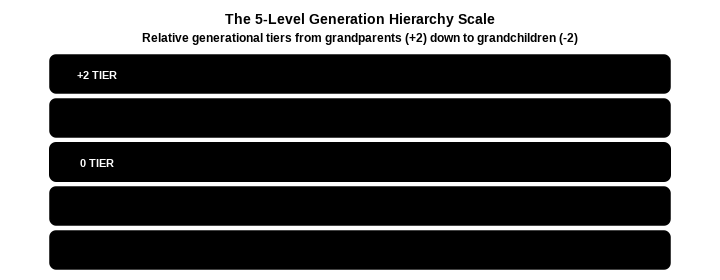
Generation Hierarchy (The 5-Level Scale)
Family relations naturally distribute across generational tiers:
In Indian exams, questions often distinguish between your father's side and your mother's side:
Paternal: Related through the Father.
Father's father = Paternal Grandfather
Father's brother = Paternal Uncle
Father's sister = Paternal Aunt
Maternal: Related through the Mother.
Mother's father = Maternal Grandfather
Mother's brother = Maternal Uncle
Mother's sister = Maternal Aunt
Cousin: Any child of your uncle or aunt (paternal or maternal). In exam English, the terms "cousin brother" and "cousin sister" are grammatically incorrect; the single word Cousin is used regardless of gender.
Nephew & Niece:
Brother's or Sister's son = Nephew [ + ]
Brother's or Sister's daughter = Niece [ - ]
In-Laws:
Spouse's brother or Sister's husband = Brother-in-law
Spouse's sister or Brother's wife = Sister-in-law
Core Rules to Avoid Common Pitfalls
Never assume gender from a name: Unless the question explicitly states "Kiran is a boy", "Sita is a female", or provides a relation like "mother/father/son/daughter", you cannot assume gender. A name like "Bobby", "Suman", or "Robin" can represent either gender.
"Only son" vs. "Only child":
Only son means the parents have only one male child, but they can still have multiple daughters.
Only daughter means only one female child, but they can still have multiple sons.
Only child means the person has no brothers and no sisters.
"My mother's only son":
If spoken by a male, it refers to himself.
If spoken by a female, it refers to her brother.
2. Type 1: Jumbled-Up Descriptions (Pointing / Dialogue Based)
In this type, one person speaks about or points to another person through a chain of relationships (e.g., "Pointing to a person in a photo, X said...").
The Solving Technique: Backtracking
Do not read the sentence from left to right. Instead, locate the word "my" or "his/her" and trace backward toward the beginning:
Identify who is speaking.
Replace segments of the statement step-by-step from the inside out.
Arrive at the final person.
Example 1
Question: Pointing to a photograph of a boy, Suresh said, "He is the son of the only son of my mother." How is Suresh related to the boy?
Step 1 (Find "my"): Suresh is speaking.
Step 2: "My mother" = Suresh's mother.
Step 3: "The only son of Suresh's mother" = Suresh himself (since Suresh is male and an only son).
Step 4: "He is the son of [Suresh himself]".
Answer: Suresh is the Father of the boy.
Example 2
Question: Pointing to a man, a woman said, "His mother is the only daughter of my mother." How is the woman related to the man?
Step 1: The woman is speaking.
Step 2: "My mother" = The woman's mother.
Step 3: "The only daughter of my mother" = The woman herself (she is the only daughter).
Step 4: "His mother is [the woman herself]".
Answer: The woman is the Mother of the man.
Example 3
Question: Introducing a man, Anita said, "He is the only son of the father of my brother." How is the man related to Anita?
Step 1: Anita is speaking.
Step 2: "My brother" = Anita's brother.
Step 3: "Father of my brother" = Anita's father.
Step 4: "The only son of Anita's father" = Anita's brother.
Answer: The man is Anita's Brother.
Example 4
Question: Pointing to a lady in a park, Amit said, "She is the daughter of my grandfather's only child." If Amit is a male, how is the lady related to Amit?
Step 1: Amit is speaking.
Step 2: "My grandfather's only child" = Amit's father (since the grandfather has only one child, who must be Amit's parent).
Step 3: "Daughter of Amit's father" = Amit's sister.
Answer: The lady is Amit's Sister.
Example 5
Question: Pointing to a gentleman, Deepak said, "His only brother is the father of my daughter's father." How is the gentleman related to Deepak?
Step 1: Deepak is a male. "My daughter's father" = Deepak himself.
Step 2: "The father of Deepak" = Deepak's father.
Step 3: "His only brother is Deepak's father" = The gentleman's only brother is Deepak's father.
Step 4: The brother of one's father is a paternal uncle.
Answer: The gentleman is Deepak's Paternal Uncle.
3. Type 2: Relation Puzzles (Family Tree Puzzles)
In this type, information about 5 to 8 family members is presented in a paragraph with multiple connected facts.
The Solving Technique: Branch-by-Branch Tree Building
Scan for definite links (statements showing parents, children, or married pairs directly).
Draw the symbols immediately.
Link secondary clues to the established diagram.
Count the number of males, females, and married couples to confirm constraints.
Example 1
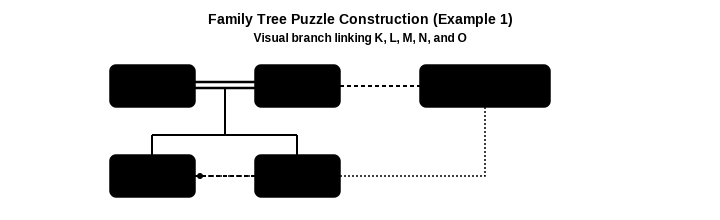
Question: In a family of five members K, L, M, N, and O:
M is the son of K.
L is the sister of M.
O is the mother of L.
N is the brother of O.
How is N related to M?
Step 1: "M is the son of K" → K is parent of M [ + ].
Step 2: "L is the sister of M" → L [ - ] --- M [ + ] (Children of K).
Step 3: "O is the mother of L" → Since K is already a parent and O is the mother, K must be the father: K [ + ] = O [ - ].
Step 4: "N is the brother of O" → O [ - ] --- N [ + ].
Step 5: N is the brother of M's mother (O).
Answer: N is the Maternal Uncle of M.
Example 2
Question: Six persons A, B, C, D, E, and F belong to a family:
B is the son of C, but C is not the mother of B.
A and C are a married couple.
E is the brother of C.
D is the daughter of A.
F is the brother of B.
How is D related to E?
Step 1: B is the son of C, but C is not the mother → C is the Father [ + ], and B is the Son [ + ].
Step 2: A and C are married → C [ + ] = A [ - ]. (A is the mother).
Step 3: E is the brother of C → C [ + ] --- E [ + ].
Step 4: D is the daughter of A → D [ - ] is the sister of B.
Step 5: F is the brother of B → F [ + ] is the brother of B and D.
Step 6: D is the child of C, and E is the brother of C.
Answer: D is the Niece of E.
Example 3
Question: In a family of six persons P, Q, R, S, T, and U:
P and Q are brothers.
R is the wife of P.
S is the daughter of R.
T is the husband of S.
U is the son of T.
How is Q related to S, and how is P related to U?
Step 1: P [ + ] --- Q [ + ] (Brothers).
Step 2: P [ + ] = R [ - ] (Married couple).
Step 3: S [ - ] is the daughter of R and P.
Step 4: Q is the brother of S's father (P) → Q is S's Paternal Uncle.
Step 5: T [ + ] = S [ - ] (Married couple).
Step 6: U [ + ] is the son of T and S.
Step 7: P is the father of U's mother (S).
Answer: Q is the Paternal Uncle of S; P is the Maternal Grandfather of U.
Example 4
Question: A family has six members: A, B, C, D, E, and F.
A and B are a married couple, where A is the male member.
D is the only son of C, who is the brother of A.
E is the sister of D.
B is the daughter-in-law of F, whose husband has passed away.
How is E related to A?
Step 1: A [ + ] = B [ - ].
Step 2: C is the brother of A → A [ + ] --- C [ + ].
Step 3: D is the only son of C → C [ + ] is father of D [ + ].
Step 4: E is the sister of D → E [ - ] is the daughter of C.
Step 5: E is the daughter of A's brother (C).
Answer: E is the Niece of A.
Example 5
Question: In a three-generation family:
G is married to K.
K is the mother of H.
H is the father of J.
J is the sister of M.
How is K related to J?
Step 1: G = K [ - ] (K is female; G is male [ + ]).
Step 2: K is the mother of H → H is child of G and K.
Step 3: H is the father of J → H [ + ] is male.
Step 4: J is the sister of M → J [ - ] and M are children of H.
Step 5: H is the father of J, and K is the mother of H.
Answer: K is the Paternal Grandmother of J.
4. Type 3: Coded Relations
In this type, relationships are defined using arithmetic or punctuation symbols (e.g., P + Q, P - Q, P * Q, P / Q).
The Two Fast Shortcuts for Competitive Exams
Gender Elimination: If the question asks for a female relation (e.g., "Find which option shows A is the mother of B"), check the symbol right after A. If that symbol defines A as male, eliminate that option immediately without drawing the tree.
Generation Gap Value: Assign numbers to generation levels:
Parent / Uncle / Aunt = +1
Sibling / Spouse = 0
Child / Nephew / Niece = -1
Grandparent = +2
Sum up the values along the chain. If the target relation is "Uncle" (gap +1), an expression totaling 0 or +2 can be discarded.
Example 1
Definitions:
A + B means "A is the brother of B"
A - B means "A is the sister of B"
A * B means "A is the father of B"
A / B means "A is the mother of B"
Question: In the expression P * Q + R - S, how is P related to S?
Step 1: Decode P * Q → P is the father of Q [P (+)].
Step 2: Decode Q + R → Q is the brother of R [Q (+)].
Step 3: Decode R - S → R is the sister of S [R (-)].
Step 4: Q, R, and S are all siblings (children of P).
Answer: P is the Father of S.
Example 2
Definitions:
P + Q means "P is the sister of Q"
P - Q means "P is the brother of Q"
P * Q means "P is the mother of Q"
P / Q means "P is the father of Q"
Question: In the expression M - N / O + P, how is M related to P?
Step 1: Decode M - N → M is the brother of N [M (+)].
Step 2: Decode N / O → N is the father of O [N (+)].
Step 3: Decode O + P → O is the sister of P.
Step 4: N is the father of both O and P.
Step 5: M is the brother of P's father (N).
Answer: M is the Paternal Uncle of P.
Example 3
Definitions:
X # Y means "X is the daughter of Y"
X @ Y means "X is the husband of Y"
X & Y means "X is the sister of Y"
Question: In the expression W @ X # Y & Z, how is W related to Y?
Step 1: Decode W @ X → W is the husband of X [W (+), X (-)].
Step 2: Decode X # Y → X is the daughter of Y [X (-)].
Step 3: Decode Y & Z → Y is the sister of Z [Y (-)].
Step 4: X is the daughter of Y, and W is the husband of X.
Answer: W is the Son-in-law of Y.
Example 4
Definitions:
P + Q means "P is the son of Q"
P - Q means "P is the wife of Q"
P * Q means "P is the brother of Q"
P / Q means "P is the mother of Q"
Question: In the expression K / L * M - N, how is N related to K?
Step 1: Decode K / L → K is the mother of L [K (-)].
Step 2: Decode L * M → L is the brother of M [L (+)].
Step 3: Decode M - N → M is the wife of N [M (-), N (+)].
Step 4: L and M are siblings; their mother is K.
Step 5: M is the daughter of K, and N is the husband of M.
Answer: N is the Son-in-law of K.
Example 5
Definitions:
A $ B means "A is the mother of B"
A # B means "A is the father of B"
A @ B means "A is the sister of B"
A % B means "A is the son of B"
Question: In the expression T @ R # V % S, how is T related to S?
Step 1: Decode T @ R → T is the sister of R [T (-)].
Step 2: Decode R # V → R is the father of V [R (+)].
Step 3: Decode V % S → V is the son of S [V (+)].
Step 4: Since R is the father of V and V is the son of S, S must be the mother of V: R [ + ] = S [ - ].
Step 5: T is the sister of R (who is S's husband).
Answer: T is the Sister-in-law of S.
Ready to Test Your Speed?
Put your family tree construction, backtracking, and symbol decoding skills to the test with real exam drills.