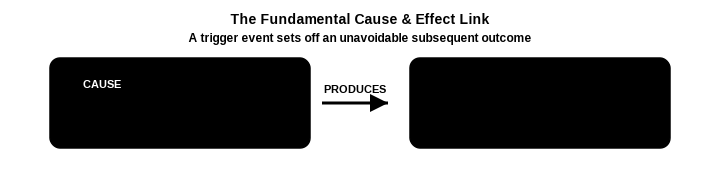
1. Fundamentals of Cause and Effect
What is a Cause?
A Cause is the condition, action, or initiating event that makes something happen. It answers the question: "Why did it happen?"
- Example: It rained heavily for four hours.
What is an Effect?
An Effect is the direct result, consequence, or outcome produced by the cause. It answers the question: "What happened as a result?"
- Example: The low-lying roads got waterlogged.
Core Rules Every Beginner Must Know
-
The Time Sequence Rule (Chronology):
- A cause always takes place before its effect, or exists as an ongoing condition prior to the effect.
- An effect can never take place before its cause.
-
The "Because / Therefore" Test:
- Join the two statements using "therefore":
- [Cause] happens, therefore [Effect] occurs. If this reads logically, the first statement is the cause.
- Join the two statements using "because":
- [Effect] happened because [Cause] occurred. If this makes rational sense, the second statement is the cause.
- Join the two statements using "therefore":
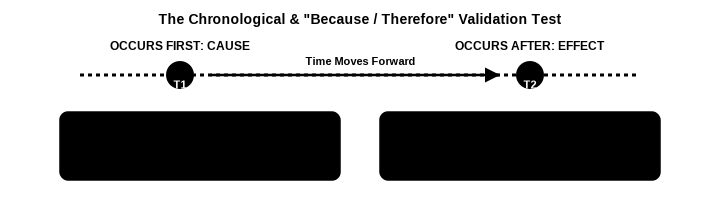
Diagram text
The Chronological & "Because / Therefore" Validation Test · T1 · OCCURS FIRST: CAUSE · Time Moves Forward · T2 · OCCURS AFTER: EFFECT
The "THEREFORE" Test · [Cause] happens, THEREFORE [Effect] occurs. · → If logical: Statement 1 is the Cause
The "BECAUSE" Test · [Effect] happened BECAUSE [Cause] occurred. · → If logical: Statement 2 is the Cause
-
Direct and Necessary Connection:
- Two events simply occurring at the same time does not mean one caused the other. There must be a clear, practical, and logical connection between them.
- Example of a false link: "A black cat crossed the road" and "A man lost his wallet." These happen near each other in time, but one does not cause the other.
-
Necessary Cause vs. Sufficient Cause:
- Sufficient Cause: An event that is entirely enough on its own to produce the outcome (e.g., pouring water on paper makes it wet).
- Necessary Cause: A condition that must be present for the outcome to occur, but might need other factors too (e.g., fuel is necessary for a car to run, but without an engine, it will not run).
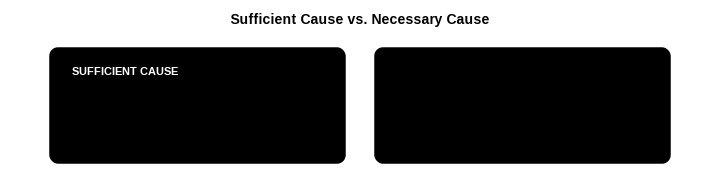
Diagram text
Sufficient Cause vs. Necessary Cause
SUFFICIENT CAUSE · Completely enough on its own to cause outcome. · Pouring water on dry paper → Paper gets wet. · Outcome is guaranteed without other conditions.
NECESSARY CAUSE · Must be present, but cannot act alone. · Fuel in car → Car runs only if engine works too. · Essential prerequisite, but needs co-factors.