Classification means putting similar things into one group based on a common feature, pattern, or rule.
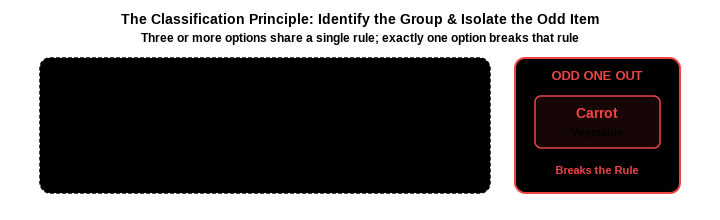
In reasoning questions, you are usually given four or more options. Most of the options have something common, but one option is different.
Your job is to find the different one. This is called the Odd One Out.
How to solve Classification questions
First, look carefully at all the options.
Do not choose an answer just because it looks different.
Instead, ask:
“What is common among most of these options?”
After finding the common rule, check which option does not follow that rule.
Example
Apple, Banana, Mango, Carrot
Apple → Fruit
Banana → Fruit
Mango → Fruit
Carrot → Vegetable
Apple, Banana, and Mango belong to the same group because they are fruits.
Carrot is different because it is a vegetable.
So: Answer: Carrot
Easy way to remember
Classification = Find the group + Find the different item
The main idea is:
3 or more options follow one rule → 1 option breaks the rule → that is the Odd One Out.
1. Word Classification
Word classification evaluates words based on semantic meaning, taxonomy, functional utility, physical properties, or general knowledge (Static GK).
Example 1: Produce Categories
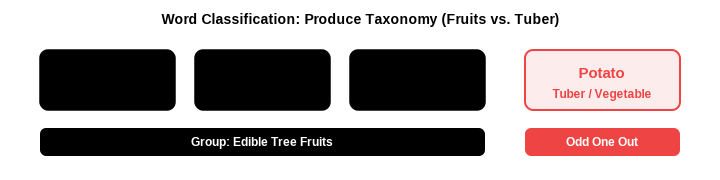
Apple, Mango, Orange, Potato
Odd One Out: Potato
Relationship: Fruits vs. Vegetable. Apple, Mango, and Orange are fruits, whereas Potato is an edible tuber/vegetable.
Example 2: Material Science
Iron, Copper, Gold, Brass
Odd One Out: Brass
Relationship: Pure Elements vs. Alloy. Iron, Copper, and Gold are elemental metals on the periodic table, whereas Brass is an alloy composed of copper and zinc.
Example 3: Zoology
Dog, Cat, Cow, Tiger
Odd One Out: Tiger
Relationship: Domestic vs. Wild Animals. Dog, Cat, and Cow are domesticated animals, whereas Tiger is a wild apex predator.
Example 4: Human Anatomy
Eyes, Ears, Nose, Liver
Odd One Out: Liver
Relationship: External Sense Organs vs. Internal Organ. Eyes, Ears, and Nose are sensory organs located on the exterior of the body, whereas the Liver is an internal organ.
Example 5: Geography & Polity
New Delhi, Tokyo, Paris, New York
Odd One Out: New York
Relationship: National Capitals. New Delhi (India), Tokyo (Japan), and Paris (France) are national capital cities. New York is a major metropolitan city, but Washington, D.C. is the capital of the USA.
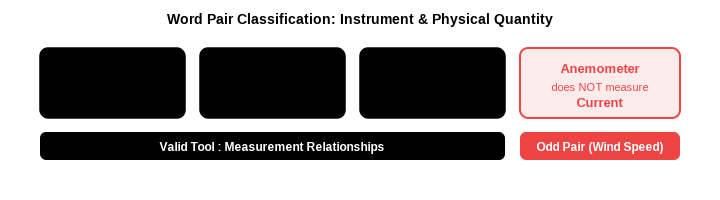
Relationship: Anemometer measures wind speed, whereas electric current is measured by an Ammeter.
2. Number Classification
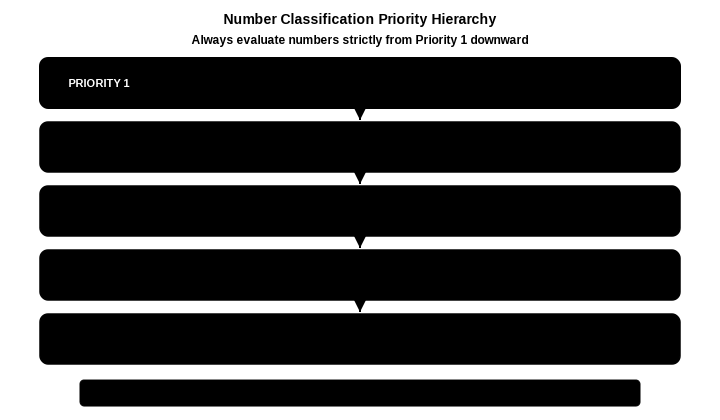
In competitive exams (such as SSC, Railways, and State PSCs), multiple operations can yield different answers. To eliminate ambiguity, test-makers follow a strict Priority Hierarchy. Always test options from Priority 1 downward.
Priority 1: Prime vs. Composite Check
Options: 11, 13, 17, 21
Odd One Out: 21
Relationship: 11, 13, and 17 are prime numbers (divisible only by 1 and themselves). 21 is a composite number (3 x 7 = 21).
Priority 2: Powers & Offsets [n³ ± k or n² ± k]
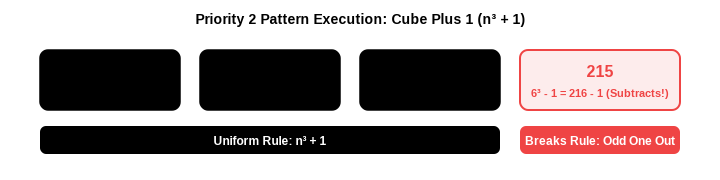
Options: 28, 65, 126, 215
Odd One Out: 215
Relationship: Cube plus 1 pattern (n³ + 1).
3³ + 1 = 27 + 1 = 28
4³ + 1 = 64 + 1 = 65
5³ + 1 = 125 + 1 = 126
6³ - 1 = 216 - 1 = 215 (Breaks the rule by subtracting 1)
Priority 3: Divisibility / Common Multiples
Options: 28, 42, 56, 65
Odd One Out: 65
Relationship: Multiples of 7.
28 = 7 x 4
42 = 7 x 6
56 = 7 x 8
65 is not evenly divisible by 7 (65 / 7 = 9 remainder 2).
Priority 4: Digit Manipulation (Digital Sum / Product)
Used for larger numbers when standard arithmetic properties do not reveal a uniform pattern.
Options: 134, 242, 305, 423
Odd One Out: 423
Relationship: Digital sum equals 8.
1 + 3 + 4 = 8
2 + 4 + 2 = 8
3 + 0 + 5 = 8
4 + 2 + 3 = 9 (Breaks the pattern)
Priority 5: Even / Odd Parity Fallback
Apply this rule only when all numbers are composite and no power, factor, or digit-sum pattern exists.
Options: 14, 22, 26, 35
Odd One Out: 35
Relationship:
14, 22, and 26 are even composite numbers.
35 is an odd composite number (5 x 7 = 35).
Note: None of these numbers are prime, so Priority 1 does not apply, making parity the valid tie-breaker.
Letter classification evaluates single letters, pairs, or clusters based on alphabetical positions, vowel/consonant distribution, uniform positional shifts, or reverse-alphabet pairs.
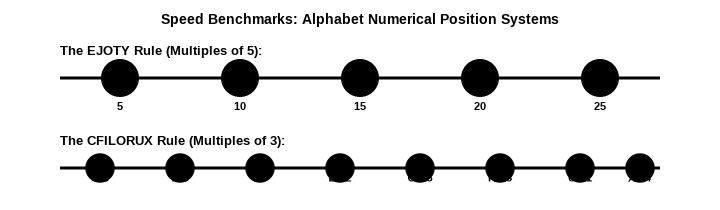
Speed Tools: Positional Reference Systems
1. The EJOTY Rule (Multiples of 5)
Letter
E
J
O
T
Y
Position
5
10
15
20
25
2. The CFILORUX Rule (Multiples of 3)
Letter
C
F
I
L
O
R
U
X
Position
3
6
9
12
15
18
21
24
3. Opposite Pairs Formula (Sum = 27)
The forward position and reverse position of any opposite pair always add up to 27.
Pair
Mnemonics
Positional Calculation
A - Z
Azad
1 + 26 = 27
B - Y
Boy
2 + 25 = 27
C - X
Crux
3 + 24 = 27
D - W
Dew
4 + 23 = 27
E - V
Even / Love
5 + 22 = 27
F - U
Full
6 + 21 = 27
G - T
GT Road
7 + 20 = 27
H - S
High School
8 + 19 = 27
I - R
Indian Railways
9 + 18 = 27
J - Q
Jungle Queen
10 + 17 = 27
K - P
Kanpur
11 + 16 = 27
L - O
Love
12 + 15 = 27
M - N
Man
13 + 14 = 27
Example 1: Vowel vs. Consonant Distribution
Options: A, E, I, T
Odd One Out: T
Relationship: A, E, and I are vowels, while T is a consonant.
Example 2: Forward Positional Increments
Options: B, D, F, I
Odd One Out: I
Relationship: Constant step of +2.
B (2) + 2 = D (4)
D (4) + 2 = F (6)
F (6) + 3 = I (9) (Breaks the +2 increment)
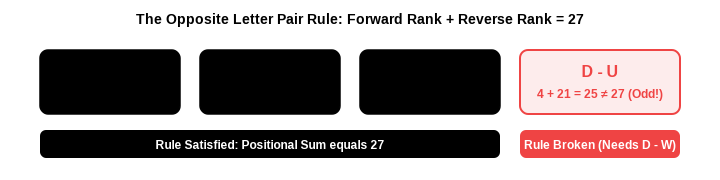
Example 3: Opposite Letter Pairs
Options: AZ, BY, CX, DU
Odd One Out: DU
Relationship: Opposite letter pairs whose positions sum to 27.
A (1) + Z (26) = 27
B (2) + Y (25) = 27
C (3) + X (24) = 27
D (4) pairs with W (23) to make 27. DU gives 4 + 21 = 25.
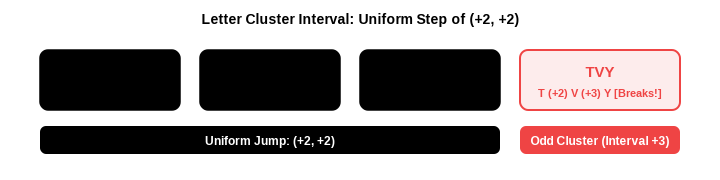
Example 4: Three-Letter Cluster Intervals
Options: BDF, KMO, PRT, TVY
Odd One Out: TVY
Relationship: Uniform interval of +2, +2.
B (+2) -> D (+2) -> F
K (+2) -> M (+2) -> O
P (+2) -> R (+2) -> T
T (+2) -> V (+3) -> Y (V to Y is an interval of +3)
Example 5: Direction of Sequence
Options: MN, GH, PQ, TS
Odd One Out: TS
Relationship: Forward sequence vs. Reverse sequence.
M to N is +1 (Forward)
G to H is +1 (Forward)
P to Q is +1 (Forward)
T to S is -1 (Backward)
Ready to Test Your Speed?
Put your classification and odd-one-out skills to the test with real exam drills.