Clock Reasoning

A clock is a circular dial of 360 degrees, divided into 12 equal hour spaces and 60 equal minute spaces. Reasoning questions based on clocks test your understanding of circular motion, angular displacement, and the relative speed between the hour hand and the minute hand.

Clock dial geometry

Part 1: Fundamentals of Clock Reasoning

1. Dial Structure and Angular Values

  • Total Angle of a Clock: A full circle contains 360°.
  • Hour Spaces (12 Divisions):
    • The dial is numbered from 1 to 12.
    • Each 1-hour division = 360° / 12 = 30°.
  • Minute Spaces (60 Divisions):
    • The dial is divided into 60 small ticks.
    • Each 1-minute division = 360° / 60 = 6°.
Clock hand speeds and relative speed

2. Speeds of the Clock Hands

  • Minute Hand:
    • Moves 360° in 60 minutes.
    • Speed = 360° / 60 = 6° per minute.
  • Hour Hand:
    • Moves 360° in 12 hours (720 minutes), or 30° in 60 minutes.
    • Speed = 30° / 60 = 0.5° (or 1/2°) per minute.
  • Relative Speed (Difference in Speeds):
    • In every minute, the minute hand moves 6° while the hour hand moves 0.5°.
    • Relative Speed = 6° - 0.5° = 5.5° per minute (or 11/2° per minute).
    • In terms of minute divisions: The minute hand gains 55 minute spaces over the hour hand in 60 minutes.
    • Therefore, gaining 1 minute space takes 60 / 55 = 12/11 minutes.
Standard clock hand configurations

3. Key Hand Positions and Standard Frequencies

Position Angle Between Hands Frequency in 12 Hours Frequency in 24 Hours Note
Coincide (Together / Overlap) 0° 11 times 22 times Between 11:00 and 1:00, they coincide only once, exactly at 12:00.
Opposite Directions (Straight Line) 180° 11 times 22 times Between 5:00 and 7:00, they are opposite only once, exactly at 6:00.
Straight Line (Combined: 0° or 180°) 0° or 180° 22 times 44 times Sum of coincide (11) and opposite (11).
Right Angle (Perpendicular) 90° 22 times 44 times Occurs twice every hour, except around 3:00 and 9:00 where one instance is shared.

Part 2: Question Types and 5 Solved Examples Each

Type 1: Finding the Angle Between Hands at a Given Time

Core Formula:
Angle = |(30 * H) - (11/2 * M)|
Where H = Hours, M = Minutes, and the vertical bars |...| mean you take the positive value.
Note: If the calculated angle is greater than 180°, it represents the reflex angle. To find the smaller internal angle, subtract it from 360°: Internal Angle = 360° - Reflex Angle.
Angle between clock hands at 4:20
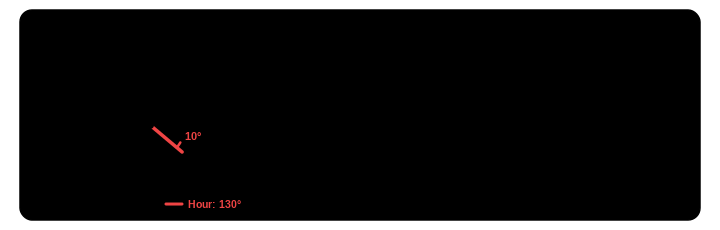
Example 1.1: What is the angle between the hands of a clock at 4:20?
• H = 4, M = 20
• Angle = |(30 * 4) - (11/2 * 20)|
• Angle = |120 - 110| = 10°
Example 1.2: Find the angle between the hands at 8:30.
• H = 8, M = 30
• Angle = |(30 * 8) - (11/2 * 30)|
• Angle = |240 - 165| = 75°
Example 1.3: What is the angle between the hands at 7:15?
• H = 7, M = 15
• Angle = |(30 * 7) - (11/2 * 15)|
• Angle = |210 - (165 / 2)| = |210 - 82.5| = 127.5° (or 127 1/2°)
Example 1.4: Find the angle between the hands at 10:10.
• H = 10, M = 10
• Angle = |(30 * 10) - (11/2 * 10)|
• Angle = |300 - 55| = 245°
• Since 245° is greater than 180°, the internal angle is: 360° - 245° = 115° (Reflex angle = 245°).
Example 1.5: What is the angle between the hands at 3:40?
• H = 3, M = 40
• Angle = |(30 * 3) - (11/2 * 40)|
• Angle = |90 - 220| = |-130| = 130°

Type 2: Finding the Exact Time for a Specific Angle

Core Formula:
M = (2/11) * (30 * H ± Angle)
  • For Coincide (0°): M = (2/11) * (30 * H)
  • For Opposite (180°): Use (30 * H - 180) if 30 * H > 180; use (30 * H + 180) if 30 * H < 180.
  • For Right Angle (90°) or any other angle: Calculate both + and - to find both instances.
Example 2.1: At what time between 3 and 4 o'clock will the hands coincide (0°)?
• H = 3, Angle = 0°
• M = (2/11) * (30 * 3) = (2/11) * 90 = 180 / 11 = 16 4/11 minutes
• Answer: At 16 4/11 minutes past 3 o'clock.
Example 2.2: At what time between 7 and 8 o'clock will the hands point in opposite directions (180°)?
• H = 7, Angle = 180°
• 30 * H = 30 * 7 = 210°
• Since 210° > 180°, subtract 180°:
• M = (2/11) * (210 - 180) = (2/11) * 30 = 60 / 11 = 5 5/11 minutes
• Answer: At 5 5/11 minutes past 7 o'clock.
Example 2.3: At what times between 4 and 5 o'clock are the hands at a right angle (90°)?
• H = 4, Angle = 90°
• 30 * H = 30 * 4 = 120°
• First instance (-): M = (2/11) * (120 - 90) = (2/11) * 30 = 60 / 11 = 5 5/11 minutes past 4 o'clock.
• Second instance (+): M = (2/11) * (120 + 90) = (2/11) * 210 = 420 / 11 = 38 2/11 minutes past 4 o'clock.
• Answer: At 5 5/11 minutes past 4 and 38 2/11 minutes past 4.
Example 2.4: At what time between 5 and 6 o'clock are the hands 3 minute spaces apart?
• 1 minute space = 6°, so 3 minute spaces = 3 * 6° = 18°
• H = 5, 30 * H = 150°
• Case 1 (-): M = (2/11) * (150 - 18) = (2/11) * 132 = 2 * 12 = 24 minutes
• Case 2 (+): M = (2/11) * (150 + 18) = (2/11) * 168 = 336 / 11 = 30 6/11 minutes
• Answer: At 5:24 and at 30 6/11 minutes past 5 o'clock.
Example 2.5: At what time between 2 and 3 o'clock will the hands be together (0°)?
• H = 2, Angle = 0°
• M = (2/11) * (30 * 2) = (2/11) * 60 = 120 / 11 = 10 10/11 minutes
• Answer: At 10 10/11 minutes past 2 o'clock.

Type 3: Mirror and Water Images of a Clock

Core Rules:
  1. Vertical Mirror Image:
    • Subtract the given time from 11:60 (for 12-hour format) or 23:60 (for 24-hour format).
    • If the time is an exact hour (e.g., 4:00), subtract directly from 12:00.
  2. Horizontal / Water Image:
    • If minutes are 30 or less: Subtract from 18:30.
    • If minutes are more than 30: Borrow 1 hour (60 minutes) to write it as 17:90, then subtract.
Mirror and water images of a clock
Example 3.1: If a clock shows 3:25, what time will it show in a vertical mirror?
• Subtract from 11:60:
• Hours: 11 - 3 = 8
• Minutes: 60 - 25 = 35
• Answer: 8:35
Example 3.2: What is the mirror image of a clock showing 12:40?
• Using the 24-hour baseline (23:60):
• Hours: 23 - 12 = 11
• Minutes: 60 - 40 = 20
• Alternatively, treat 12:40 as 0:40: 11:60 - 0:40 = 11:20.
• Answer: 11:20
Example 3.3: What is the mirror image of a clock showing exactly 6:00?
• For exact hours, subtract from 12:00:
• 12:00 - 6:00 = 6:00
• Answer: 6:00
Example 3.4: Find the water image of a clock showing 4:15.
• Minutes are ≤ 30, so subtract from 18:30:
• Hours: 18 - 4 = 14 (which is 2:00 PM in 12-hour format)
• Minutes: 30 - 15 = 15
• Answer: 2:15
Example 3.5: Find the water image of a clock showing 8:50.
• Minutes are > 30, so subtract from 17:90:
• Hours: 17 - 8 = 9
• Minutes: 90 - 50 = 40
• Answer: 9:40

Type 4: Faulty / Defective Clocks (Gaining or Losing Time)

Core Rules:
  1. Standard Coincidence Interval: In a normal, correct clock, the two hands coincide every 720/11 minutes = 65 5/11 minutes.
  2. Gain or Loss per Coincidence:
    • If the hands meet in less than 65 5/11 minutes, the clock runs fast (gaining time).
    • If the hands meet in more than 65 5/11 minutes, the clock runs slow (losing time).
    • Gain or Loss per interval = |(720/11) - X| minutes, where X is the faulty meeting interval.
  3. Uniform Error Problems: Calculate total elapsed hours, total time gained or lost, and use a simple unitary ratio to find when the error was exactly zero.
Faulty clock coincidence interval benchmark
Example 4.1: The minute hand of a clock overtakes the hour hand every 65 minutes of correct time. How much does the clock gain or lose in 24 hours?
• Standard interval = 720/11 minutes. Faulty interval = 65 minutes.
• Since 65 < 720/11, the clock is gaining time.
• Gain in 65 minutes = (720/11) - 65 = (720 - 715) / 11 = 5/11 minutes.
• Gain in 1 minute = (5/11) / 65 = 1 / 143 minutes.
• Minutes in 24 hours = 24 * 60 = 1440 minutes.
• Total gain in 24 hours = 1440 * (1 / 143) = 1440 / 143 = 10 10/143 minutes.
• Answer: The clock gains 10 10/143 minutes in a day.
Example 4.2: The minute hand overtakes the hour hand every 66 minutes. How much does the clock gain or lose in 24 hours?
• Standard interval = 720/11 minutes. Faulty interval = 66 minutes.
• Since 66 > 720/11, the clock is losing time.
• Loss in 66 minutes = 66 - (720/11) = (726 - 720) / 11 = 6/11 minutes.
• Loss in 1 minute = (6/11) / 66 = 1 / 121 minutes.
• Total loss in 24 hours (1440 minutes) = 1440 * (1 / 121) = 1440 / 121 = 11 109/121 minutes.
• Answer: The clock loses 11 109/121 minutes in a day.
Example 4.3: A watch that gains uniformly is 5 minutes slow at 8:00 AM on Sunday, and is 5 minutes 48 seconds fast at 8:00 PM on the following Sunday. When did it show the correct time?
• Time from Sunday 8:00 AM to following Sunday 8:00 PM:
  - 7 full days = 7 * 24 = 168 hours
  - Sunday 8:00 AM to 8:00 PM = 12 hours
  - Total elapsed time = 168 + 12 = 180 hours
• Total time gained:
  - 5 minutes (to reach correct time) + 5 minutes 48 seconds (fast) = 10 minutes 48 seconds
  - 48 seconds = 48 / 60 = 4/5 minutes
  - Total gain = 10 + 4/5 = 54/5 minutes
• To show the correct time, the watch must gain exactly its initial deficit of 5 minutes:
  - Time to gain 54/5 minutes = 180 hours
  - Time to gain 1 minute = 180 / (54/5) = (180 * 5) / 54 = 50 / 3 hours
  - Time to gain 5 minutes = 5 * (50 / 3) = 250 / 3 hours = 83 hours and 20 minutes (83 1/3 hours)
• Add 83 hours 20 minutes to Sunday 8:00 AM:
  - 83 hours = 72 hours (3 days) + 11 hours
  - Sunday 8:00 AM + 3 days = Wednesday 8:00 AM
  - Wednesday 8:00 AM + 11 hours = Wednesday 7:00 PM
  - Adding 20 minutes gives Wednesday 7:20 PM.
• Answer: It showed the correct time on Wednesday at 7:20 PM.

Example 4.4: A clock is set right at 5:00 AM. It loses 16 minutes in 24 hours. What will be the true time when this clock indicates 10:00 PM on the 4th day?
• Time indicated by the faulty clock from Day 1 at 5:00 AM to Day 4 at 10:00 PM:
  - Day 1 (5:00 AM) to Day 4 (5:00 AM) = 3 days = 72 hours
  - Day 4 (5:00 AM) to Day 4 (10:00 PM) = 17 hours
  - Total faulty time elapsed = 72 + 17 = 89 hours
• Faulty clock speed ratio:
  - In 24 hours, faulty clock runs: 24 hours - 16 minutes = 23 hours 44 minutes
  - 23 hours 44 minutes = 23 + (44 / 60) = 23 + 11/15 = 356/15 hours
  - (356/15) hours of faulty clock = 24 hours of true time
  - 1 hour of faulty clock = 24 * (15 / 356) = 360 / 356 = 90 / 89 hours of true time
• True time for 89 faulty hours:
  - True time = 89 * (90 / 89) = 90 hours
• The true clock has run 90 hours, while the faulty clock ran 89 hours (1 hour behind).
• Answer: True time is 10:00 PM + 1 hour = 11:00 PM on the 4th day.
Example 4.5: Clock A gains 2 minutes every hour, and Clock B loses 3 minutes every hour. Both are set correctly at 12:00 noon on Monday. What is the difference between them at 6:00 PM on the same day?
• Time elapsed from 12:00 noon to 6:00 PM = 6 hours.
• Divergence per hour:
  - Clock A gains 2 minutes per hour.
  - Clock B loses 3 minutes per hour.
  - Combined separation rate = 2 + 3 = 5 minutes every hour.
• Total separation in 6 hours = 6 * 5 = 30 minutes.
• Check:
  - Clock A shows: 6:00 PM + (6 * 2 min) = 6:12 PM
  - Clock B shows: 6:00 PM - (6 * 3 min) = 5:42 PM
  - Difference: 6:12 PM - 5:42 PM = 30 minutes.
• Answer: The difference between the two clocks is 30 minutes.

Ready to Test Your Speed?

Put your clock reasoning skills, angle calculation speeds, and shortcut tricks to the test with real exam drills.