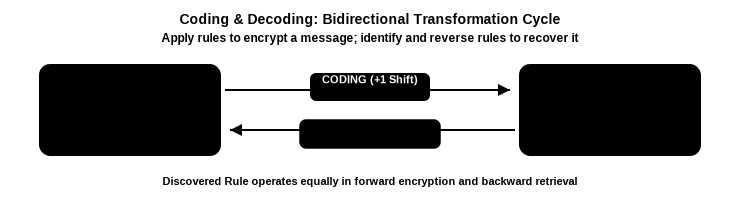
The process of converting a given word, sentence, or sequence of numbers into another form using a specific set of rules or hidden patterns.
Decoding:
The reverse process of discovering the original message from the coded text by analyzing and identifying the underlying rule.
Foundational Concepts
Before solving questions, mastery of English alphabet position values is essential:
1. Alphabet Positions
Letter
Position
Letter
Position
A
1
N
14
B
2
O
15
C
3
P
16
D
4
Q
17
E
5
R
18
F
6
S
19
G
7
T
20
H
8
U
21
I
9
V
22
J
10
W
23
K
11
X
24
L
12
Y
25
M
13
Z
26
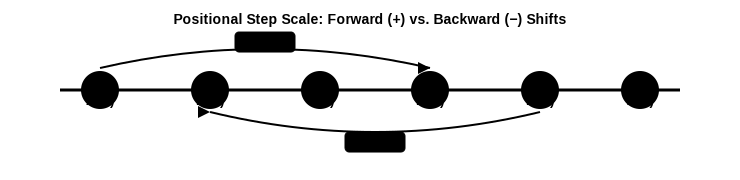
2. Forward / Backward Letter Movement
Movement
Example
Result
+1
A →
B
+2
A →
C
+3
A →
D
+4
A →
E
−1
D →
C
−2
D →
B
−3
D →
A
−4
E →
A
3. Reverse / Opposite Letter Pairs (Sum of Positions = 27)
A − Z (Azad)
B − Y (BoY)
C − X (CruX)
D − W (DeW)
E − V (EVening)
F − U (FUn)
G − T (GT Road)
H − S (High School)
I − R (Indian Railway)
J − Q (Jungle Queen)
K − P (KanPur)
L − O (LOve)
M − N (MaN)
4. Letter Patterns
Pattern
Example
Explanation
Constant +1
A, B, C, D
Add 1 each time
Constant +2
A, C, E, G
Add 2 each time
Constant −1
Z, Y, X, W
Subtract 1 each time
Increasing
A, C, F, J
+2, +3, +4
Decreasing
Z, W, S, N
−3, −4, −5
Alternating
A, C, B, D, C, E
+2, −1 repeatedly
5. Simple Number Patterns
Pattern
Example
Rule
Addition
2, 4, 6, 8
+2
Subtraction
20, 17, 14, 11
−3
Multiplication
2, 4, 8, 16
* 2
Division
64, 32, 16, 8
/ 2
Squares
1, 4, 9, 16, 25
1², 2², 3²...
Cubes
1, 8, 27, 64
1³, 2³, 3³...
Increasing addition
2, 3, 5, 8, 12
+1, +2, +3, +4
1. Letter Coding
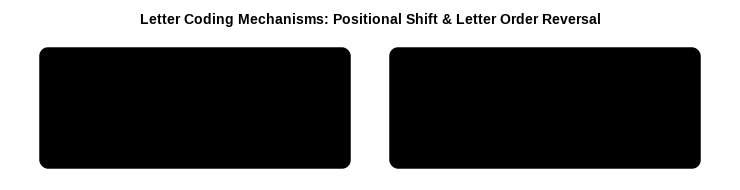
In Letter Coding, the letters of a given word are replaced by other letters based on specific mathematical or positional shifts (e.g., forward shift, backward shift, alternating shift, reverse ordering, or opposite letters).
Examples
Example 1 (+1 Forward Shift)
Question: If CAT is coded as DBU, how is DOG coded?
Logic: Each letter moves 1 position forward in the alphabet (C + 1 = D, A + 1 = B, T + 1 = U).
Answer: D + 1 = E, O + 1 = P, G + 1 = H -> EPH
Example 2 (-2 Backward Shift)
Question: If TIGER is coded as RGCEP, how is LION coded?
Logic: Each letter moves 2 positions backward (T - 2 = R, I - 2 = G, G - 2 = E, E - 2 = C, R - 2 = P).
Answer: L - 2 = J, I - 2 = G, O - 2 = M, N - 2 = L -> JGML
Example 3 (Opposite Letter Pairs)
Question: If BOY is coded as YLB, how is KING coded?
Logic: Each letter is replaced by its reverse pair (B <-> Y, O <-> L, Y <-> B).
Answer: K <-> P, I <-> R, N <-> M, G <-> T -> PRMT
Example 4 (Word Reversal)
Question: If WATER is coded as RETAW, how is STEAM coded?
Logic: The letters are written in reverse order.
Answer: S-T-E-A-M reversed -> MAETS
Example 5 (Alternating Shift: +1, -1)
Question: If BIRD is coded as CJSC, how is FISH coded?
Logic: Alternating pattern: B + 1 = C, I - 1 = H -> J (here, B+1, I+1, R+1, D-1) -> Standard +1, -1: F + 1 = G, I - 1 = H, S + 1 = T, H - 1 = G.
Answer: F + 1 = G, I - 1 = H, S + 1 = T, H - 1 = G -> GHTG
2. Direct Coding
In Direct Coding, no alphabetical shift or mathematical rule is applied. Instead, each letter is assigned a specific corresponding code character (letter, digit, or symbol). This type is identified when two reference words share common letters that have identical coded characters.
Examples
Example 1
Question: If STARK is coded as LBFOM and MOBILE is coded as TNSPCW, how is SMILE coded?
Logic: Directly match letters: S = L, M = T, I = P, L = C, E = W.
Answer: LTPCW
Example 2
Question: If ROAD is coded as 4516 and LANE is coded as 2183, how is DARE coded?
Logic: D = 6, A = 1, R = 4, E = 3.
Answer: 6143
Example 3
Question: If ROSE is coded as 6821 and CHAIR is coded as 73456, how is SEARCH coded?
Logic: S = 2, E = 1, A = 4, R = 6, C = 7, H = 3.
Answer: 214673
Example 4
Question: If PAINT is coded as 74128 and EXCEL is coded as 93596, how is ACCEPT coded?
Logic: A = 4, C = 5, C = 5, E = 9, P = 7, T = 8.
Answer: 455978
Example 5
Question: If GIVE is coded as 5137 and BAT is coded as 924, how is GATE coded?
Logic: G = 5, A = 2, T = 4, E = 7.
Answer: 5247
3. Number or Symbol Coding
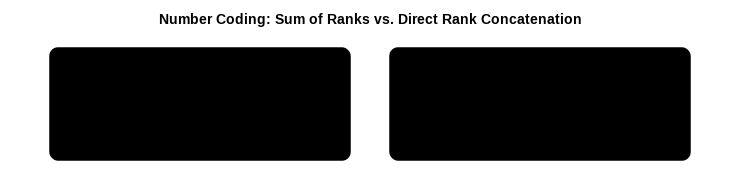
Letters or words are represented by numerical values or arbitrary symbols (@, #, $, %, etc.). Common patterns include:
Sum of alphabetical positions
Position numbers concatenated
Letter count
Pre-assigned symbols
Examples
Example 1 (Sum of Forward Positions)
Question: If A = 1 and CAT = 24, what is the code for DOG?
Logic: Sum of letter ranks: C (3) + A (1) + T (20) = 24.
Answer: D (4) + O (15) + G (7) = 4 + 15 + 7 = 26
Example 2 (Rank Concatenation)
Question: If SUN is coded as 192114, how is MOON coded?
Logic: Direct forward ranks placed side by side: S = 19, U = 21, N = 14.
Answer: M = 13, O = 15, O = 15, N = 14 -> 13151514
Example 3 (Letter Count)
Question: If RED is coded as 3 and GREEN is coded as 5, what is the code for ELEPHANT?
Logic: Total number of letters in the word.
Answer: ELEPHANT contains 8 letters -> 8
Example 4 (Symbol Assignment)
Question: If M = @, A = #, N = $, and E = %, how is NAME coded?
Logic: Replace each letter with its defined symbol: N = $, A = #, M = @, E = %.
Answer: $#@%
Example 5 (Sum of Reverse Positions)
Question: If Z = 1 and GO = 32, how is SHE coded?
Logic: Reverse rank values: G = 20, O = 12 (20 + 12 = 32). For SHE: S = 8, H = 19, E = 22.
Answer: 8 + 19 + 22 = 49
4. Substitution Coding
In Substitution Coding, particular objects or words are assigned fictitious names using relational keywords:
"Is called" format: The answer moves forward. If X is called Y, the answer for X is Y.
"Means" format: The answer moves backward. If X means Y, the answer for Y is X.
Examples
Example 1
Question: If sky is called sea, sea is called water, water is called air, and air is called cloud, what do we drink when thirsty?
Logic: We drink "water". In this code, "water is called air".
Answer: Air
Example 2
Question: If white is called black, black is called red, red is called yellow, and yellow is called green, what is the color of human blood?
Logic: Blood is "red". In this code, "red is called yellow".
Answer: Yellow
Example 3
Question: If eye is called hand, hand is called mouth, mouth is called ear, and ear is called nose, with which organ does a person hear?
Logic: A person hears with an "ear". In this code, "ear is called nose".
Answer: Nose
Example 4
Question: If book is called watch, watch is called bag, bag is called pen, and pen is called paper, what is used to carry school books?
Logic: A "bag" is used to carry school books. In this code, "bag is called pen".
Answer: Pen
Example 5 (The "Means" variation)
Question: If blue means green, green means white, and white means yellow, what is the color of milk?
Logic: Milk is "white". Since "green means white", the coded word representing white is "green".
Answer: Green
5. Deciphering Message Word Codes
Often called Chinese Coding or Fictitious Language Coding, complete sentences are paired with pseudo-words. You compare common words across statements to isolate the code for each term by elimination.
Examples
Example 1
Question:
"ka bi ti" = "read good books"
"ti lo po" = "books and pens"
What is the code for books?
Logic: "books" is the only common word in both statements; "ti" is the only common code.
Answer: ti
Example 2
Question:
"sa re ga" = "music is life"
"ga ma pa" = "life brings joy"
What is the code for life?
Logic: "life" is the common word; "ga" is the common code.
Answer: ga
Example 3
Question:
"pit dar na" = "you are good"
"dar tok pa" = "good and bad"
"tok na so" = "they are bad"
What is the code for they?
Logic: From statements 1 & 2, "good" = "dar". From statements 1 & 3, "are" = "na". From statements 2 & 3, "bad" = "tok". In statement 3, the remaining word "they" must be "so".
Answer: so
Example 4
Question:
"chi mo pe" = "summer is hot"
"pe la tu" = "winter is cold"
What is the code for is?
Logic: "is" is common to both statements; "pe" is the common code.
Answer: pe
Example 5
Question:
"lu ja ke" = "birds fly high"
"ke so ra" = "planes fly fast"
"ja pi nu" = "birds sing loud"
What is the code for high?
Logic: "fly" is common to 1 & 2 -> "ke". "birds" is common to 1 & 3 -> "ja". In statement 1, the remaining word "high" is "lu".
Answer: lu
6. Deciphering Number and Symbol Codes for Messages
Identical in logic to deciphering word codes, but digits or symbols are used instead of pseudo-words. Find the code for a word by cross-matching sentences and eliminating common items.
Examples
Example 1
Question:
"1 2 3" = "hot filtered coffee"
"3 5 6" = "very hot day"
What number stands for hot?
Logic: "hot" is the common word; "3" is the common digit.
Answer: 3
Example 2
Question:
"7 8 6" = "study very hard"
"9 5 8" = "hard work pays"
What number stands for hard?
Logic: "hard" is the common word; "8" is the common digit.
Answer: 8
Example 3
Question:
"2 4 7" = "spread red carpet"
"2 5 6" = "dust one carpet"
"2 6 4" = "one red carpet"
What digit represents dust?
Logic: Comparing 1, 2, and 3: "carpet" = 2. Comparing 1 and 3: "red" = 4. Comparing 2 and 3: "one" = 6. In statement 2, "dust" remains with digit 5.
Answer: 5
Example 4
Question:
"@ # $" = "sun shines bright"
"# % &" = "bright blue sky"
Which symbol represents bright?
Logic: "bright" is the common word; "#" is the common symbol.
Answer: #
Example 5
Question:
"8 4 2" = "apples are ripe"
"4 3 9" = "oranges are sweet"
"8 1 5" = "eat ripe fruits"
What digit represents ripe?
Logic: Comparing statements 1 & 3, "ripe" is the shared word and "8" is the shared digit.
Answer: 8
Ready to Test Your Speed?
Put your Coding and Decoding pattern identification skills and speed shortcuts to the test with real exam drills.