Critical Reasoning (often called Verbal Reasoning) is the study of evaluating statements, arguments, and situations using formal logic rather than personal opinions or outside knowledge. Learn to break down arguments into premises and conclusions, identify hidden assumptions, and evaluate the strength of logical claims.
1. Fundamentals of Critical Reasoning
Every question in Critical Reasoning tests your ability to break down a passage or set of statements into basic building blocks.
The Anatomy of an Argument
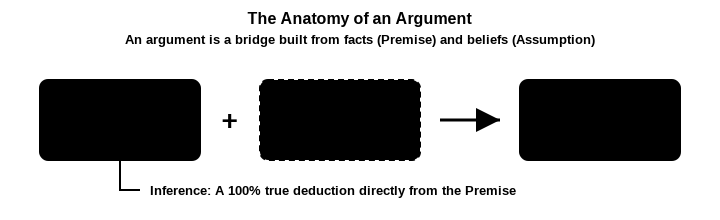
An argument is not a fight; it is a claim supported by evidence. It consists of three main elements:
Premise (Fact / Evidence): The explicit information, data, or facts provided by the author. You must accept premises as 100% true, even if they contradict real-world facts.
Conclusion (Main Point): The author's final claim, opinion, or verdict based on the premises.
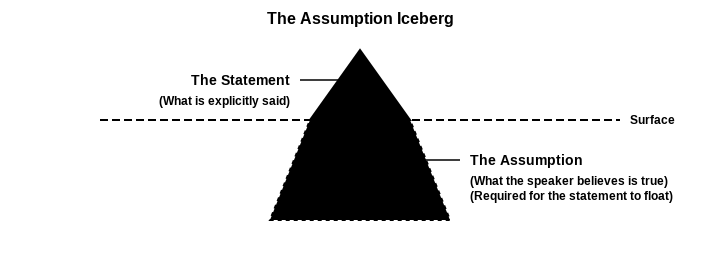
Assumption (The Unstated Bridge): An unstated, hidden belief that must be true for the conclusion to make sense.
Inference (Deduction): An unstated fact that is 100% true solely based on the given premises. Unlike an assumption (which supports a conclusion), an inference is a natural result of the facts.
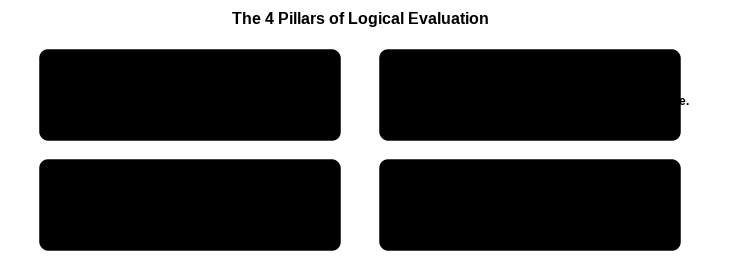
4 Golden Rules for Beginners
The Boundary Rule: Never bring outside general knowledge into the problem unless the question type specifically asks for real-world viability (like Arguments or Course of Action). If a statement says "All fish can fly," you must treat flying fish as a fact.
Beware of Extreme Words: Words like always, never, all, none, impossible, entirely, only make statements rigid and are usually false unless explicitly justified. Balanced words like some, many, often, can, may, generally indicate safer, more logical deductions.
Assume the Speaker is Logical: When analyzing what someone said, assume they had a rational reason for saying it.
Avoid Personal Bias: Disregard your personal beliefs, emotions, or political views. Evaluate only what is printed.
Type 1: Statement and Assumptions
An assumption is something taken for granted or assumed before making a statement. When someone speaks, they do not state obvious background thoughts. You must identify what was in the speaker's mind when making the statement.
Example 1: Advisory Logic
Statement: "Please do not use your mobile phone while driving." — Traffic Police Advisory.
Assumption I: People generally know how to operate a mobile phone while driving.
Assumption II: Some drivers use mobile phones while driving, and an advisory may change their behavior.
Analysis: Why would the police issue an advisory? Because people are currently doing the act, and the authority believes the public pays attention to advisories. Assumption I is irrelevant to the warning.
Verdict: Only Assumption II is implicit.
Example 2: Advertising Logic
Statement: "Consume Brand X honey daily to boost your natural immunity." — An advertisement.
Assumption I: People want to boost their immunity.
Assumption II: Brand X contains ingredients that can support immunity.
Analysis: An advertiser creates an ad targeting an existing desire (people want immunity) and assumes their product has the qualities claimed to attract buyers.
Verdict: Both Assumptions I and II are implicit.
Example 3: Administrative Action
Statement: "The municipal corporation decided to deploy 100 special water tankers to Ward 5 during the summer months."
Assumption I: Ward 5 faces an acute water shortage during summer.
Assumption II: The municipal corporation has enough budget and capacity to operate 100 water tankers.
Analysis: You only deploy tankers if there is an expected deficit (I) and if you have the resources to arrange them (II).
Verdict: Both Assumptions I and II are implicit.
Example 4: Promotions & Offers
Statement: "Enroll your child in our academy before May 15 to secure a 20% discount on tuition fees."
Assumption I: Parents prefer paying less tuition fees whenever possible.
Assumption II: Seats will be completely filled before May 15.
Analysis: The discount assumes that financial savings motivate parents (I). It does not guarantee or assume that all seats will be sold out before May 15 (II is an extreme leap).
Verdict: Only Assumption I is implicit.
Example 5: Policy Proposals
Statement: "The government should immediately shut down all diesel vehicles older than 15 years in the capital city."
Assumption I: Diesel vehicles older than 15 years contribute significantly to city pollution.
Assumption II: Banning these vehicles is feasible and will lower pollution levels.
Analysis: A policy is suggested under the premise that the targeted vehicles are a primary cause of the problem (I) and that the ban will produce a positive outcome (II).
Verdict: Both Assumptions I and II are implicit.
Type 2: Statement and Conclusions
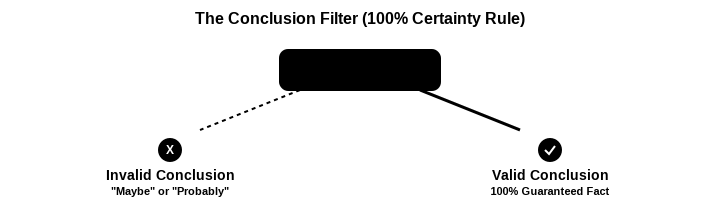
A conclusion is a fact that directly and undoubtedly follows from the given statement. You cannot assume anything extra. If it does not follow with 100% certainty, it is invalid.
Example 1: Statistical Claims
Statement: In a 50-over cricket match, Team A scored 260 runs. Out of these, 210 runs were scored by spin bowlers.
Conclusion I: Team A consists of 80% spin bowlers.
Conclusion II: The opening batsmen of Team A were spin bowlers.
Analysis: The statement only speaks about the runs scored, not the exact number of players or their batting positions.
Verdict: Neither Conclusion I nor II follows.
Example 2: Necessary vs Sufficient Conditions
Statement: All successful software engineers in Company X have completed their master's degree. Rahul is a software engineer in Company X with a master's degree.
Conclusion I: Rahul is a successful software engineer.
Conclusion II: Rahul will be promoted next year.
Analysis: Having a master's degree is a necessary condition for being successful, but having one does not automatically guarantee success (other factors may apply). Promotion is completely unmentioned.
Verdict: Neither Conclusion I nor II follows.
Example 3: Conditional Logic ("Only")
Statement: Only candidates with a valid passport can register for the international exchange program. Sneha registered for the program.
Conclusion I: Sneha has a valid passport.
Conclusion II: Sneha will travel abroad next month.
Analysis: Because a valid passport is mandatory ("only candidates"), Sneha must possess one to register (I follows). Whether she actually travels abroad next month is not confirmed by merely registering (II does not follow).
Verdict: Only Conclusion I follows.
Example 4: Scientific Findings
Statement: Modern medical studies show that people who walk at least 30 minutes every day reduce their risk of heart disease by 40%.
Conclusion I: Walking 30 minutes daily guarantees that a person will never suffer from heart disease.
Conclusion II: Regular physical exercise plays a role in reducing cardiovascular risk.
Analysis: "Guarantees never" is an extreme word that violates the 40% reduction claim (I is invalid). II directly paraphrases the medical finding in general terms.
Verdict: Only Conclusion II follows.
Example 5: Either/Or Scenarios
Statement: Most students who attended the weekend coaching sessions scored above 85% in the final exam. Vikas scored 90% in the final exam.
Conclusion I: Vikas attended the weekend coaching sessions.
Conclusion II: Vikas did not attend the coaching sessions.
Analysis: The statement says "most students who attended scored > 85%." It does not state that only those students scored > 85%. Vikas could belong to the group that attended, or he could be an independent student. Either I or II must be true, but neither can be confirmed alone.
Verdict: Either Conclusion I or II follows.
Type 3: Statement and Arguments
Here, a decision or policy is proposed, followed by arguments for or against it. You must classify arguments as:
Strong: Logically sound, directly relevant to the core issue, practical, and backed by a clear reason or consequence.
Weak: Irrelevant, emotional, ambiguous, narrow, superstitious, or merely an unsupported personal opinion.
Example 1: Health Policies
Statement: Should junk food be completely banned in school canteens?
Argument I: Yes, because regular consumption of junk food leads to childhood obesity and lifestyle diseases.
Argument II: No, because students like eating burgers and French fries.
Analysis: Argument I addresses health consequences with a clear cause-effect relationship (Strong). Argument II relies merely on personal taste/preference without addressing health or school policy (Weak).
Verdict: Only Argument I is strong.
Example 2: Economics and Rights
Statement: Should higher education in state universities be made completely free for all citizens?
Argument I: Yes, because education is a fundamental right and financial constraints should not prevent anyone from learning.
Argument II: No, because offering it entirely free will burden the state exchequer and may reduce the quality of infrastructure and faculty salaries.
Analysis: Both arguments present valid, balanced, real-world economic and constitutional dilemmas.
Verdict: Both Arguments I and II are strong.
Example 3: Accountability Constraints
Statement: Should all primary school teachers be evaluated based on the exam scores of their students?
Argument I: Yes, because this is the only way to make teachers accountable.
Argument II: No, because students' exam performance is influenced by multiple home and socio-economic factors outside the teacher's sole control.
Analysis: Argument I uses the extreme and unproven term "only way" (Weak). Argument II provides a realistic, practical operational factor (Strong).
Verdict: Only Argument II is strong.
Example 4: Logical Fallacies (Comparisons)
Statement: Should nuclear energy be phased out completely in favor of solar and wind energy?
Argument I: Yes, because nuclear power plants carry severe safety hazards and produce radioactive waste that remains dangerous for centuries.
Argument II: No, because Country X has not phased it out yet.
Analysis: Argument I highlights verified safety and environmental realities (Strong). Argument II is a blind comparison ("Country X hasn't done it"), which is a logical fallacy (Weak).
Verdict: Only Argument I is strong.
Example 5: Public Welfare vs Individual Convenience
Statement: Should private vehicles be prohibited inside central commercial districts during peak hours?
Argument I: Yes, because it will drastically decrease traffic congestion and air pollution in high-density pedestrian areas.
Argument II: No, because people should have the complete freedom to take their personal vehicles anywhere at any time.
Analysis: Argument I presents a measurable public welfare benefit (Strong). Argument II insists on absolute personal convenience at the expense of public order and city planning (Weak).
Verdict: Only Argument I is strong.
Type 4: Statement and Course of Action
A problem or situation is described. You must judge whether the proposed solution (course of action) is appropriate. A valid Course of Action must:
Directly reduce, control, or solve the problem.
Be feasible and practical (not an extreme overreaction).
Not create a worse secondary problem.
Example 1: Civic Hazards
Statement: Many commuters on a central route are injured every week due to large potholes formed during the rainy season.
Action I: The municipal body should immediately fill the potholes with cold-mix asphalt and set up caution markers.
Action II: All vehicular traffic on that route should be permanently suspended until the entire monsoon season ends.
Analysis: Action I is a feasible, direct remediation step. Action II is an extreme, impractical overreaction that paralyzes city transport.
Verdict: Only Course of Action I follows.
Example 2: Health Emergencies
Statement: Several students fell seriously ill after consuming the midday meal served at a local primary school.
Action I: All affected students should be rushed to the nearest hospital for immediate medical treatment.
Action II: An independent inspection team should test food samples and identify lapses in hygiene.
Analysis: Action I addresses the immediate health emergency. Action II investigates the root cause to prevent future occurrences. Both are standard, logical administrative responses.
Verdict: Both Courses of Action I and II follow.
Example 3: Corporate Management
Statement: A major tech company noticed a 30% drop in employee productivity after transitioning to a remote work model.
Action I: The company should immediately terminate all employees whose output dropped.
Action II: Management should survey employees to identify communication bottlenecks and implement daily check-ins.
Analysis: Terminating staff en masse (Action I) is harsh, destructive, and ignores underlying technical or workflow issues. Action II investigates and rectifies the workflow (constructive).
Verdict: Only Course of Action II follows.
Example 4: Disaster Management
Statement: Due to sudden cloudbursts, low-lying residential areas in the city have become heavily waterlogged.
Action I: The civic authority should deploy high-capacity water pumps to drain the water into main canals.
Action II: Residents of the most submerged zones should be evacuated to temporary relief shelters.
Analysis: Action I tackles the physical accumulation of water, while Action II protects human life from immediate hazards. Both are realistic disaster management steps.
Verdict: Both Courses of Action I and II follow.
Example 5: Educational Gaps
Statement: A survey reported that 60% of rural secondary school students struggle to read textbooks in English.
Action I: English should be completely removed from the school curriculum in all rural schools.
Action II: The education board should conduct remedial reading sessions and provide bilingual learning materials.
Analysis: Removing the subject entirely (Action I) is an extreme step that denies students opportunities. Action II offers corrective support to bridge the learning gap.
Verdict: Only Course of Action II follows.
Type 5: Cause and Effect
You are given two statements. You must determine the relationship between them:
Statement I is the cause and Statement II is the effect.
Statement II is the cause and Statement I is the effect.
Both statements are independent causes.
Both statements are effects of independent causes.
Both statements are effects of a common cause.
Example 1: Direct Link
Statement I: The prices of crude oil in the international market rose sharply by 25%.
Statement II: The state transport authority increased bus and taxi fares across the state.
Analysis: Rising crude oil prices cause fuel costs to escalate, which directly forces transport operators to increase fares.
Verdict: Statement I is the cause, and Statement II is its effect.
Example 2: Reverse Chronology
Statement I: A large number of people gathered at the central railway station with blankets and warm clothing.
Statement II: The meteorological department announced that the night temperature in the city dropped to a 10-year low.
Analysis: Extreme cold temperatures (Statement II) lead people to wear and carry warm clothing and blankets (Statement I).
Verdict: Statement II is the cause, and Statement I is its effect.
Example 3: Independent Causes
Statement I: The local municipality canceled the annual flower exhibition scheduled for this weekend.
Statement II: Several private schools in the city announced a two-day holiday for primary sections.
Analysis: There is no direct link between a canceled flower exhibition and school holidays. Both events occurred due to separate, unstated reasons.
Verdict: Both statements are effects of independent causes.
Example 4: Direct Link II
Statement I: The city administration shut down all primary schools for three days.
Statement II: Air quality indices across the city entered the "Severe Plus" hazardous zone due to crop burning and calm winds.
Analysis: Hazardous air pollution (Statement II) poses an immediate health risk to young children, leading the administration to close schools as a protective measure (Statement I).
Verdict: Statement II is the cause, and Statement I is its effect.
Example 5: Common Cause
Statement I: Most textile mills in the industrial area remained closed on Tuesday.
Statement II: Public buses and auto-rickshaws stayed off the roads in the industrial area on Tuesday.
Analysis: Textile mills closing does not cause buses to stop, nor does buses stopping force mills to shut down. However, both events typically happen when a broader strike (bandh) or regional curfew is called in that area.
Verdict: Both statements are effects of a common cause.
Ready to Test Your Skills?
Put your critical reasoning and analytical skills to the test with real exam drills.