Decision Making in logical reasoning tests your ability to evaluate facts against strict guidelines, eliminate personal bias, and arrive at an objective, legally and logically sound conclusion.
1. Fundamentals of Decision Making
In competitive reasoning, you act as an authorized official (such as an HR director, bank loan manager, or public administrator). You are provided with fixed guidelines and must evaluate individuals or situations against them.
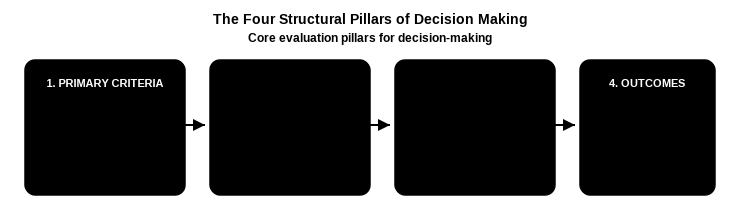
The Four Core Elements
Primary Criteria: The mandatory minimum requirements (e.g., educational qualifications, age range, minimum percentage of marks, minimum work experience).
Sub-clauses / Exceptions: Alternative rules provided if an applicant fails exactly one specific primary condition. If the applicant meets the alternative condition, their case is redirected to a senior authority (e.g., "Refer to the Managing Director" or "Refer to the Chairman").
Candidate / Case Profile: The specific set of facts about the person or event being evaluated.
Outcome Options: Predefined verdicts, usually including:
Select / Approve
Reject / Disapprove
Refer to Authority A (under Exception 1)
Refer to Authority B (under Exception 2)
Data Inadequate / Cannot be determined
Golden Rules Every Beginner Must Follow
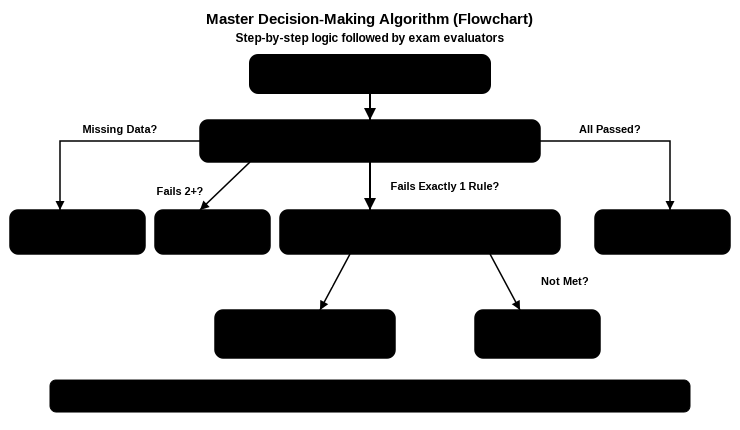
Strict Objectivity (No Assumptions): Base decisions solely on stated information. If a profile says an applicant holds a Master's degree, you cannot assume they scored 60% in their Bachelor's degree unless explicitly stated. If a required detail is missing, do not assume they failed; the verdict must be Data Inadequate.
Precise Cutoff Dates: Calculate age strictly as of the stated cutoff date. Count years, months, and days accurately.
Exact Percentages: Never round up percentages. A score of 59.9% does not satisfy a 60% requirement.
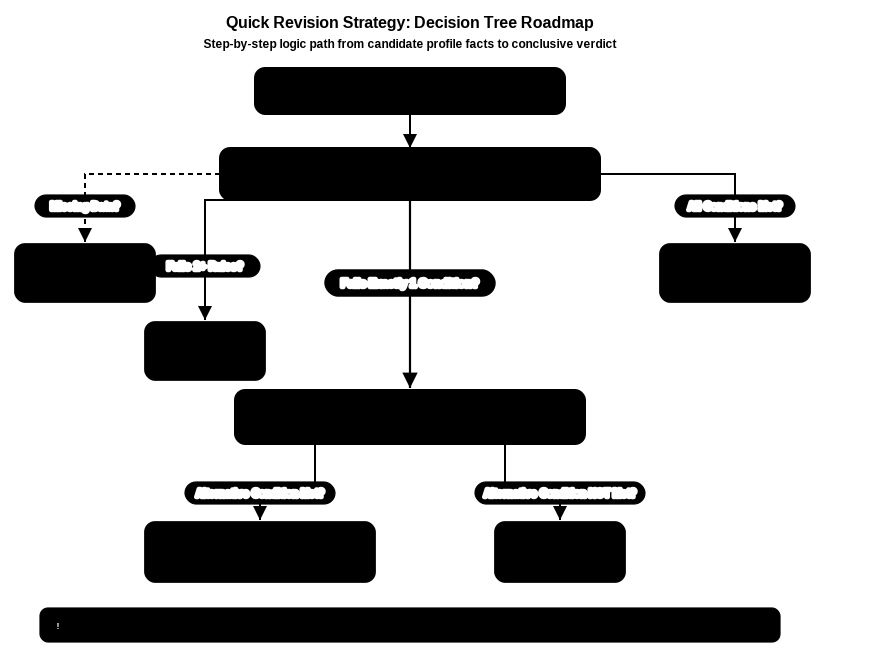
Check Exceptions Only When a Condition Fails: Do not check an exception unless the candidate fails the exact corresponding primary rule. An applicant who satisfies the main rule is processed normally; they do not get referred to an exception authority.
Exceptions Require All Other Conditions to Pass: If an applicant fails two primary conditions, they are Rejected outright, even if an exception exists for one of those failures.
2. The Two Major Types Used in Exam Books
Criteria-Based Decision Making (Eligibility / Selection Rules): Involves mathematical cutoffs, age limits, marks percentages, and administrative sub-clauses.
Situational & Administrative Decision Making (Scenario / Caselet Analysis): Involves workplace ethics, public administration dilemmas, crisis management, and choosing the most balanced course of action.
Type 1: Criteria-Based Decision Making
Master Criteria Framework:
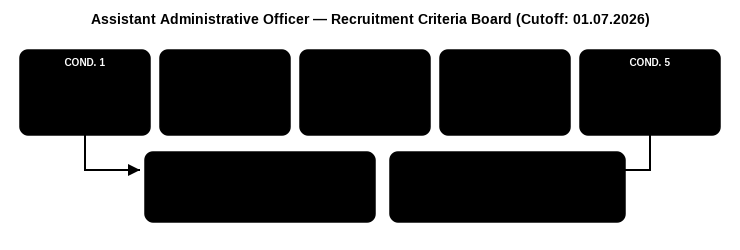
An organization is hiring an Assistant Administrative Officer. The applicant must satisfy the following conditions as of 01 July 2026:
Have a Bachelor's degree in any discipline with at least 60% marks.
Be at least 21 years old and not more than 28 years old as of 01 July 2026 (Born between 02 July 1998 and 01 July 2005, both dates inclusive).
Have secured at least 65% marks in the Written Selection Test.
Have secured at least 50% marks in the Personal Interview.
Have completed at least 2 years of full-time administrative work experience.
Exceptions:
(A) If the applicant fulfills all conditions except Condition 1, but has a Post-Graduate degree with at least 65% marks, the case is to be Referred to the Executive Director.
(B) If the applicant fulfills all conditions except Condition 5, but has scored at least 80% in the Written Selection Test, the case is to be Referred to the General Manager (HR).
Example 1: Direct Selection
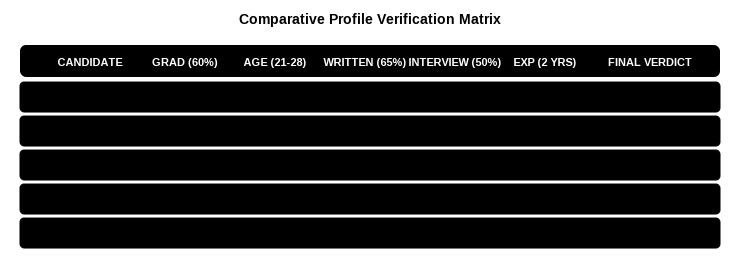
Profile: Ananya Roy was born on 14 March 2000. She completed her B.Com with 68% marks. She has been working as an administrative assistant for the past 3 years. In the selection process, she scored 72% marks in the Written Selection Test and 58% marks in the Personal Interview.
Condition 1 (Graduation ≥ 60%): 68% → Pass
Condition 2 (Age 21 to 28 on 01.07.2026): Born 14.03.2000. Age on 01.07.2026 is 26 years, 3 months, 17 days → Pass
Condition 3 (Written Test ≥ 65%): 72% → Pass
Condition 4 (Interview ≥ 50%): 58% → Pass
Condition 5 (Experience ≥ 2 years): 3 years → Pass
✓ Decision: The candidate is Selected.
Example 2: Direct Rejection
Profile: Rohan Sharma was born on 22 December 1999. He scored 64% marks in his B.Sc degree and 68% in the Written Selection Test. In the interview, he secured 45% marks. He has 2.5 years of administrative work experience.
Condition 1 (Graduation ≥ 60%): 64% → Pass
Condition 2 (Age 21 to 28 on 01.07.2026): Born 22.12.1999. Age on 01.07.2026 is 26 years, 6 months, 9 days → Pass
Condition 5 (Experience ≥ 2 years): 2.5 years → Pass
Check Exception: There is no exception clause for failing Condition 4.
✗ Decision: The candidate is Not Selected (Rejected).
Example 3: Exception Route A (Referral to Senior Authority)
Profile: Vikram Verma was born on 10 January 2001. He graduated in B.A. with 56% marks and later completed his M.A. (Post-Graduation) with 70% marks. He has 2 years of relevant administrative experience. He obtained 74% marks in the Written Selection Test and 55% marks in the Personal Interview.
Condition 1 (Graduation ≥ 60%): 56% → Fail
Condition 2 (Age 21 to 28 on 01.07.2026): Born 10.01.2001. Age on 01.07.2026 is 25 years, 5 months, 21 days → Pass
Condition 3 (Written Test ≥ 65%): 74% → Pass
Condition 4 (Interview ≥ 50%): 55% → Pass
Condition 5 (Experience ≥ 2 years): 2 years → Pass
Check Exception (A): Fails only Condition 1, but has a Post-Graduate degree with 70% marks (≥ 65% required).
➔ Decision: Case is to be Referred to the Executive Director.
Example 4: Exception Route B (Referral to HR Authority)
Profile: Sneha Patel was born on 05 August 2002. She completed her B.Tech with 75% marks. She scored 84% marks in the Written Selection Test and 62% marks in the Personal Interview. She recently completed her college studies and has only 6 months of work experience.
Condition 1 (Graduation ≥ 60%): 75% → Pass
Condition 2 (Age 21 to 28 on 01.07.2026): Born 05.08.2002. Age on 01.07.2026 is 23 years, 10 months, 26 days → Pass
Check Exception (B): Fails only Condition 5, but has 84% marks in the Written Selection Test (≥ 80% required).
➔ Decision: Case is to be Referred to the General Manager (HR).
Example 5: Data Inadequate
Profile: Kavita Iyer has been working in an administrative role for 3 years. She scored 66% marks in B.Sc, 70% marks in the Written Selection Test, and 54% marks in the Personal Interview. She was among the top students in her university.
Condition 1 (Graduation ≥ 60%): 66% → Pass
Condition 2 (Age 21 to 28 on 01.07.2026): Date of birth / age is Not Mentioned.
Condition 3 (Written Test ≥ 65%): 70% → Pass
Condition 4 (Interview ≥ 50%): 54% → Pass
Condition 5 (Experience ≥ 2 years): 3 years → Pass
Verification: Without her date of birth or age, it cannot be determined whether she meets Condition 2. Do not assume her age from graduation or work experience.
? Decision: Data Inadequate / Cannot be determined.
Type 2: Situational & Administrative Decision Making
In these questions, you are given a realistic workplace, ethical, or public administration scenario followed by 4 potential courses of action.
Core Principles for Choosing the Correct Option
Fact-finding First: Never punish or reward based on rumors or unverified allegations. Always verify facts.
Proportionality: The action must fit the severity of the problem. Minor errors do not warrant termination; criminal fraud warrants legal action, not a casual verbal warning.
Institutional Accountability: Avoid shifting your responsibility to other departments or delaying action indefinitely.
Public Good over Private Convenience: Safety, legal adherence, and fairness always override convenience, profit, or personal loyalty.
Example 1: Workplace Misconduct and Due Process
Scenario: You are the Regional Manager of an office. An anonymous letter accuses a high-performing senior supervisor of accepting gifts from external vendors. The supervisor has an unblemished 10-year track record.
Options:
A) Immediately suspend the supervisor to send a zero-tolerance message.
B) Dismiss the anonymous letter as workplace jealousy and take no action.
C) Form a discreet fact-finding committee to verify vendor records and audit recent approvals before taking formal action.
D) Confront the supervisor publicly in the weekly team meeting and ask for an explanation.
Correct Decision: C
Why C is correct: It upholds due process. The claim is unverified; an independent, discreet inquiry preserves operational integrity without defaming an employee based solely on an anonymous complaint.
Why others fail: (A) violates natural justice and punishes without proof; (B) ignores potential organizational risk; (D) damages team morale and breaches workplace confidentiality.
Example 2: Public Safety vs. Project Deadlines
Scenario: You are the Chief Project Engineer of an elevated transit bridge scheduled for public inauguration by dignitaries tomorrow. During the final inspection this evening, your quality control team discovers structural micro-fractures on a central support beam that need 48 hours of ultrasonic testing.
Options:
A) Allow the inauguration ceremony to proceed as planned and conduct tests immediately afterward.
B) Postpone the opening, submit an urgent technical briefing to senior leadership, and begin comprehensive safety testing immediately.
C) Instruct the contractors to cover the cracks with sealant so the bridge looks intact for the opening ceremony.
D) Resign from your post immediately to avoid personal accountability if an incident occurs.
Correct Decision: B
Why B is correct: Human life and structural safety override administrative convenience, deadlines, and public relations.
Why others fail: (A) and (C) endanger lives and constitute criminal negligence; (D) is dereliction of duty and evades professional responsibility.
Example 3: Essential Public Services During a Disruption
Scenario: You are the District Medical Officer. Contractual sanitization workers in the emergency ward have gone on an immediate strike due to a two-week delay in payment processing from a third-party payroll agency. Hospital waste is piling up, threatening patient safety.
Options:
A) Call the local police to arrest the striking workers immediately.
B) Divert permanent hospital maintenance staff for emergency cleaning, issue emergency contingency funds to clear undisputed dues within 24 hours, and hold the agency accountable.
C) Close the emergency ward indefinitely until the workers and their agency resolve the wage dispute.
D) Tell the workers that the hospital has no contract with them directly, advising them to file a case in labor court.
Correct Decision: B
Why B is correct: It addresses the immediate public health crisis by maintaining emergency sanitation, while simultaneously resolving the grievance through administrative intervention.
Why others fail: (A) escalates the conflict without resolving the core sanitation crisis; (C) abandons critical emergency medical services; (D) is bureaucratic evasion during an emergency.
Example 4: Regulatory Discretion and Compliance
Scenario: You are a Branch Manager at a state agency disbursing agricultural relief subsidies. An elderly farmer whose crops were destroyed by floods meets all criteria, but his biometrics fail due to weathered fingerprints, and he lacks an alternate digital phone number. The deadline closes today.
Options:
A) Reject the application strictly, as system validation failed.
B) Use the official offline physical exception clause (manual identity verification via local revenue records and witnessed identification) to disburse the relief before the cutoff.
C) Advise the farmer to apply next year when he has updated his biometric records.
D) Disburse the cash out of your personal pocket and avoid recording the transaction in the official portal.
Correct Decision: B
Why B is correct: Government and administrative frameworks maintain explicit manual override/exception procedures precisely for technological failures affecting genuine beneficiaries.
Why others fail: (A) and (C) cause administrative failure to a genuine beneficiary in an emergency; (D) violates official accounting regulations and financial audit rules.
Example 5: Resource Allocation During Crisis Management
Scenario: You are the Municipal Commissioner during a severe urban flood. Two zones request emergency rescue boats simultaneously:
• Zone X: A residential area where 200 elderly residents and hospital patients are stranded on the ground floor with rising water levels.
• Zone Y: A commercial market where shop owners are demanding boats to salvage valuable electronic goods before the water rises.
You have only 4 rescue boats available right now.
Options:
A) Allocate 2 boats to Zone X and 2 boats to Zone Y to ensure equal treatment.
B) Direct all 4 rescue boats to Zone X to evacuate the elderly and hospital patients, while directing police to secure Zone Y from looting.
C) Send all boats to Zone Y, as the economic value of goods is very high.
D) Keep the boats stationed at headquarters until more boats arrive so all areas can be served together.
Correct Decision: B
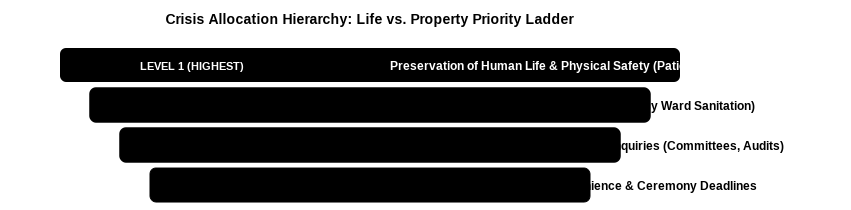
Why B is correct: The hierarchy of administrative crisis response prioritizes preservation of human life over preservation of commercial property.
Why others fail: (A) compromises life-saving capacity to save physical goods; (C) values goods above vulnerable lives; (D) delays urgent rescue efforts while water levels are actively rising.
Quick Revision Strategy
Ready to Test Your Decision Making Speed?
Put your eligibility evaluation, rule analysis, and situational judgment to the test with real exam drills.