The Direction Sense Test is a foundational reasoning topic across Indian competitive exams (SSC CGL/CHSL, Banking IBPS/SBI PO & Clerk, Railways RRB NTPC, UPSC CSAT, and State PSCs). It tests your spatial orientation, geometric understanding, and ability to track movements accurately on paper.
Part 1: Fundamentals Every Beginner Must Know
1. The 8 Standard Directions
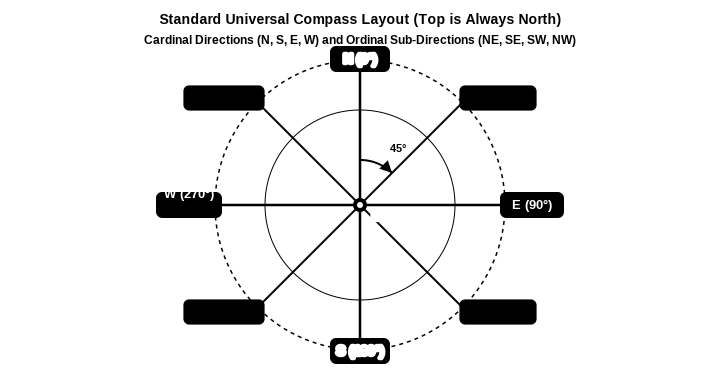
On paper, maps and exam diagrams always follow one universal rule:
Top is North (N)
Bottom is South (S)
Right is East (E)
Left is West (W)
These four are called Cardinal Directions. Between each pair of cardinal directions sits an Ordinal (Sub-cardinal) Direction:
Between North and East: North-East (NE)
Between South and East: South-East (SE)
Between South and West: South-West (SW)
Between North and West: North-West (NW)
2. Angular Measurements
The angle between any two adjacent cardinal directions (e.g., North and East) is 90°.
The angle between a cardinal direction and its adjacent ordinal direction (e.g., North and North-East) is 45°.
The angle between two opposite directions (e.g., North and South, or East and West) is 180°.
A complete rotation around a point equals 360°.
3. Left Turn vs. Right Turn Mechanics
In reasoning questions:
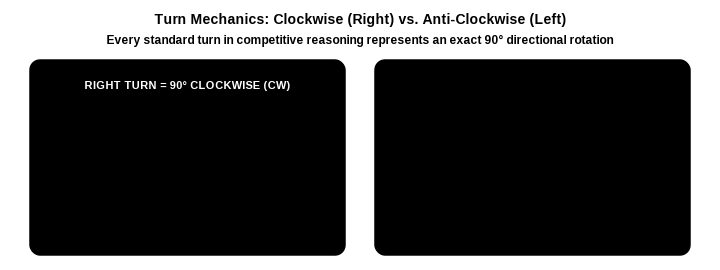
A Right Turn means turning 90° Clockwise (CW).
A Left Turn means turning 90° Anti-Clockwise (ACW).
Your physical left and right only match the diagram when facing North. When facing South, left and right reverse.
Facing Direction
Taking a Right Turn (90° CW)
Taking a Left Turn (90° ACW)
North
East
West
South
West
East
East
South
North
West
North
South
4. Shortest Distance (Pythagoras Theorem)
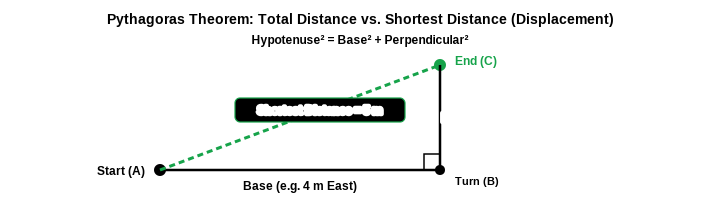
When a person turns at 90°, their path forms a right-angled triangle.
Total Distance Walked = Sum of all individual path segments.
Shortest Distance (Displacement) = Direct straight line from Start Point to End Point.
Memorize these common Pythagorean Triplets to solve questions without manual calculations:
(3, 4, 5) and its multiples: (6, 8, 10), (9, 12, 15), (12, 16, 20)
(5, 12, 13) and its multiples: (10, 24, 26)
(7, 24, 25)
(8, 15, 17)
(9, 40, 41)
(20, 21, 29)
5. Sun and Shadow Rules
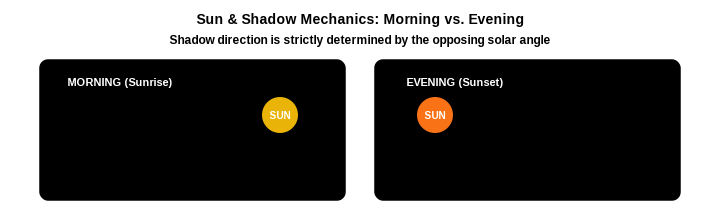
Shadows always form directly opposite to the light source.
Morning (Sunrise to 11:59 AM):
The Sun is in the East.
All shadows fall towards the West.
If a person faces North, their shadow falls to their Left.
If a person faces South, their shadow falls to their Right.
If a person faces East, their shadow falls Behind them.
If a person faces West, their shadow falls In front of them.
Evening (12:01 PM to Sunset):
The Sun is in the West.
All shadows fall towards the East.
If a person faces North, their shadow falls to their Right.
If a person faces South, their shadow falls to their Left.
If a person faces East, their shadow falls In front of them.
If a person faces West, their shadow falls Behind them.
At 12:00 Noon:
The Sun is directly overhead.
No directional shadow is cast.
Part 2: Question Types with 5 Worked Examples Each
In Indian competitive exams, Direction Sense questions fall into 6 core types:
Direction Faced vs. Direction with Reference to Starting Point
Total Distance and Shortest Distance
Angle / Degree of Rotation
Sun and Shadow Based
Direction Interchange / Compass Shift
Coded Direction Sense (Mains Level)
Type 1: Direction Faced & Direction from Starting Point
Pay close attention to whether the question asks:
"Which direction is he facing now?" (Requires only his final heading)
"In which direction is he from the starting point?" (Requires vector position from origin)
Example 1.1
Problem: A man walks 10 m North, turns right and walks 6 m, then turns right again and walks 10 m. (a) Which direction is he facing now? (b) In which direction is he from his starting point?
Step-by-Step Solution:
1. Start at origin (0, 0).
2. Walk 10 m North: Reaches (0, 10), facing North.
3. Turn right (East) and walk 6 m: Reaches (6, 10), facing East.
4. Turn right (South) and walk 10 m: Reaches (6, 0), facing South.
Answer (a): He is facing South. Answer (b): Relative to (0, 0), he is at (6, 0), which is due East.
Example 1.2
Problem: Priya walks 15 m West, turns left and walks 20 m, turns left again and walks 15 m, then turns right and walks 10 m. In which direction is she now with respect to her starting point?
Step-by-Step Solution:
1. Start at (0, 0).
2. 15 m West: Position is (-15, 0).
3. Left turn (South) 20 m: Position is (-15, -20).
4. Left turn (East) 15 m: Position is (0, -20).
5. Right turn (South) 10 m: Position is (0, -30).
Answer: She is directly South of her starting point.
Example 1.3
Problem: Rohan walks 25 m South, turns right and walks 15 m, turns right again and walks 10 m, then turns left and walks 10 m. Finally, he turns left and walks 15 m. In which direction is he facing, and where is he relative to the start?
Step-by-Step Solution:
1. Start at (0, 0).
2. South 25 m: (0, -25), facing South.
3. Turn right (West) 15 m: (-15, -25), facing West.
4. Turn right (North) 10 m: (-15, -15), facing North.
5. Turn left (West) 10 m: (-25, -15), facing West.
6. Turn left (South) 15 m: (-25, -30), facing South.
Answer: He is facing South, and his position relative to start is South-West.
Example 1.4
Problem: A delivery driver travels 8 km East, turns left and drives 4 km, turns right and drives 5 km, and finally turns right and drives 9 km. In which direction is he with respect to his starting point?
6. Net position: +13 on East axis, -5 on South axis.
Answer: He is in the South-East direction from his starting point.
Example 1.5
Problem: Ankit is facing North-East. He turns 90° clockwise, walks 10 m, then turns left and walks 5 m. Which direction is he facing now?
Step-by-Step Solution:
1. Initial facing: North-East.
2. Turn 90° Clockwise: 45° clockwise is East, another 45° clockwise is South-East. So he faces South-East.
3. Walks 10 m facing South-East.
4. Turns left (which means turning 90° Anti-Clockwise): 90° anti-clockwise from South-East brings him back to North-East.
Answer: He is facing North-East.
Type 2: Total Distance and Shortest Distance Calculations
Example 2.1
Problem: Amit walks 8 km South, then turns West and walks 6 km. What is the total distance walked, and what is the shortest distance between his starting point and final position?
Step-by-Step Solution:
1. Total Distance = 8 km + 6 km = 14 km.
2. The path forms a right-angled triangle with sides 8 km and 6 km.
3. Shortest Distance = √(8² + 6²)
= √(64 + 36)
= √100 = 10 km.
Answer: Total distance is 14 km; shortest distance is 10 km.
Example 2.2
Problem: A cyclist starts from point P, rides 12 km North to point Q, turns right and rides 9 km to point R. From point R, he turns right and rides 24 km to point S. What is the shortest distance between P and S?
Step-by-Step Solution:
1. Let P be at (0, 0).
2. Point Q is at (0, 12).
3. Turn right (East) 9 km to R: R is at (9, 12).
4. Turn right (South) 24 km to S: S is at (9, 12 - 24) = (9, -12).
5. Distance between P(0, 0) and S(9, -12):
Base = 9 km, Height = 12 km.
Shortest Distance = √(9² + (-12)²)
= √(81 + 144)
= √225 = 15 km.
Answer: The shortest distance between P and S is 15 km.
Example 2.3
Problem: Neha walks 14 m East, turns left and walks 7 m, turns left again and walks 10 m, and finally turns left and walks 4 m. Find the shortest distance between her starting point and current position.
Step-by-Step Solution:
1. Start at (0, 0).
2. East 14 m: (14, 0).
3. Left (North) 7 m: (14, 7).
4. Left (West) 10 m: (14 - 10, 7) = (4, 7).
5. Left (South) 4 m: (4, 7 - 4) = (4, 3).
6. Net position from start: 4 m East, 3 m North.
7. Shortest Distance = √(4² + 3²)
= √(16 + 9)
= √25 = 5 m.
Answer: The shortest distance is 5 m.
Example 2.4
Problem: A car travels 20 km North, turns left and travels 15 km, turns left again and travels 28 km, and finally turns left and travels 30 km. Find the shortest distance and direction of the car from the starting point.
Answer: Shortest distance is 17 km in the South-East direction.
Example 2.5
Problem: Two runners, A and B, start from the same point O. Runner A runs 12 km North, then turns East and runs 5 km. Runner B runs 8 km South, then turns West and runs 16 km. Find the straight-line distance between Runner A and Runner B.
Step-by-Step Solution:
1. Let O be at (0, 0).
2. Position of Runner A: (5, 12).
3. Position of Runner B: (-16, -8).
4. Total East-West separation = 5 - (-16) = 21 km.
5. Total North-South separation = 12 - (-8) = 20 km.
6. Straight-line distance = √(21² + 20²)
= √(441 + 400)
= √841 = 29 km.
Answer: The straight-line distance between them is 29 km.
Type 3: Degree of Rotation (Clockwise & Anticlockwise)
Shortcut Method:
Instead of drawing every turn, sum all angles:
Net Angle = (Sum of all Clockwise angles) - (Sum of all Anti-Clockwise angles)
• If the result is positive, turn that many degrees Clockwise from the initial direction.
• If the result is negative, turn that many degrees Anti-Clockwise.
Example 3.1
Problem: A man is facing North. He turns 45° clockwise, then 180° clockwise, and then 45° anticlockwise. Which direction is he facing now?
Step-by-Step Solution:
1. Clockwise (CW) turns = 45° + 180° = 225°.
2. Anticlockwise (ACW) turns = 45°.
3. Net rotation = 225° - 45° = 180° CW.
4. Turning 180° from North points directly opposite.
Answer: He is facing South.
Example 3.2
Problem: Deepak is facing South-West. He turns 90° clockwise, then 135° anticlockwise, and then 45° clockwise. Which direction is he facing now?
Step-by-Step Solution:
1. CW turns = 90° + 45° = 135°.
2. ACW turns = 135°.
3. Net rotation = 135° - 135° = 0°.
4. Since the net angle is 0°, his direction remains unchanged.
Answer: He is facing South-West.
Example 3.3
Problem: A girl is facing East. She turns 135° in the clockwise direction and then 225° in the anticlockwise direction. Which direction is she facing now?
4. Turning 90° anticlockwise from East: East turned 90° left is North.
Answer: She is facing North.
Example 3.4
Problem: A person is facing West. He turns 45° clockwise, then 90° anticlockwise, then 180° clockwise, and finally 45° anticlockwise. Which direction is he facing?
Step-by-Step Solution:
1. Total CW = 45° + 180° = 225°.
2. Total ACW = 90° + 45° = 135°.
3. Net rotation = 225° - 135° = 90° CW.
4. Initial direction is West. Turning 90° Clockwise (right) from West gives North.
Answer: He is facing North.
Example 3.5
Problem: A compass needle initially points North-West. It rotates 270° clockwise, then 180° anticlockwise, and finally 45° clockwise. Which direction does the needle point?
Problem: One morning after sunrise, Suresh was standing facing a pole. The shadow of the pole fell exactly to his right. Which direction was Suresh facing?
Step-by-Step Solution:
1. Time: Morning -> Sun is in the East.
2. Therefore, all shadows fall towards the West.
3. The shadow falls to Suresh's Right side.
4. This means Suresh's Right side = West.
5. When facing South, your right arm points West and left arm points East.
Answer: Suresh was facing South.
Example 4.2
Problem: One evening before sunset, Rekha and Hema were talking to each other face to face. If Hema's shadow was exactly to the right of Hema, which direction was Rekha facing?
Step-by-Step Solution:
1. Time: Evening -> Sun is in the West.
2. Therefore, all shadows fall towards the East.
3. Hema's shadow falls to Hema's Right side.
4. This means Hema's Right side = East.
5. When facing North, your right arm points East. Thus, Hema is facing North.
6. Since Rekha is talking face to face with Hema, Rekha faces the opposite direction.
Answer: Rekha was facing South.
Example 4.3
Problem: One morning, Rahul started walking towards the sun. After walking 10 m, he turned left and walked 5 m, then turned right and walked 8 m. In which direction is his shadow falling relative to his body?
Step-by-Step Solution:
1. Morning: Sun is in the East. Rahul starts walking East.
2. Turns left -> He now walks North.
3. Turns right -> He now walks East.
4. Rahul is currently facing East.
5. In the morning, shadows always fall to the West.
6. Since he is facing East, West is directly behind him.
Answer: His shadow is falling Behind him.
Example 4.4
Problem: One evening before sunset, two friends Sumit and Mohit were talking to each other face to face in a park. If Sumit's shadow fell exactly to the left of Mohit, which direction was Sumit facing?
Step-by-Step Solution:
1. Evening: All shadows fall towards the East.
2. Sumit's shadow is pointing East.
3. The problem states this shadow is to the Left of Mohit.
4. Therefore, Mohit's Left side = East.
5. A person whose left side is East must be facing South.
6. Mohit is facing South. Since Sumit is facing Mohit, Sumit must be facing the opposite direction.
Answer: Sumit was facing North.
Example 4.5
Problem: At exactly 12:00 PM, an athlete is standing in the middle of a ground facing East. Where does his shadow fall?
Step-by-Step Solution:
1. At 12:00 PM (Noon), the sun is positioned directly overhead vertically.
2. The sun rays fall straight down perpendicular to the ground.
Answer: No directional shadow is formed (it falls directly beneath his feet).
Type 5: Direction Interchange / Compass Shift Problems
In these questions, the entire compass dial is rotated by a specific angle. Find the angle and direction of shift, then apply the exact same shift to the target direction.
Example 5.1
Problem: If South-East becomes North, North-East becomes West, and so on, what will West become?
Step-by-Step Solution:
1. Find the shift:
Original South-East is at 135° from North.
It is turned into North (0°).
This is a rotation of 135° Anti-Clockwise.
2. Verify with the second pair:
North-East (45°) rotated 135° Anti-Clockwise becomes West (270°). It matches.
3. Apply 135° Anti-Clockwise rotation to West:
West is at 270°.
270° - 135° = 135° (which is South-East).
Answer: West will become South-East.
Example 5.2
Problem: A faulty compass shows North as West, and East as South. If a traveler follows this compass and walks in the direction marked "East", which actual direction is he walking towards?
Step-by-Step Solution:
1. Look at the shift of the markings:
The mark "North" points to actual West (a 90° Anti-Clockwise rotation).
The mark "East" points to actual South (a 90° Anti-Clockwise rotation).
2. Therefore, every mark on the compass points 90° Anti-Clockwise from its label.
3. When the traveler follows the mark "East", he is moving in the direction where that mark points.
Answer: He is actually walking towards South.
Example 5.3
Problem: A clock is placed on a table. At 9:00 AM, the hour hand points towards North. In which direction will the minute hand point at 6:00 AM?
Step-by-Step Solution:
1. On a standard clock at 9:00 AM:
Hour hand points at 9 (standard direction is West).
Minute hand points at 12 (standard direction is North).
2. Given condition: The hour hand (West) points North.
Shift = West rotated 90° Clockwise to become North.
3. Now look at 6:00 AM:
The minute hand is at 12 (which is standard North).
4. Apply the same 90° Clockwise shift to North:
North rotated 90° Clockwise becomes East.
Answer: The minute hand will point East.
Example 5.4
Problem: If North becomes North-East, and West becomes North-West, what will South become?
Step-by-Step Solution:
1. North becomes North-East: Shift = 45° Clockwise.
2. West becomes North-West: Shift = 45° Clockwise.
3. Apply a 45° Clockwise shift to South:
South turned 45° clockwise becomes South-West.
Answer: South will become South-West.
Example 5.5
Problem: A clock shows 4:30 PM. If the minute hand points towards East, in which direction does the hour hand point?
Step-by-Step Solution:
1. Standard positions at 4:30:
Minute hand is at 6 (points South).
Hour hand is halfway between 4 and 5 (points South-East).
2. The problem states the minute hand (South) points East.
Shift = South rotated 90° Anti-Clockwise to become East.
3. Apply the same 90° Anti-Clockwise shift to the hour hand:
In Banking (IBPS PO, SBI PO) and SSC Mains, directions are represented using symbols like @, #, $, %, &. Decode the statements into regular movements before plotting.
Example 6.1
Problem: A # B means A is 5 m North of B A $ B means A is 6 m South of B A % B means A is 8 m East of B A & B means A is 4 m West of B Given expression: P # Q, Q % R, R $ S. What is the shortest distance between P and S?
Step-by-Step Solution:
1. Decode each statement:
P # Q: P is 5 m North of Q.
Q % R: Q is 8 m East of R (meaning R is 8 m West of Q).
R $ S: R is 6 m South of S (meaning S is 6 m North of R).
2. Assign coordinates with R at (0, 0):
R = (0, 0)
S = (0, 6) [since S is 6 m North of R]
Q = (8, 0) [since Q is 8 m East of R]
P = (8, 5) [since P is 5 m North of Q]
3. Find distance between P(8, 5) and S(0, 6):
Horizontal distance = 8 - 0 = 8 m
Vertical distance = 6 - 5 = 1 m
Shortest Distance = √(8² + 1²)
= √(64 + 1) = √65 m.
Answer: The shortest distance is √65 m (approx. 8.06 m).
Example 6.2
Problem: X + Y (10m) means X is 10 m North of Y X / Y (15m) means X is 15 m West of Y X - Y (10m) means X is 10 m South of Y Given expression: M + N (10m), N / O (15m), O - P (10m). In which direction is M with respect to P, and what is the distance between them?
Step-by-Step Solution:
1. Decode each statement:
M + N (10m): M is 10 m North of N.
N / O (15m): N is 15 m West of O.
O - P (10m): O is 10 m South of P (meaning P is 10 m North of O).
2. Plot using coordinates:
Let O = (0, 0).
P is 10 m North of O -> P = (0, 10).
N is 15 m West of O -> N = (-15, 0).
M is 10 m North of N -> M = (-15, 10).
3. Compare M(-15, 10) and P(0, 10):
Both have the same vertical coordinate (y = 10).
M is 15 m to the left of P along the horizontal axis.
Answer: M is 15 m due West of P.
Example 6.3
Problem: A @ B means A is to the North of B A # B means A is to the South of B A $ B means A is to the East of B A % B means A is to the West of B Given: K @ L (8m), L $ M (6m), M # N (8m). What is the direction and shortest distance of K from N?
Step-by-Step Solution:
1. Decode:
K @ L (8m): K is 8 m North of L.
L $ M (6m): L is 6 m East of M.
M # N (8m): M is 8 m South of N (meaning N is 8 m North of M).
2. Set M at (0, 0):
M = (0, 0)
N = (0, 8)
L = (6, 0)
K = (6, 8) [8 m North of L]
3. Compare K(6, 8) with N(0, 8):
Vertical level is identical (y = 8).
K is at x = 6, N is at x = 0.
Answer: K is 6 m East of N.
Example 6.4
Problem: P ↑ Q (d) means P is d meters North of Q P ↓ Q (d) means P is d meters South of Q P → Q (d) means P is d meters East of Q P ← Q (d) means P is d meters West of Q Expression: A → B (12m), B ↓ C (5m), C ← D (12m). Find the shortest distance between A and D, and the direction of D with respect to A.
Step-by-Step Solution:
1. Decode:
A → B (12m): A is 12 m East of B.
B ↓ C (5m): B is 5 m South of C (so C is 5 m North of B).
C ← D (12m): C is 12 m West of D (so D is 12 m East of C).
2. Assign coordinates with B at (0, 0):
B = (0, 0)
A = (12, 0)
C = (0, 5)
D = (12, 5) [12 m East of C]
3. Compare D(12, 5) with A(12, 0):
Both have x = 12.
D is 5 m above A.
Answer: Shortest distance is 5 m; D is North of A.
Example 6.5
Problem: P * Q (d) means P is d meters North of Q P / Q (d) means P is d meters South of Q P + Q (d) means P is d meters East of Q P - Q (d) means P is d meters West of Q Given path: Point K * Point L (15m) Point J + Point K (20m) Point M - Point L (20m) Point N / Point M (25m) (a) What is the shortest distance between Point J and Point N? (b) In which direction is Point N with respect to Point J?
Step-by-Step Solution:
1. Decode and set L at origin (0, 0):
K * L (15m): K is 15 m North of L -> K = (0, 15).
J + K (20m): J is 20 m East of K -> J = (20, 15).
M - L (20m): M is 20 m West of L -> M = (-20, 0).
N / M (25m): N is 25 m South of M -> N = (-20, -25).
2. Coordinates to compare: J = (20, 15) and N = (-20, -25).
Difference in X = 20 - (-20) = 40 m.
Difference in Y = 15 - (-25) = 40 m.
3. Calculate shortest distance:
Shortest Distance = √(40² + 40²)
= √(1600 + 1600)
= √3200
= √(1600 * 2) = 40√2 m (approx. 56.56 m).
4. Direction of N from J:
From J(20, 15) to N(-20, -25), you must move West and South.
Answer: Shortest distance is 40√2 m; Point N is in the South-West direction with respect to Point J.
Ready to Test Your Speed?
Put your direction sense, turn calculations, and displacement shortcuts to the test with real exam drills.