An embedded figure is a simple geometric shape or pattern that is completely hidden inside a larger, more complex design such that all its original lines, angles, and intersections remain intact.
Fundamentals of Embedded Figures
In non-verbal reasoning, embedded figure questions evaluate spatial visualization, visual closure, and pattern isolation. You must separate a target shape from surrounding visual noise and camouflage lines.
1. The Core Rules Every Beginner Must Know
Structural Continuity: Every single line segment, curve, and junction of the target shape must exist continuously in the host figure. If the target shape has a continuous line, an option where that line is broken or missing a segment is invalid.
Presence of Camouflage Lines: The host figure will contain numerous background lines, overlapping shapes, grids, and diagonals. You do not need the target shape to stand alone; you only need to verify that all of its lines can be traced over the existing lines of the host figure.
Angle and Proportion Preservation: The geometric relationships must remain exact. A 90-degree right angle cannot turn into a 60-degree acute angle. A square cannot become a stretched rectangle. Relative proportions between segments must match.
The Golden Rotation Rule:
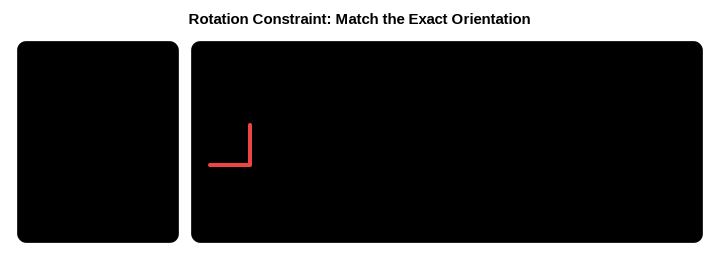
Default / Strict Condition ("Rotation is NOT allowed"): In standard competitive exams, questions frequently specify: "Rotation is not allowed." In this scenario, the target figure must appear in the exact same orientation (upright, tilted, or inverted) as presented.
Secondary Condition ("Rotation is allowed" or No Instruction): If the question does not explicitly forbid rotation, first search for an exact match in the original orientation. If no option contains the unrotated shape, look for the shape rotated (turned 90 degrees, 180 degrees, etc.). A non-rotated exact match always takes priority over a rotated one.
2. The Step-by-Step "Anchor Feature" Method
Beginners often make the mistake of looking at the whole complex pattern at once, which causes visual fatigue. Use this three-step scanning technique instead:
Pick an "Anchor Feature": Look at the target figure and identify its most unique or sharpest part (for example, a sharp diagonal cross, a small triangle at the corner, or an arrow head).
Scan and Eliminate: Check each option solely for that anchor feature. If an option does not contain that specific angle or junction, eliminate it immediately without checking the rest of the shape.
Trace Outward: Once you find the anchor feature in an option, trace the remaining connected lines outward to confirm whether the complete figure is present.
Types of Embedded Figures in Competitive Exam Books
Standard competitive reasoning textbooks categorize embedded figure questions into three distinct operational types:
Type 1: Finding the Option Figure that contains the given Question Figure (Direct Search).
Type 2: Finding which Option Figure is hidden inside the given Complex Master Figure (Reverse Search).
Type 3: Embedded Figures governed by strict Rotation Rules (Allowed vs. Not Allowed).
Type 1: Finding the Option Figure that Contains the Question Figure
In this type, you are given a simple Question Figure (X) and four complex designs (A, B, C, D). You must find which complex design embeds Figure X.
Example 1.1
Question Figure (X): An inverted capital letter T (a horizontal baseline with a vertical line rising straight up from its midpoint).
Options: (A) A plain square with two diagonal lines. (B) A circle with a vertical line. (C) A rectangle divided into four equal rectangles. (D) An equilateral triangle with a median line.
Correct Answer: (C)
Explanation: In option (C), the bottom horizontal edge of the rectangle acts as the baseline, and the central vertical dividing line rises straight up from its midpoint, forming an exact inverted 'T'. Options (A), (B), and (D) lack this perpendicular junction on a flat base.
Example 1.2
Question Figure (X): A capital letter Z made of two equal horizontal lines and one sharp diagonal connecting them.
Options: (A) Diamond with a vertical line. (B) Parallelogram with one diagonal. (C) Hexagon with spokes. (D) Circle with a plus sign.
Correct Answer: (B)
Explanation: A parallelogram has a top horizontal edge, a bottom horizontal edge, and a diagonal cutting across. Following the top edge rightward, moving down the diagonal, and moving rightward along the bottom edge traces the letter 'Z' continuously.
Example 1.3
Question Figure (X): A right-angled triangle where the right angle is at the bottom-left corner.
Options: (A) Slanted parallelogram with non-perpendicular diagonals. (B) Square divided by both main diagonals. (C) Pentagon. (D) Oval with horizontal line.
Correct Answer: (B)
Explanation: In option (B), trace the square’s left edge from the top-left to the bottom-left corner, its bottom edge to the bottom-right corner, and the diagonal from the top-left to the bottom-right. These three segments form a right-angled triangle with its 90-degree angle at the bottom-left corner.
Example 1.4
Question Figure (X): An arrow pointing upward, consisting of a vertical stem topped by a triangular arrowhead.
Options: (A) Concentric circles. (B) Large triangle with a vertical line dropping down from the top apex. (C) 3x3 Grid. (D) Wavy lines.
Correct Answer: (B)
Explanation: In option (B), the top apex of the large triangle along with its two upper slanted edges forms the arrowhead, while the central vertical line running down the middle provides the stem.
Example 1.5
Question Figure (X): A capital letter V sitting upright on its sharp vertex.
Options: (A) Straight horizontal line with vertical lines. (B) Equilateral triangle resting flat. (C) A letter 'M' formed by two peaks and a central dip. (D) A circle touching a flat horizontal line.
Correct Answer: (C)
Explanation: In a standard capital letter 'M', the two inner slanted lines meet at the bottom center to form a clear, upright letter 'V'.
Type 2: Finding Which Option Figure is Hidden Inside the Master Figure
Here, the role is reversed. You are given one complex Master Figure (X), and you must check which of the four simple Option Figures (A, B, C, D) can be traced completely inside it.
Example 2.1
Master Figure (X): A large square with both main diagonals drawn, plus a horizontal line connecting the midpoints of the vertical sides.
Options: (A) A small circle with a central dot. (B) An hourglass / bow-tie shape. (C) A regular hexagon. (D) A five-pointed star.
Correct Answer: (B)
Explanation: The two diagonals inside the square cross at the center. The top horizontal edge with the top halves of the two diagonals forms an upper triangle pointing down. The bottom edge with the bottom diagonals forms a lower triangle pointing up. Together, they form an hourglass shape.
Example 2.2
Master Figure (X): A regular hexagon with its three diameters drawn through opposite vertices, plus three straight segments joining every second vertex to form an inscribed equilateral triangle.
Options: (A) Circle with square. (B) Crescent moon. (C) Equilateral triangle pointing up. (D) Four-step staircase.
Correct Answer: (C)
Explanation: The three added segments joining every second outer vertex form the equilateral triangle directly. The three diameters are additional internal lines; they do not by themselves create the triangle’s three sides.
Example 2.3
Master Figure (X): Two identical squares offset by the same distance horizontally and vertically, so their overlap is itself a smaller square.
Options: (A) Circle. (B) Small square. (C) Trapezium. (D) Arrow.
Correct Answer: (B)
Explanation: Because the squares are offset by equal horizontal and vertical distances, the shared region has equal width and height. Its four boundary segments form a smaller square that matches option (B).
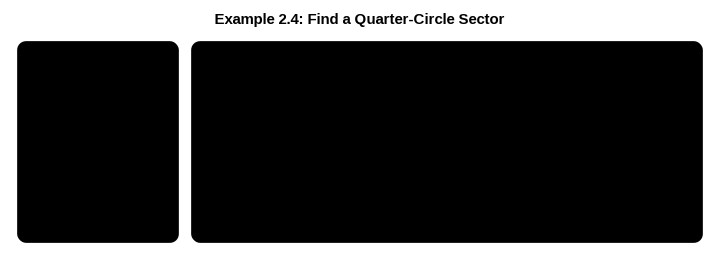
Example 2.4
Master Figure (X): A circle containing an inscribed cross (+) that divides the circle into four equal quadrants.
Explanation: The cross divides the circle into four quarters. Any single quarter consists of two straight perpendicular radii meeting at the center point and connected by a quarter-circle arc.
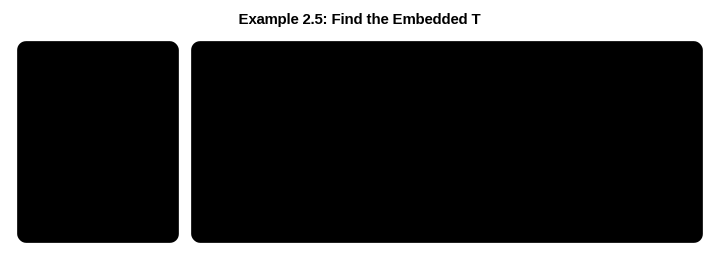
Example 2.5
Master Figure (X): An H-like line figure with unequal outer uprights, small horizontal feet at the bottom, and an extra vertical segment rising from the midpoint of the horizontal crossbar. That added segment and the crossbar form a T.
Options: (A) A simple letter 'T'. (B) Closed triangle. (C) Circle with bar. (D) Upright cross.
Correct Answer: (A)
Explanation: The added central vertical segment meets the horizontal crossbar at its midpoint and extends upward from it, giving the exact junction needed for option (A), the letter T.
Type 3: Embedded Figures Governed by Rotation Rules
In modern reasoning tests, examiners explicitly test whether you follow orientation constraints. Pay close attention to whether the instructions state "Rotation is NOT allowed" or allow the shape to turn.
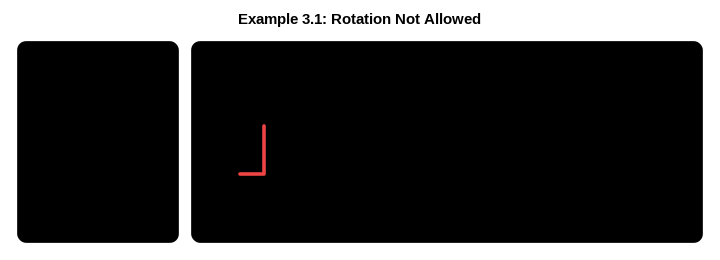
Example 3.1 (Condition: Rotation is NOT allowed)
Question Figure (X): A capital letter L (vertical line going down, then turning 90 degrees to the right).
Explanation: Even though options (A) and (B) contain the exact same line lengths and 90-degree corners, they are rotated or mirrored versions. Because the question specifies that rotation is not allowed, only option (C) matches the exact upright orientation.
Example 3.2 (Condition: Rotation is allowed)
Question Figure (X): A right-pointing arrow: --->
Options: (A) Complex network containing an upward-pointing arrow ^. (B) Curves and circles. (C) Parallel lines. (D) Empty grid.
Correct Answer: (A)
Explanation: Here, rotation is permitted. Rotating the right-pointing arrow 90 degrees counterclockwise yields an upward-pointing arrow of the exact same line length and arrowhead proportion. It is completely embedded in (A).
Example 3.3 (Condition: Rotation is NOT allowed)
Question Figure (X): A staircase profile with two steps going upward from left to right.
Options: (A) Steps descending left to right. (B) Steps ascending left to right. (C) Vertical lines. (D) Semicircles.
Correct Answer: (B)
Explanation: Because rotation is forbidden, an ascending staircase cannot be replaced by a descending staircase. Option (B) maintains the exact left-to-right ascending step pattern.
Example 3.4 (Condition: Rotation is allowed)
Question Figure (X): A symmetrical capital letter W.
Options: (A) Complex grid containing a capital letter M. (B) Isolated vertical bars. (C) Concentric pentagons. (D) Circle with spokes.
Correct Answer: (A)
Explanation: Turning a letter 'W' upside down (a 180-degree rotation) creates a letter 'M'. Since rotation is allowed and no unrotated 'W' exists, option (A) is the correct choice.
Example 3.5 (Condition: Rotation is NOT allowed)
Question Figure (X): A rectangle standing vertically (height is twice its width).
Explanation: Under the non-rotation rule, a horizontal rectangle is invalid because it is turned 90 degrees. Option (C) preserves both the vertical aspect ratio and the exact original orientation.
Ready to Test Your Skill?
Put your visual isolation skills and pattern recognition to the test with real embedded figure exam drills.