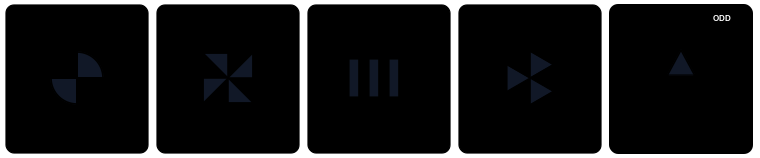
Figure Classification (also known as Odd One Out or Classification of Figures) is a major chapter in Non-Verbal Reasoning. In this topic, you are given a set of geometric or abstract figures (usually 4 or 5 options labeled A, B, C, D, and E). All figures in the group follow a specific hidden rule, property, or pattern, except for one figure that breaks this rule. Your objective is to discover the common pattern and pick the odd figure out.
1. Fundamentals of Figure Classification
To solve figure classification questions quickly and accurately, you do not need complex formulas. You only need to train your eyes to check specific visual parameters in a disciplined order.
Whenever you see a question, evaluate the options using the S-N-O-P-R Rule:
S
Shape and Structure
Open vs. Closed: Is the figure fully closed (like a square or circle) or open with a gap (like a horseshoe or letter 'U')?
Boundary Type: Is the shape made entirely of straight line segments (polygons), curved lines, or a combination of both?
Symmetry: Does the shape possess a line of symmetry (can it be folded into two identical halves), or is it asymmetric?
N
Number of Elements & Lines
Count the number of sides of the outer boundary.
Count internal items such as dots, crosses, arrows, stars, or line segments.
Check for mathematical properties in the count: Even vs. Odd numbers, Prime numbers, or matching ratios (such as number of dots = number of sides).
O
Orientation and Rotation
Clockwise vs. Counter-Clockwise: Look at how elements turn from one step to the next.
Pure Rotation vs. Reflection (Mirror Image): A shape that is simply rotated in 2D space stays identical. If a shape is laterally flipped (mirror image), it cannot be matched by simple rotation; this is one of the most common traps in reasoning tests.
P
Position and Placement
Where are internal symbols located? (At a vertex/corner, on an edge/side, or dead-center?)
Are symbols placed inside or outside the main boundary?
Are two symbols placed adjacent (next to each other) or diametrically opposite?
R
Relationship Between Nested Figures
When one shape is drawn inside another, compare the number of sides:
Does the inner shape have 1 side fewer than the outer shape?
Does the inner shape have 1 side more?
Is the inner shape an inverted (upside down) copy of the outer shape?
2. Types of Figure Classification
Standard reasoning textbooks divide Figure Classification into 5 primary types. Below is a detailed breakdown of each type along with 5 fully explained examples.
Type 1: Classification Based on Number of Elements or Lines
In this type, the odd figure is identified by counting the outer lines, inner elements, or calculating a simple arithmetic count (even, odd, or equal counts).
Example 1.1
Red outline marks the answer supplied in the lesson. Scroll horizontally on narrow screens.
(A) Triangle (3 sides)
(B) Pentagon (5 sides)
(C) Heptagon (7 sides)
(D) Quadrilateral (4 sides)
(E) Nonagon (9 sides)
Answer: (D)
Explanation: Figures (A), (B), (C), and (E) all have an odd number of straight sides (3, 5, 7, 9). Figure (D) has an even number of sides (4).
Example 1.2
Red outline marks the answer supplied in the lesson. Scroll horizontally on narrow screens.
(A) Letter 'H'
(B) Letter 'F'
(C) Letter 'A'
(D) Letter 'E'
(E) Letter 'Z'
Answer: (D)
Explanation: Count the straight line segments used to draw each capital letter:
H = 2 vertical lines + 1 horizontal line = 3 lines
F = 1 vertical line + 2 horizontal lines = 3 lines
A = 2 slanting lines + 1 horizontal line = 3 lines
Z = 2 horizontal lines + 1 slanting line = 3 lines
E = 1 vertical line + 3 horizontal lines = 4 lines
Letters (A), (B), (C), and (E) are made of exactly 3 lines, while (D) requires 4 lines.
Example 1.3
Red outline marks the answer supplied in the lesson. Scroll horizontally on narrow screens.
(A) A triangle containing 3 internal dots
(B) A rectangle containing 4 internal dots
(C) A pentagon containing 5 internal dots
(D) A hexagon containing 7 internal dots
(E) An octagon containing 8 internal dots
Answer: (D)
Explanation: In (A), (B), (C), and (E), the number of internal dots is equal to the number of sides of the outer polygon (3 = 3, 4 = 4, 5 = 5, 8 = 8). In (D), a hexagon has 6 sides, but contains 7 dots.
Example 1.4
Red outline marks the answer supplied in the lesson. Scroll horizontally on narrow screens.
(A) A circle containing 5 plus (+) symbols and 3 minus (-) symbols
(B) A circle containing 6 plus (+) symbols and 2 minus (-) symbols
(C) A circle containing 4 plus (+) symbols and 4 minus (-) symbols
(D) A circle containing 7 plus (+) symbols and 1 minus (-) symbol
(E) A circle containing 5 plus (+) symbols and 4 minus (-) symbols
Answer: (E)
Explanation: Count the total number of internal symbols:
(A) 5 + 3 = 8 symbols
(B) 6 + 2 = 8 symbols
(C) 4 + 4 = 8 symbols
(D) 7 + 1 = 8 symbols
(E) 5 + 4 = 9 symbols
All figures contain a total of 8 symbols, except (E), which contains 9.
Example 1.5
Red outline marks the answer supplied in the lesson. Scroll horizontally on narrow screens.
(A) A central circle with 3 radiating line rays
(B) A central circle with 5 radiating line rays
(C) A central circle with 7 radiating line rays
(D) A central circle with 6 radiating line rays
(E) A central circle with 11 radiating line rays
Answer: (D)
Explanation: In (A), (B), (C), and (E), the number of rays attached to the circle is an odd number (3, 5, 7, 11). Figure (D) has an even number of rays (6).
Type 2: Classification Based on Spatial Orientation and Rotation
Here, the figures are identical in shape, but they are rotated in a 2D plane. Four of the figures can be rotated into one another, while the odd one is either rotated by a different angle or is a mirror image (flipped laterally).
Example 2.1
Red outline marks the answer supplied in the lesson. Scroll horizontally on narrow screens.
(A) An arrow pointing straight Up (0 degrees)
(B) An arrow pointing straight Right (rotated 90 degrees clockwise)
(C) An arrow pointing straight Down (rotated 180 degrees clockwise)
(D) An arrow pointing straight Left (rotated 270 degrees clockwise)
(E) An arrow pointing toward North-East (rotated 45 degrees)
Answer: (E)
Explanation: Figures (A), (B), (C), and (D) point along the main cardinal axes at 90-degree intervals. Figure (E) is diagonal (at a 45-degree angle).
Example 2.2
Red outline marks the answer supplied in the lesson. Scroll horizontally on narrow screens.
(A) Standard upright letter 'P'
(B) Letter 'P' rotated 90 degrees clockwise (vertical stem is horizontal, loop is below the stem to the right)
(C) Letter 'P' rotated 180 degrees (vertical stem points up, loop is on the left side)
(D) Letter 'P' rotated 270 degrees clockwise (vertical stem is horizontal, loop is above the stem to the left)
(E) Letter 'P' flipped like a mirror reflection (vertical stem is upright, but loop is on the left side, resembling a lowercase 'q')
Answer: (E)
Explanation: (A), (B), (C), and (D) are pure rigid 2D plane rotations of the letter 'P'. Figure (E) is a lateral reflection (mirror image); no amount of flat rotation can convert (A) into (E).
Example 2.3
Red outline marks the answer supplied in the lesson. Scroll horizontally on narrow screens.
(A) A circle with 3 arrows on its perimeter pointing Clockwise
(B) A circle with 3 arrows on its perimeter pointing Clockwise
(C) A circle with 3 arrows on its perimeter pointing Counter-Clockwise
(D) A circle with 3 arrows on its perimeter pointing Clockwise
(E) A circle with 3 arrows on its perimeter pointing Clockwise
Answer: (C)
Explanation: In figures (A), (B), (D), and (E), all curved arrows circulate in a clockwise direction. In figure (C), they point in a counter-clockwise direction.
Example 2.4
Red outline marks the answer supplied in the lesson. Scroll horizontally on narrow screens.
(A) A straight arrow with a small black square attached to its right side
(B) An arrow rotated 90 degrees clockwise, with the small black square still on its right side relative to the arrow's head
(C) An arrow rotated 180 degrees, with the small black square still on its right side relative to the arrow's head
(D) An arrow rotated 270 degrees clockwise, with the small black square attached to its left side relative to the arrow's head
(E) An arrow rotated 45 degrees clockwise, with the small black square still on its right side relative to the arrow's head
Answer: (D)
Explanation: If you rotate your perspective to match the forward direction of each arrow, the black square sits on the right-hand side in (A), (B), (C), and (E). In (D), the square sits on the left-hand side.
Example 2.5
Red outline marks the answer supplied in the lesson. Scroll horizontally on narrow screens.
(A) Two vertical parallel arrows, both pointing Upward
(B) Two horizontal parallel arrows, both pointing Rightward
(C) Two diagonal parallel arrows, both pointing North-East
(D) Two vertical parallel arrows, one pointing Upward and one pointing Downward
(E) Two horizontal parallel arrows, both pointing Leftward
Answer: (D)
Explanation: In (A), (B), (C), and (E), the two arrows point in the exact same direction (unidirectional). In (D), the arrows point in opposite directions (antiparallel).
Type 3: Classification Based on Geometric Shape, Structure, and Division
This category checks fundamental geometric properties: open vs. closed shapes, straight line vs. curved line boundaries, symmetry, and proportions of divided areas.
Example 3.1
Red outline marks the answer supplied in the lesson. Scroll horizontally on narrow screens.
(A) Square
(B) Circle
(C) Triangle
(D) Regular Pentagon
(E) Letter 'U' shape
Answer: (E)
Explanation: Figures (A), (B), (C), and (D) are completely closed 2D shapes that enclose an area. Figure (E) is an open figure with two free endpoints.
Example 3.2
Red outline marks the answer supplied in the lesson. Scroll horizontally on narrow screens.
(A) Rhombus
(B) Trapezium
(C) Regular Hexagon
(D) Semicircle
(E) Parallelogram
Answer: (D)
Explanation: (A), (B), (C), and (E) are rectilinear polygons made exclusively of straight line segments. A semicircle (D) contains a curved arc boundary.
Example 3.3
Red outline marks the answer supplied in the lesson. Scroll horizontally on narrow screens.
(A) A square divided into 4 equal quarters by two crossing lines passing through the center
(B) A circle divided into 4 equal sectors by two perpendicular diameters
(C) An equilateral triangle divided into 4 equal smaller triangles by joining the midpoints of its sides
(D) A rectangle divided into 4 unequal sections by two random lines crossing off-center
(E) A regular hexagon divided into 6 equal equilateral triangles by three lines passing through the center
Answer: (D)
Explanation: In figures (A), (B), (C), and (E), the dividing lines split the main shape into pieces of equal surface area. In (D), the resulting sections have unequal areas.
Example 3.4
Red outline marks the answer supplied in the lesson. Scroll horizontally on narrow screens.
(A) Equilateral Triangle
(B) Rectangle
(C) Regular Pentagon
(D) Circle
(E) Scalene Triangle
Answer: (E)
Explanation: Figures (A), (B), (C), and (D) are symmetric figures that have at least one line of reflective symmetry. A scalene triangle (E) has three unequal sides and zero lines of symmetry (asymmetrical).
Example 3.5
Red outline marks the answer supplied in the lesson. Scroll horizontally on narrow screens.
(A) A circle divided into 4 equal parts, with 2 parts shaded black (2/4 = 1/2 shaded)
(B) A square divided into 8 equal triangles, with 4 triangles shaded black (4/8 = 1/2 shaded)
(C) A rectangle divided into 6 equal strips, with 3 strips shaded black (3/6 = 1/2 shaded)
(D) A regular hexagon divided into 6 equal parts, with 3 parts shaded black (3/6 = 1/2 shaded)
(E) A triangle divided into 4 equal parts, with 1 part shaded black (1/4 shaded)
Answer: (E)
Explanation: In figures (A), (B), (C), and (D), exactly half (1/2 or 50%) of the figure is shaded. In figure (E), only one-fourth (1/4 or 25%) of the total area is shaded.
Type 4: Classification Based on Relative Position of Elements
In this type, each option contains two or more distinct symbols or elements. The classification is decided by how these elements are arranged relative to each other or relative to the main frame.
Example 4.1
Red outline marks the answer supplied in the lesson. Scroll horizontally on narrow screens.
(A) A triangle with a black dot placed on one of its corner points (vertex)
(B) A square with a black dot placed on one of its corner points (vertex)
(C) A pentagon with a black dot placed on one of its corner points (vertex)
(D) A hexagon with a black dot placed along the middle of one of its straight edges (side)
(E) An octagon with a black dot placed on one of its corner points (vertex)
Answer: (D)
Explanation: In (A), (B), (C), and (E), the dot is positioned exactly on a vertex (corner). In (D), the dot lies on a flat side edge.
Example 4.2
Red outline marks the answer supplied in the lesson. Scroll horizontally on narrow screens.
(A) A circle with a small star inside it
(B) A square with a small star inside it
(C) A triangle with a small star positioned outside its boundary
(D) A hexagon with a small star inside it
(E) A pentagon with a small star inside it
Answer: (C)
Explanation: In options (A), (B), (D), and (E), the secondary symbol (star) is located inside the interior region. In (C), the star is placed outside.
Example 4.3
Red outline marks the answer supplied in the lesson. Scroll horizontally on narrow screens.
(A) A square with a plus sign at the top-left corner and a minus sign at the bottom-right corner
(B) A rectangle with a black dot at the top-right corner and a white dot at the bottom-left corner
(C) A circle with an arrow at the northernmost point and an arrow at the southernmost point
(D) A square with a star at the top-left corner and a triangle at the top-right corner
(E) A regular hexagon with a dot at the topmost vertex and a dot at the lowermost vertex
Answer: (D)
Explanation: In (A), (B), (C), and (E), the two elements are positioned diagonally or diametrically opposite to one another. In (D), the two elements are placed on adjacent corners along the same top edge.
Example 4.4
Red outline marks the answer supplied in the lesson. Scroll horizontally on narrow screens.
(A) Two circles intersecting each other at two points
(B) Two squares overlapping each other so their boundaries cross
(C) Two triangles overlapping each other
(D) Two circles touching each other externally at a single point (tangent)
(E) A circle and a square overlapping each other
Answer: (D)
Explanation: In (A), (B), (C), and (E), the boundaries of the two shapes intersect/overlap. In (D), the two shapes only touch each other externally at a single point without intersecting.
Example 4.5
Red outline marks the answer supplied in the lesson. Scroll horizontally on narrow screens.
(A) Two arrows facing directly toward each other (head-to-head)
(B) Two semicircles with their open mouths facing inward toward each other
(C) Two bracket curves facing inward toward each other: ( )
(D) Two arrows pointing directly away from each other (tails facing each other, heads pointing outward)
(E) Two acute angle shapes pointing directly toward each other: > <
Answer: (D)
Explanation: In (A), (B), (C), and (E), the elements are oriented inward toward each other. In (D), the elements point outward away from each other.
Type 5: Classification Based on Relationship Between Outer and Inner Figures
In this type, questions feature nested figures (a smaller shape enclosed inside a larger shape). The governing logic relates the sides of the outer shape to the sides of the inner shape, or checks the orientation/shading of the inner shape.
Example 5.1
Red outline marks the answer supplied in the lesson. Scroll horizontally on narrow screens.
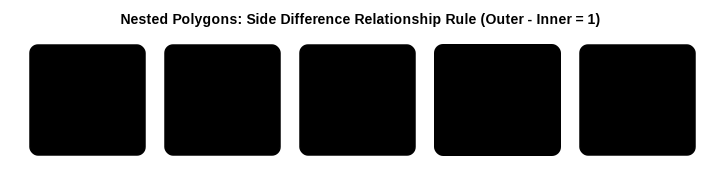
Explanation: In (A), (B), (C), and (E), the outer shape has exactly 1 more side than the inner shape (Outer sides - Inner sides = 1). In (D), the difference in sides is 6 - 3 = 3.
Example 5.2
Red outline marks the answer supplied in the lesson. Scroll horizontally on narrow screens.
(A) A large square containing a smaller square inside it
(B) A large circle containing a smaller circle inside it
(C) A large triangle containing a smaller triangle inside it
(D) A large pentagon containing a smaller circle inside it
(E) A large hexagon containing a smaller hexagon inside it
Answer: (D)
Explanation: In (A), (B), (C), and (E), the inner and outer shapes are geometrically similar (same shape, different size). In (D), the outer shape is a polygon (pentagon) while the inner shape is a circle.
Example 5.3
Red outline marks the answer supplied in the lesson. Scroll horizontally on narrow screens.
(A) An upward-pointing triangle containing an inverted (downward-pointing) triangle inside it
(B) An upward-pointing arrow containing a downward-pointing arrow inside it
(C) An upright U-shape containing an inverted U-shape inside it
(D) An upward-pointing chevron (^) containing a downward-pointing chevron (v) inside it
(E) An upward-pointing triangle containing an upward-pointing triangle inside it
Answer: (E)
Explanation: In (A), (B), (C), and (D), the inner element is rotated 180 degrees (inverted) relative to the outer element. In (E), both the inner and outer triangles face in the same upward direction.
Example 5.4
Red outline marks the answer supplied in the lesson. Scroll horizontally on narrow screens.
(A) Outer: Triangle (3 sides); Inner: Square (4 sides) -> (Inner has 1 more side)
(B) Outer: Square (4 sides); Inner: Pentagon (5 sides) -> (Inner has 1 more side)
(C) Outer: Pentagon (5 sides); Inner: Hexagon (6 sides) -> (Inner has 1 more side)
(E) Outer: Hexagon (6 sides); Inner: Heptagon (7 sides) -> (Inner has 1 more side)
Answer: (D)
Explanation: In (A), (B), (C), and (E), the inner polygon has 1 more side than the outer polygon (Outer sides + 1 = Inner sides). In (D), the outer polygon has more sides than the inner polygon (6 > 4).
Example 5.5
Red outline marks the answer supplied in the lesson. Scroll horizontally on narrow screens.
(A) Three concentric circles: Outer is white, middle ring is shaded black, inner circle is white
(B) Three concentric squares: Outer is white, middle layer is shaded black, inner square is white
(C) Three concentric triangles: Outer is white, middle layer is shaded black, inner triangle is white
(D) Three concentric pentagons: Outer layer is shaded black, middle layer is white, inner pentagon is white
(E) Three concentric hexagons: Outer is white, middle layer is shaded black, inner hexagon is white
Answer: (D)
Explanation: In figures (A), (B), (C), and (E), only the middle concentric layer is shaded black (White - Black - White pattern). In figure (D), the outermost layer is shaded while both inner layers are white.
Ready to Test Your Speed?
Put your visual observation, rotation detection, and pattern recognition speed to the test with real exam drills.