Figure Formation is a core area of non-verbal reasoning that evaluates spatial visualization, mental rotation, and 2D geometric assembly. The objective is to analyze individual geometric pieces and determine how they fit together to create a single complete figure, or conversely, to determine which exact pieces make up a given composite shape.
Fundamentals of Figure Formation
1. What is Figure Formation?
In figure formation problems, you are presented with either:
A set of isolated 2D shapes (called elements or components) that must be joined along their boundaries to construct a target figure.
An incomplete geometric figure (such as a square, rectangle, or circle) where you must find the missing fragment that perfectly locks into the empty space.
A composite figure that must be broken down into its original constituent parts.
2. Core Geometric Rules
Every figure formation question obeys four physical and mathematical constraints:
Conservation of Element Count: The number of individual pieces in the question must exactly match the number of pieces present in the correct answer figure. If the question gives 4 pieces, an answer figure containing 3 or 5 pieces is automatically disqualified.
Conservation of Dimensions and Area: The total surface area of all constituent parts equals the total surface area of the formed figure. Pieces cannot be stretched, shrunk, elongated, or compressed. A right-angled triangle cannot become an equilateral triangle in the solution.
Permissible Transformations (2D Movements):
Translation: Pieces can slide up, down, left, or right.
Rotation: Pieces can rotate clockwise or counter-clockwise by any degree within the 2D plane.
Reflection (Flipping): In most standard conventions, pieces are treated as 2D cut-outs that can be turned over, unless an exam specifies that patterns or colors on one face must face upward.
No Overlapping or Unaccounted Gaps: Unless a problem explicitly mentions transparent overlay/superimposition, pieces must touch edge-to-edge. They cannot cross over one another or leave gaps within the solid silhouette.
3. Step-by-Step Solving Strategy
To solve any figure formation question quickly and accurately, apply this elimination sequence:
Step 1 (Count): Count the total pieces in the question. Eliminate any option with the wrong total count.
Step 2 (The Anchor Element): Locate the most distinctive or unusual piece (e.g., an obtuse triangle, a curved sector, or an irregular pentagon). Scan the options to see which figures actually contain that specific piece. This step typically eliminates 2 out of 4 options immediately.
Step 3 (Angles and Proportions): Check whether the side lengths and internal angles match. If a piece has a 90-degree corner, the composite figure must be able to accommodate that exact 90-degree corner.
Step 4 (Assembly Check): Mentally rotate and snap the remaining common pieces into position to verify the final boundary.
Types of Figure Formation
Competitive reasoning materials divide figure formation into three primary types:
Type 1: Assembling Figures from Loose Components (Piece Assembly)
Type 2: Completion of Regular Geometric Figures (Square, Triangle, and Circle Completion)
Type 3: Figure Decomposition (Identifying Constituent Components)
Type 1: Assembling Figures from Loose Components
In this type, you are given a set of disconnected geometric shapes. You must identify which option represents the solid figure formed by joining all given pieces edge-to-edge.
Example 1.1
Given Components: Four identical right-angled isosceles triangles of the same size.
Options:
(A) A regular hexagon
(B) A single large square formed by meeting the four right angles at the center
(C) A single equilateral triangle
(D) A circle
Correct Answer: (B)
Explanation:
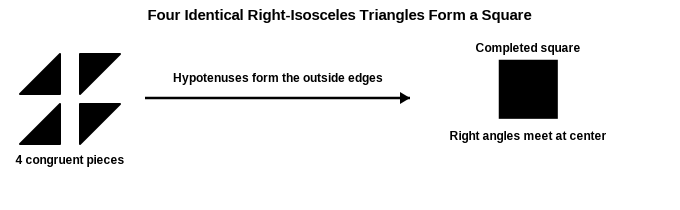
Two right-angled isosceles triangles joined along their hypotenuses form a smaller square.
Joining four such triangles so that their 90-degree right angles meet at the center produces a single large square (with the four hypotenuses forming the four outer sides).
A circle or regular hexagon cannot be constructed from flat, straight-edged right triangles.
Example 1.2
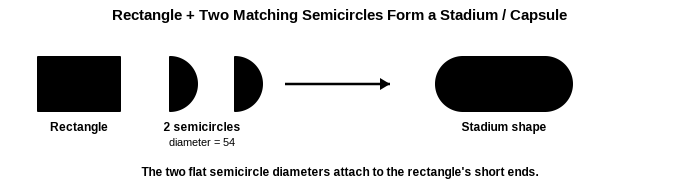
Given Components: One rectangle and two identical semicircles, where the diameter of each semicircle matches the shorter side (width) of the rectangle.
Options:
(A) A perfect circle
(B) A stadium/capsule shape (flat top and bottom, rounded ends)
Attaching the flat diameter edge of each semicircle to the two opposite short edges of the rectangle creates an elongated oval or stadium shape.
(A) is incorrect because the rectangle's length separates the two halves; they do not form a pure circle.
Example 1.3
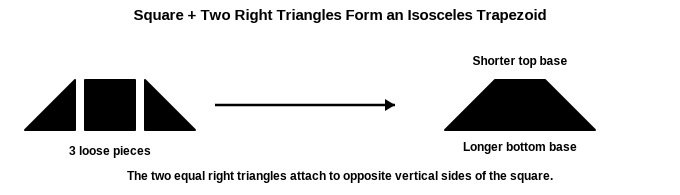
Given Components: Three pieces: One medium square and two identical right-angled triangles whose base equals the side length of the square.
Options:
(A) An isosceles trapezoid
(B) A regular pentagon
(C) A circle divided into three slices
(D) A shape with 7 unequal curved sides
Correct Answer: (A)
Explanation:
Placing the square in the center provides a flat base and top.
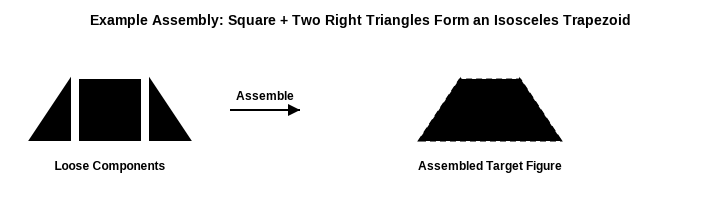
Attaching one right-angled triangle to the left vertical edge and the other to the right vertical edge (with their vertical legs touching the square's sides) forms a continuous flat base and a shorter top edge with sloped sides.
This matches an isosceles trapezoid.
Example 1.4
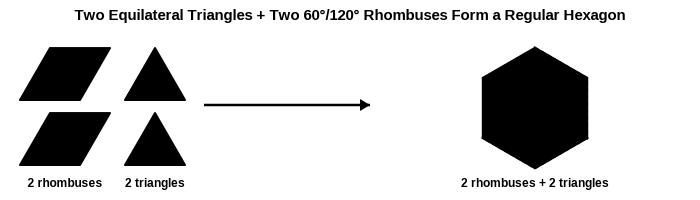
Given Components: Two identical equilateral triangles and two identical rhombuses (diamond shapes) with equal side lengths.
Options:
(A) A standard five-pointed star
(B) A regular hexagon
(C) A solid circular disc
(D) A long straight line without thickness
Correct Answer: (B)
Explanation:
A regular hexagon can be divided into six identical equilateral triangles.
One rhombus with equal sides and 60-degree/120-degree angles is exactly equivalent to two joined equilateral triangles.
Two rhombuses equal four equilateral triangles (2 x 2 = 4).
Adding the two individual equilateral triangles gives 4 + 2 = 6 equilateral triangles, which assemble into a regular hexagon.
Example 1.5
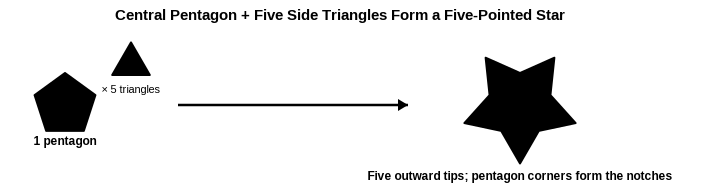
Given Components: Five pieces: One central regular pentagon and five identical isosceles triangles whose bases match the sides of the pentagon.
Options:
(A) A square box
(B) A symmetrical five-pointed star
(C) A straight six-sided column
(D) A circle
Correct Answer: (B)
Explanation:
The central pentagon has 5 outer edges.
Attaching the base of one isosceles triangle to each of the 5 edges points the apexes outward in all 5 directions.
This creates a standard five-pointed star.
Type 2: Completion of Regular Geometric Figures
Here, a standard shape (typically a square, circle, or triangle) has a piece cut out of it. You are shown the remaining portion and must choose the exact complementary piece from the options that completes the boundary.
Example 2.1 (Square Completion - L-Cut)
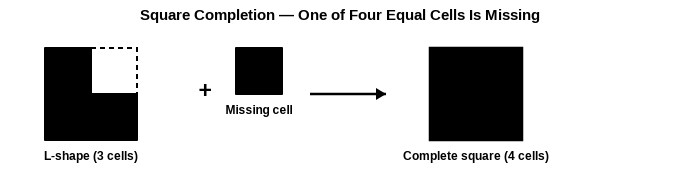
Problem Figure: A square missing its top-right quarter. The remaining figure is an "L-shape" formed by three equal small square units.
Options:
(A) A narrow triangle
(B) A single square unit of the same size as the other three quadrants
(C) A circle of diameter equal to the square's side
(D) A long rectangle consisting of two square units
Correct Answer: (B)
Explanation:
A full square divided into a 2 x 2 grid contains 4 equal square units.
An L-shape occupies 3 units.
To complete the 2 x 2 square, exactly 1 square unit is missing.
Example 2.2 (Square Completion - Triangular Corner Cut)
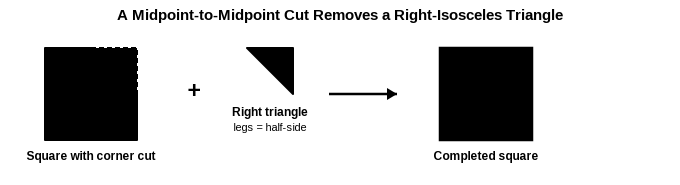
Problem Figure: A large square with one corner missing. The cut is a straight diagonal line connecting the midpoint of the top edge to the midpoint of the right edge.
Options:
(A) A small right-angled triangle with legs equal to half the square's side length
(B) A full equilateral triangle
(C) A semicircular arc
(D) A square of equal size
Correct Answer: (A)
Explanation:
The cut-out boundary is bounded by: half of the top edge, half of the right edge, and a straight diagonal hypotenuse.
The angle at the missing corner is 90 degrees.
The complementary missing piece is a right-angled triangle whose two perpendicular legs equal half the square's side.
Example 2.3 (Circle Completion - Missing Sector)
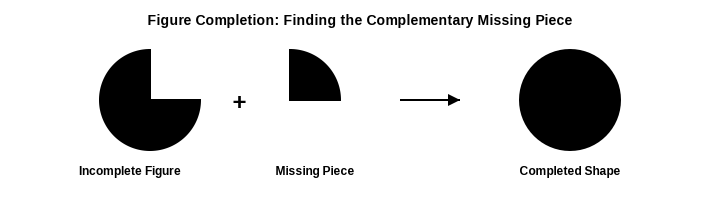
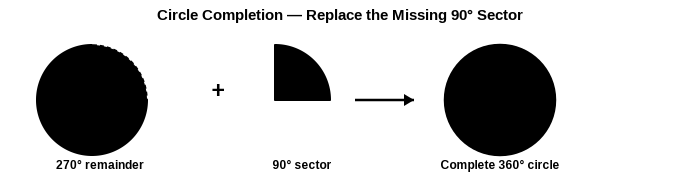
Problem Figure: A circular pie missing a 90-degree slice (a quadrant). The remaining part covers 270 degrees.
Options:
(A) A rectangular strip
(B) A 90-degree circular sector (quarter-circle) with two straight radial edges meeting at a right angle
(C) A semicircle (180-degree sector)
(D) An equilateral triangle
Correct Answer: (B)
Explanation:
A complete circle equals 360 degrees.
360 degrees - 270 degrees = 90 degrees.
The missing piece must be bounded by two radii meeting at a 90-degree angle and a curved circular arc spanning one-quarter of the circumference.
Example 2.4 (Square Completion - Stepped Profile)
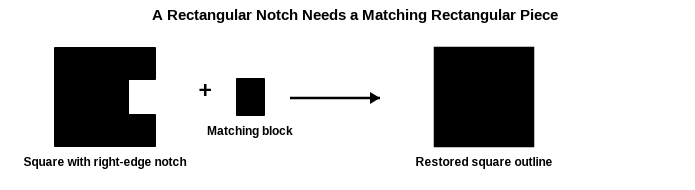
Problem Figure: A square whose right edge has a rectangular slot (groove) cut inward into its center.
Options:
(A) A matching rectangular block (tongue) that fits the depth and height of the groove
(B) A circular plug
(C) A triangular wedge
(D) An irregular wavy strip
Correct Answer: (A)
Explanation:
The indentation inside the square has three straight internal edges forming an internal rectangular pocket.
To restore the square's outer vertical flat edge, the inserted piece must have an identical rectangular projection.
Example 2.5 (Equilateral Triangle Completion)
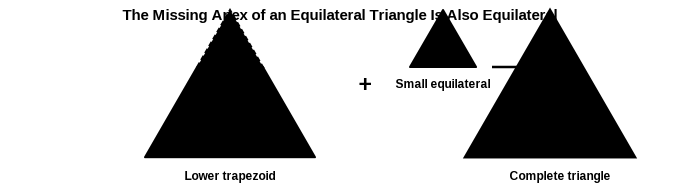
Problem Figure: An equilateral triangle missing its top peak (apex). The remaining bottom portion is an isosceles trapezoid with a horizontal top boundary.
Options:
(A) A small equilateral triangle with base matching the top horizontal edge of the trapezoid
(B) A long narrow strip
(C) A right-angled triangle
(D) A semicircle
Correct Answer: (A)
Explanation:
Cutting an equilateral triangle with a line parallel to its base divides it into a smaller equilateral triangle at the top and an isosceles trapezoid at the bottom.
The missing top portion must be an equilateral triangle with base equal to the upper edge of the trapezoid.
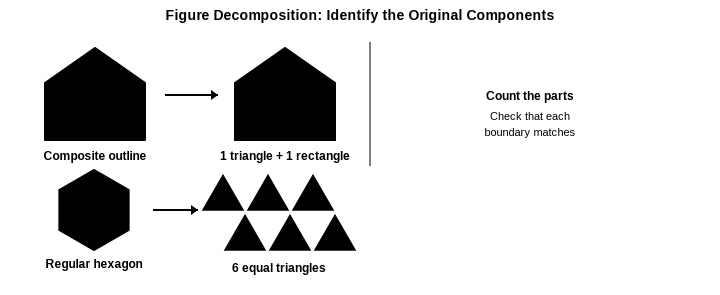
Type 3: Figure Decomposition (Component Analysis)
In this type, you are given a complete, composite figure. You must dissect it mentally and identify which set of loose parts from the options can be combined to build it without any surplus or missing pieces.
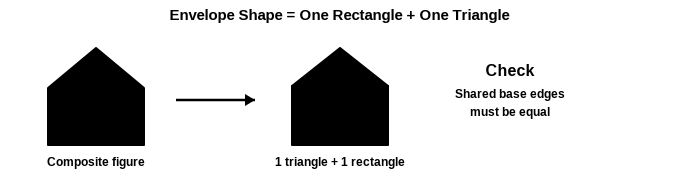
Example 3.1
Problem Figure: A standard envelope outline (a rectangle with a triangle on top sharing the upper horizontal edge).
Options:
(A) 1 circle and 2 squares
(B) 1 rectangle and 1 triangle
(C) 3 identical squares
(D) 4 semicircles
Correct Answer: (B)
Explanation:
The base of the envelope figure is a 4-sided rectangle.
The roof flap is a 3-sided triangle.
Decomposing the outline along the shared horizontal line yields exactly one rectangle and one triangle.
Example 3.2
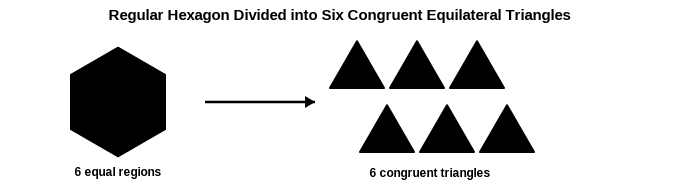
Problem Figure: A regular hexagon with lines drawn from its center point to all 6 vertices.
Options:
(A) Four right-angled triangles
(B) Six identical equilateral triangles
(C) Two squares and two circles
(D) Five scalene triangles
Correct Answer: (B)
Explanation:
A regular hexagon has six equal sides and internal angles of 120 degrees.
Radii drawn from the center divide the central 360 degrees into 6 equal angles of 60 degrees (360 / 6 = 60).
Since the radii are equal in length to the side of the hexagon, each of the 6 internal sections is an equilateral triangle with all angles equal to 60 degrees.
Example 3.3
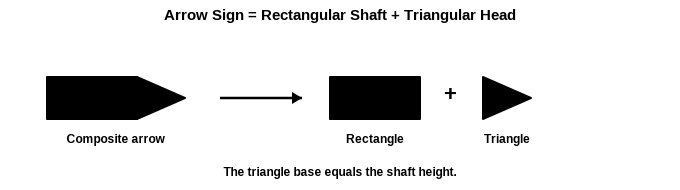
Problem Figure: A traditional arrow sign pointing right (a rectangular shaft attached to a triangular arrowhead).
Options:
(A) Two circles and one oval
(B) One rectangle and one triangle
(C) Four small squares
(D) Three identical trapezoids
Correct Answer: (B)
Explanation:
Separating the straight shaft from the pointed head splits the figure into two distinct polygons.
The shaft is a 4-sided rectangle.
The arrowhead is a 3-sided triangle.
Example 3.4
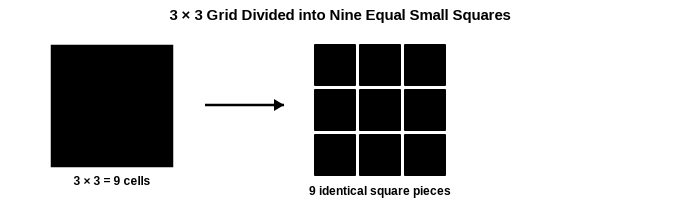
Problem Figure: A 3 x 3 square grid (a large square divided into 9 small, identical squares).
Options:
(A) Nine small identical squares
(B) Six identical rectangles
(C) Eight triangles and one circle
(D) Four pentagons
Correct Answer: (A)
Explanation:
The grid is formed by 2 vertical and 2 horizontal internal lines dividing both length and width into 3 equal segments.
Total individual units = 3 * 3 = 9.
Each individual unit is a square of equal dimensions.
Example 3.5
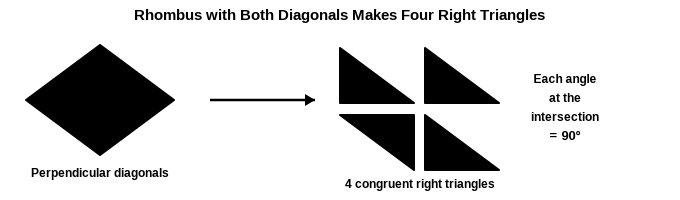
Problem Figure: A rhombus (diamond) with both of its internal diagonals drawn from corner to corner.
Options:
(A) Four right-angled triangles
(B) Four circles
(C) Two squares and two trapezoids
(D) One single equilateral triangle
Correct Answer: (A)
Explanation:
The diagonals of a rhombus bisect each other at perpendicular angles (90 degrees).
The intersection divides the interior into 4 distinct triangular quadrants.
Because the diagonals intersect at 90 degrees, each of the four quadrants is a right-angled triangle.
Ready to Test Your Figure Formation Skills?
Put your mental rotation, assembly, and decomposition skills to the test with real exam visual drills.