Inequality is a chapter in reasoning that tests your ability to determine mathematical and logical relationships between different variables (usually represented by letters) using comparison symbols.
1. Fundamentals of Inequality
To solve any inequality problem quickly and accurately, you must understand three core concepts: the symbols, the priority rule, and the blocked path rule.
The Basic and Derived Symbols
There are three primary symbols and three derived symbols:
Strictly Greater Than (>): A > B means A is strictly greater than B. A cannot be equal to B or smaller than B.
Strictly Less Than (<): A < B means A is strictly smaller than B. A cannot be equal to B or greater than B.
Equal To (=): A = B means A and B have the exact same value.
Greater Than or Equal To (>=): A >= B means A is either greater than B OR equal to B. A is never smaller than B.
Less Than or Equal To (<=): A <= B means A is either smaller than B OR equal to B. A is never greater than B.
Not Equal To (!=): A != B means A is not equal to B. Therefore, A is either strictly greater than B (A > B) OR strictly smaller than B (A < B).
Negative Statements and Conversions
In many questions, negative phrasing is used. Convert them into standard symbols immediately:
Not Greater Than (not >): If A is not greater than B, then A must be less than or equal to B (A <= B).
Not Less Than (not <): If A is not less than B, then A must be greater than or equal to B (A >= B).
Not Greater Than and Not Smaller Than: If A is neither greater nor smaller than B, then A must be equal to B (A = B).
The Priority Rule (Order of Precedence)
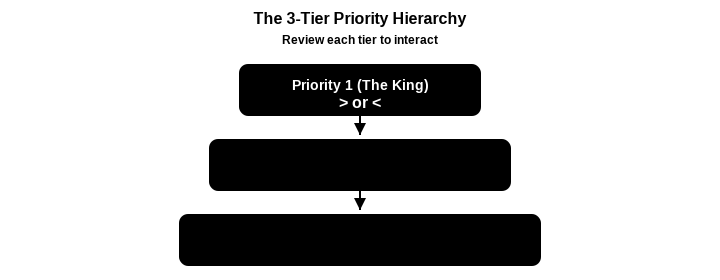
When moving from a starting variable to an ending variable in a statement, you must look at all the symbols connecting them. If all symbols face the same direction, determine the final relationship using this 3-tier priority hierarchy:
Priority 1 (The King): > or <
Priority 2 (The Minister): >= or <=
Priority 3 (The Public): =
How Priority Works in a Path:
If Priority 1 (> or <) appears even once along an unbroken path, the final conclusion must be Priority 1.
Example: A >= B = C > D contains >=, =, and >. Since > (Priority 1) is present, the definite conclusion is A > D.
If Priority 1 is absent, and the path only contains Priority 2 and Priority 3, then Priority 2 wins.
Example: A >= B = C >= D contains >= and =. The definite conclusion is A >= D.
If the path contains only Priority 3 (=), then the conclusion is =.
Example: A = B = C = D gives A = D.
The Blocked Path Rule (Opposite Signs)
Whenever two symbols in a continuous chain face opposite directions, the path is blocked.
Example 1: A > B < C (The signs > and < oppose each other).
Example 2: A >= B <= C (The signs >= and <= oppose each other).
Example 3: A < B > C (The signs < and > oppose each other).
Rule: When signs face in opposite directions between two variables, no definite relation can be formed between them. Any individual definite conclusion (such as A > C, A < C, or A = C) is automatically treated as False / Cannot be Determined.
The "Either - Or" Conditions
An "Either - Or" answer occurs when two conclusions are individually doubtful/false, but together they cover all possible outcomes. There are two distinct cases:
Case 1: Two-Sign Case (When a >= or <= relation is established)
Both conclusions must have the exact same two elements (e.g., both talk about A and B).
Both individual conclusions must be false on their own.
The statement establishes a definite >= or <= relation, and the two conclusions split that relation into strictly greater/smaller and equal.
Example: Statement gives A >= B.
Conclusion I: A > B (Individually false)
Conclusion II: A = B (Individually false)
Result: Either I or II follows.
Case 2: Three-Sign Case (When the path is blocked by opposite signs)
Both conclusions must have the exact same two elements.
Both individual conclusions must be false on their own.
The path between the two elements is blocked (no relation exists).
Between the two conclusions, all three basic comparison signs (>, <, and =) must be covered.
Example: Statement gives A > B < C (Path between A and C is blocked).
Conclusion I: A > C (False)
Conclusion II: A <= C (False, covers < and =)
Result: Either I or II follows.
2. Common Types of Inequality in Exam Books
In standard reasoning textbooks, inequality problems are organized into five primary types:
Type 1: Direct / Single Statement Inequality (A single linear chain of relations is given).
Type 2: Multiple / Connecting Statement Inequality (Two or more short statements separated by semicolons or commas that must be joined through common variables).
Type 3: "Either - Or" Case Inequality (Testing the 2-sign and 3-sign complementary conditions).
Type 4: Coded Inequality (Mathematical symbols are disguised as special characters like @, #, $, %, *).
Type 5: Reverse / Fill in the Blanks Inequality (A conclusion is already given, and you must select which symbols or statement makes that conclusion true).
3. Five Examples for Each Type
Type 1: Direct / Single Statement Inequality
Example 1.1
Statement: P > Q >= R = S > T
Conclusions: I. P > S II. R >= T
Step-by-step logic:
- For Conclusion I (P > S): The path from P to S is P > Q >= R = S. The symbols are >, >=, =. Priority 1 (>) is present. Thus, P > S is definitely true.
- For Conclusion II (R >= T): The path from R to T is R = S > T. The symbols are = and >. Priority 1 (>) is present, so the true relation is R > T. Conclusion II states R >= T, which is false.
Answer: Only Conclusion I follows.
Example 1.2
Statement: A >= B = C > D <= E < F
Conclusions: I. A > D II. C < F
Step-by-step logic:
- For Conclusion I (A > D): The path from A to D is A >= B = C > D. The symbols are >=, =, >. Priority 1 (>) is present. Thus, A > D is definitely true.
- For Conclusion II (C < F): The path from C to F is C > D <= E < F. Notice the symbols > and <=. They face opposite directions. The path is blocked. No definite relation can be formed.
Answer: Only Conclusion I follows.
Example 1.3
Statement: M <= N < O = P <= Q
Conclusions: I. M < P II. N <= Q
Step-by-step logic:
- For Conclusion I (M < P): The path from M to P is M <= N < O = P. The symbols are <=, <, =. Priority 1 (<) is present, so M < P is definitely true.
- For Conclusion II (N <= Q): The path from N to Q is N < O = P <= Q. The symbols are <, =, <=. Priority 1 (<) is present, meaning N < Q is the only true relation. Conclusion II claims N <= Q, which is false.
Answer: Only Conclusion I follows.
Example 1.4
Statement: W > X >= Y = Z >= K
Conclusions: I. X >= K II. W > Z
Step-by-step logic:
- For Conclusion I (X >= K): The path from X to K is X >= Y = Z >= K. The symbols are >=, =, >=. Only Priority 2 and Priority 3 are present. Priority 2 (>=) wins. Thus, X >= K is definitely true.
- For Conclusion II (W > Z): The path from W to Z is W > X >= Y = Z. The symbols are >, >=, =. Priority 1 (>) is present. Thus, W > Z is definitely true.
Answer: Both Conclusions I and II follow.
Example 1.5
Statement: G < H <= I = J < K <= L
Conclusions: I. H = J II. G < L
Step-by-step logic:
- For Conclusion I (H = J): The path from H to J is H <= I = J. The resulting relation is H <= J. A claim that H = J alone is doubtful/false.
- For Conclusion II (G < L): The path from G to L is G < H <= I = J < K <= L. The symbols all face in the less-than direction, and Priority 1 (<) is present. Thus, G < L is definitely true.
Answer: Only Conclusion II follows.
Type 2: Multiple / Connecting Statement Inequality
Example 2.1
Statements: A > B >= C; C = D < E; E <= F
Conclusions: I. A > D II. D < F
Step-by-step logic:
- Connect the common variables: C connects the first two statements, and E connects to the third:
A > B >= C = D < E <= F
- For Conclusion I (A > D): Path is A > B >= C = D. Priority 1 (>) is present. Thus, A > D is true.
- For Conclusion II (D < F): Path is D < E <= F. Priority 1 (<) is present. Thus, D < F is true.
Answer: Both Conclusions I and II follow.
Example 2.2
Statements: P >= Q > R; S < T <= Q; U > P
Conclusions: I. U > T II. S < R
Step-by-step logic:
- Link variables through P and Q:
U > P >= Q >= T > S and Q > R
- For Conclusion I (U > T): Path is U > P >= Q >= T. The symbols are >, >=, >=. Priority 1 (>) is present. Thus, U > T is true.
- For Conclusion II (S < R): Path from S to R through Q is S < T <= Q and Q > R. Writing them together: S < T <= Q > R. The signs < and > face opposite directions (blocked path). No relation exists between S and R.
Answer: Only Conclusion I follows.
Example 2.3
Statements: K <= L = M; N > O >= M; P < K
Conclusions: I. N > P II. O >= L
Step-by-step logic:
- Link variables through K and M:
P < K <= L = M <= O < N
- For Conclusion I (N > P): Reading from P to N: P < K <= L = M <= O < N. Priority 1 (<) is present, so P < N, which means N > P is true.
- For Conclusion II (O >= L): Reading from L to O: L = M <= O, which simplifies to L <= O. Reversing it gives O >= L, which is true.
Answer: Both Conclusions I and II follow.
Example 2.4
Statements: X > Y >= Z; W < V <= Z; T = X
Conclusions: I. T > V II. Y > W
Step-by-step logic:
- Link variables through X and Z:
T = X > Y >= Z >= V > W
- For Conclusion I (T > V): Path is T = X > Y >= Z >= V. Priority 1 (>) is present. Thus, T > V is true.
- For Conclusion II (Y > W): Path is Y >= Z >= V > W. Priority 1 (>) is present. Thus, Y > W is true.
Answer: Both Conclusions I and II follow.
Example 2.5
Statements: D < E <= F; G > H = F; J <= D
Conclusions: I. G > D II. J < F
Step-by-step logic:
- Link variables through D and F:
J <= D < E <= F = H < G
- For Conclusion I (G > D): Path from D to G is D < E <= F = H < G. All signs point toward G with Priority 1 (<). So D < G, which means G > D is true.
- For Conclusion II (J < F): Path from J to F is J <= D < E <= F. Priority 1 (<) is present. Thus, J < F is true.
Answer: Both Conclusions I and II follow.
Type 3: "Either - Or" Case Inequality
Example 3.1
Statement: A >= B = C >= D
Conclusions: I. A > D II. A = D
Step-by-step logic:
- Path from A to D: A >= B = C >= D.
- The combined relation gives A >= D.
- A >= D means either A is greater than D OR A is equal to D.
- Conclusion I (A > D) alone cannot be confirmed.
- Conclusion II (A = D) alone cannot be confirmed.
- Both share the same variables and together satisfy A >= D.
Answer: Either Conclusion I or II follows.
Example 3.2
Statement: P <= Q = R <= S
Conclusions: I. P < S II. P = S
Step-by-step logic:
- Path from P to S: P <= Q = R <= S.
- The combined relation gives P <= S.
- P <= S means either P < S or P = S.
- Conclusion I (P < S) is individually false.
- Conclusion II (P = S) is individually false.
- Together they cover the complete relation P <= S.
Answer: Either Conclusion I or II follows.
Example 3.3
Statement: M > N >= O < P = Q
Conclusions: I. M > Q II. M <= Q
Step-by-step logic:
- Path from M to Q: M > N >= O < P = Q.
- Between M and Q, we have >= and <, which are opposite signs (blocked path).
- No definite relation exists between M and Q. Any of the three outcomes (>, <, =) is possible.
- Conclusion I gives M > Q.
- Conclusion II gives M <= Q (which combines < and =).
- All three signs (>, <, =) are covered between the same two variables.
Answer: Either Conclusion I or II follows.
Example 3.4
Statement: E < F > G = H
Conclusions: I. E >= H II. E < H
Step-by-step logic:
- Path from E to H: E < F > G = H.
- The signs < and > face each other (blocked path). No relation exists between E and H.
- Conclusion I states E >= H (covers > and =).
- Conclusion II states E < H (covers <).
- Both conclusions are individually false, use the same variables, and cover all three possibilities (>, <, =).
Answer: Either Conclusion I or II follows.
Example 3.5
Statements: W >= X = Y; Y >= Z
Conclusions: I. W > Z II. W = Z
Step-by-step logic:
- Combining statements: W >= X = Y >= Z, which gives W >= Z.
- Conclusion I says W > Z (not definitely true on its own).
- Conclusion II says W = Z (not definitely true on its own).
- Since W >= Z must hold, one of these two outcomes must be true.
Answer: Either Conclusion I or II follows.
Type 4: Coded Inequality
For the following five examples, use this decoding key:
P @ Q means P > Q (P is strictly greater than Q)
P # Q means P >= Q (P is greater than or equal to Q)
P % Q means P = Q (P is equal to Q)
P $ Q means P < Q (P is strictly less than Q)
P & Q means P <= Q (P is less than or equal to Q)
Example 4.1
Statement: A # B % C @ D
Conclusions: I. A @ D II. B # D
Step-by-step logic:
- Decode the statement: A >= B = C > D.
- Decode Conclusion I: A > D. Path from A to D is A >= B = C > D. Priority 1 (>) is present. Thus, A > D is true.
- Decode Conclusion II: B >= D. Path from B to D is B = C > D, which gives B > D. Claiming B >= D is false.
Answer: Only Conclusion I follows.
Example 4.2
Statement: P $ Q & R % S
Conclusions: I. P $ S II. Q & S
Step-by-step logic:
- Decode the statement: P < Q <= R = S.
- Decode Conclusion I: P < S. Path is P < Q <= R = S. Priority 1 (<) is present. Thus, P < S is true.
- Decode Conclusion II: Q <= S. Path from Q to S is Q <= R = S. Only Priority 2 and 3 are present. Priority 2 (<=) wins. Thus, Q <= S is true.
Answer: Both Conclusions I and II follow.
Example 4.3
Statement: K @ L # M % N
Conclusions: I. K @ N II. L % N
Step-by-step logic:
- Decode the statement: K > L >= M = N.
- Decode Conclusion I: K > N. Path is K > L >= M = N. Priority 1 (>) is present. Thus, K > N is true.
- Decode Conclusion II: L = N. Path from L to N is L >= M = N, which gives L >= N. Stating L = N alone is false.
Answer: Only Conclusion I follows.
Example 4.4
Statement: E # F @ G $ H
Conclusions: I. E @ G II. F @ H
Step-by-step logic:
- Decode the statement: E >= F > G < H.
- Decode Conclusion I: E > G. Path from E to G is E >= F > G. Priority 1 (>) is present. Thus, E > G is true.
- Decode Conclusion II: F > H. Path from F to H is F > G < H. The signs > and < oppose each other (blocked path). Thus, Conclusion II is false.
Answer: Only Conclusion I follows.
Example 4.5
Statement: U # V % W # X
Conclusions: I. U @ X II. U % X
Step-by-step logic:
- Decode the statement: U >= V = W >= X.
- The combined relation is U >= X.
- Decode Conclusion I: U > X.
- Decode Conclusion II: U = X.
- Neither is definitely true on its own, but together they cover U >= X.
Answer: Either Conclusion I or II follows.
Type 5: Reverse / Fill in the Blanks Inequality
Example 5.1
Problem: Which set of symbols placed in the blanks from left to right in A _ B _ C _ D makes both A > C and B >= D definitely true?
- Option 1: >, >=, =
- Option 2: >=, >, <
- Option 3: =, >, <=
- Option 4: <, =, >=
Step-by-step logic:
- Test Option 1: A > B >= C = D
- Path A to C: A > B >= C. Priority 1 (>) is present, so A > C holds true.
- Path B to D: B >= C = D. Priority 2 (>=) is present with =, so B >= D holds true.
Answer: Option 1 (>, >=, =).
Example 5.2
Problem: What symbol must replace the question mark (?) in P >= Q ? R = S > T to make P > S definitely true?
- Option 1: =
- Option 2: >
- Option 3: <=
- Option 4: <
Step-by-step logic:
- Path from P to S: P >= Q ? R = S.
- Currently, we have >= and =. To make the definite conclusion strictly greater than (P > S), a Priority 1 symbol facing right (>) is mandatory somewhere along the path.
- If ? is replaced by =, the result is P >= S (not strictly >).
- If ? is replaced by >, the path becomes P >= Q > R = S, giving P > S.
Answer: Option 2 (>).
Example 5.3
Problem: In which of the following expressions is the conclusion M < P definitely FALSE?
- Option 1: M < N = O < P
- Option 2: M <= N < O = P
- Option 3: M = N < O <= P
- Option 4: M > N >= O = P
Step-by-step logic:
- In Option 1: M < P is definitely true.
- In Option 2: M < P is definitely true.
- In Option 3: M < P is definitely true.
- In Option 4: M > N >= O = P simplifies to M > P. Since M is strictly greater than P, M < P is impossible and definitely false.
Answer: Option 4 (M > N >= O = P).
Example 5.4
Problem: Which set of symbols in X _ Y _ Z _ W from left to right makes both X > Z and Y >= W definitely true?
- Option 1: >, >=, =
- Option 2: >=, =, <
- Option 3: =, >, >=
- Option 4: <, >=, >
Step-by-step logic:
- Test Option 1: X > Y >= Z = W
- Path X to Z: X > Y >= Z gives X > Z (True).
- Path Y to W: Y >= Z = W gives Y >= W (True).
Answer: Option 1 (>, >=, =).
Example 5.5
Problem: Which of the following expressions makes both K > M and L < O definitely true?
- Option 1: K = L > M < N = O
- Option 2: K > L = M < N < O
- Option 3: K > L >= M = N < O
- Option 4: K < L = M < N < O
Step-by-step logic:
- Check Option 3: K > L >= M = N < O
- Path K to M: K > L >= M. Priority 1 (>) is present, so K > M is true.
- Path L to O: L >= M = N < O. Notice the signs: >= and < face opposite directions (blocked path). So Option 3 fails.
- Check Option 2: K > L = M < N < O
- Path K to M: K > L = M gives K > M (True).
- Path L to O: L = M < N < O gives L < O (True).
- Both conditions are satisfied without any blocked paths.
Answer: Option 2 (K > L = M < N < O).
Tip: Mastering reasoning inequality comes down to tracing the open chain between the two required variables, checking whether any opposite symbols block the path, and reading the highest-priority symbol in that line.
Ready to Test Your Speed?
Put your inequality identification skills and speed shortcuts to the test with real exam drills.