Mathematical Operations is a reasoning topic where standard arithmetic symbols (+, -, x, /) are either replaced by letters, shapes, or alternative symbols, or require rearrangement to make a mathematical equation true. The core goal is to test your logical deduction, pattern recognition, and strict adherence to arithmetic precedence.
Fundamentals of Mathematical Operations
Before attempting any problem, you must master three fundamental rules:
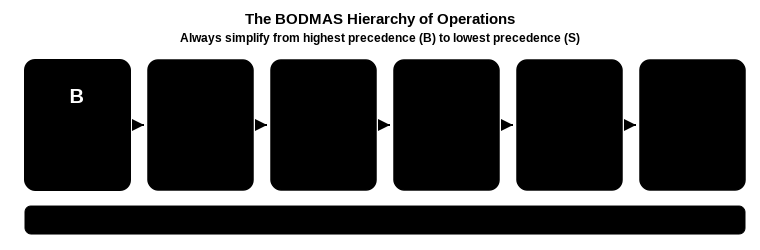
1. The BODMAS Rule
Every mathematical expression must be simplified in a strict order from left to right. Never calculate numbers from left to right as they appear; always follow this sequence:
Letter
Operation
Meaning & Scope
B
Brackets
Solve expressions inside brackets first: Bar/Vinculum first, then Round brackets (), then Curly { }, then Square [ ].
O
Order / Of
Powers, square roots, and the word "of" (which means multiplication performed before regular division).
D
Division
Perform all / operations next.
M
Multiplication
Perform all x operations after division.
A
Addition
Perform all + operations after multiplication.
S
Subtraction
Perform all - operations last.
Note: Division and Multiplication have equal priority in pure arithmetic, as do Addition and Subtraction. However, strictly following the D → M → A → S sequence avoids errors in competitive reasoning questions.
2. The Division Elimination Trick
In competitive exams, almost all final answers are whole numbers (integers). When testing multiple-choice options:
Check where the division sign / falls.
If a division sign results in an improper fraction that cannot be cancelled out by an adjacent multiplication (e.g., 7 / 3 with no multiple of 3 nearby), you can immediately eliminate that option without calculating the rest.
3. Systematic Step Replacement
Always rewrite the expression on paper with the new signs substituted before doing mental math. Skipping this step and calculating directly from the screen causes over 80% of student mistakes.
Type 1: Symbol / Letter Substitution
In this type, English alphabets or non-standard symbols stand for basic arithmetic operators. You replace the letters with their assigned signs and solve using BODMAS.
Example 1: Question
If P means +, Q means -, R means x, and S means /, find the value of:
18 R 12 S 4 P 5 Q 6
Solution:
1. Replace letters with mathematical operators:
18 x 12 / 4 + 5 - 6
2. Apply Division (12 / 4 = 3):
18 x 3 + 5 - 6
3. Apply Multiplication (18 x 3 = 54):
54 + 5 - 6
4. Apply Addition (54 + 5 = 59):
59 - 6
5. Apply Subtraction:
53
Example 2: Question
If + means /, - means x, x means +, and / means -, solve:
36 + 6 - 3 x 5 / 3
Solution:
1. Substitute the new meanings:
36 / 6 x 3 + 5 - 3
2. Apply Division (36 / 6 = 6):
6 x 3 + 5 - 3
3. Apply Multiplication (6 x 3 = 18):
18 + 5 - 3
4. Apply Addition (18 + 5 = 23):
23 - 3
5. Apply Subtraction:
20
Example 3: Question
If @ means x, # means /, $ means +, and % means -, find the value of:
12 $ 8 # 2 @ 5 % 7
Solution:
1. Replace symbols with operators:
12 + 8 / 2 x 5 - 7
2. Apply Division (8 / 2 = 4):
12 + 4 x 5 - 7
3. Apply Multiplication (4 x 5 = 20):
12 + 20 - 7
4. Apply Addition (12 + 20 = 32):
32 - 7
5. Apply Subtraction:
25
Example 4: Question
If L denotes +, M denotes -, N denotes x, and P denotes /, calculate:
15 N 4 M 36 P 6 L 10
Solution:
1. Substitute the letters:
15 x 4 - 36 / 6 + 10
2. Apply Division (36 / 6 = 6):
15 x 4 - 6 + 10
3. Apply Multiplication (15 x 4 = 60):
60 - 6 + 10
4. Group addition terms (60 + 10 = 70):
70 - 6
5. Apply Subtraction:
64
Example 5: Question
If + means -, - means x, x means /, and / means +, find:
48 x 6 - 2 + 15 / 5
Solution:
1. Substitute the given rules:
48 / 6 x 2 - 15 + 5
2. Apply Division (48 / 6 = 8):
8 x 2 - 15 + 5
3. Apply Multiplication (8 x 2 = 16):
16 - 15 + 5
4. Combine addition and subtraction:
16 - 15 = 1, then 1 + 5 = 6
6
Type 2: Interchange of Signs and Numbers
In this type, you must swap two specific signs, two specific numbers, or both, to verify if an equation balances or to find the resulting value.
Example 1 (Interchanging Signs): Question
Which value is obtained if + and x are interchanged in the expression:
4 + 6 x 2 - 8?
Solution:
1. Swap + with x and x with +:
4 x 6 + 2 - 8
2. Apply Multiplication (4 x 6 = 24):
24 + 2 - 8
3. Apply Addition (24 + 2 = 26):
26 - 8
4. Apply Subtraction:
18
Example 2 (Interchanging Numbers): Question
What value is obtained if numbers 3 and 6 are interchanged in:
12 / 3 + 6 x 2 - 4?
Solution:
1. Swap 3 and 6 (signs remain unchanged):
12 / 6 + 3 x 2 - 4
2. Apply Division (12 / 6 = 2):
2 + 3 x 2 - 4
3. Apply Multiplication (3 x 2 = 6):
2 + 6 - 4
4. Apply Addition and Subtraction:
8 - 4 = 4
4
Example 3 (Interchanging Both Signs and Numbers): Question
If the signs + and - are interchanged, and the numbers 4 and 8 are interchanged, find the value of:
8 - 4 + 6 x 2
Solution:
1. Swap 8 with 4, 4 with 8, and - with +:
4 + 8 - 6 x 2
2. Apply Multiplication (6 x 2 = 12):
4 + 8 - 12
3. Apply Addition (4 + 8 = 12):
12 - 12
4. Apply Subtraction:
0
Example 4 (Finding Which Signs to Swap): Question
In the equation 16 - 8 / 4 + 5 x 2 = 8, which two signs should be interchanged to make the equation correct?
Solution:
1. Current equation value: 16 - 2 + 10 = 24 (Not equal to 8).
2. Test swapping - and +:
Expression becomes: 16 + 8 / 4 - 5 x 2
3. Apply Division (8 / 4 = 2):
16 + 2 - 5 x 2
4. Apply Multiplication (5 x 2 = 10):
16 + 2 - 10
5. Apply Addition and Subtraction:
18 - 10 = 8 (Equals 8).
Correct Interchange: - and +
Example 5 (Finding Which Numbers to Swap): Question
In the equation 8 + 4 x 3 - 9 / 3 = 25, which two numbers should be interchanged to make it true?
Solution:
1. Current equation value: 8 + 12 - 3 = 17 (Not equal to 25).
2. Test swapping numbers 8 and 4:
Expression becomes: 4 + 8 x 3 - 9 / 3
3. Apply Division (9 / 3 = 3):
4 + 8 x 3 - 3
4. Apply Multiplication (8 x 3 = 24):
4 + 24 - 3
5. Apply Addition and Subtraction:
28 - 3 = 25 (Equals 25).
Correct Interchange: 8 and 4
Type 3: Balancing the Equation (Inserting Signs)
Here, placeholder symbols (usually asterisks *) separate numbers. You must choose the correct sequence of mathematical signs from the options to make the Left Hand Side (LHS) equal to the Right Hand Side (RHS).
Example 1: Question
Which set of signs replaces the asterisks in order to balance:
24 * 6 * 3 * 3 = 15?
Solution:
1. Test the sign sequence /, x, +:
24 / 6 x 3 + 3
2. Divide: 24 / 6 = 4 → 4 x 3 + 3
3. Multiply: 4 x 3 = 12 → 12 + 3
4. Add: 12 + 3 = 15
5. LHS equals RHS (15 = 15).
Correct Signs: /, x, +
Example 2: Question
Which set of signs correctly replaces * in:
18 * 3 * 2 * 8 = 20?
Solution:
1. Test the sign sequence /, x, +:
18 / 3 x 2 + 8
2. Divide: 18 / 3 = 6 → 6 x 2 + 8
3. Multiply: 6 x 2 = 12 → 12 + 8
4. Add: 12 + 8 = 20
5. LHS equals RHS (20 = 20).
Correct Signs: /, x, +
Example 3: Question
Which set of signs balances:
30 * 5 * 4 * 10 = 14?
Solution:
1. Test the sign sequence /, x, -:
30 / 5 x 4 - 10
2. Divide: 30 / 5 = 6 → 6 x 4 - 10
3. Multiply: 6 x 4 = 24 → 24 - 10
4. Subtract: 24 - 10 = 14
5. LHS equals RHS (14 = 14).
Correct Signs: /, x, -
Example 4: Question
Which set of signs replaces * in:
14 * 2 * 4 * 8 = 20?
Solution:
1. Test the sign sequence /, x, -:
14 / 2 x 4 - 8
2. Divide: 14 / 2 = 7 → 7 x 4 - 8
3. Multiply: 7 x 4 = 28 → 28 - 8
4. Subtract: 28 - 8 = 20
5. LHS equals RHS (20 = 20).
Correct Signs: /, x, -
Example 5: Question
Which set of signs balances:
20 * 4 * 6 * 2 = 2?
Solution:
1. Test the sign sequence /, -, /:
20 / 4 - 6 / 2
2. Apply Division to both terms:
20 / 4 = 5 and 6 / 2 = 3
3. Substitute back:
5 - 3 = 2
4. LHS equals RHS (2 = 2).
Correct Signs: /, -, /
Type 4: Custom / Coded Function Operators
In this category, an artificial operator (such as @, *, or #) is assigned an algebraic rule. You must identify the formula and apply it to new inputs.
Example 1: Question
If a * b = (a + b) + (a x b), find the value of 3 * 4.
Solution:
1. Identify inputs: a = 3, b = 4.
2. Substitute into the given formula:
(3 + 4) + (3 x 4)
3. Solve brackets:
7 + 12 = 19
19
Example 2: Question
If a # b = (a x a) - (b x b), find the value of 5 # 3.
Solution:
1. Identify inputs: a = 5, b = 3.
2. Substitute into formula:
(5 x 5) - (3 x 3)
3. Calculate:
25 - 9 = 16
16
Example 3: Question
If a $ b = 2 x a + 3 x b - 4, find the value of (3 $ 2) $ 5.
Solution:
1. Solve inner bracket first (3 $ 2) where a = 3, b = 2:
2 x 3 + 3 x 2 - 4 = 6 + 6 - 4 = 8
2. Now solve 8 $ 5 where a = 8, b = 5:
2 x 8 + 3 x 5 - 4
3. Calculate:
16 + 15 - 4 = 31 - 4 = 27
27
Example 4: Question
If m ˆ n = (m + n) x (m - n), find the value of 6 ˆ 4.
Solution:
1. Identify inputs: m = 6, n = 4.
2. Substitute:
(6 + 4) x (6 - 4)
3. Calculate brackets:
10 x 2 = 20
20
Example 5: Question
If A * B = 3 x A - 2 x B, find the value of (4 * 3) + (5 * 2).
Solution:
1. Find (4 * 3):
3 x 4 - 2 x 3 = 12 - 6 = 6
2. Find (5 * 2):
3 x 5 - 2 x 2 = 15 - 4 = 11
3. Add the two results:
6 + 11 = 17
17
Type 5: Pattern-Based Arithmetic Operations
In these questions, standard arithmetic symbols do not mean what they appear to mean. Instead, a hidden logic (such as powers, digit manipulation, or differences) connects the left numbers to the result.
Example 1: Question
If 3 * 4 = 25 and 5 * 2 = 29, find 6 * 3.
Solution:
1. Decode pattern from example 1:
32 + 42 = 9 + 16 = 25
2. Verify with example 2:
52 + 22 = 25 + 4 = 29
3. Apply to 6 * 3:
62 + 32 = 36 + 9 = 45
45
Example 2: Question
If 7 # 3 = 40 and 9 # 4 = 65, find 8 # 5.
Solution:
1. Decode pattern from example 1:
(7 + 3) x (7 - 3) = 10 x 4 = 40
2. Verify with example 2:
(9 + 4) x (9 - 4) = 13 x 5 = 65
3. Apply to 8 # 5:
(8 + 5) x (8 - 5) = 13 x 3 = 39
39
Example 3: Question
If 2 * 3 = 35 and 3 * 4 = 91, find 1 * 5.
Solution:
1. Decode pattern from example 1 (Sum of cubes):
23 + 33 = 8 + 27 = 35
2. Verify with example 2:
33 + 43 = 27 + 64 = 91
3. Apply to 1 * 5:
13 + 53 = 1 + 125 = 126
126
Example 4: Question
If 5 * 6 = 61 and 8 * 3 = 73, find 4 * 7.
Solution:
1. Decode pattern from example 1 (Sum of squares):
52 + 62 = 25 + 36 = 61
2. Verify with example 2:
82 + 32 = 64 + 9 = 73
3. Apply to 4 * 7:
42 + 72 = 16 + 49 = 65
65
Example 5: Question
If 4 * 2 = 18 and 5 * 3 = 28, find 6 * 4.
Solution:
1. Decode pattern from example 1:
42 + 2 = 16 + 2 = 18
2. Verify with example 2:
52 + 3 = 25 + 3 = 28
3. Apply to 6 * 4:
62 + 4 = 36 + 4 = 40
40
Ready to Test Your Speed?
Put your Mathematical Operations speed, precedence rules, and sign substitution shortcuts to the test with timed drills.