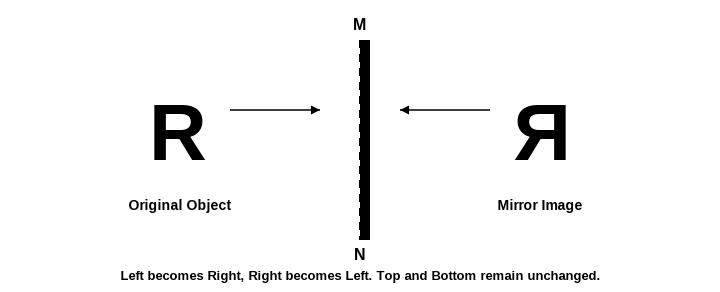
A mirror image is the reflection of an object seen when a plane mirror is placed vertically along one of its sides. Master the core rules of lateral inversion, visual symmetry, and proximity to conquer non-verbal reasoning problems.
Fundamentals of Mirror Images
To solve mirror image problems accurately, you must master three fundamental rules:
1. The Rule of Lateral Inversion (Left-Right Reversal)
• The left side of an object becomes the right side in the mirror image.
• The right side of an object becomes the left side in the mirror image.
2. The Rule of Vertical Stability (Top-Bottom Invariance)
• The top of the object remains at the top.
• The bottom of the object remains at the bottom.
• A vertical mirror never turns an object upside down. (If an object turns upside down, that is a Water Image, not a standard vertical mirror image).
3. The Proximity Principle (Distance Rule)
• Any part of the object that is nearer to the mirror line appears nearer in the reflection.
• Any part of the object that is farther from the mirror line appears farther in the reflection.
Note: Unless a question explicitly places the mirror horizontally (at the top or bottom), the standard mirror line (labeled MN or XY) is assumed to be placed vertically to the right of the object.
Types of Mirror Image Questions
Mirror image questions are categorized into five distinct types:
1. Letter Images (Alphabets): Capital and small letters reflecting across a vertical plane.
2. Number Images (Digits): Numerical digits (0 through 9).
3. Word and Alphanumeric Images: Combinations of letters, numbers, and signs where both character sequence and individual shapes invert.
4. Clock-Based Mirror Images: Determining real time from mirror time or vice versa using fixed mathematical formulas.
5. Geometric Shapes and Symbols: Polygons, arrows, shaded regions, and complex line figures.
Type 1: Letter Images (Alphabets)
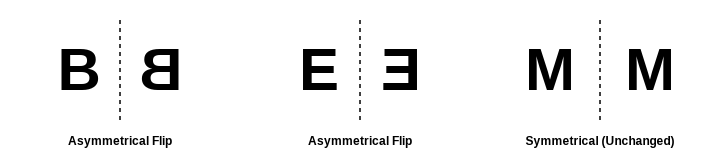
When reflecting letters, symmetrical letters remain unchanged, while asymmetrical letters reverse horizontally.
Key Rule for Capital Letters:
• 11 capital letters remain completely unchanged in a vertical mirror: A, H, I, M, O, T, U, V, W, X, Y.
• All other 15 letters invert horizontally.
Letter B
Original: Vertical straight line on the left; two rounded loops on the right.
Mirror Image: The vertical line moves to the far right; the two rounded loops face toward the left.
Letter E
Original: Vertical line on the left; three horizontal arms extending to the right.
Mirror Image: The vertical line moves to the right; the three horizontal arms extend toward the left.
Letter P
Original: Vertical stem on the left; single semicircular loop at the top-right.
Mirror Image: The vertical stem moves to the right; the loop stays at the top, but curves to the left.
Letter R
Original: Vertical stem on the left; loop at top-right; slanted leg pointing toward the bottom-right.
Mirror Image: The vertical stem moves to the right; loop points top-left; slanted leg points toward the bottom-left.
Letter M
Original: Two vertical outer legs with an internal "V" pointing downward in the center.
Mirror Image: Exactly identical to the original because letter M is vertically symmetrical.
Type 2: Number Images (Digits)
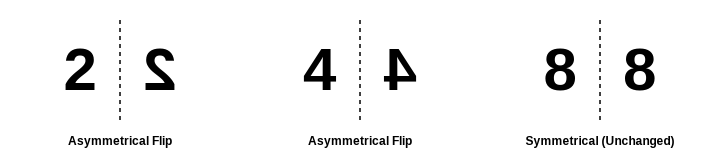
Only two standard digits (0 and 8) look identical in a standard vertical mirror. All other digits (1, 2, 3, 4, 5, 6, 7, 9) change their horizontal orientation.
Digit 2
Original: Curved arc starts at the top-left, curves over to the right, slants down to the left base, and finishes with a horizontal line pointing right.
Mirror Image: Curved arc starts at top-right, curves over to the left, slants down to the right base, and finishes with a horizontal line pointing left.
Digit 4
Original: Main vertical spine is on the right; the horizontal bar and diagonal line sit on the left.
Mirror Image: Main vertical spine moves to the left; the horizontal bar and diagonal line sit on the right.
Digit 5
Original: Top horizontal bar extends to the right; short vertical drop on the left; open curved loop on the right.
Mirror Image: Top horizontal bar extends to the left; short vertical drop on the right; open curved loop on the left.
Digit 7
Original: Top horizontal bar goes left-to-right; straight slanted line drops down toward the bottom-left.
Mirror Image: Top horizontal bar goes right-to-left; straight slanted line drops down toward the bottom-right.
Mirror Image: Appears identical because the digit is symmetrical along its vertical axis.
Type 3: Word and Alphanumeric Combinations
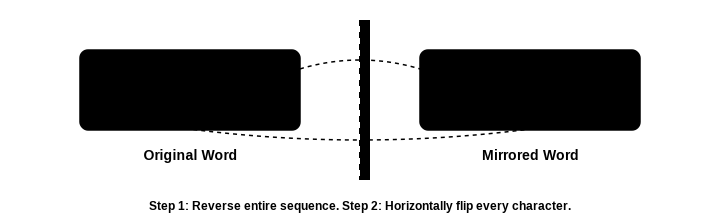
Words and mixed alphanumeric codes require a two-step reversal:
Reverse the sequence of characters: The last character of the word is closest to a right-side mirror, so it becomes the first character in the reflection.
Invert each individual character laterally: Each letter or digit must individually flip horizontally.
Word: CAT
Sequence reversal: T becomes first, A stays middle, C becomes last.
Individual reflection: T remains T; A remains A; C flips horizontally to open toward the left.
Mirror Image: T A (reversed C).
Word: RED
Sequence reversal: D becomes first, E stays middle, R becomes last.
Individual reflection: D flips (curved part faces left); E flips (arms point left); R flips (loop and leg face left).
Individual reflection: Y, T, I, A, U remain unchanged; L flips horizontally (base foot points left); Q flips (the small tail points down-left instead of down-right).
Mirror Image: Y T I (reversed L) A U (reversed Q).
Alphanumeric: 5 B 8 X
Sequence reversal: X → 8 → B → 5.
Individual reflection: X and 8 remain unchanged; B flips horizontally; 5 flips horizontally.
Mirror Image: X 8 (reversed B) (reversed 5).
Alphanumeric: P 9 K 2
Sequence reversal: 2 → K → 9 → P.
Individual reflection: All four characters are asymmetrical, so each flips horizontally.
Clock mirror image questions ask you to find the real time when looking at a reflection, or the reflection time when given real time on a clock face without written numbers (using dots or marks).
Calculation Rules:
• For times up to 12:00: Subtract the given time from 11:60 (which equals 12:00).
• For times between 12:00 and 1:00 (or 24-hour format): Subtract the given time from 23:60 (which equals 24:00).
• If seconds are included: Subtract the given time from 11:59:60.
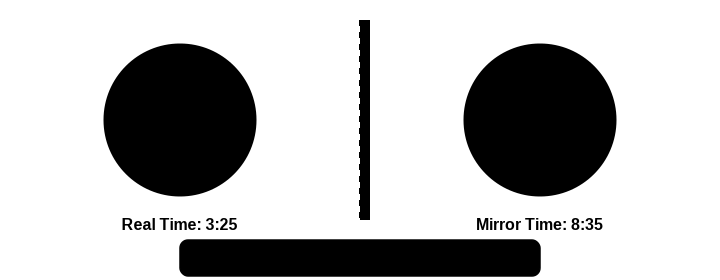
Given Time: 3:25
Formula: 11:60 - Given Time
Hours: 11 - 3 = 8
Minutes: 60 - 25 = 35
Mirror Time: 8:35
Given Time: 8:40
Formula: 11:60 - Given Time
Hours: 11 - 8 = 3
Minutes: 60 - 40 = 20
Mirror Time: 3:20
Given Time: 12:20
Formula: 23:60 - Given Time
Hours: 23 - 12 = 11
Minutes: 60 - 20 = 40
Mirror Time: 11:40
Given Time: 6:00 (Exact Hour)
Formula: 12:00 - Given Time
Result: 12:00 - 6:00 = 6:00
Mirror Time: 6:00 (Both hands point along the central vertical line, so the reflection is identical).
Given Time: 5:35:15 (With Seconds)
Formula: 11:59:60 - Given Time
Hours: 11 - 5 = 6
Minutes: 59 - 35 = 24
Seconds: 60 - 15 = 45
Mirror Time: 6:24:45
Type 5: Geometric Shapes, Figures, and Symbols
In non-verbal figures, look at individual elements (arrows, shading, slanting lines, and corner dots) and trace their relative positions to the mirror.
Horizontal Arrow Pointing Right (→)
Original: Arrow tail is on the left; arrowhead points toward the right.
Mirror Image: Arrowhead is closest to the mirror line, so it appears on the left; tail appears on the far right (←).
Flag with Pole on the Left and Banner on the Right
Original: Vertical pole on the left; triangular fabric extends toward the right.
Mirror Image: Vertical pole moves to the right; triangular fabric extends toward the left.
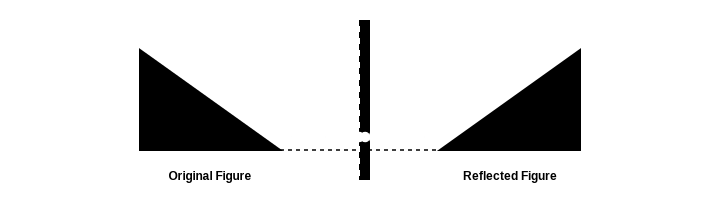
Right-Angled Triangle
Original: Vertical base line is on the left; horizontal baseline extends right; hypotenuse slants down from top-left to bottom-right.
Mirror Image: Vertical line moves to the right; horizontal base extends left; hypotenuse slants down from top-right to bottom-left.
Circle with Top-Right Quadrant Shaded
Original: Shading is in the upper half and on the right side.
Mirror Image: Vertical position stays the same (upper half); horizontal position inverts from right to left.
Result: Shading moves to the Top-Left quadrant.
Square with a Diagonal Line from Bottom-Left to Top-Right
Original: Line segment starts at bottom-left and rises to top-right.
Mirror Image: The bottom-left point reflects to bottom-right; the top-right point reflects to top-left.
Result: A diagonal line that slopes from Bottom-Right to Top-Left.
Fast Elimination Strategy for Exam Questions
When solving multiple-choice mirror image questions under time pressure:
Check the first and last characters first: In word questions, immediately check whether the first letter of the original word has shifted to the far right of the answer option. This eliminates 2 out of 4 options in under 3 seconds.
Watch for vertical inversion traps: Exam options often flip characters upside down (making a 'B' look like an inverted water image). Immediately reject any option where the top and bottom have swapped places.
Identify 1 unique asymmetrical element: In complex geometric figures, isolate a single dot, shading, or arrow tip near the boundary and track only that single feature in the options.
Ready to Test Your Speed?
Put your mirror image identification skills and speed shortcuts to the test with real exam drills.