Miscellaneous Reasoning is a cluster of independent, rule-based questions that test basic logic, alphabetical ordering, digit operations, and fundamental arithmetic. Unlike major reasoning chapters such as Puzzles or Syllogisms that require extensive setups, miscellaneous questions are standalone, quick-hit problems designed to test speed, pattern identification, and attention to detail.
Fundamentals of Miscellaneous Reasoning
Every beginner must master four core foundation areas before attempting these questions:
1. English Alphabet Positions
You must know the forward positional rank of all 26 letters instantly without counting on your fingers:
A = 1, B = 2, C = 3, ... Z = 26.
Shortcut Word (EJOTY): E = 5, J = 10, O = 15, T = 20, Y = 25.
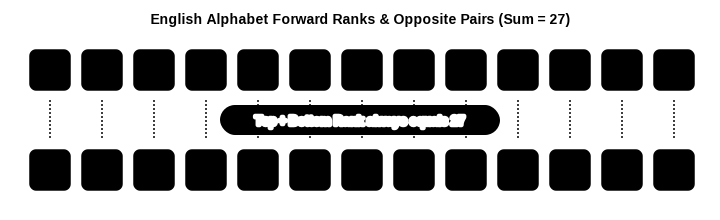
Backward / Reverse Positions: To find the reverse position of any letter from the right end, subtract its forward position from 27. Reverse Position = 27 - Forward Position
Example: Reverse position of H (8) = 27 - 8 = 19.
2. Opposite Letter Pairs
Two letters are opposite to each other if the sum of their numerical positions is exactly 27.
3. Left and Right End Navigation
From Left End: Moving from the beginning toward the end (A to Z or left to right).
From Right End: Moving from the end toward the beginning (Z to A or right to left).
Relative Direction Rule:
Left of Left = Subtract positions
Right of Right = Subtract positions
Right of Left = Add positions
Left of Right = Add positions
4. Basic Number Terminology
Preceding: The item that comes immediately before.
Succeeding / Followed by: The item that comes immediately after.
Odd and Even Digits: Odd = 1, 3, 5, 7, 9; Even = 0, 2, 4, 6, 8.
Ascending vs. Descending: Ascending is lowest to highest (1, 2, 3...); Descending is highest to lowest (9, 8, 7...).
Type 1: Pair Formation (Letters and Digits)
In this type, you are given a word or a number and asked to find how many pairs of letters or digits have the exact same number of letters/digits between them as they do in the standard English alphabet or natural number sequence, in both forward and backward directions.
Example 1.1
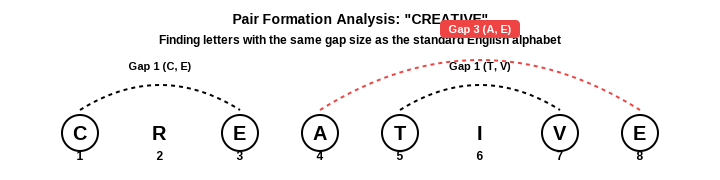
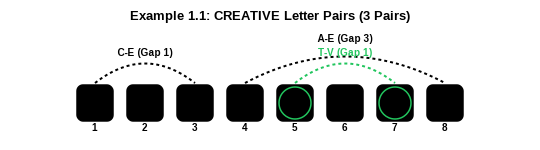
Question: How many such pairs of letters are there in the word CREATIVE, each of which has as many letters between them in the word as in the English alphabetical series (both forward and backward)?
Forward checks: From C (pos 3 in alphabet): counting forward gives D, E. In the word, E is at pos 3. Pair 1: (C, E).
From A (pos 1 in alphabet): counting gives B, C, D, E. In the word, E is at pos 8. Pair 2: (A, E).
From T (pos 20 in alphabet): counting gives U, V. In the word, V is at pos 7. Pair 3: (T, V).
Backward checks: Counting backward yields no matching letter-gap.
Answer: 3 pairs (C-E, A-E, T-V).
Example 1.2
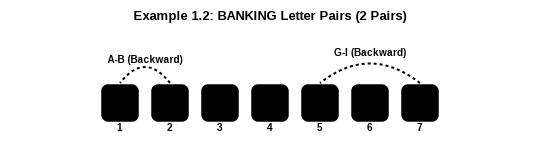
Question: How many pairs of letters are there in the word BANKING which have as many letters between them as in the English alphabet (both forward and backward)?
Word: B - A - N - K - I - N - G
Forward check: No matches.
Backward check: From G (pos 7): counting backward, pos 6 is H, pos 5 is I. In the word, I is at position 5. Pair 1: (G, I).
From A (pos 2 in word): counting backward to position 1 gives B. A and B are adjacent in the alphabet and adjacent here. Pair 2: (A, B).
Answer: 2 pairs (G-I, A-B).
Example 1.3
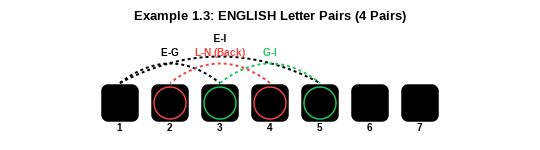
Question: How many pairs of letters are there in the word ENGLISH which have as many letters between them as in the English alphabet (both forward and backward)?
Forward check: From E: F at 2, G at 3. (E, G). Continuing count: H at 4, I at 5. (E, I). From G: H at 4, I at 5. (G, I).
Backward check: From L: M at 3, N at 2. (L, N).
Answer: 4 pairs (E-G, E-I, G-I, L-N).
Example 1.4
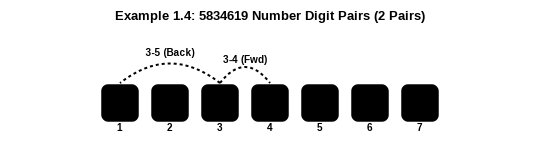
Question: How many such pairs of digits are there in the number 5834619, each of which has as many digits between them in the number as in the natural number series (both forward and backward)?
Number: 5 - 8 - 3 - 4 - 6 - 1 - 9
Forward check: From 3: next digit 4 is at the next position. Pair 1: (3, 4).
Backward check: From 3 (3rd position): counting backward, 4 would be at 2nd pos, 5 is at 1st pos. In the number, 5 is at 1st pos. Gap is 1 digit. Pair 2: (3, 5).
Answer: 2 pairs (3-4, 3-5).
Example 1.5
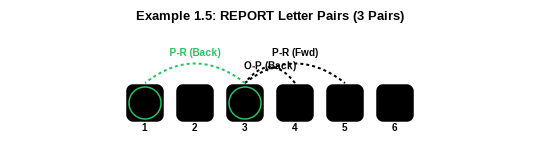
Question: How many pairs of letters are there in the word REPORT which have as many letters between them as in the English alphabet (both forward and backward)?
Word: R(1) - E(2) - P(3) - O(4) - R(5) - T(6)
Forward check: From P(3): count Q at 4, R at 5. Pair 1: (P, R).
Backward check: From O(4): count backward, P is at 3. Pair 2: (O, P). From P(3): count backward, Q at 2, R at 1. Pair 3: (P, R).
Answer: 3 pairs.
Type 2: Meaningful Word Formation from Selected Letters
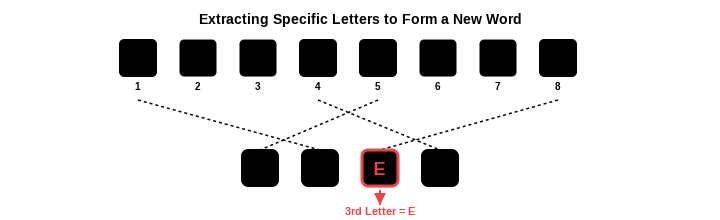
You are instructed to take specific letters (like 1st, 3rd, 5th, etc.) from a given word and determine if one, more than one, or zero meaningful English dictionary words can be formed using each letter only once.
Example 2.1
Question: If a meaningful English word can be formed using the 1st, 4th, 5th, and 8th letters of the word HANDSOME, which will be the third letter of that word from the left? If more than one word can be formed, give 'M' as your answer. If no such word can be formed, give 'X' as your answer.
No other valid 4-letter dictionary word can be formed.
The third letter of the word SHED from the left is E.
Answer: E.
Example 2.2
Question: If it is possible to make a meaningful word with the 2nd, 4th, 6th, and 9th letters of the word IMPORTANT, what is the first letter of that word? If no such word can be made, answer 'X'. If more than one word can be made, answer 'M'.
Word: I - M - P - O - R - T - A - N - T
Letters available: 2nd = M, 4th = O, 6th = T, 9th = T.
Rearranging these four letters gives no meaningful English dictionary word.
Answer: X.
Example 2.3
Question: If a meaningful word can be formed using the 2nd, 3rd, 4th, and 5th letters of the word CREATION, mark 'M' if more than one word is formed, 'X' if no word is formed, or the last letter of the word if only one word is formed.
Word: C(1) - R(2) - E(3) - A(4) - T(5) - I(6) - O(7) - N(8). Letters selected: 2nd = R, 3rd = E, 4th = A, 5th = T.
Possible valid English words: RATE, TEAR, TARE.
Because three valid English words can be formed, the answer is 'more than one' (M).
Answer: M.
Example 2.4
Question: If it is possible to make a meaningful word from the 1st, 3rd, 6th, and 8th letters of the word DIAGNOSIS, what will be the second letter from the left? If no word can be formed, answer 'X'. If more than one word can be formed, answer 'M'.
Letters available: D, A, O, I.
No standard English word can be constructed using D, A, O, I.
Answer: X.
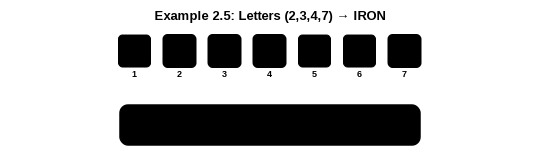
Example 2.5
Question: If a meaningful word can be formed with the 2nd, 3rd, 4th, and 7th letters of the word MONITOR, what is the second letter of that word from the left?
Letters available: 2nd = O, 3rd = N, 4th = I, 7th = R.
Possible valid words: IRON.
The second letter from the left is R.
Answer: R.
Type 3: Alphabetical Operations within Words
These questions ask you to modify letters based on specific substitution rules (changing vowels to next letter, consonants to previous letter) or re-ordering letters alphabetically, and then finding positions or counting changes.
Example 3.1
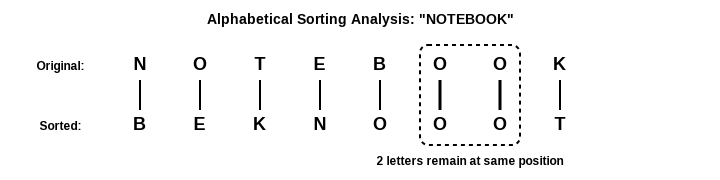
Question: If the letters of the word NOTEBOOK are arranged in alphabetical order from left to right, how many letters will remain in the exact same position as before?
Original word: N - O - T - E - B - O - O - K
Sorted alphabetically: B, E, K, N, O, O, O, T
Comparing position by position, only Position 6 (O -> O) and Position 7 (O -> O) remain the same.
Answer: 2 letters (the 6th and 7th letters 'O').
Example 3.2
Question: In the word COMPUTERS, each vowel is replaced by the next letter in the English alphabet, and each consonant is replaced by the previous letter in the English alphabet. How many letters appear more than once in the newly formed arrangement?
New arrangement: B - P - L - O - V - S - F - Q - R
All 9 letters are distinct. None appears more than once.
Answer: None (0).
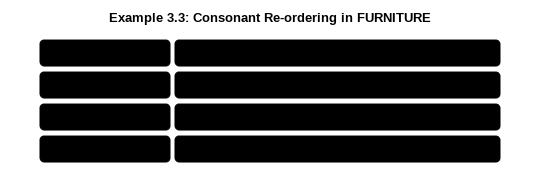
Example 3.3
Question: In the word FURNITURE, all vowels are dropped, and the remaining consonants are arranged in reverse alphabetical order from left to right. Which letter will be fourth from the right end?
Original word: F - U - R - N - I - T - U - R - E
Vowels: U, I, U, E (drop these).
Consonants remaining: F, R, N, T, R
Reverse alphabetical order: T, R, R, N, F
Counting from right end: 1st=F, 2nd=N, 3rd=R, 4th=R.
Answer: R.
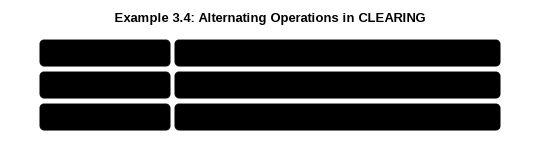
Example 3.4
Question: In the word CLEARING, each letter at an odd-numbered position (from left) is changed to its succeeding letter, and each letter at an even-numbered position is changed to its preceding letter. What will be the fifth letter from the left in the new arrangement?
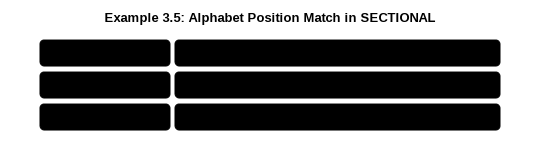
Question: How many letters in the word SECTIONAL occupy the same position in the word as they do in the English alphabetical series?
Check each position against the letter's alphabetical rank:
Position 3: C (C is 3rd in alphabet, and is at position 3 → Matches)
No other positions match (e.g., S is 19th, not 1st).
Answer: 1 letter ('C').
Type 4: Digit Manipulation within Numbers
These questions involve applying math/sorting rules to individual digits inside a number or comparing a set of 3-digit numbers.
Example 4.1
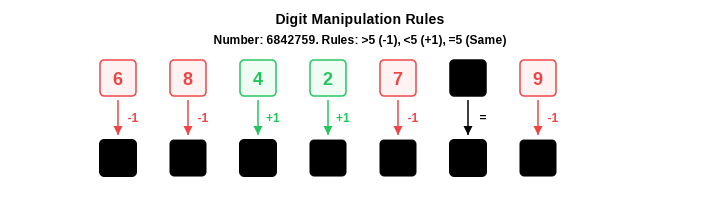
Question: In the number 6842759, 1 is added to each digit smaller than 5, 1 is subtracted from each digit greater than 5, and digits equal to 5 remain unchanged. How many digits appear more than once in the newly formed number?
Original digits: 6, 8, 4, 2, 7, 5, 9
New number formed: 5 - 7 - 5 - 3 - 6 - 5 - 8
Only the digit 5 appears more than once (it appears three times).
Answer: 1 digit.
Example 4.2
Question: If the digits of the number 94628351 are arranged in ascending order from left to right, what will be the sum of the digit which is third from the left end and the digit which is second from the right end?
Ascending order: 1, 2, 3, 4, 5, 6, 8, 9
Digit third from left end = 3
Digit second from right end = 8
Required sum: 3 + 8 = 11.
Answer: 11.
Example 4.3
Question: In the number 5824963, all even digits are arranged in ascending order first, followed by all odd digits in descending order. Which digit will be fourth from the right end?
Even ascending: 2, 4, 6, 8
Odd descending: 9, 5, 3
Combined: 2, 4, 6, 8, 9, 5, 3
4th from the right end is 8.
Answer: 8.
Example 4.4
Question: Consider the five 3-digit numbers: 482, 735, 619, 294, 851. If the positions of the first and third digits within each number are interchanged, which original number becomes the second lowest?
Question: In the number 8372645, how many digits remain in the same position when all the digits are arranged in descending order from left to right?
Original: 8 - 3 - 7 - 2 - 6 - 4 - 5
Descending: 8 - 7 - 6 - 5 - 4 - 3 - 2
Comparing positions, only the '8' remains in the exact same spot (1st position).
Answer: 1 digit.
Type 5: Arithmetical Reasoning
Arithmetical Reasoning covers logic-based mathematical puzzles that frequently appear in the reasoning section. These test your ability to convert everyday scenarios into simple algebraic or logical equations.
Example 5.1 (The Heads and Legs Problem)
Question: A farmer has some hens and some goats. If the total number of animal heads is 48 and the total number of legs is 140, how many goats does the farmer have?
Let H = number of hens (2 legs) and G = number of goats (4 legs).
Equation 1 (Heads): H + G = 48
Equation 2 (Legs): 2H + 4G = 140
Multiply Eq 1 by 2: 2H + 2G = 96.
Subtract from Eq 2: 2G = 44 → G = 22.
Answer: 22 goats (and 26 hens).
Example 5.2 (The Handshake Problem)
Question: In a room of 12 people, every person shakes hands with every other person exactly once. How many total handshakes take place?
When person A shakes hands with person B, it counts as one handshake for both.
Formula: Total Handshakes = n * (n - 1) / 2
Calculation: 12 * 11 / 2 = 132 / 2 = 66.
Answer: 66 handshakes.
Example 5.3 (The Climbing Monkey Problem)
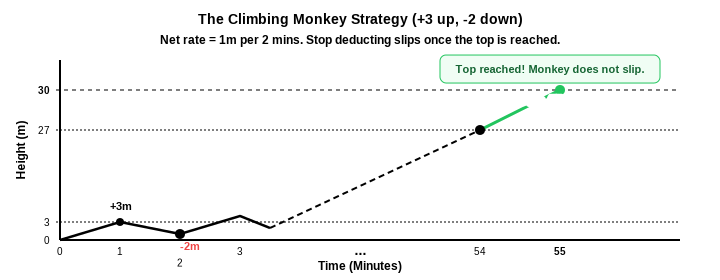
Question: A monkey tries to climb a greased pole that is 30 meters high. In the first minute, he climbs up 3 meters, but in the second minute, he slips down 2 meters. If he continues this pattern, in how many minutes will he reach the top?
Net climb: 1 meter every 2 minutes.
Critical rule: Reserve the final 3-meter climb (30 - 3 = 27m).
Time to reach 27 meters at the cyclic rate = 27 * 2 = 54 minutes.
In the 55th minute, he climbs 3 meters and reaches 30 meters (the top).
Answer: 55 minutes.
Example 5.4 (The Cutting Problem)
Question: A carpenter has a wooden log that is 60 meters long. He needs to cut it into smaller pieces of 5 meters each. How many total cuts must he make?
Total number of pieces required = 60 / 5 = 12 pieces.
To divide any continuous strip or log into n pieces, you always need (n - 1) cuts.
Number of cuts: 12 - 1 = 11 cuts.
Answer: 11 cuts.
Example 5.5 (The Gift Exchange Problem)
Question: In a group of 10 students, every student gives a gift to every other student. How many total gifts are exchanged?
Unlike a handshake, a gift is directional (A gives to B, B gives to A).
Each of the 10 students gives a gift to the remaining 9 students.
Formula: Total Gifts = n * (n - 1)
Calculation: 10 * 9 = 90.
Answer: 90 gifts.
Ready to Test Your Speed?
Put your miscellaneous reasoning identification skills and logic to the test with real exam drills.