Subjects
/
Reasoning
/
Missing Number / Missing Character
1. Fundamentals Every Beginner Must Know
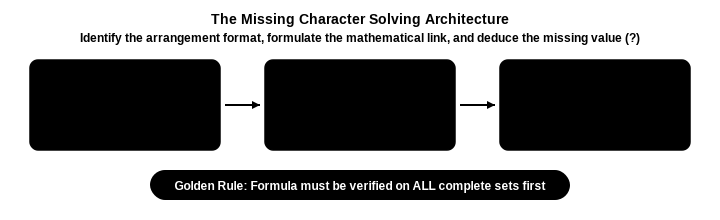
Before attempting to solve questions, you must build a strong foundation. In reasoning, patterns are almost always constructed using a specific set of mathematical operations, positional systems, and number properties.
A. Mathematical Tools to Memorize
1. Squares of Numbers (1 to 30):
12 = 1, 22 = 4, 32 = 9, 42 = 16, 52 = 25
62 = 36, 72 = 49, 82 = 64, 92 = 81, 102 = 100
112 = 121, 122 = 144, 132 = 169, 142 = 196, 152 = 225
162 = 256, 172 = 289, 182 = 324, 192 = 361, 202 = 400
212 = 441, 222 = 484, 232 = 529, 242 = 576, 252 = 625
262 = 676, 272 = 729, 282 = 784, 292 = 841, 302 = 900
2. Cubes of Numbers (1 to 20):
13 = 1, 23 = 8, 33 = 27, 43 = 64, 53 = 125
63 = 216, 73 = 343, 83 = 512, 93 = 729, 103 = 1000
113 = 1331, 123 = 1728, 133 = 2197, 143 = 2744, 153 = 3375
163 = 4096, 173 = 4913, 183 = 5832, 193 = 6859, 203 = 8000
3. Prime Numbers (up to 50):
2, 3, 5, 7, 11, 13, 17, 19, 23, 29, 31, 37, 41, 43, 47
4. Digital Operations:
Sum of digits (for example, in 38: 3 + 8 = 11)
Product of digits (for example, in 38: 3 * 8 = 24)
Difference of digits (for example, in 83: 8 - 3 = 5)
B. Alphabetical Foundations (For Missing Characters)
Questions involving letters require converting letters into numbers using positional values.
1. Forward Rank (A = 1 to Z = 26):
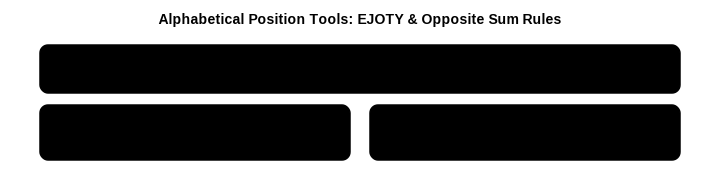
Use the standard mnemonic EJOTY to recall positions in steps of 5:
E = 5, J = 10, O = 15, T = 20, Y = 25
2. Reverse Rank (Z = 1 to A = 26):
Formula: Forward Position + Reverse Position = 27Example: For K (forward = 11), reverse rank = 27 - 11 = 16.
3. Opposite Letter Pairs (Sum of positions = 27):
A - Z (Azad / Amazon)
B - Y (Boy / Bye)
C - X (Crux / Coca-Cola)
D - W (Dew / Down)
E - V (Even / Love)
F - U (Full / Fun)
G - T (GT Road)
H - S (High School)
I - R (Indian Railway)
J - Q (Jack - Queen / Jungle Queen)
K - P (Kurta - Pajama / Kanpur)
L - O (Light Out / Love)
M - N (Man / Moon)
C. Standard Solving Strategy
Target the Largest Number: In any set, the largest number is almost always the result of an operation performed on the smaller numbers.
Order of Operation Checks:
• Step 1: Addition or Subtraction.
Consistency Rule: A pattern must work on all complete rows, columns, or figures before applying it to find the missing value.
2. Common Types and Worked Examples
Type 1: Matrix and Grid-Based Puzzles
Numbers are arranged in rows and columns. Patterns generally move row-wise (left to right) or column-wise (top to bottom).
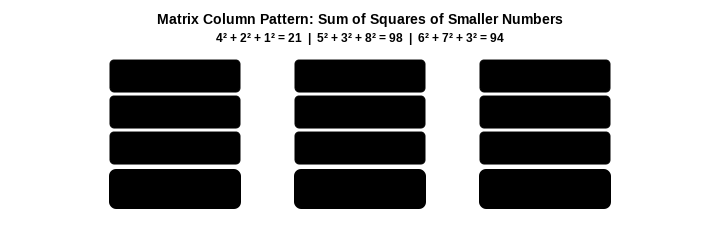
Example 1.1: Sum of Squares in Columns
Find the missing number in the matrix:
4 5 6
Step 1: Look at Column 1. The bottom number (21) is the largest. Check if smaller numbers combine to form 21:2 + 22 + 12 = 16 + 4 + 1 = 21.
Step 2: Test this rule on Column 2:2 + 32 + 82 = 25 + 9 + 64 = 98. (Rule holds true).
Step 3: Apply the verified rule to Column 3:2 + 72 + 32 = 36 + 49 + 9 = 94.
Answer: 94
Example 1.2: Difference of Squares in Rows
Find the missing number:
7 4 33
Step 1: Look at Row 1. 33 is the largest number.2 = 49, and 42 = 16.
Step 2: Test this rule on Row 2:2 = 81, and 52 = 25.
Step 3: Apply the rule to Row 3:2 = 121, and 62 = 36.
Answer: 85
Example 1.3: Constant Row Sum
Find the missing number:
13 12 17
Step 1: Check row sums:
Step 2: Since the sum is constant (42), set up Row 3:
Answer: 15
Example 1.4: Difference Progression Across Columns
Find the missing number:
8 13 10
Step 1: Observe Row 1:
Step 2: Observe Row 2:
Step 3: Apply the rule to Row 3:
Answer: 12
Example 1.5: Division and Multiplication in Columns
Find the missing number:
28 36 48
Step 1: Look at Column 1. Divide Row 1 by Row 2, then multiply by Row 3:
Step 2: Test this rule on Column 2:
Step 3: Apply the rule to Column 3:
Answer: 56
Type 2: Circular and Sector-Based Puzzles
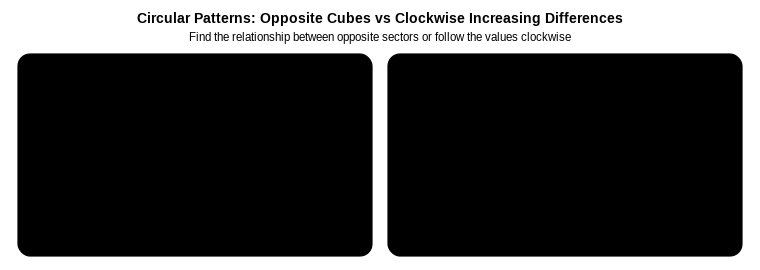
Numbers are placed inside divided sectors of a circle. Patterns usually run clockwise around the circle or between directly opposite sectors.
Example 2.1: Opposite Sectors (Cubes)
A circle is divided into 6 equal sectors. The numbers placed in opposite pairs are:
• Pair 1: 4 is opposite to 64
• Pair 2: 5 is opposite to 125
• Pair 3: 3 is opposite to ?
Step 1: Analyze Pair 1: 43 = 64.
Step 2: Analyze Pair 2: 53 = 125.
Step 3: The number in the opposite sector is the cube of the original number:3 = 3 * 3 * 3 = 27.
Answer: 27
Example 2.2: Opposite Sectors (Multiply and Add)
A circle is divided into 8 sectors with the following opposite pairs:
• Pair 1: 3 is opposite to 10
• Pair 2: 5 is opposite to 16
• Pair 3: 7 is opposite to 22
• Pair 4: 9 is opposite to ?
Step 1: Analyze Pair 1: (3 * 3) + 1 = 9 + 1 = 10.
Step 2: Analyze Pair 2: (5 * 3) + 1 = 15 + 1 = 16.
Step 3: Analyze Pair 3: (7 * 3) + 1 = 21 + 1 = 22. (Rule: (Number * 3) + 1).
Step 4: Apply to Pair 4:
Answer: 28
Example 2.3: Clockwise Increasing Differences
A circle is divided into 6 sectors. Starting from 5 and reading clockwise, the numbers are:
Step 1: Calculate consecutive differences:
Step 2: The differences increase by consecutive odd numbers: +3, +5, +7, +9.
Step 3: The next difference must be +11:
Answer: 40
Example 2.4: Concentric Circles (Inner Ring to Outer Ring)
A circular figure has 4 quadrants, each with an inner number and an outer number:
• Quadrant 1: Inner = 3, Outer = 26
• Quadrant 2: Inner = 4, Outer = 63
• Quadrant 3: Inner = 5, Outer = 124
• Quadrant 4: Inner = 6, Outer = ?
Step 1: Analyze Quadrant 1: 33 - 1 = 27 - 1 = 26.
Step 2: Analyze Quadrant 2: 43 - 1 = 64 - 1 = 63.
Step 3: Analyze Quadrant 3: 53 - 1 = 125 - 1 = 124. (Rule: (Inner)3 - 1 = Outer).
Step 4: Calculate for Quadrant 4:3 - 1 = 216 - 1 = 215.
Answer: 215
Example 2.5: Clockwise Doubling Pattern
A circle is divided into 8 sectors arranged clockwise:
Step 1: Find the multiplier between terms:
Step 2: Apply the rule (Previous * 2) + 1:
Answer: 639
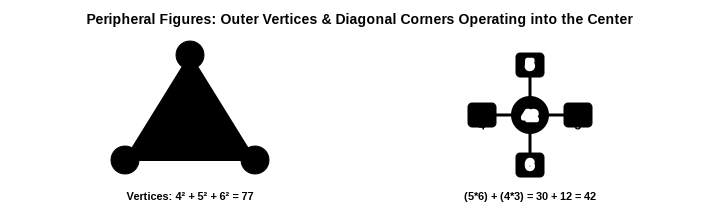
Type 3: Peripheral Geometric Figures (Outer to Inner Numbers)
A central number is enclosed inside a geometric shape (triangle, diamond, box, or cross) and is derived from numbers on the perimeter or corners.
Example 3.1: Triangle with Central Number (Sum of Squares)
Three triangles with numbers at the vertices and one number at the center:
• Triangle 1: Vertices = 4, 5, 6; Center = 77
• Triangle 2: Vertices = 3, 7, 8; Center = 122
• Triangle 3: Vertices = 2, 6, 9; Center = ?
Step 1: For Triangle 1, square the vertices and add them:2 + 52 + 62 = 16 + 25 + 36 = 77.
Step 2: Verify with Triangle 2:2 + 72 + 82 = 9 + 49 + 64 = 122. (Rule holds true).
Step 3: Calculate for Triangle 3:2 + 62 + 92 = 4 + 36 + 81 = 121.
Answer: 121
Example 3.2: Cross Shape with Central Number (Sum of Products)
Three cross figures with numbers at Top, Bottom, Left, Right, and Center:
• Figure 1: Top = 5, Bottom = 6, Left = 4, Right = 3; Center = 42
• Figure 2: Top = 7, Bottom = 4, Left = 6, Right = 2; Center = 40
• Figure 3: Top = 8, Bottom = 5, Left = 9, Right = 3; Center = ?
Step 1: For Figure 1, multiply vertical arms and horizontal arms, then add:
Step 2: Verify with Figure 2:
Step 3: Calculate for Figure 3:
Answer: 67
Example 3.3: Triangle with Central Number (Product Divided by Constant)
Three triangles:
• Triangle 1: Vertices = 6, 4, 5; Center = 12
• Triangle 2: Vertices = 8, 5, 3; Center = 12
• Triangle 3: Vertices = 9, 6, 5; Center = ?
Step 1: For Triangle 1, multiply the three vertices:
Step 2: Verify with Triangle 2:
Step 3: Calculate for Triangle 3:
Answer: 27
Example 3.4: Four-Corner Box (Difference of Diagonal Products)
Three square boxes with four corners and a central number:
• Box 1: Corners = Top-Left: 9, Bottom-Right: 7; Top-Right: 8, Bottom-Left: 5; Center = 23
• Box 2: Corners = Top-Left: 11, Bottom-Right: 6; Top-Right: 7, Bottom-Left: 4; Center = 38
• Box 3: Corners = Top-Left: 12, Bottom-Right: 8; Top-Right: 9, Bottom-Left: 6; Center = ?
Step 1: For Box 1, multiply diagonally and subtract:
Step 2: Verify with Box 2:
Step 3: Calculate for Box 3:
Answer: 42
Example 3.5: Peripheral Sum with Square Root Center
Three figures with 4 outer numbers and a center:
• Figure 1: Outer = 12, 18, 14, 5; Center = 7
• Figure 2: Outer = 25, 17, 31, 27; Center = 10
• Figure 3: Outer = 34, 42, 28, 40; Center = ?
Step 1: Sum the outer numbers of Figure 1:
Step 2: Verify with Figure 2:
Step 3: Calculate for Figure 3:
Answer: 12
Type 4: Alphabet and Alphanumeric Character Puzzles
These problems use English letters alone or combine letters with numbers.
Example 4.1: Pure Letter Matrix (Positional Shifts)
Find the missing letter in the matrix:
A D G
Step 1: Convert Row 1 letters to their forward positions:
Step 2: Convert Row 2:
Step 3: Convert Row 3:
Step 4: Find the letter at position 23:
Answer: W
Example 4.2: Column-Wise Letter Addition
Find the missing letter:
B C E
Step 1: Convert Column 1 letters to numbers:
Step 2: Convert Column 2:
Step 3: Apply the rule to Column 3:
Step 4: Position 12 corresponds to letter L.
Answer: L
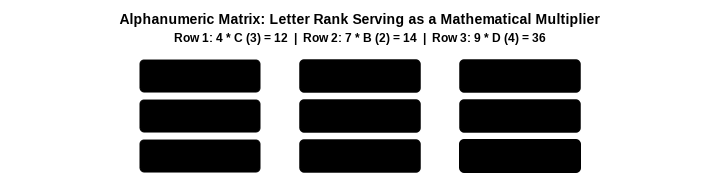
Example 4.3: Alphanumeric Matrix (Letter as an Operator)
Find the missing number:
4 C 12
Step 1: Convert the middle letter in Row 1 to its numerical value:
Step 2: Check Row 2:
Step 3: Apply to Row 3:
Answer: 36
Example 4.4: Circular Alphanumeric Sectors (Square of Rank)
A circle is divided into 8 sectors. Opposite pairs are made up of a letter and a number:
• Pair 1: D is opposite to 16
• Pair 2: F is opposite to 36
• Pair 3: H is opposite to 64
• Pair 4: J is opposite to ?
Step 1: Convert D to position: D = 4. Square of 4 = 42 = 16.
Step 2: Convert F to position: F = 6. Square of 6 = 62 = 36.
Step 3: Convert H to position: H = 8. Square of 8 = 82 = 64.
Step 4: The opposite number is the square of the letter's positional value:2 = 100.
Answer: 100
Example 4.5: Opposite Letter Pairs Matrix
Find the missing character:
A Z 27
Step 1: Look at Row 1:
Step 2: Look at Row 2:
Step 3: Apply to Row 3:
Step 4: Position 14 corresponds to letter N (M and N are opposite letters).
Answer: N
Ready to Test Your Speed?
Put your pattern discovery, calculation rules, and missing character strategies to the test with real exam drills.
Practice