A puzzle in logical reasoning is a problem where multiple scattered and indirect clues about persons, objects, places, or dates must be analyzed and organized into a single, complete structure or table.
Fundamentals of Puzzles for Beginners
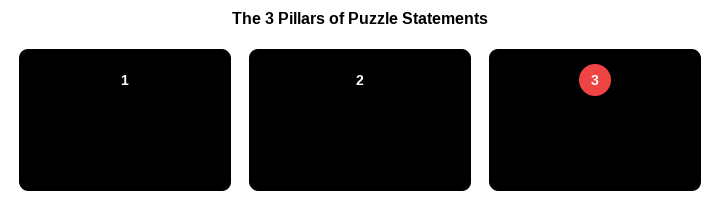
To solve any puzzle, you must convert written clues into a structured visual diagram. Every puzzle is built upon three types of statements:
Definite Clues: Statements that give an exact, fixed position immediately. (e.g., "A lives on the 3rd floor" or "B sits on Monday.") You must place these into your grid right away.
Relative Clues: Statements connecting two entities without giving their absolute positions. (e.g., "P lives two floors above Q" or "X is senior to Y.") These create linked blocks that move together.
Negative Clues: Statements telling you where an entity cannot go. (e.g., "R does not like Red" or "S does not live on an odd-numbered floor.") These are critical for eliminating false arrangements.
Key Terminology and Mathematical Rules: Understanding the exact wording prevents common mistakes:
"N places / floors above Y": If X is 3 floors above Y, and Y is on floor 2, then X is on floor 2 + 3 = 5. The number of entities between X and Y is (N - 1). Here, 3 - 1 = 2 entities live between them.
"Immediately above / below": There is no gap between them. If A is immediately above B, their positions are consecutive.
"Between A and B": "Three persons sit between A and B" means there are exactly 3 positions separating A and B. The distance is 3 + 1 = 4.
"At least" vs. "At most": "At least 2" means 2 or more. "At most 2" means 2 or fewer (2, 1, or 0).
"As many persons above A as below B": The rank of A from the top equals the rank of B from the bottom.
Step-by-Step Solving Technique
Fix the Base (Skeleton): Always pick the most rigid, sequential variable as your starting vertical column (such as Floor numbers 1 to 8, Days Monday to Sunday, or Ranks 1 to 6).
Work with Cases (Possibilities): If a primary clue allows two valid positions, draw Case 1 and Case 2 side-by-side. Never guess. As you read further clues, one case will violate a rule and get eliminated.
Chain the Relative Clues: Look for common names that connect multiple clues together.
Apply Negative Limits: Cross out invalid positions to force the remaining names into their only available spots.
Type 1: Floor-Based Puzzles
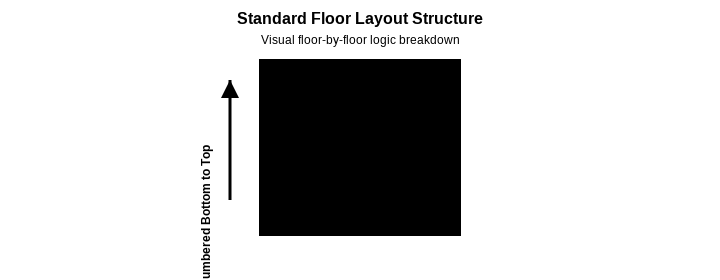
In floor puzzles, a building has floors numbered from bottom to top. Unless stated otherwise, the bottom-most floor is numbered 1, the floor above it is 2, and the topmost floor is the highest number.
Example 1.1: Basic 5-Floor Puzzle
Problem: Five persons (A, B, C, D, E) live on floors 1 to 5. B lives on floor 2. Exactly two persons live between B and E. A lives immediately above C. D lives on the remaining floor.
Step-by-Step Logic:
Floor 2 is fixed for B.
Exactly two persons live between B (floor 2) and E. So E must be on floor 2 + 3 = 5 (floors 3 and 4 are between them).
A lives immediately above C. The only two consecutive empty floors are 4 and 3. Therefore, A is on floor 4 and C is on floor 3.
Floor 1 is left for D.
Floor
Person
5
E
4
A
3
C
2
B
1
D
Example 1.2: 6-Floor Puzzle with Odd/Even Constraints
Problem: Six persons (P, Q, R, S, T, U) live on floors 1 to 6. R lives on floor 1. Three persons live between R and P. Q lives on an even floor immediately below S. T lives above U.
Step-by-Step Logic:
R is on floor 1.
Three persons live between R and P, so P is on floor 1 + 4 = 5.
S and Q must be adjacent, with Q on an even floor below S. Available empty spots: 2, 3, 4, 6. If S is on floor 3, Q is on floor 2 (even).
Remaining floors are 6 and 4. T lives above U, so T is on 6 and U is on 4.
Floor
Person
6
T
5
P
4
U
3
S
2
Q
1
R
Example 1.3: 7-Floor Puzzle with Fixed Midpoint
Problem: Seven persons (A, B, C, D, E, F, G) live on floors 1 to 7. G lives on floor 4. Two persons live between G and A, who lives above G. F lives on an odd floor below G. Three persons live between F and B. C lives immediately above D. E lives on the remaining floor.
Step-by-Step Logic:
G is on floor 4.
Two persons between G and A (A above G): floor 4 + 3 = 7. A is on floor 7.
F on an odd floor below 4 means F is on 1 or 3. If F is 3, B is on 7 (already occupied by A). Thus, F is on floor 1.
Three floors between F (floor 1) and B places B on floor 1 + 4 = 5.
C lives immediately above D. Empty spots: 3 and 2. C is on 3, D is on 2.
E takes remaining floor 6.
Floor
Person
7
A
6
E
5
B
4
G
3
C
2
D
1
F
Example 1.4: 6-Floor Puzzle with Top/Bottom Conditions
Problem: Six persons (J, K, L, M, N, O) live on floors 1 to 6. M lives on the topmost floor. Two persons live between M and K. L lives immediately below K. J lives on floor 1. N lives above O.
Step-by-Step Logic:
M is on floor 6.
Two persons between M and K: floor 6 - 3 = 3. K is on floor 3.
L is immediately below K: L is on floor 2.
J lives on floor 1.
Remaining floors 5 and 4. N lives above O, so N is on 5, O is on 4.
Floor
Person
6
M
5
N
4
O
3
K
2
L
1
J
Example 1.5: Floor and Flat Puzzle (3 Floors, 2 Flats)
Problem: Six persons (A, B, C, D, E, F) live in 3 floors (1 to 3) and 2 flats: Flat P (West) and Flat Q (East). A lives on an even-numbered floor in Flat P. B lives immediately above A in the same flat. C lives in Flat Q on the same floor as A. D lives immediately below C in the same flat. E lives west of D. F occupies the remaining flat.
Step-by-Step Logic:
Even floor is 2. A is on floor 2, Flat P.
B is immediately above A in same flat: floor 3, Flat P.
C is on the same floor as A (floor 2) in Flat Q.
D is immediately below C in same flat: floor 1, Flat Q.
E lives west of D: E is on floor 1, Flat P.
F takes remaining spot: floor 3, Flat Q.
Floor
Flat P (West)
Flat Q (East)
3
B
F
2
A
C
1
E
D
Type 2: Box / Stack Puzzles
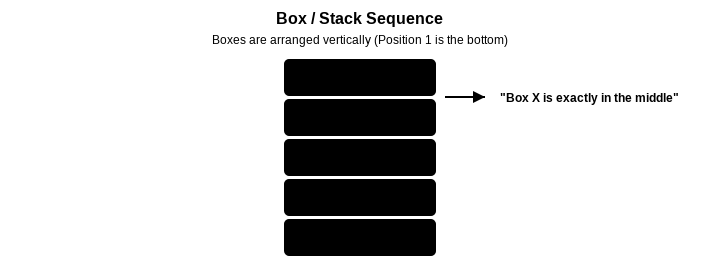
In box puzzles, items are stacked vertically one on top of another. Position 1 is typically the bottom-most box, and the highest number is the topmost box.
Example 2.1: 5-Box Stack
Problem: Five boxes (A, B, C, D, E) are stacked. Box C is at the bottom-most position (position 1). Two boxes are kept between C and A. Box B is kept immediately above A. Box D is kept above E.
Step-by-Step Logic:
Box C is at position 1.
Two boxes between C and A places A at position 1 + 3 = 4.
Box B is immediately above A, so B is at position 5.
Positions 2 and 3 are empty. Since D is above E, D is at 3 and E is at 2.
Position
Box
5 (Top)
B
4
A
3
D
2
E
1 (Bottom)
C
Example 2.2: 6-Box Stack
Problem: Six boxes (P, Q, R, S, T, U) are kept one above another. Box T is at the topmost position (6). Three boxes are kept between T and Q. Box R is kept immediately below Q. Box P is kept immediately above S. Box S is at position 3. Box U takes the remaining position.
Step-by-Step Logic:
Box T is at position 6.
Three boxes between T and Q places Q at position 6 - 4 = 2.
Box R is immediately below Q, so R is at position 1.
Box S is at position 3, and P is immediately above S, so P is at 4.
Box U fills remaining position 5.
Position
Box
6 (Top)
T
5
U
4
P
3
S
2
Q
1 (Bottom)
R
Example 2.3: 7-Box Stack with Fixed Center
Problem: Seven boxes (M, N, O, P, Q, R, S) are stacked. P is at position 4. One box is kept between P and M (M above P). S is at the top. Q is kept immediately below P. Two boxes are kept between P and R (R below P). N is kept above O.
Step-by-Step Logic:
Box P is at position 4.
One box between P and M (M above P) puts M at 4 + 2 = 6.
Box S is at position 7.
Box Q is immediately below P, so Q is at position 3.
Two boxes between P and R (R below P) puts R at 4 - 3 = 1.
Positions 5 and 2 are vacant. N above O means N is at 5, O is at 2.
Position
Box
7 (Top)
S
6
M
5
N
4
P
3
Q
2
O
1 (Bottom)
R
Example 2.4: 6-Box Stack with Gaps
Problem: Six boxes (V, W, X, Y, Z, K). W is at the bottom (1). X is placed three places above W. Z is placed immediately above X. K is placed at the top (6). Y is placed above V.
Step-by-Step Logic:
Box W is at position 1.
"Three places above W" = 1 + 3 = 4. Box X is at 4.
Box Z is immediately above X, so Z is at 5.
Box K is at position 6.
Positions 2 and 3 remain. Y above V means Y is at 3, V is at 2.
Position
Box
6 (Top)
K
5
Z
4
X
3
Y
2
V
1 (Bottom)
W
Example 2.5: 5-Box Stack with Top Down Chain
Problem: Five boxes (J, H, G, I, F). J is at the topmost position (5). H is immediately below J. G is immediately below H. Exactly one box is kept between G and F. I takes the remaining position.
Step-by-Step Logic:
Box J is at position 5.
Box H is immediately below J (pos 4).
Box G is immediately below H (pos 3).
One box between G (pos 3) and F places F at 3 - 2 = 1.
Box I takes position 2.
Position
Box
5 (Top)
J
4
H
3
G
2
I
1 (Bottom)
F
Type 3: Scheduling Puzzles (Days, Months, Years)
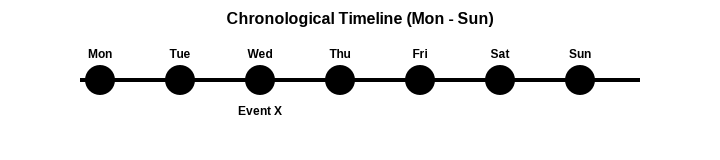
In scheduling puzzles, events or persons are arranged along a chronological timeline: days of the week, calendar months, or specific birth years.
Example 3.1: 5-Day Week Schedule
Problem: Five persons (A, B, C, D, E) attend class Mon to Fri. A attends Monday. B attends Tuesday. E attends Friday. C attends immediately before D.
Step-by-Step Logic:
Monday: A, Tuesday: B, Friday: E.
Remaining days: Wednesday and Thursday.
C attends immediately before D, so C is Wed, D is Thu.
Day
Person
Monday
A
Tuesday
B
Wednesday
C
Thursday
D
Friday
E
Example 3.2: 7-Day Week Schedule
Problem: Seven persons (P, Q, R, S, T, U, V) from Mon to Sun. P takes it on Thursday. Two persons between P and S (S after P). Q takes it on Tuesday. R takes it immediately before Q. T takes it immediately after P. U takes it before V.
Step-by-Step Logic:
Thursday is P.
Two days between P and S (S after P) places S on Sunday.
Q is on Tuesday. R is immediately before Q, so R is on Monday.
T is immediately after P, so T is on Friday.
Remaining: Wed and Sat. U before V means U is Wed, V is Sat.
Day
Person
Monday
R
Tuesday
Q
Wednesday
U
Thursday
P
Friday
T
Saturday
V
Sunday
S
Example 3.3: Month-Based Puzzle
Problem: Six persons (A, B, C, D, E, F) born in Jan, Mar, Apr, Jun, Aug, Oct. C born in Jan. A born in a 30-day month. D born in a 31-day month immediately before A. One person between A and B (B after A). E born before F.
Step-by-Step Logic:
Days: Jan(31), Mar(31), Apr(30), Jun(30), Aug(31), Oct(31). C is Jan.
A in 30-day month (Apr or Jun). D in 31-day month immediately before A. If A is Jun, month before is Apr (30 days - invalid). So A is Apr, D is Mar.
One person between A(Apr) and B(after A), so B is Aug.
Remaining: Jun, Oct. E before F means E is Jun, F is Oct.
Month
Days
Person
January
31
C
March
31
D
April
30
A
June
30
E
August
31
B
October
31
F
Example 3.4: Two Dates in Two Months
Problem: Four persons (W, X, Y, Z) attend on 10th and 25th of March and April. W attends on an even date in a 31-day month. One person between W and Y. Z attends after X.
Step-by-Step Logic:
Dates: Mar 10, Mar 25, Apr 10, Apr 25. March has 31 days.
Even date in March is Mar 10. W attends Mar 10.
One person between W and Y places Y on Apr 10.
Remaining: Mar 25, Apr 25. Z attends after X, so X is Mar 25, Z is Apr 25.
Month
Date
Person
March
10
W
March
25
X
April
10
Y
April
25
Z
Example 3.5: Year and Age Calculation Puzzle
Problem: Five persons born in 1980, 1988, 1995, 2000, 2005. Base year: 2024. P is the oldest. Difference between P and R is 8 years. Q's age is an odd number. T born in 2005. S takes remaining.
Difference P (44) and R is 8 years: 44 - 8 = 36. R is 1988.
T is 2005 (19).
Q's age is odd. Remaining: 1995 (29), 2000 (24). Q is 1995.
S takes 2000 (24).
Birth Year
Age (2024)
Person
1980
44
P
1988
36
R
1995
29
Q
2000
24
S
2005
19
T
Type 4: Tabular / Matrix / Classification Puzzles
In tabular puzzles, you match persons to two or more attributes (like cities, professions, hobbies, or vehicles) without any inherent spatial or chronological order.
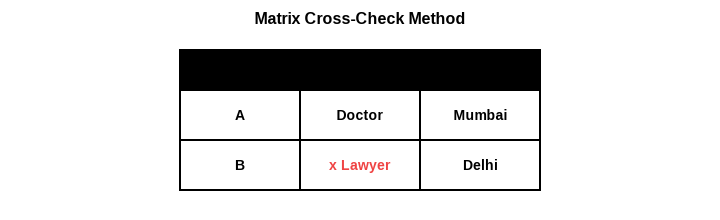
Example 4.1: Persons, Professions, and Cities
Problem: Four persons (A, B, C, D), professions (Doctor, Engineer, Lawyer, Teacher), cities (Delhi, Mumbai, Kolkata, Chennai). A is Doctor in Mumbai. B lives in Delhi but is not Lawyer. Engineer lives in Kolkata. D does not live in Kolkata.
Step-by-Step Logic:
Place A: Doctor, Mumbai.
B lives in Delhi. Engineer is in Kolkata, so B is not Engineer. B is not Lawyer/Doctor. Thus, B is Teacher.
Engineer is in Kolkata. D is not Kolkata, so C is Kolkata (Engineer).
D must be Chennai (Lawyer).
Person
Profession
City
A
Doctor
Mumbai
B
Teacher
Delhi
C
Engineer
Kolkata
D
Lawyer
Chennai
Example 4.2: Friends and Favorite Colors
Problem: Five friends (P, Q, R, S, T) like distinct colors: Red, Blue, Green, Yellow, White. P likes Blue. R likes Yellow. Q likes neither Red nor Green. S does not like Red. T takes the remaining color.
Step-by-Step Logic:
P: Blue, R: Yellow.
Left for Q, S, T: Red, Green, White.
Q likes neither Red nor Green, so Q likes White.
Left for S, T: Red, Green. S not Red, so S likes Green.
T likes Red.
Person
Color
P
Blue
Q
White
R
Yellow
S
Green
T
Red
Example 4.3: Department Grouping Puzzle
Problem: Six employees (A, B, C, D, E, F) in HR, IT, Finance. Exactly two per department. A in IT. B & C in same department, not IT. D in Finance. E does not work with A.
Step-by-Step Logic:
A in IT, D in Finance.
B and C work together (not IT). If Finance, total = 3 (invalid). Thus, B and C are in HR.
HR is full (B, C).
E does not work with A (IT), cannot be HR. E is in Finance.
Finance is full (D, E). F must be in IT with A.
Department
Employees
HR
B, C
IT
A, F
Finance
D, E
Example 4.4: Students, Subjects, and Fruits
Problem: Four students (K, L, M, N), subjects (Maths, Physics, Chemistry, Biology), fruits (Apple, Mango, Banana, Orange). K: Maths, Apple. L not Chemistry. Biology student likes Banana. M: Physics, not Orange.
Step-by-Step Logic:
K: Maths, Apple. M: Physics.
Biology student likes Banana. K/M have subjects, so they aren't Biology.
L not Chemistry, so L must be Biology (likes Banana).
N must be Chemistry.
Fruits for M, N: Mango, Orange. M not Orange, so M is Mango. N is Orange.
Student
Subject
Fruit
K
Maths
Apple
L
Biology
Banana
M
Physics
Mango
N
Chemistry
Orange
Example 4.5: Friends and Car Brands
Problem: Five persons (V, W, X, Y, Z) and car brands: Tata, Hyundai, Honda, Maruti, Toyota. V owns Honda. X owns Maruti. W does not own Tata or Toyota. Y does not own Toyota.
Step-by-Step Logic:
V: Honda; X: Maruti.
Remaining: W, Y, Z. Brands: Tata, Hyundai, Toyota.
W not Tata/Toyota, so W owns Hyundai.
Remaining: Y, Z. Brands: Tata, Toyota. Y not Toyota, so Y owns Tata.
Z owns Toyota.
Person
Car Brand
V
Honda
W
Hyundai
X
Maruti
Y
Tata
Z
Toyota
Type 5: Designation / Hierarchy Puzzles
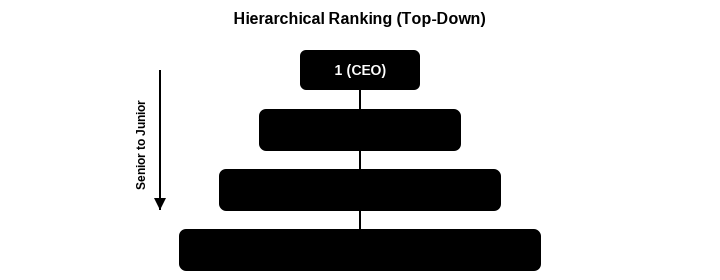
In designation puzzles, individuals hold ranks in an organization. The hierarchy is fixed from senior-most (Rank 1) to junior-most.
Example 5.1: 5-Rank Corporate Hierarchy
Problem: Five persons (A, B, C, D, E) work as CEO > GM > Manager > AM > Clerk. A is GM. Exactly two persons senior to C. B is senior to E but junior to D.
Step-by-Step Logic:
Hierarchy: 1=CEO, 2=GM, 3=Manager, 4=AM, 5=Clerk.
A is GM (Rank 2).
Exactly two senior to C, so C is Manager (Rank 3).
Vacant: 1, 4, 5. D > B > E means D is CEO (1), B is AM (4), E is Clerk (5).
Rank
Designation
Person
1 (Senior-most)
CEO
D
2
GM
A
3
Manager
C
4
Assistant Manager
B
5 (Junior-most)
Clerk
E
Example 5.2: 6-Rank Bank Hierarchy
Problem: Six persons (P, Q, R, S, T, U) with ranks Director > AGM > CM > Manager > Officer > Clerk. R is Officer. P is senior to R, exactly one person between P and R. S is junior-most. Q senior to T but junior to U.
Step-by-Step Logic:
Ranks: 1=Director to 6=Clerk. R is Officer (Rank 5).
P senior to R with one between them: P is Rank 3 (CM).
S is junior-most (Rank 6).
Vacant: 1, 2, 4. U > Q > T means U=1, Q=2, T=4.
Rank
Designation
Person
1
Director
U
2
AGM
Q
3
Chief Manager
P
4
Manager
T
5
Officer
R
6
Clerk
S
Example 5.3: 5-Rank Administrative Hierarchy
Problem: Five persons (J, K, L, M, N) with ranks MD > GM > DGM > Manager > Clerk. J senior to GM. Only two persons junior to K. M is immediately senior to N. L takes the remaining post.
Step-by-Step Logic:
Ranks 1=MD to 5=Clerk. J senior to GM -> J is MD (Rank 1).
Only two junior to K -> K is DGM (Rank 3).
M immediately senior to N. Empty consecutive ranks: 4 and 5. M=4, N=5.
L takes Rank 2 (GM).
Rank
Designation
Person
1
MD
J
2
GM
L
3
DGM
K
4
Manager
M
5
Clerk
N
Example 5.4: 6-Rank Corporate Board
Problem: Six persons (F, G, H, I, J, K) as Chairman > President > VP > Director > Associate > Trainee. H is Trainee. Three persons between H and F. G immediately senior to F. I senior to J, and J senior to K.
Step-by-Step Logic:
H is Trainee (Rank 6).
Three between H and F -> F is Rank 2 (President).
G immediately senior to F -> G is Chairman (Rank 1).
Vacant: 3, 4, 5. I > J > K -> I=3, J=4, K=5.
Rank
Designation
Person
1
Chairman
G
2
President
F
3
VP
I
4
Director
J
5
Associate
K
6
Trainee
H
Example 5.5: 5-Rank Academic Hierarchy
Problem: Five professors (V, W, X, Y, Z) as Dean > HOD > Professor > Assoc Prof > Lecturer. W is Professor. V is senior to W but not Dean. Z is Lecturer. X is senior to Y.
Step-by-Step Logic:
W is Professor (Rank 3).
V senior to W (1 or 2). Not Dean, so V is HOD (Rank 2).
Z is Lecturer (Rank 5).
Vacant: 1, 4. X senior to Y -> X is Dean (1), Y is Assoc Prof (4).
Rank
Designation
Person
1
Dean
X
2
HOD
V
3
Professor
W
4
Associate Professor
Y
5
Lecturer
Z
Ready to Test Your Speed?
Put your puzzle arrangement skills and logic to the test with real exam drills.