Ranking and Order deals with determining the position or rank of an individual or an object in a row, queue, or comparison list from either end (left/right, top/bottom, front/back), or arranging individuals according to attributes such as height, weight, age, or marks.
Fundamentals of Ranking and Order
1. Directional Equivalents
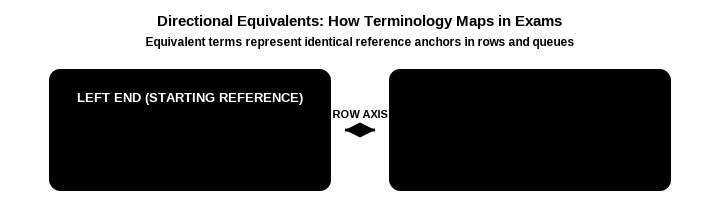
In exam questions, different words represent the same directional ends:
Left End = Top = Front = Ahead = Start
Right End = Bottom = Back = Behind = End
2. The Core Golden Rules and Formulas
Rule 1: Finding Total When One Person's Rank from Both Ends is Given
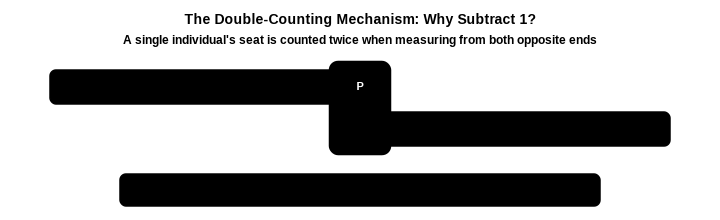
Total = (Rank from Left) + (Rank from Right) - 1
Why subtract 1? Because that specific person is counted twice—once from the left side and once from the right side. Subtracting 1 removes the duplicate count.
Rule 2: Finding Position from One End When Total is Known
Rank from Left = Total - (Rank from Right) + 1
Rank from Right = Total - (Rank from Left) + 1
Why add 1? If you subtract a person's rank from the total, you remove everyone on that side including that person. Adding 1 puts that person back into their spot.
Rule 3: Finding the Number of Persons Between Two People
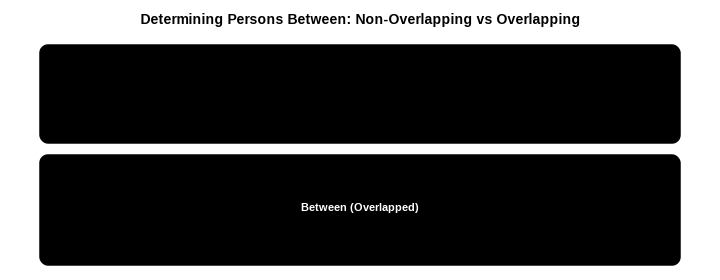
To find how many persons sit between Person A and Person B, compare the Total with the Sum of their positions (Left rank of Person A + Right rank of Person B).
Case A: Simple (Non-Overlapping) Case
Occurs when Total is greater than (Left Rank + Right Rank).
Persons Between = Total - (Left Rank + Right Rank)
Case B: Overlapping Case
Occurs when (Left Rank + Right Rank) is greater than Total. In this case, the two individuals have crossed each other.
Persons Between = (Left Rank + Right Rank) - Total - 2
Why subtract 2? Because in an overlapping sum, both individuals are counted twice in the ranks.
Rule 4: Interchanging Positions
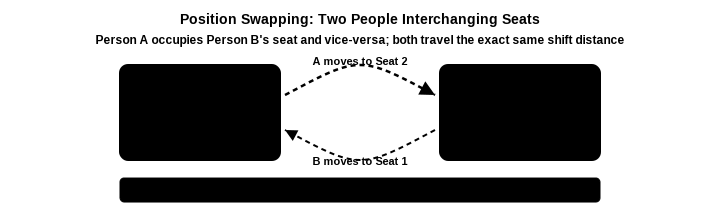
When Person A and Person B swap their seats:
Person A takes Person B's original place, and Person B takes Person A's original place.
The new position of Person A from one end is the exact same seat as the old position of Person B from the other end.
Total = (New Rank of Person A from Left) + (Old Rank of Person B from Right) - 1
Both persons shift by the exact same number of positions:
Shift Distance = Absolute difference between Person A's old and new ranks
New Rank of Person B = Old Rank of Person B + Shift Distance
Rule 5: Maximum and Minimum Persons in a Row
When you are given:
Rank of Person 1 from Left = L
Rank of Person 2 from Right = R
Persons between them = B
Maximum Persons (Non-Overlapping):
Maximum = L + R + B
Minimum Persons (Overlapping):
Minimum = L + R - B - 2
Condition for Minimum to exist: The number of people between (B) must be at most equal to (Smaller of the two ranks - 2). If B is greater than that, overlapping is physically impossible.
Type 1: Single Person Problems (Total, Left, or Right Rank)
This type focuses on calculating the total strength of a line or finding a person's rank from the opposite end.
Example 1.1
Problem: Rahul ranks 15th from the top and 28th from the bottom in a class. How many students are there in the class?
• Step 1: Identify given values: Top rank = 15, Bottom rank = 28.
• Step 2: Apply formula: Total = Top + Bottom - 1
• Step 3: Total = 15 + 28 - 1 = 43 - 1 = 42.
Answer: 42 students.
Example 1.2
Problem: In a row of 50 students, Priya is 18th from the left end. What is her rank from the right end?
• Step 1: Total = 50, Left rank = 18.
• Step 2: Apply formula: Right rank = Total - Left rank + 1
• Step 3: Right rank = 50 - 18 + 1 = 32 + 1 = 33.
Answer: 33rd from the right end.
Example 1.3
Problem: In a row of trees, a mango tree is 7th from both the left end and the right end. How many trees are in the row?
• Step 1: Left rank = 7, Right rank = 7.
• Step 2: Apply formula: Total = Left + Right - 1
• Step 3: Total = 7 + 7 - 1 = 14 - 1 = 13.
Answer: 13 trees.
Example 1.4
Problem: In an examination of 65 candidates, Rohit passed and ranked 23rd from the top among successful candidates, while 8 students failed. What is Rohit's rank from the bottom among the students who passed?
• Step 1: Calculate passed students = Total candidates - Failed students = 65 - 8 = 57.
• Step 2: Rohit's rank from top among passed students = 23.
• Step 3: Rank from bottom = Total passed - Rank from top + 1
Problem: Amit is sitting in a row of 30 boys. When shifted 4 places to his left, he becomes 8th from the left end. What was his original position from the right end?
• Step 1: New position from left = 8.
• Step 2: Since he shifted 4 places to the left to reach 8, his original position from the left was 8 + 4 = 12th.
• Step 3: Original position from right = Total - Original left rank + 1
• Step 4: Original position from right = 30 - 12 + 1 = 18 + 1 = 19.
Answer: 19th from the right end.
Type 2: Finding the Number of Persons Between Two People
This type involves two individuals whose ranks from opposite ends are given, and you must calculate how many people sit between them.
Example 2.1 (Non-Overlapping)
Problem: In a row of 40 students, Aman is 12th from the left and Varun is 15th from the right. How many students are sitting between Aman and Varun?
• Step 1: Total = 40, Left rank = 12, Right rank = 15.
• Step 2: Sum of ranks = 12 + 15 = 27.
• Step 3: Since Total (40) is greater than Sum of ranks (27), they do not overlap.
• Step 4: Persons between = Total - Sum of ranks = 40 - 27 = 13.
Answer: 13 students.
Example 2.2 (Overlapping)
Problem: In a row of 35 students, Divya is 22nd from the left end and Karan is 19th from the right end. How many students are between Divya and Karan?
• Step 1: Total = 35, Left rank = 22, Right rank = 19.
• Step 2: Sum of ranks = 22 + 19 = 41.
• Step 3: Since Sum of ranks (41) is greater than Total (35), they overlap.
• Step 4: Persons between = (Sum of ranks) - Total - 2 = 41 - 35 - 2 = 6 - 2 = 4.
Answer: 4 students.
Example 2.3 (Exact Middle Person)
Problem: In a class of 45 students, Rohan is 12th from the left and Sohan is 14th from the right. If Mohan sits exactly in the middle of Rohan and Sohan, what is Mohan's position from the left end?
• Step 1: Sum of ranks = 12 + 14 = 26.
• Step 2: Students between Rohan and Sohan = 45 - 26 = 19.
• Step 3: Since Mohan is exactly in the middle, the number of students between Rohan and Mohan is (19 - 1) / 2 = 18 / 2 = 9.
• Step 4: Mohan's position from the left = Rohan's left rank + Students between them + 1 = 12 + 9 + 1 = 22.
Answer: 22nd from the left end.
Example 2.4 (Overlapping)
Problem: In a row of 28 children, Neha is 18th from the left and Pooja is 16th from the right. How many children are sitting between them?
• Step 1: Total = 28, Left rank = 18, Right rank = 16.
• Step 2: Sum of ranks = 18 + 16 = 34.
• Step 3: Since 34 is greater than 28, it is an overlapping case.
• Step 4: Children between = (18 + 16) - 28 - 2 = 34 - 30 = 4.
Answer: 4 children.
Example 2.5 (Finding Total from Given Middle Count)
Problem: In a row of girls, Sita is 9th from the left and Gita is 16th from the right. If there are 5 girls between Sita and Gita, and Sita is to the left of Gita (no overlap), how many girls are there in the row?
• Step 1: Left rank = 9, Right rank = 16, Between = 5.
• Step 2: Since there is no overlap: Total = Left rank + Right rank + Girls between
• Step 3: Total = 9 + 16 + 5 = 30.
Answer: 30 girls.
Type 3: Interchanging Positions
Two individuals swap their positions. The new position of one person is provided, allowing you to determine the total number of people, the other person's new position, or the number of people between them.
Example 3.1
Problem: In a row of students, Suresh is 7th from the left and Kamlesh is 12th from the right. If they interchange their positions, Suresh becomes 22nd from the left. How many students are there in the row?
• Step 1: Suresh's new position is the exact position previously occupied by Kamlesh.
• Step 2: Therefore, that seat is 22nd from the left and 12th from the right.
• Step 3: Total = (Suresh's new left rank) + (Kamlesh's old right rank) - 1
• Step 4: Total = 22 + 12 - 1 = 33.
Answer: 33 students.
Example 3.2
Problem: In a row of boys, Deepak is 11th from the left and Kashish is 17th from the right. When they interchange positions, Deepak becomes 19th from the left. What will be Kashish's new position from the right?
• Step 1: Deepak's position change = New rank - Old rank = 19 - 11 = 8 positions.
• Step 2: Both people shift by the same number of places.
• Step 3: Kashish's new rank from right = Kashish's old right rank + Shift distance = 17 + 8 = 25.
Answer: 25th from the right end.
Example 3.3
Problem: In a row of girls, Priya is 13th from the left and Ritu is 18th from the right. If they interchange their positions, Priya becomes 21st from the left. How many girls are sitting between Priya and Ritu?
• Step 1: Priya shifts from 13th to 21st.
• Step 2: Difference in positions = 21 - 13 = 8.
• Step 3: Persons sitting between two positions = Difference - 1 = 8 - 1 = 7.
Answer: 7 girls.
Example 3.4
Problem: In a queue, A is 10th from the front and B is 25th from the back. If they interchange their positions, B becomes 31st from the back. How many people are there in the queue?
• Step 1: B is now in A's original seat.
• Step 2: This seat is 10th from the front and 31st from the back.
• Step 3: Total = Front rank + Back rank - 1 = 10 + 31 - 1 = 40.
Answer: 40 people.
Example 3.5
Problem: Manoj is 8th from the left and Naresh is 14th from the right. They swap seats, and Manoj becomes 15th from the left. Find: (1) Total people in the row, (2) Naresh's new rank from the right, and (3) People between them.
• Step 1 (Total): Total = Manoj's new left rank + Naresh's old right rank - 1 = 15 + 14 - 1 = 28 people.
• Step 2 (Naresh's new rank): Manoj shifted by 15 - 8 = 7 places. Naresh's new right rank = 14 + 7 = 21st from the right.
Answer: Total = 28, Naresh's new rank = 21st, People between = 6.
Type 4: Maximum and Minimum Number of Persons in a Row
Given the ranks of two people and the number of people between them, you calculate the two possible row sizes: the non-overlapping maximum and the overlapping minimum.
Example 4.1
Problem: In a row, Anil is 12th from the left and Sunil is 15th from the right. There are 4 students between them. Find the maximum and minimum possible number of students in the row.
• Step 1 (Maximum): Max = Left + Right + Between = 12 + 15 + 4 = 31.
• Step 2 (Check Minimum condition): Smaller rank is 12. Maximum allowed between for overlap is 12 - 2 = 10. Since 4 is less than or equal to 10, overlap is valid.
• Step 3 (Minimum): Min = Left + Right - Between - 2 = 12 + 15 - 4 - 2 = 27 - 6 = 21.
Answer: Maximum = 31 students, Minimum = 21 students.
Example 4.2
Problem: In a line, Meena is 16th from the left and Tina is 18th from the right. If 6 girls are standing between them, find the minimum number of girls in the line.
• Step 1: Smaller rank = 16. Allowed between for overlap = 16 - 2 = 14. Since 6 is less than or equal to 14, overlap is possible.
Problem: In a row, Ajay is 7th from the left and Vijay is 9th from the right. There are 6 boys between them. Can an overlapping arrangement exist? What is the total number of boys?
• Step 1: Check overlap condition: Smaller rank is 7.
• Step 2: For overlap, the maximum number of people between them can only be 7 - 2 = 5.
• Step 3: Here, the number of boys between is 6, which is greater than 5. Hence, overlapping is impossible.
• Step 4: Only the maximum (non-overlapping) case is possible: Total = 7 + 9 + 6 = 22.
Answer: Overlapping is impossible; the only possible total is 22 boys.
Example 4.4
Problem: In a row of soldiers, Commander A is 20th from the left and Commander B is 24th from the right. There are 8 soldiers between them. What is the difference between the maximum and minimum number of soldiers that can stand in the row?
Problem: In a row of children, Ravi is 10th from the left and Kavi is 11th from the right. There are 3 children between them. What is the minimum number of children in the row?
• Step 1: Smaller rank is 10. Allowed between = 10 - 2 = 8. Since 3 is less than 8, overlap is valid.
• Step 2: Minimum = Left + Right - Between - 2 = 10 + 11 - 3 - 2 = 21 - 5 = 16.
Answer: 16 children.
Type 5: Comparison-Based Ordering (Puzzle/Attribute Ordering)
In this type, persons or items are compared based on attributes like height, weight, age, or marks.
Key Phrases to Decode
"A is heavier than only B": B is the lightest person (last rank), and A is second from the bottom. Everyone else is heavier than A.
"A is shorter than only B": B is the tallest person (rank 1), and A is second tallest (rank 2).
"Neither the tallest nor the shortest": That person cannot occupy rank 1 or the last rank.
Example 5.1
Problem: Five friends P, Q, R, S, and T have different heights.
• P is taller than S but shorter than Q.
• T is taller than Q.
• R is the shortest.
Who is the tallest among them?
• Step 1: P is taller than S, but shorter than Q: Q is taller than P, and P is taller than S.
• Step 2: T is taller than Q: T is taller than Q is taller than P is taller than S.
• Step 3: R is the shortest: Place R at the bottom.
• Arrangement (Tallest to Shortest):
1. T (Tallest)
2. Q
3. P
4. S
5. R (Shortest)
Answer: T is the tallest.
Example 5.2
Problem: Among six persons A, B, C, D, E, and F:
• B is lighter than only A.
• D is heavier than C.
• C is heavier than both E and F.
• F is not the lightest.
Who is the third heaviest person?
• Step 1: "B is lighter than only A" means A is the heaviest (Rank 1) and B is the second heaviest (Rank 2).
• Step 2: For the remaining ranks (3, 4, 5, 6), D is heavier than C, and C is heavier than E and F. So D must be Rank 3 and C must be Rank 4.
• Step 3: For ranks 5 and 6, F is not the lightest, which means E is the lightest (Rank 6), and F is Rank 5.
• Arrangement (Heaviest to Lightest):
1. A
2. B
3. D
4. C
5. F
6. E
Answer: D is the third heaviest person.
Example 5.3
Problem: Five students J, K, L, M, and N scored different marks in a test:
• M scored more marks than N but fewer than L.
• J scored more marks than only K.
• The person who scored the second highest marks scored 85 marks.
Who scored the highest marks?
• Step 1: "J scored more marks than only K" means K scored the lowest marks (Rank 5), and J scored Rank 4.
• Step 2: Ranks 1, 2, and 3 belong to L, M, and N.
• Step 3: M scored more than N but fewer than L: L is higher than M, and M is higher than N.
• Arrangement (Highest to Lowest Marks):
1. L (Highest)
2. M (85 marks)
3. N
4. J
5. K (Lowest)
Answer: L scored the highest marks.
Example 5.4
Problem: Six boxes U, V, W, X, Y, and Z have different weights:
• Box W is heavier than Box V but lighter than Box X.
• Box Y is lighter than Box Z.
• Box X is lighter than Box Y.
• Box V is not the lightest.
Which box is the second lightest?
• Step 1: W is heavier than V but lighter than X: X is heavier than W is heavier than V.
• Step 2: X is lighter than Y: Y is heavier than X.
• Step 3: Y is lighter than Z: Z is heavier than Y.
• Step 4: Combining these gives five boxes in order: Z is heavier than Y is heavier than X is heavier than W is heavier than V.
• Step 5: Box U is remaining. Since V is stated as not the lightest, Box U must be the lightest (Rank 6).
• Arrangement (Heaviest to Lightest):
1. Box Z
2. Box Y
3. Box X
4. Box W
5. Box V
6. Box U
Answer: Box V is the second lightest box.
Example 5.5
Problem: Five colleagues A, B, C, D, and E earn different monthly salaries:
• D earns more than A and E, but less than B.
• C earns more than B.
• E does not earn the lowest salary.
Who earns the lowest salary?
• Step 1: D earns less than B, and C earns more than B: C earns more than B earns more than D.
• Step 2: D earns more than both A and E, so A and E must occupy the bottom two salary ranks (Rank 4 and Rank 5).
• Step 3: E does not earn the lowest salary, so E is Rank 4 and A is Rank 5.
• Arrangement (Highest to Lowest Salary):
1. C (Highest)
2. B
3. D
4. E
5. A (Lowest)
Answer: A earns the lowest salary.
Ready to Test Your Speed?
Put your ranking rules and position calculation shortcuts to the test with real exam drills.