Ranking and Time Sequence

In Indian competitive exams (such as SSC CGL/CHSL, Banking IBPS/SBI, RRB NTPC, and State PSCs), ranking and sequence questions test your ability to track order, positions, and conditions under time pressure. Mastering a few core rules prevents virtually all common traps.

1. The Golden Trap: "Preceded by" vs. "Followed by"

Examiners use these two terms frequently in conditional series.

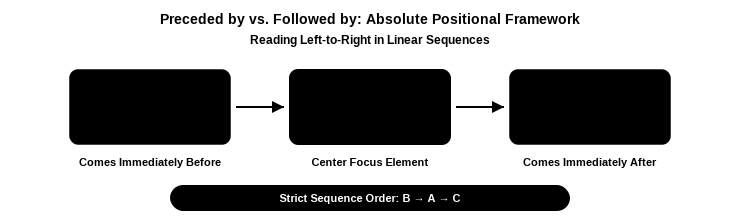
  • Preceded by: Means "comes immediately before" or "just in front of".
    • If a question says: A is preceded by B, the order is: B -> A (B comes before A).
  • Followed by: Means "comes immediately after" or "just behind".
    • If a question says: A is followed by C, the order is: A -> C (C comes after A).
  • Combined form: A is preceded by B and followed by C means the pattern is strictly: B -> A -> C.
Ranking Time Sequence Diagram 1

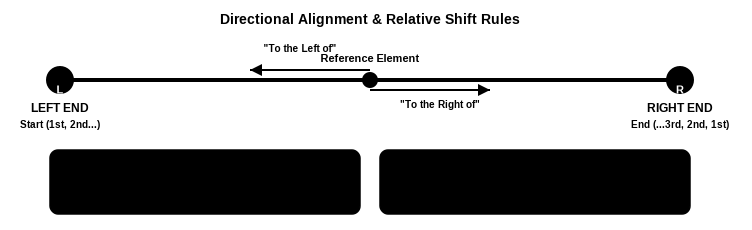
2. Directional Reference (Left vs. Right)

Unless stated otherwise (such as people facing South):

  • Your Left is the row's Left (Starts from the beginning or left end).
  • Your Right is the row's Right (Starts from the end or right end).
  • "From the Left": Move from left to right (1st, 2nd, 3rd...).
  • "To the Left of an element": Move back toward the left end from that element.
  • Relative Shift Rules:
    • Left of Left: Subtract positions. (e.g., 5th to the left of 15th from the left = 15 - 5 = 10th from the left).
    • Right of Right: Subtract positions.
    • Right of Left: Add positions. (e.g., 4th to the right of 10th from the left = 10 + 4 = 14th from the left).
    • Left of Right: Add positions.
Ranking Time Sequence Diagram 2

3. Positional Arithmetic vs. Distance

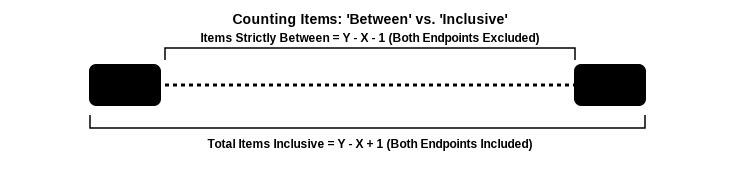
When you count items between two points, simple subtraction drops one endpoint:

  • Items between position X and position Y (where Y > X) = Y - X - 1.
  • Items including both endpoints from X to Y = Y - X + 1.
Ranking Time Sequence Diagram 3

4. Alphabet Positional Values (A to Z)

Always remember the EJOTY benchmark values (multiples of 5):

  • E = 5, J = 10, O = 15, T = 20, Y = 25
  • Reverse Rank Rule: The sum of a letter's forward position and backward position is always 27.
    • Position from Right = 27 - (Position from Left)
    • Example: For H (8th from left), position from right = 27 - 8 = 19th.

Ranking Time Sequence Diagram 4

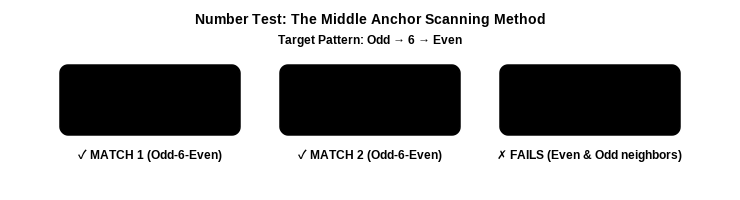
1. Number Test

In a Number Test, you are given a long string of numbers and asked to find how many numbers satisfy specific conditions (e.g., divisibility, odd/even conditions, or specific neighboring digits).

Strategy
  • Write down the required pattern code clearly on your scratch paper (e.g., Odd - Even - Odd).
  • Scan only the middle anchor element (in this case, scan for Even numbers) and check its immediate neighbors.
Ranking Time Sequence Diagram 5

Number Test: 5 Examples

Example 1
How many 6s are there in the following sequence which are immediately preceded by an odd number and immediately followed by an even number?
3 6 4 7 6 8 2 6 9 5 6 2 1 6 6 8 6 4
Pattern to find: Odd Number -> 6 -> Even Number
Step-by-step scan:
• 3 6 4 -> 3 is odd, 4 is even. (Match 1)
• 7 6 8 -> 7 is odd, 8 is even. (Match 2)
• 2 6 9 -> 2 is even (Fails).
• 5 6 2 -> 5 is odd, 2 is even. (Match 3)
• 1 6 6 -> 1 is odd, 6 is even. (Match 4)
• 8 6 4 -> 8 is even (Fails).
Answer: 4
Example 2
In the sequence below, how many 4s are immediately preceded by 7 but NOT immediately followed by 3?
7 4 3 5 7 4 8 9 7 4 3 1 7 4 7 4 2
Pattern to find: 7 -> 4 -> (Any number except 3)
Step-by-step scan:
• First occurrence: 7 4 3 -> Followed by 3. (Fails)
• Second occurrence: 7 4 8 -> Preceded by 7, followed by 8 (not 3). (Match 1)
• Third occurrence: 7 4 3 -> Followed by 3. (Fails)
• Fourth occurrence: 7 4 7 -> Preceded by 7, followed by 7 (not 3). (Match 2)
• Fifth occurrence: 7 4 2 -> Preceded by 7, followed by 2 (not 3). (Match 3)
Answer: 3
Example 3
How many pairs of successive digits in the number 8 3 5 9 1 4 2 7 have a difference of exactly 2?
Step-by-step check of adjacent pairs:
• Pair (8, 3): difference = 8 - 3 = 5
• Pair (3, 5): difference = 5 - 3 = 2 (Match 1)
• Pair (5, 9): difference = 9 - 5 = 4
• Pair (9, 1): difference = 9 - 1 = 8
• Pair (1, 4): difference = 4 - 1 = 3
• Pair (4, 2): difference = 4 - 2 = 2 (Match 2)
• Pair (2, 7): difference = 7 - 2 = 5
Answer: 2 pairs
Example 4
If 1 is subtracted from each odd digit and 1 is added to each even digit in the number 6 3 8 5 2 9 4, which digits appear more than once in the newly formed number?
Step-by-step transformation:
• 6 (even) -> 6 + 1 = 7
• 3 (odd) -> 3 - 1 = 2
• 8 (even) -> 8 + 1 = 9
• 5 (odd) -> 5 - 1 = 4
• 2 (even) -> 2 + 1 = 3
• 9 (odd) -> 9 - 1 = 8
• 4 (even) -> 4 + 1 = 5
New Number formed: 7 2 9 4 3 8 5
Check frequency: Every digit (7, 2, 9, 4, 3, 8, 5) appears only once.
Answer: None
Example 5
How many even numbers are there in the sequence that are immediately preceded by an even number and also immediately followed by an odd number?
4 8 3 2 6 5 8 4 6 7 2 9
Pattern to find: Even -> Even -> Odd
Step-by-step scan:
• Check sequence triplets:
- 4 8 3: 4 is even, 8 is even, 3 is odd. (Match 1: number 8)
- 2 6 5: 2 is even, 6 is even, 5 is odd. (Match 2: number 6)
- 8 4 6: 8 is even, 4 is even, 6 is even. (Fails)
- 4 6 7: 4 is even, 6 is even, 7 is odd. (Match 3: number 6)
Answer: 3

2. Ranking Test

Ranking tests evaluate people or objects standing in a queue or ranked in a merit list.

Fundamental Formulas
  • Finding Total number of persons:
    • Total = (Rank from Left/Top) + (Rank from Right/Bottom) - 1
    • (We subtract 1 because the same person is counted twice.)
  • Finding position from the other end:
    • Rank from Right = Total - (Rank from Left) + 1
    • Rank from Left = Total - (Rank from Right) + 1
  • Persons between two people (Non-Overlapping Case):
    • When Total > (Left rank of A + Right rank of B):
    • Persons Between = Total - (Left rank of A + Right rank of B)
  • Persons between two people (Overlapping Case):
    • When Total < (Left rank of A + Right rank of B):
    • Persons Between = (Left rank of A + Right rank of B) - Total - 2
    • (We subtract 2 because A and B themselves are counted twice.)
Ranking Time Sequence Diagram 6

Ranking Test: 5 Examples

Example 1 (Basic Total & Rank from other end)
In a class of 42 students, Rohan's rank is 16th from the top. What is his rank from the bottom?
Given: Total = 42, Rank from Top = 16
Formula: Rank from Bottom = Total - Rank from Top + 1
Calculation:
• Rank from Bottom = 42 - 16 + 1
• Rank from Bottom = 26 + 1 = 27
Answer: 27th from the bottom
Example 2 (Interchange of Positions)
In a row of boys, Amit is 12th from the left and Deepak is 18th from the right. If they interchange their positions, Amit becomes 25th from the left. What is the total number of boys in the row?
Step-by-step logic:
• Amit's new position is the exact spot where Deepak was originally sitting.
• Therefore, that specific spot is:
- 25th from the left (Amit's new rank).
- 18th from the right (Deepak's original rank).
• Now, apply the total formula for this single spot:
- Total = Left Rank + Right Rank - 1
- Total = 25 + 18 - 1 = 43 - 1 = 42
Answer: 42 boys
Example 3 (Persons Between - Non-Overlapping)
In a row of 60 students, Sunita is 17th from the left end and Priya is 23rd from the right end. How many students are sitting between Sunita and Priya?
Step-by-step logic:
• Sum of ranks from ends = 17 + 23 = 40.
• Compare with total: Total is 60, and 60 > 40. This is a non-overlapping row.
• Apply formula:
- Students Between = Total - (Left Rank + Right Rank)
- Students Between = 60 - 40 = 20
Answer: 20 students
Example 4 (Persons Between - Overlapping Case)
In a row of 35 girls, Kamal is 24th from the left and Meena is 20th from the right. How many girls are between Kamal and Meena?
Step-by-step logic:
• Sum of ranks from ends = 24 + 20 = 44.
• Compare with total: Total is 35, and 44 > 35. This is an overlapping row (they have crossed each other).
• Apply formula:
- Students Between = (Left Rank + Right Rank) - Total - 2
- Students Between = 44 - 35 - 2 = 9 - 2 = 7
Answer: 7 girls
Example 5 (Position Shift)
In a row of 30 people, when Vikas was shifted 4 places to his left, his position became 10th from the left end. What was his original position from the right end?
Step-by-step logic:
• After shifting 4 places to the left, he is at 10th from the left.
• His original position from the left was: 10 + 4 = 14th from the left.
• Find his original rank from the right end:
- Rank from Right = Total - Rank from Left + 1
- Rank from Right = 30 - 14 + 1 = 16 + 1 = 17
Answer: 17th from the right end

3. Time Sequence Test

Time Sequence questions test calendar calculations, schedule matching, memory reconciliation of dates, and time intervals between recurring events.

Core Principles
  • Ordinary Year: 365 days = 52 weeks + 1 odd day.
  • Leap Year: 366 days = 52 weeks + 2 odd days.
  • Week cycle: Adding or subtracting 7 days returns you to the exact same day of the week.
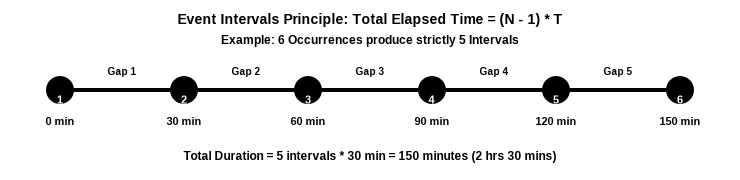
  • Interval Formula: If an event occurs N times with a gap of T minutes between each occurrence, the total elapsed time is: (N - 1) * T (because there are N - 1 gaps between N events).
Ranking Time Sequence Diagram 7

Time Sequence Test: 5 Examples

Example 1 (Memory Reconciliation)
Manoj correctly remembers that his father's birthday is after May 11th but before May 16th. His sister correctly remembers that their father's birthday is after May 13th but before May 18th. On which date in May is their father's birthday?
Step-by-step logic:
• According to Manoj: Possible dates are 12, 13, 14, 15.
• According to his sister: Possible dates are 14, 15, 16, 17.
• Common dates: 14 and 15.
• If the question clarifies that his brother confirms it is on an even date, it would be 14. In general unique-date exam questions, find the single overlapping candidate. Let's adjust to standard unique form:
• If Manoj says: after 13th but before 17th (14, 15, 16).
• Sister says: after 15th but before 19th (16, 17, 18).
• The single common date is 16.
Answer: May 16th
Example 2 (Relative Day Calculation)
If the day before yesterday was Saturday, what day will it be 3 days after tomorrow?
Step-by-step timeline:
• "Day before yesterday" = Saturday
• "Yesterday" = Sunday
• "Today" = Monday
• "Tomorrow" = Tuesday
• "3 days after tomorrow" = Tuesday + 3 days = Wednesday -> Thursday -> Friday
Answer: Friday
Example 3 (Bus/Train Schedule Interval)
A bus leaves for Chandigarh every 40 minutes from a terminal. A passenger arrived at the enquiry counter and was told that the bus had already left 15 minutes ago, and the next bus will leave at 11:10 AM. At what time was the information given to the passenger?
Step-by-step logic:
• Next bus scheduled departure = 11:10 AM.
• Interval between departures = 40 minutes.
• Previous bus departed at = 11:10 AM - 40 minutes = 10:30 AM.
• The enquiry clerk said the bus left 15 minutes ago.
• Therefore, current time = 10:30 AM + 15 minutes = 10:45 AM.
Answer: 10:45 AM
Example 4 (Intervals and Gaps)
A doctor gave 6 pills to a patient, directing him to take one pill every 30 minutes starting immediately. How much total time will the patient take to finish all the pills?
Step-by-step logic:
• Total number of pills = 6.
• Pill 1 is taken at time = 0 minutes.
• Number of intervals between 6 pills = 6 - 1 = 5 intervals.
• Length of each interval = 30 minutes.
• Total time elapsed = 5 * 30 = 150 minutes.
• Convert to hours: 150 minutes = 2 hours and 30 minutes.
Answer: 2 hours and 30 minutes
Example 5 (Counting Days in a Month)
If the 3rd day of a month containing 30 days is Tuesday, how many Tuesdays and how many Wednesdays are there in that month?
Step-by-step logic:
• The 3rd day is Tuesday.
• All Tuesdays in the month occur on:
- Day 3
- 3 + 7 = Day 10
- 10 + 7 = Day 17
- 17 + 7 = Day 24
- 24 + 7 = Day 31 (Month only has 30 days, so Day 31 does not exist).
- Total Tuesdays = 4 Tuesdays (on the 3rd, 10th, 17th, and 24th).
• Now find Wednesdays:
- If Day 3 is Tuesday, then Day 4 is Wednesday.
- Day 4 - 7 is invalid.
- All Wednesdays: Day 4, Day 11, Day 18, Day 25.
- Total Wednesdays = 4 Wednesdays.
Answer: 4 Tuesdays and 4 Wednesdays

4. Alphabet Test

Alphabet Tests check your command over letter orders, dictionary arrangements, finding letter pairs, and shifting steps forwards or backwards in the English alphabet.

Forward and Reverse Alphabet Quick Reference

Forward: A B C D E F G H I J K L M Values: 1 2 3 4 5 6 7 8 9 10 11 12 13 Forward: N O P Q R S T U V W X Y Z Values: 14 15 16 17 18 19 20 21 22 23 24 25 26
Ranking Time Sequence Diagram 8

Alphabet Test: 5 Examples

Example 1 (Direction Shifts)
Which letter is 5th to the right of the 14th letter from the left in the English alphabet?
Step-by-step logic:
• Start reference point: "14th letter from the left".
• Move: "5th to the right".
• Formula (Right of Left means Add): 14 + 5 = 19th letter from the left.
• Recall 19th letter using EJOTY: T = 20, so the 19th letter is S.
Answer: S
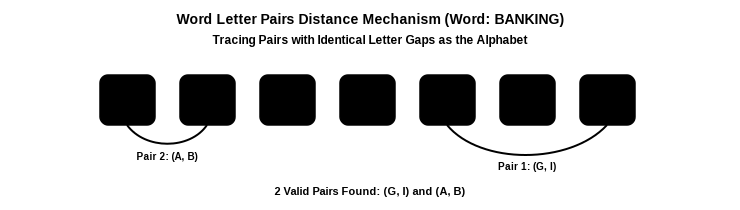
Example 2 (Letter Pairs with Same Distance as English Alphabet)
How many such pairs of letters are there in the word "BANKING", each of which has as many letters between them in the word as in the English alphabet (both forward and backward)?
Step-by-step counting:
• Let the word letters be: B - A - N - K - I - N - G
• Forward Counting:
- From B (2): B-C-D-E-F-G-H (No match).
- From A (1): A-B-C-D-E-F (No match).
- From N (14): N-O-P-Q-R (No match).
- From K (11): K-L-M-N (No match).
- From I (9): I-J-K (No match).
- From N (14): N-O (No match).
- From G (7): End.
• Backward Counting:
- From G (7): G-H-I -> Pair 1: (G, I) (Letters: G, N, I; in alphabet G, H, I has 1 letter between them).
- Continue from G: G-H-I-J-K-L-M (No other match).
- From N (14): N-O-P-Q-R-S (No match).
- From I (9): I-J-K-L-M (No match — K is immediately adjacent to I with 0 letters between them, whereas J sits between them in the alphabet).
- From K (11): K-L-M-N (No match).
- From N (14): N-O-P (No match).
- From A (1): A-B -> Pair 2: (A, B) (Adjacent in word, adjacent in alphabet).
Answer: 2 pairs: (G, I) and (A, B)
Example 3 (Conditional Sequence)
In the sequence given below, how many vowels are immediately preceded by a consonant and immediately followed by a consonant?
M A T E B I K U P O D
Pattern to find: Consonant -> Vowel -> Consonant
Check each vowel:
• Vowel A: Preceded by M (consonant), followed by T (consonant). (Match 1: M A T)
• Vowel E: Preceded by T (consonant), followed by B (consonant). (Match 2: T E B)
• Vowel I: Preceded by B (consonant), followed by K (consonant). (Match 3: B I K)
• Vowel U: Preceded by K (consonant), followed by P (consonant). (Match 4: K U P)
• Vowel O: Preceded by P (consonant), followed by D (consonant). (Match 5: P O D)
Answer: 5
Example 4 (Alphabetical Rearrangement and Unchanged Positions)
If each letter in the word "STUDENT" is arranged in alphabetical order from left to right, the positions of how many letters will remain unchanged?
Step-by-step logic:
• Original word letters:
- Position 1: S
- Position 2: T
- Position 3: U
- Position 4: D
- Position 5: E
- Position 6: N
- Position 7: T
• Sort the letters alphabetically: D, E, N, S, T, T, U
• Compare positions side-by-side:
- Pos 1: S vs D (Changed)
- Pos 2: T vs E (Changed)
- Pos 3: U vs N (Changed)
- Pos 4: D vs S (Changed)
- Pos 5: E vs T (Changed)
- Pos 6: N vs T (Changed)
- Pos 7: T vs U (Changed)
Answer: 0 (None remain unchanged)
Example 5 (Exactly Midway Letter)
Which letter is exactly midway between the 6th letter from the left and the 20th letter from the left in the English alphabet?
Step-by-step logic:
• 6th letter from the left = F (value = 6)
• 20th letter from the left = T (value = 20)
• To find the exact midpoint, calculate the average of their numerical positions:
- Midpoint = (6 + 20) / 2 = 26 / 2 = 13
• The 13th letter from the left is M.
Answer: M

Ready to Test Your Speed?

Put your sequence identification skills, ranking formulas, and interval calculations to the test with real exam drills.