Series and Sequences in logical reasoning test your ability to identify hidden mathematical rules, alphabetical positions, or repeating structures within an ordered list of terms. In Indian competitive exams (such as SSC, Banking, Railways, and State PSCs), speed and pattern recognition are essential.
1. Core Fundamentals for Beginners
Before attempting any series problem, you must memorize three foundational toolkits.
Alphabet Forward and Reverse Positions
Every letter of the English alphabet has a forward positional value (1 to 26) and a reverse positional value (counting backwards from Z = 1 to A = 26).
Letter
A
B
C
D
E
F
G
H
I
J
K
L
M
Forward
1
2
3
4
5
6
7
8
9
10
11
12
13
Reverse
26
25
24
23
22
21
20
19
18
17
16
15
14
Letter
N
O
P
Q
R
S
T
U
V
W
X
Y
Z
Forward
14
15
16
17
18
19
20
21
22
23
24
25
26
Reverse
13
12
11
10
9
8
7
6
5
4
3
2
1
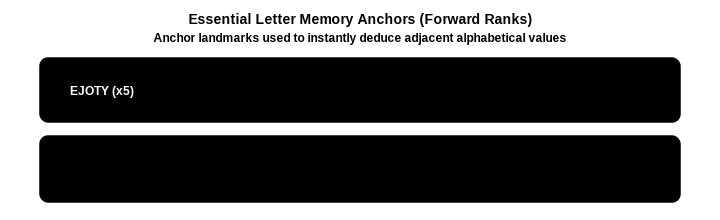
EJOTY Rule (Multiples of 5): E = 5, J = 10, O = 15, T = 20, Y = 25. Use these as anchor points to find adjacent letters quickly (e.g., G is two steps after E, so G = 7).
CFILORUX Rule (Multiples of 3): C = 3, F = 6, I = 9, L = 12, O = 15, R = 18, U = 21, X = 24.
Reverse Rank Formula:
Reverse Position = 27 - Forward Position
(Example: Forward position of H is 8. Reverse position = 27 - 8 = 19).
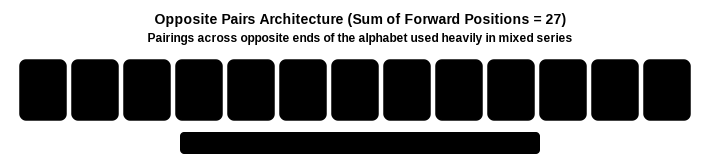
Opposite Letter Pairs (Sum = 27)
Two letters are opposites when their forward ranks add up to 27. Memorize these simple word associations:
A - ZA to Z / Azad
B - YBoy / Bye
C - XCoca-Cola / Crux
D - WDew / Down
E - VEvening / EV
F - UFull / For You
G - TGT Road
H - SHigh School
I - RIndian Railway
J - QJungle Queen / Jack-Queen
K - PKanpur / PK
L - OLove
M - NMan
Essential Number Toolkits
Prime Numbers (up to 50): 2, 3, 5, 7, 11, 13, 17, 19, 23, 29, 31, 37, 41, 43, 47. (Note: 1 is not a prime number; 2 is the only even prime).
• This sequence consists of two distinct interleaved series:
- Series 1 (odd positions): 12, 14, 16, 18 (adds +2 each time).
- Series 2 (even positions): 8, 10, 12, ? (adds +2 each time).
• The missing number sits at position 8 (an even position in Series 2).
• Missing term = 12 + 2 = 14.
3. Letter Series
In a Letter Series, the positions of letters follow consistent numerical steps.
How to approach:
Convert every letter into its forward numerical position immediately.
Analyze it as a standard number series.
For groups of 2 or 3 letters, track corresponding positions independently (first letters together, second letters together).
Examples
Example 1: Single Letter Increasing Gap
Problem: B, E, I, N, T, ?
Step-by-step logic:
• Convert to forward numbers: B = 2, E = 5, I = 9, N = 14, T = 20.
• Find step intervals:
- 2 to 5 = +3
- 5 to 9 = +4
- 9 to 14 = +5
- 14 to 20 = +6
• Next interval must be +7.
• 20 + 7 = 27.
• Since the alphabet has 26 letters: 27 - 26 = 1, which corresponds to A.
• Missing term = A.
Example 2: Two-Letter Group Series
Problem: AC, FH, KM, PR, ?
Step-by-step logic:
• Track the first letter of each pair:
- A (1) + 5 = F (6)
- F (6) + 5 = K (11)
- K (11) + 5 = P (16)
- Next first letter = 16 + 5 = 21, which is U.
• Track the second letter of each pair:
- C (3) + 5 = H (8)
- H (8) + 5 = M (13)
- M (13) + 5 = R (18)
- Next second letter = 18 + 5 = 23, which is W.
• Missing term = UW.
Example 3: Three-Letter Cluster Series
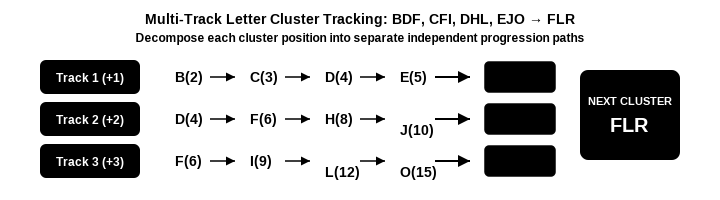
Problem: BDF, CFI, DHL, EJO, ?
Step-by-step logic:
• First letters: B (2), C (3), D (4), E (5) -> Next is 5 + 1 = 6 = F.
• Second letters: D (4), F (6), H (8), J (10) -> Next is 10 + 2 = 12 = L.
• Third letters: F (6), I (9), L (12), O (15) -> Next is 15 + 3 = 18 = R.
• Missing term = FLR.
Example 4: Opposite Letters Pattern
Problem: AZ, CX, EV, GT, ?
Step-by-step logic:
• First letter movement: A (1) -> C (3) -> E (5) -> G (7) (adds +2 each step).
• Next first letter = 7 + 2 = 9 = I.
• Second letter movement: Z (26) -> X (24) -> V (22) -> T (20) (subtracts -2 each step).
• Next second letter = 20 - 2 = 18 = R.
• Notice that each pair is an opposite pair (A-Z, C-X, E-V, G-T, I-R: sum of ranks = 27).
• Missing term = IR.
Example 5: Alternating Letter Series
Problem: Z, A, X, C, V, E, T, ?
Step-by-step logic:
• Separate into two interleaved sequences:
- Odd positions: Z (26), X (24), V (22), T (20) (decreases by -2).
- Even positions: A (1), C (3), E (5), ? (increases by +2).
• The missing term is at position 8 (an even position): 5 + 2 = 7 = G.
• Missing term = G.
4. Letter - Number Mixed Series
These combinations (also called Alpha-Numeric Series) pair letters and numbers together.
How to approach:
Separate the components: treat the letters and the numbers as two parallel streams.
Determine whether the number directly represents the letter's positional value, its opposite value, or an independent arithmetic sequence.
Examples
Example 1: Letter Paired with Alphabetical Value
Problem: D-4, G-7, J-10, M-13, ?
Step-by-step logic:
• Letter movement: D (4), G (7), J (10), M (13) -> Increases by +3.
• Next letter rank = 13 + 3 = 16 = P.
• Number movement: The number directly reflects the forward alphabetical rank of the letter (4, 7, 10, 13).
• Next number = 16.
• Missing term = P-16.
Example 2: Letter Progression with Geometric Number Pattern
Problem: C-3, F-6, I-12, L-24, ?
Step-by-step logic:
• Letters: C (3), F (6), I (9), L (12) -> Increases by +3 each step.
• Next letter = 12 + 3 = 15 = O.
• Numbers: 3, 6, 12, 24 -> Each number is multiplied by 2.
• Next number = 24 * 2 = 48.
• Missing term = O-48.
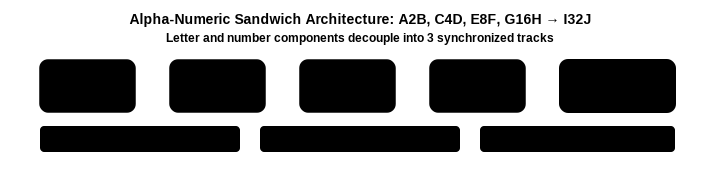
Example 3: Sandwich Pattern (Letter-Number-Letter)
Problem: A2B, C4D, E8F, G16H, ?
Step-by-step logic:
• First letter: A (1), C (3), E (5), G (7) -> Increases by +2. Next letter = 7 + 2 = 9 = I.
• Middle number: 2, 4, 8, 16 -> Powers of 2 (multiplied by 2). Next number = 16 * 2 = 32.
• Third letter: B (2), D (4), F (6), H (8) -> Increases by +2. Next letter = 8 + 2 = 10 = J.
• Missing term = I32J.
Example 4: Increasing Difference with Rank Correspondence
Problem: 2B, 4D, 8H, 14N, ?
Step-by-step logic:
• Numbers: 2, 4, 8, 14.
• Differences:
- 4 - 2 = +2
- 8 - 4 = +4
- 14 - 8 = +6
- Next difference = +8. Next number = 14 + 8 = 22.
• Letters: B = 2, D = 4, H = 8, N = 14. The letter's position matches the preceding number.
• 22nd letter of the alphabet = V.
• Missing term = 22V.
Example 5: Reverse Rank with Consecutive Squares
Problem: Z1, X4, V9, T16, ?
Step-by-step logic:
• Letters: Z (26), X (24), V (22), T (20) -> Decreases by -2. Next letter = 20 - 2 = 18 = R.
• Numbers: 1, 4, 9, 16 -> Consecutive squares: 1^2, 2^2, 3^2, 4^2. Next number = 5^2 = 25.
• Missing term = R25.
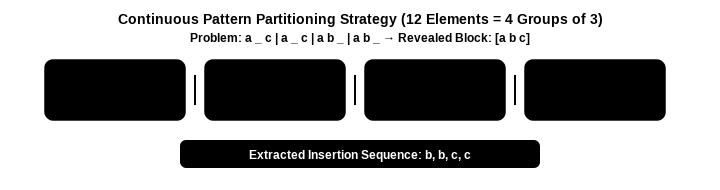
5. Balance or Repeated Series (Continuous Pattern Series)
This type consists of small letters separated by blanks (e.g., a _ b c _ a b _ c). The goal is to fill the blanks to complete an underlying repeating or progressive pattern.
How to approach:
Count total elements: Add the number of given letters plus all empty spaces.
Divide into equal blocks: Break down the total count using its factors:
12 elements: Divide into 3 groups of 4, or 4 groups of 3.
15 elements: Divide into 3 groups of 5, or 5 groups of 3.
16 elements: Divide into 4 groups of 4.
18 elements: Divide into 3 groups of 6, or 6 groups of 3.
20 elements: Divide into 4 groups of 5, or 5 groups of 4.
Identify the balance type:
Identical Repeating Block: Every block is identical (abc | abc | abc).
Alternating Block: Block 1 matches Block 3, Block 2 matches Block 4 (aba | cdc | aba | cdc).