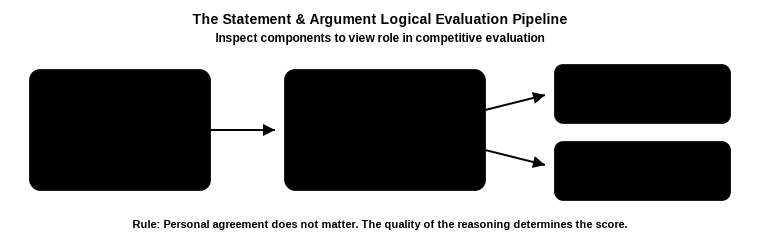
In logical reasoning, Statement and Argument questions evaluate your ability to judge whether a given reason (argument) logically and effectively supports or refutes a proposed idea, policy, or decision (statement).
1. Fundamentals of the Topic
What is a Statement?
A statement presents a situation, policy, proposal, or problem. In exams, it is almost always framed as a debatable question or an action plan:
Example: "Should private tutoring institutes be completely banned?"
What is an Argument?
An argument is a response to the statement. It always contains two parts:
A Stance: A direct "Yes" (supporting) or "No" (opposing).
A Premise / Reason: The justification ("...because [Reason]").
The Core Objective
Your task is not to pick the side you personally agree with. Your personal opinion, political leaning, or emotional reaction must be set aside completely.
Your only task is to determine whether the reason provided is Strong or Weak:
Both a "Yes" argument and a "No" argument can be strong at the same time.
An argument is not strong just because it says "Yes" to an idea you like. If the reasoning behind it is flawed, the argument is weak.
Characteristics of a Strong Argument
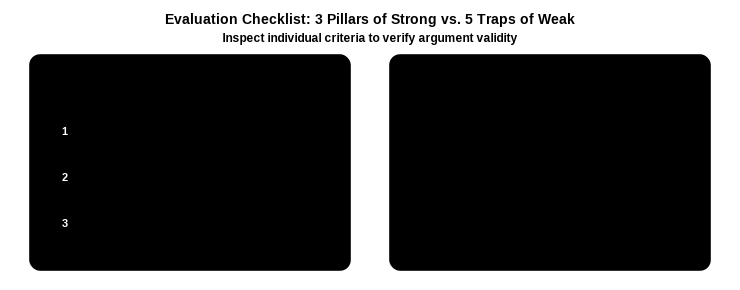
An argument is classified as Strong when it meets all three of these conditions:
Directly Relevant: It addresses the exact core issue of the statement rather than a side topic.
Realistic and Practical: It is grounded in real-world logic, feasibility, and established facts.
High Impact: It considers long-term consequences, public welfare, constitutional rights, or established scientific truths.
Characteristics of a Weak Argument
An argument is classified as Weak when it suffers from any of these flaws:
Simple Assertion: It merely restates the opinion without providing a logical reason (e.g., "Yes, because it is good").
Extreme or Blanket Statements: It relies on words like only, all, never, every, always without factual proof.
Superfluous or Irrelevant: The reason mentions something completely disconnected from the central premise.
Faulty Analogy: It justifies an action simply because another country, state, or person did it.
Emotional or Biased: It relies on personal sentiments, moral preaching, or blind tradition instead of objective evidence.
2. Types of Arguments in Competitive Exams
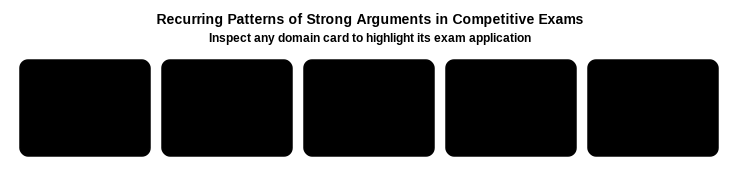
Reasoning books classify arguments into two primary categories: Strong Arguments and Weak Arguments. Within each category, questions follow distinct recurring patterns.
Type 1: Strong Arguments
Strong arguments provide substantial, objective reasons. They generally fall into patterns involving public safety, fundamental rights, economic feasibility, practical consequences, or established facts.
Example 1 (Public Safety & Health)
Statement: Should helmet use be made mandatory for two-wheeler pillion riders on city roads?
Argument: Yes, because statistical evidence shows that head injuries account for the majority of deaths in two-wheeler accidents, regardless of whether the victim was driving or riding pillion.
Why it is Strong: It relies on verifiable accident data and directly protects human lives, which is a primary administrative priority.
Example 2 (Constitutional & Democratic Principles)
Statement: Should primary school education be made free and compulsory for all children?
Argument: Yes, because foundational literacy is a fundamental right necessary to eliminate child labor and provide equal social opportunities.
Why it is Strong: It aligns directly with basic human rights and long-term socio-economic development.
Example 3 (Economic & Administrative Feasibility)
Statement: Should the government provide tax incentives for companies setting up factories in rural regions?
Argument: Yes, because it encourages industrial decentralization, creates local employment, and reduces forced migration to already overcrowded urban centers.
Why it is Strong: It demonstrates a practical, cause-and-effect relationship that solves dual economic problems: rural unemployment and urban congestion.
Example 4 (Preventing Negative Repercussions)
Statement: Should the government immediately shut down all thermal (coal-based) power plants to combat pollution?
Argument: No, because coal power currently supplies over 70% of the base power grid, and shutting them down overnight without sufficient renewable energy capacity will lead to massive blackouts and industrial paralysis.
Why it is Strong: It evaluates real-world practical constraints. A desirable goal (reducing pollution) cannot be executed if the immediate consequence causes systemic collapse.
Example 5 (Root Cause Resolution)
Statement: Should vocational training be integrated into secondary school curricula alongside traditional academic subjects?
Argument: Yes, because it equips students who cannot pursue higher college education with employable skills right after school.
Why it is Strong: It directly links the proposed educational reform to a tangible outcome: addressing youth unemployability.
Type 2: Weak Arguments
Weak arguments fail because they either do not provide a real reason, rely on faulty logic, or focus on extreme or irrelevant details.
Example 1 (Simple Assertion / Mere Opinion)
Statement: Should the retirement age of central government employees be reduced from 60 to 55 years?
Argument: Yes, because 55 is the ideal age for retirement and everyone should accept it.
Why it is Weak: This is a bare assertion. It offers no evidence, economic rationale, or operational reason to justify why 55 is "ideal."
Example 2 (Faulty Analogy / Blind Copying)
Statement: Should Country X privatize its passenger railway network?
Argument: Yes, because Country Y privatized its railways two years ago.
Why it is Weak: What works in Country Y may not work in Country X. Population density, geography, income distribution, and railway network sizes differ completely between nations.
Example 3 (Extreme / Blanket Generalization)
Statement: Should all written school examinations be completely abolished?
Argument: Yes, because examinations only cause unnecessary mental stress and serve no useful purpose.
Why it is Weak: The argument uses extreme terms ("only cause stress", "serve no useful purpose"). While exams can cause stress, completely denying their role in measuring learning progress is an unsubstantiated exaggeration.
Example 4 (Superfluous / Irrelevant Reason)
Statement: Should university tuition fees be subsidized for students from economically weaker sections?
Argument: No, because universities already have very large campuses with modern sports facilities.
Why it is Weak: The physical size and sports amenities of a campus have zero logical relevance to the financial need of low-income students.
Example 5 (Emotional or Sentimental Appeal)
Statement: Should heavy polluting factories located inside city residential limits be forced to relocate outside city boundaries?
Argument: No, because the factory owners have worked hard for several decades to build their factories at these exact locations.
Why it is Weak: Personal sentiment or empathy toward the owners' hard work cannot override public health hazards and environmental toxicity affecting thousands of residents.
3. Quick Decision Framework for Answering Questions
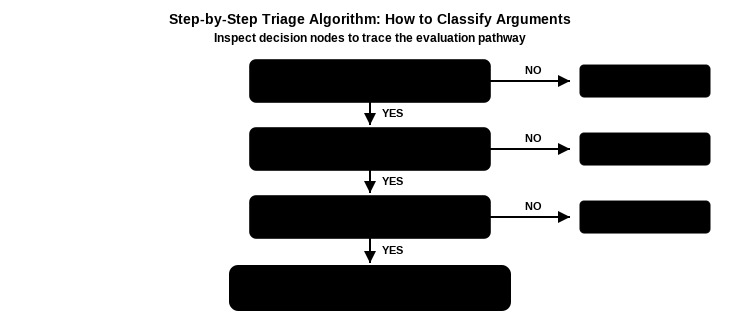
Use this rapid classification matrix during competitive exam practice to evaluate any presented argument instantly:
Argument Characteristic
Classification
Reason
Contains words like only, all, never, entirely without data
Weak
Overgeneralized / Extreme
Just states "Yes, it is good" or "No, it is bad"
Weak
Simple assertion without reasoning
Uses "Country A did it, so we must"
Weak
Faulty analogy
Involves personal, religious, or emotional sentiments
Weak
Subjective, not objective
Mentions realistic social, economic, or legal outcomes
Strong
Cause-and-effect relationship
Backed by established scientific facts or constitutional law
Strong
Factually verifiable
Ready to Test Your Critical Judgment?
Put your Statement and Argument identification skills and decision framework to the test with real exam drills.