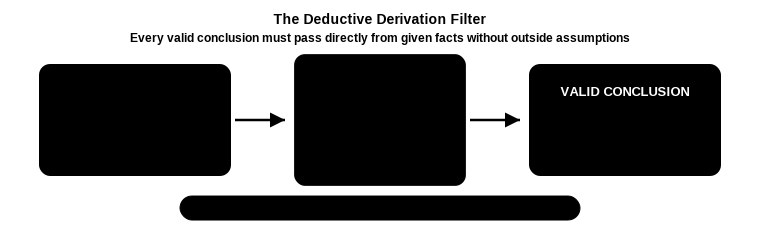
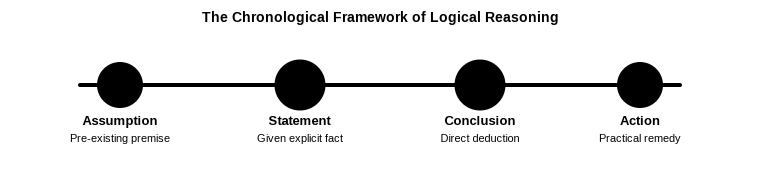
In logical reasoning, a Statement is a formal assertion providing specific information, facts, or observations, while a Conclusion is a direct deduction or derived truth that must logically follow from that statement without requiring outside information.
Fundamentals of Statement and Conclusion
1. What Defines a Valid Conclusion?
A conclusion is not a guess, a personal opinion, or a prediction. It is an undeniable logical derivation.
A conclusion is valid if it must be true whenever the given statement is true.
A conclusion is invalid if it is merely possible, assumes unmentioned facts, or goes beyond the boundaries of the statement.
2. Distinguishing Conclusions from Other Reasoning Concepts
Reasoning Type
What It Means
Position in Logic
Assumption
An unstated premise taken for granted to make the statement.
Exists before the statement is made.
Conclusion
An undeniable deduction drawn directly out of the given facts.
Derived after analyzing the statement.
Course of Action
A practical step or solution proposed to solve an issue.
An actionable measure, not a logical deduction.
3. Core Rules Every Beginner Must Follow
Rule 1: Treat the statement as 100% true. Even if the statement contradicts real-world facts, you must accept it as absolute truth for that question.
Rule 2: Never bring in outside knowledge. Do not use your own general knowledge, current affairs, or personal opinions. If it is not stated or directly implied by the text, it does not exist.
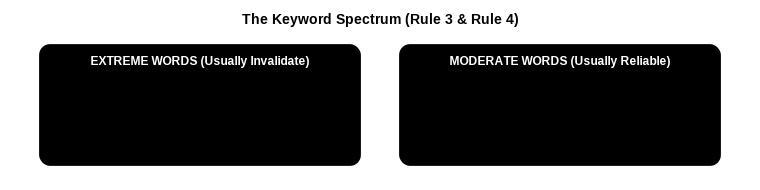
Rule 3: Beware of absolute words (Extreme Keywords). Words such as all, always, every, only, never, definitely, completely, none generally make a conclusion invalid unless the statement explicitly uses equally absolute language.
Rule 4: Moderate words are usually reliable. Words such as some, many, often, can, may, generally, mostly show non-absolute claims and are far more likely to follow logically if supported by the text.
Rule 5: Watch the direction of logic (Contrapositive).
If a statement says "Every citizen with a pass can enter," it does not automatically mean "Those without a pass cannot enter" unless it explicitly says only pass holders can enter.
If a statement says "Only pass holders can enter," then anyone inside must have a pass.
Rule 6: A recommendation is not a conclusion. If a statement discusses a problem (e.g., pollution), a conclusion stating "The government should ban cars" does not follow—that is a Course of Action, not a derived deduction.
Rule 7: Cause and correlation are distinct. Two events mentioned together do not mean one caused the other unless a direct causal link is stated.
4. Standard Options Format in Competitive Exams
For each set of statements and conclusions, questions typically offer these choices:
Only Conclusion I follows
Only Conclusion II follows
Either Conclusion I or II follows
Neither Conclusion I nor II follows
Both Conclusions I and II follow
Types of Statement and Conclusion Questions
Type 1: Direct Factual and Quantitative Deductions
These questions present concrete numbers, percentages, rankings, or measurable facts. The conclusion tests your ability to make simple, accurate mathematical or factual deductions without projecting unstated data.
Example 1Correct: Only Conclusion I follows
Statement: Out of 120 employees in an office, 70 are men. 40 employees walk to work, of which 25 are men.
Conclusion I: Exactly 15 women walk to work.
Conclusion II: More than half of the women in the office walk to work.
Explanation: Total employees = 120, Men = 70. Therefore, Women = 120 - 70 = 50. Total walkers = 40, Male walkers = 25. Therefore, Female walkers = 40 - 25 = 15. Conclusion I is directly true. Half of the women is 50 / 2 = 25. Since 15 is less than 25, Conclusion II does not follow.
Example 2Correct: Only Conclusion II follows
Statement: In a class test, Rohit scored higher marks than Priya, and Priya scored higher marks than Amit.
Conclusion I: Rohit scored the highest marks in the class.
Conclusion II: Amit scored fewer marks than Rohit.
Explanation: The ranking is Rohit > Priya > Amit. Amit clearly scored fewer marks than Rohit, so Conclusion II follows. We do not know the scores of any other students in the class, so Conclusion I cannot be verified.
Example 3Correct: Only Conclusion I follows
Statement: Company ABC recorded a 20% increase in revenue this year compared to last year, while its operating expenses remained completely unchanged.
Conclusion I: Company ABC earned higher operating profit this year than last year.
Conclusion II: The company doubled its total sales volume this year.
Explanation: Operating Profit = Revenue - Operating Expenses. If revenue increases and expenses stay the same, profit must increase. Conclusion I follows. The statement gives no data on sales volume (revenue growth could come from higher prices), so Conclusion II does not follow.
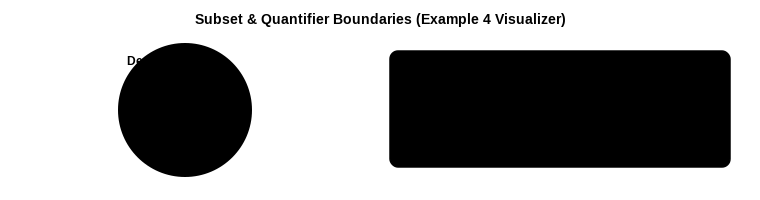
Example 4Correct: Only Conclusion II follows
Statement: The temperature in City X remained above 40 degrees Celsius on every single day of the previous week.
Conclusion I: City X experienced a heatwave last week.
Conclusion II: The temperature in City X on Wednesday was higher than 40 degrees Celsius.
Explanation: Wednesday is one of the seven days of the week, so its temperature was definitely above 40 degrees Celsius. Conclusion II follows. The term "heatwave" is a technical meteorological status not defined in the statement, so Conclusion I does not follow.
Example 5Correct: Both Conclusions I and II follow
Statement: A bookstore sold 300 books in January. In February, sales dropped by 50 books. In March, sales increased by 80 books compared to February.
Conclusion I: The bookstore sold 330 books in March.
Conclusion II: The total sales for the three months combined exceeded 800 books.
Explanation: January = 300. February = 300 - 50 = 250. March = 250 + 80 = 330. Conclusion I follows. Total sales = 300 + 250 + 330 = 880. Since 880 is greater than 800, Conclusion II also follows.
Type 2: Conditional and Cause-and-Effect Statements
These questions use conditional reasoning (if-then statements) or describe a direct cause behind an outcome. Deductions must follow strict logic without falling into the trap of assuming the reverse is true.
Example 1Correct: Only Conclusion II follows
Statement: If an applicant does not hold a valid driving license, their driver application is automatically rejected.
Conclusion I: Holding a valid driving license guarantees that the applicant will be hired.
Conclusion II: An applicant whose driver application was accepted holds a valid driving license.
Explanation: A valid license is a compulsory requirement; without it, rejection is automatic. Therefore, anyone accepted must hold a license (contrapositive logic). Conclusion II follows. Holding a license does not guarantee getting hired, as other requirements may exist. Conclusion I does not follow.
Example 2Correct: Only Conclusion I follows
Statement: Prolonged exposure to noise levels above 85 decibels causes permanent hearing loss. Worker K has worked in a factory section with noise levels of 95 decibels for ten years without any ear protection.
Conclusion I: Worker K has suffered permanent hearing loss.
Conclusion II: Ear protection completely eliminates all types of occupational health risks.
Explanation: 95 decibels is above 85 decibels, and ten years is prolonged exposure without protection. Therefore, Worker K has suffered permanent hearing loss. Conclusion I follows. Conclusion II makes an extreme claim about "all types" of occupational hazards, which is outside the scope of the statement.
Example 3Correct: Only Conclusion II follows
Statement: Regular aerobic exercise reduces the risk of heart disease by strengthening the heart muscles and lowering blood pressure.
Conclusion I: People who never exercise will definitely suffer from heart disease.
Conclusion II: Strengthening heart muscles and lowering blood pressure helps lower the risk of heart disease.
Explanation: The statement directly explains that strengthening heart muscles and lowering blood pressure reduces the risk of heart disease, so Conclusion II follows. Conclusion I uses the extreme word "definitely"; not exercising increases risk, but it does not guarantee disease.
Example 4Correct: Neither Conclusion I nor II follows
Statement: Whenever the warehouse temperature exceeds 30 degrees Celsius, the cooling alarm rings. Yesterday, the cooling alarm rang.
Conclusion I: The warehouse temperature exceeded 30 degrees Celsius yesterday.
Conclusion II: The cooling alarm rings only when the temperature exceeds 30 degrees Celsius.
Explanation: The statement tells us that exceeding 30 degrees triggers the alarm, but it does not state that this is the only reason the alarm can ring (it could ring for tests, maintenance, or smoke). Thus, we cannot assume the temperature exceeded 30 degrees Celsius, nor that it rings only for that reason.
Example 5Correct: Neither Conclusion I nor II follows
Statement: Consistent rainfall throughout July leads to a bumper harvest of paddy in State Y, provided fertilizer supply remains uninterrupted. State Y achieved a bumper harvest of paddy this year.
Conclusion I: State Y received consistent rainfall throughout July this year.
Conclusion II: Fertilizer supply remained uninterrupted in State Y this year.
Explanation: Consistent rain with fertilizers is one path to a bumper harvest, but the statement does not say it is the only way. Better irrigation or special seeds might have led to the bumper harvest. We cannot reverse the cause and effect.
Type 3: Quantifier and Extremity-Based Statements
These statements hinge on quantifiers like "all", "some", "most", "only", or "none". The objective is to identify whether conclusions stretch a partial truth into a whole truth, or invert an exclusion.
Example 1Correct: Only Conclusion II follows
Statement: Many creative writers lead unconventional daily routines.
Conclusion I: All individuals who lead unconventional daily routines are creative writers.
Conclusion II: Some individuals who lead unconventional daily routines are creative writers.
Explanation: "Many creative writers" means at least some writers have unconventional routines. Therefore, some individuals with unconventional routines are creative writers. Conclusion II follows. Conclusion I commits an invalid generalization by using "All".
Example 2Correct: Only Conclusion I follows
Statement: Only registered medical practitioners are authorized to prescribe scheduled drugs.
Conclusion I: A person who is not a registered medical practitioner cannot prescribe scheduled drugs.
Conclusion II: Every registered medical practitioner routinely prescribes scheduled drugs.
Explanation: "Only" defines a mandatory boundary. If someone is not registered, they are not authorized. Conclusion I follows. Being authorized to prescribe does not mean they "routinely" do so. Conclusion II does not follow.
Example 3Correct: Only Conclusion I follows
Statement: No candidate who failed the physical fitness test was admitted to the police academy.
Conclusion I: All candidates who were admitted to the police academy passed the physical fitness test.
Conclusion II: Every candidate who passed the physical fitness test was admitted to the police academy.
Explanation: Anyone who failed was excluded, meaning every admitted candidate must have passed the test. Conclusion I follows. Passing the test does not guarantee admission (written exams or background checks could disqualify them). Conclusion II does not follow.
Example 4Correct: Only Conclusion II follows
Statement: Some files on the desktop are confidential reports, and all confidential reports are password-protected.
Conclusion I: All password-protected files on the desktop are confidential reports.
Conclusion II: Some files on the desktop are password-protected.
Explanation: The confidential files that sit on the desktop are password-protected, meaning some files on the desktop are definitely password-protected. Conclusion II follows. There could be other files (such as personal documents) that are password-protected without being confidential reports, so Conclusion I does not follow.
Example 5Correct: Only Conclusion I follows
Statement: All luxury sedans manufactured by Brand Z come equipped with side airbags.
Conclusion I: Any car manufactured by Brand Z that does not have side airbags is not a luxury sedan.
Conclusion II: Non-luxury cars manufactured by Brand Z never have side airbags.
Explanation: Since every luxury sedan has side airbags, any car lacking side airbags cannot be a luxury sedan. Conclusion I follows. The statement gives no information about non-luxury cars, so Conclusion II does not follow.
Type 4: Contextual, Social, and Policy Statements
These statements mirror real-world administrative, environmental, economic, or social reports. The biggest pitfall is confusing a practical recommendation (Course of Action) or personal opinion with a logical conclusion.
Example 1Correct: Only Conclusion I follows
Statement: Despite several awareness drives by the civic body, household waste segregation in the city remains below 25%.
Conclusion I: Civic awareness drives alone have not been sufficient to achieve widespread waste segregation in the city.
Conclusion II: The civic body should penalize households that fail to segregate waste.
Explanation: The repeated drives failed to raise compliance above 25%, proving that awareness drives alone have not been enough. Conclusion I follows. Conclusion II is an administrative recommendation or remedy (Course of Action), not a deduced fact.
Example 2Correct: Only Conclusion I follows
Statement: A three-year study showed that workers who take a scheduled ten-minute walk during lunch hours report lower stress levels than those who remain at their desks.
Conclusion I: Taking a short walk during lunch hours helps reduce workplace stress.
Conclusion II: Workers who stay at their desks during lunch hours are less productive.
Explanation: Conclusion I directly restates the core finding of the study. Conclusion I follows. The study measured stress levels, not work productivity. Conclusion II brings in an unmentioned metric and does not follow.
Example 3Correct: Only Conclusion I follows
Statement: The literacy rate in District M rose from 45% in 2014 to 86% in 2024 following the rollout of free primary education centers.
Conclusion I: The free primary education centers contributed positively to literacy in District M.
Conclusion II: District M now has the highest literacy rate in the country.
Explanation: The steep increase occurred following the centers, indicating a positive contribution. Conclusion I follows. The statement provides no data comparing District M to other districts or national figures, so Conclusion II does not follow.
Example 4Correct: Only Conclusion II follows
Statement: Over the past five years, consumers have increasingly preferred purchasing groceries through mobile apps over visiting local physical stores.
Conclusion I: Physical grocery stores will completely shut down within the next two years.
Conclusion II: Consumer buying patterns for groceries have shifted toward digital platforms.
Explanation: Conclusion II directly reflects the described change in consumer preference. Conclusion I makes an extreme, speculative prediction with a strict time limit ("completely shut down within two years"), which is unsupported by the text.
Example 5Correct: Only Conclusion I follows
Statement: Solar and wind energy installations generated 40% of the state's power last month, leading to a 15% reduction in coal consumption compared to the previous year.
Conclusion I: Clean energy generation helped lower the state's reliance on coal for power last month.
Conclusion II: Wind energy is more cost-effective to produce than solar energy.
Explanation: The statement directly attributes the 15% reduction in coal consumption to solar and wind generation. Conclusion I follows. The statement provides no financial or cost comparison between solar and wind energy, so Conclusion II does not follow.
To master this topic, read the statement once to identify its exact boundary, cross out extreme adjectives in the conclusions, and eliminate any option that reads like a suggested remedy rather than a direct logical result.
Ready to Test Your Speed?
Put your deduction abilities, keyword tracking, and logic validation to the test with real exam drills.