Syllogism is a branch of deductive logical reasoning where you are given two or more statements (premises) and are asked to determine whether given conclusions logically follow from those statements. In syllogisms, the statements must be taken as 100% true, even if they completely contradict real-world facts (for example, "All cats are trees").
1. Fundamentals of Syllogism (What Every Beginner Must Know)
The Structure
A syllogism problem consists of:
Statements: Facts you must assume to be absolute truth.
Conclusions: Claims you must verify solely based on the statements.
Options: Choices indicating which conclusion follows (Conclusion I follows, Conclusion II follows, Either I or II follows, Neither follows, Both follow).
The Four Standard Statement Types
Every standard statement in syllogism connects two elements (Subject and Predicate) using one of four quantifying words:
1. Universal Affirmative ("All A are B"):
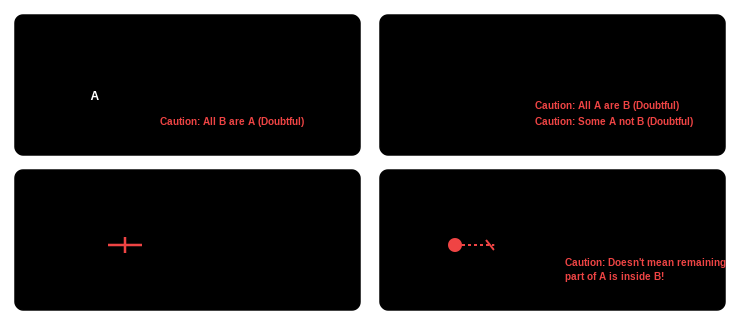
• Meaning: 100% of circle A lies inside circle B.
• Definite Truths: "Some A are B" and "Some B are A" are automatically true.
• Caution: "All B are A" is not definitely true.
2. Particular Affirmative ("Some A are B"):
• Meaning: There is an overlap between circle A and circle B (at least 1% up to 100%).
• Definite Truth: "Some B are A" is definitely true.
• Caution: "All A are B" or "Some A are not B" cannot be claimed definitely.
3. Universal Negative ("No A is B"):
• Meaning: Circle A and circle B are 100% separated with a complete barrier.
• Definite Truths: "No B is A", "Some A are not B", and "Some B are not A" are all definitely true.
4. Particular Negative ("Some A are not B"):
• Meaning: At least a specific portion of circle A can never enter circle B.
• Caution: This does not mean the remaining part of A is inside B.
The Two Venn Diagram Rules
• Basic Diagram (Minimum Overlap): Draw strictly what is mentioned, without assuming any extra overlap.
• Possible Diagram: Any alternative drawing that does not violate any given statement.
Definite Conclusion vs. Possibility
• Definite Conclusion: Must be true in every single possible diagram. If it fails in even one diagram, it does not follow.
• Possibility Conclusion: Must be true in at least one valid diagram without violating the given statements. If it works in even one case, the possibility follows.
Type 1: Basic Definite Syllogisms
In this type, statements and conclusions only use direct words like All, Some, No, and Some not. A conclusion follows only if it is universally true across all diagrams.
Example 1
Statements: 1. All Cats are Dogs. 2. All Dogs are Birds.
Conclusions: I. All Cats are Birds. II. Some Birds are Dogs.
Explanation: The Cat circle is entirely inside the Dog circle, and the Dog circle is entirely inside the Bird circle. Therefore, the Cat circle is entirely inside the Bird circle. Conclusion I follows. Since all Dogs are inside Birds, the area occupied by Dogs is a part of Birds. Thus, some Birds are definitely Dogs. Conclusion II follows.
✓ Answer: Both conclusions I and II follow.
Example 2
Statements: 1. Some Pens are Books. 2. All Books are Scales.
Conclusions: I. Some Pens are Scales. II. All Scales are Pens.
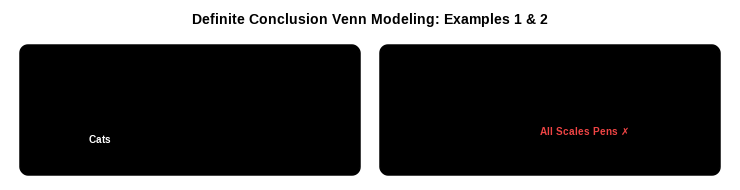
Explanation: The overlapping portion between Pens and Books lies completely inside Scales. Hence, that portion of Pens is definitely Scales. Conclusion I follows. We only know that some Scales are Pens; we have no information forcing all Scales to be Pens. Conclusion II does not follow.
✓ Answer: Only conclusion I follows.
Example 3
Statements: 1. No Tree is Flower. 2. All Flowers are Fruits.
Conclusions: I. No Tree is Fruit. II. Some Fruits are Flowers.
Explanation: Trees cannot touch Flowers, but Trees can freely overlap with the outer Fruit circle without touching Flowers. So, "No Tree is Fruit" is not definite. Conclusion I does not follow. Since all Flowers are inside Fruits, the portion occupied by Flowers belongs to Fruits. Hence, some Fruits are Flowers. Conclusion II follows.
✓ Answer: Only conclusion II follows.
Example 4
Statements: 1. Some Chairs are Tables. 2. No Table is Desk.
Conclusions: I. Some Chairs are not Desks. II. No Chair is Desk.
Explanation: The specific portion of Chairs that overlaps with Tables can never touch Desks because no Table can touch a Desk. Hence, that part of Chairs is definitely not a Desk. Conclusion I follows. The remaining portion of Chairs (outside Tables) could potentially touch Desks. So we cannot say "No Chair is Desk". Conclusion II does not follow.
✓ Answer: Only conclusion I follows.
Example 5
Statements: 1. All Cars are Buses. 2. No Bus is Train. 3. Some Trains are Planes.
Conclusions: I. No Car is Train. II. Some Planes are not Buses.
Explanation: Cars are completely inside Buses. Since the entire Bus circle cannot touch Trains, Cars can never touch Trains. Conclusion I follows. The portion of Planes that overlaps with Trains cannot touch Buses (because no Train can touch a Bus). Therefore, those Planes are not Buses. Conclusion II follows.
✓ Answer: Both conclusions I and II follow.
Type 2: Possibility-Based Syllogisms
Keywords used: "is a possibility", "can be", "may be".
Core Rules:
1. If two elements have no direct or indirect negative relation, any possibility between them is true.
2. If something is already a 100% known definite fact, calling it a possibility is false (what is certain cannot merely be possible).
3. If an action violates a statement (e.g., trying to put an element into an area where it is prohibited), the possibility is false.
Example 1
Statements: 1. Some Red are Blue. 2. Some Blue are Green.
Conclusions: I. All Red being Green is a possibility. II. No Red is Green is a possibility.
Explanation: There is no direct negative restriction between Red and Green. We can draw Green completely enveloping Red without violating any statement. Conclusion I follows. We can also draw Green completely away from Red without violating any statement. Conclusion II follows.
✓ Answer: Both conclusions I and II follow.
Example 2
Statements: 1. All Apples are Mangoes. 2. No Mango is Banana.
Conclusions: I. Some Apples being Bananas is a possibility. II. All Bananas being Mangoes is a possibility.
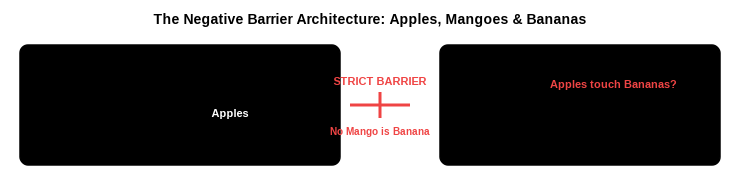
Explanation: Apples are inside Mangoes, and Mangoes have a strict negative barrier with Bananas. Apples can never touch Bananas. Conclusion I does not follow. Bananas can never touch Mangoes due to the direct negative statement. Conclusion II does not follow.
✓ Answer: Neither conclusion I nor II follows.
Example 3
Statements: 1. Some Cups are Plates. 2. All Plates are Spoons.
Conclusions: I. All Cups being Spoons is a possibility. II. Some Spoons being Cups is a possibility.
Explanation: Cups already overlap with Plates (inside Spoons). Expanding the Spoon circle to enclose all Cups violates nothing. Conclusion I follows. Since Some Cups are Plates and All Plates are Spoons, it is already a 100% definite fact that Some Spoons are Cups. Because it is already definitely true, calling it a possibility is considered invalid. Conclusion II does not follow.
✓ Answer: Only conclusion I follows.
Example 4
Statements: 1. No River is Ocean. 2. All Oceans are Seas.
Conclusions: I. All Seas being Rivers is a possibility. II. All Rivers being Seas is a possibility.
Explanation: Seas contain Oceans. Oceans can never touch Rivers. If all Seas went inside Rivers, Oceans would also go inside Rivers, which violates statement 1. Conclusion I does not follow. Rivers cannot touch Oceans, but Rivers can easily sit inside the part of Seas that is outside Oceans. Conclusion II follows.
✓ Answer: Only conclusion II follows.
Example 5
Statements: 1. Some Phones are Laptops. 2. No Laptop is Watch. 3. All Watches are Bands.
Conclusions: I. All Bands being Laptops is a possibility. II. Some Phones being Watches is a possibility.
Explanation: Bands contain Watches, and Watches can never enter Laptops. Therefore, all Bands can never enter Laptops. Conclusion I does not follow. The part of Phones that does not overlap with Laptops is free to overlap with Watches. Conclusion II follows.
✓ Answer: Only conclusion II follows.
Type 3: "Either - Or" Case (Complementary Pairs)
The "Either - Or" case occurs when two conclusions cannot both be true at the same time, but one of them must necessarily be true.
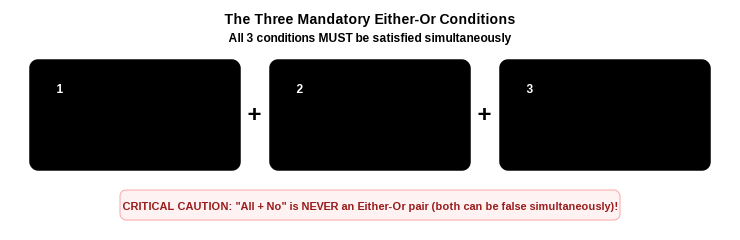
The Three Mandatory Conditions for Either-Or:
1. Both individual conclusions must be doubtful / false independently (neither is definitely true on its own).
2. Both conclusions must have the exact same Subject and Predicate.
3. The two conclusions must form a valid complementary pair:
• Pair A: Some + No
• Pair B: All + Some not
• Pair C: Some + Some not (Note: "All + No" is NEVER an Either-Or pair because both can be false simultaneously).
Example 1
Statements: 1. Some Cats are Rats. 2. Some Rats are Bats.
Conclusions: I. Some Cats are Bats. II. No Cat is Bat.
Explanation: Condition 1: Looking at the basic diagram, Cats and Bats do not touch, so Conclusion I is doubtful. In a possible diagram, they can touch, so Conclusion II is also doubtful. Both are false independently. Condition 2: Both have the same elements (Cat and Bat). Condition 3: They form the pair "Some + No".
✓ Answer: Either conclusion I or II follows.
Example 2
Statements: 1. All Circles are Squares. 2. Some Squares are Triangles.
Conclusions: I. All Circles are Triangles. II. Some Circles are not Triangles.
Explanation: Condition 1: There is no direct link between Circles and Triangles. "All Circles are Triangles" is doubtful. "Some Circles are not Triangles" is also doubtful. Condition 2: Both have the same subject and predicate (Circles and Triangles). Condition 3: They form the pair "All + Some not".
✓ Answer: Either conclusion I or II follows.
Example 3
Statements: 1. No Water is Milk. 2. No Milk is Juice.
Conclusions: I. Some Water is Juice. II. No Water is Juice.
Explanation: Condition 1: Water cannot touch Milk, and Milk cannot touch Juice. But the relation between Water and Juice is completely unknown. Thus, both Conclusion I and Conclusion II are doubtful independently. Condition 2: Both conclusions have the elements Water and Juice. Condition 3: They form the pair "Some + No".
✓ Answer: Either conclusion I or II follows.
Example 4
Statements: 1. Some Doctors are Lawyers. 2. Some Lawyers are Engineers.
Conclusions: I. Some Doctors are Engineers. II. Some Doctors are not Engineers.
Explanation: Condition 1: The relation between Doctors and Engineers is unknown. Conclusion I is doubtful. Conclusion II is doubtful. Condition 2: Both contain the elements Doctors and Engineers. Condition 3: They form the pair "Some + Some not".
✓ Answer: Either conclusion I or II follows.
Example 5
Statements: 1. All Doors are Windows. 2. All Windows are Walls. 3. Some Walls are Floors.
Conclusions: I. Some Doors are Floors. II. No Door is Floor.
Explanation: Condition 1: Doors are inside Walls. Floors overlap with Walls, but we do not know if Floors touch Doors. Both conclusions are doubtful on their own. Condition 2: Both elements are identical (Doors and Floors). Condition 3: They form the pair "Some + No".
✓ Answer: Either conclusion I or II follows.
Type 4: "Only" and "Only a Few" Syllogisms
These are modern standard patterns with specific structural rules:
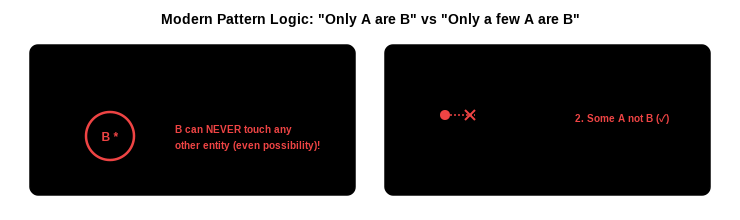
1. "Only A are B":
• Translates to: All B are A.
• Critical Restriction: Element B becomes exclusive to A. Element B cannot touch or belong to any other element, neither definitely nor as a possibility.
2. "Only a few A are B":
• Translates to two definite truths combined:
1. Some A are B (Definite positive)
2. Some A are not B (Definite negative)
• All A can never become B. However, all B can become A (unless restricted elsewhere).
Example 1
Statements: 1. Only a few Roses are Lilies. 2. All Lilies are Tulips.
Conclusions: I. Some Roses are not Lilies. II. All Roses being Lilies is a possibility.
Explanation: "Only a few Roses are Lilies" means both "Some Roses are Lilies" and "Some Roses are not Lilies" are definite facts. Conclusion I follows directly. Because some Roses can never be Lilies, the possibility of all Roses becoming Lilies is impossible. Conclusion II does not follow.
✓ Answer: Only conclusion I follows.
Example 2
Statements: 1. Only a few Mobiles are Tablets. 2. Some Tablets are Laptops.
Conclusions: I. All Tablets being Mobiles is a possibility. II. All Mobiles being Tablets is a possibility.
Explanation: The restriction "only a few" applies from Mobiles toward Tablets (all Mobiles cannot be Tablets). But Tablets have no such restriction preventing them from entering Mobiles. Conclusion I follows. "Only a few Mobiles are Tablets" guarantees that a portion of Mobiles is strictly outside Tablets. Thus, all Mobiles can never be Tablets. Conclusion II does not follow.
✓ Answer: Only conclusion I follows.
Example 3
Statements: 1. Only Stars are Moons. 2. Some Stars are Planets.
Conclusions: I. All Moons are Stars. II. Some Moons being Planets is a possibility.
Explanation: "Only Stars are Moons" directly converts to "All Moons are Stars". Conclusion I follows. In "Only Stars are Moons", Moons belong exclusively to Stars. Moons cannot have any positive connection with any other element (including Planets), even as a possibility. Conclusion II does not follow.
✓ Answer: Only conclusion I follows.
Example 4
Statements: 1. Only a few Red are Black. 2. Only a few Black are White.
Conclusions: I. Some Red are not Black. II. Some Red being White is a possibility.
Explanation: "Only a few Red are Black" explicitly implies that some Red are definitely not Black. Conclusion I follows. There is no direct negative relation between Red and White. They can easily overlap in a possible diagram. Conclusion II follows.
✓ Answer: Both conclusions I and II follow.
Example 5
Statements: 1. Only Paper is Pen. 2. Some Paper is Eraser.
Conclusions: I. No Pen is Eraser. II. All Erasers being Paper is a possibility.
Explanation: "Only Paper is Pen" means all Pens are inside Paper, and Pens cannot touch any entity other than Paper. Therefore, Pen is completely restricted from touching Eraser. Conclusion I follows. Eraser can completely go inside the remaining area of Paper without touching Pen. Conclusion II follows.
✓ Answer: Both conclusions I and II follow.
Ready to Test Your Speed?
Put your syllogism deduction skills and speed shortcuts to the test with real exam drills.