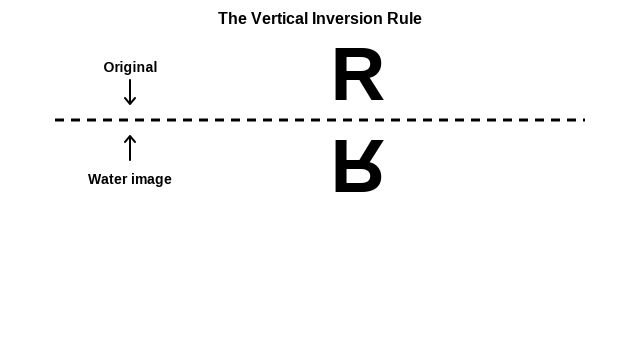
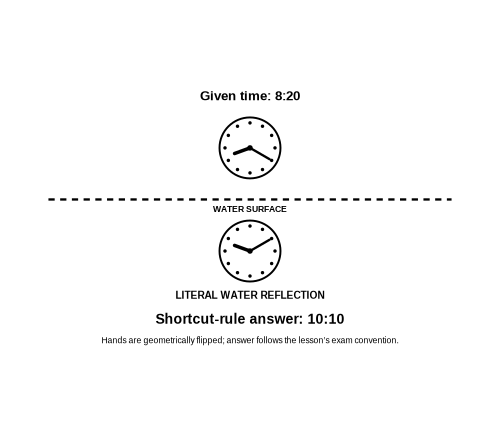
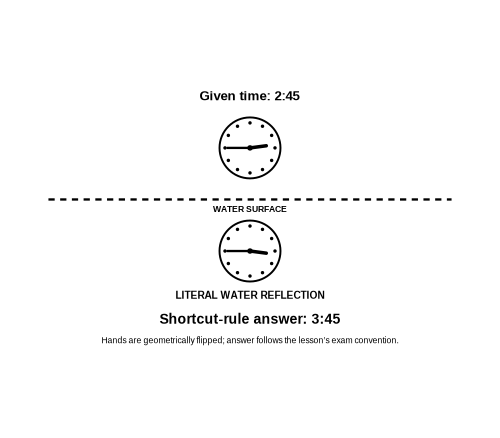
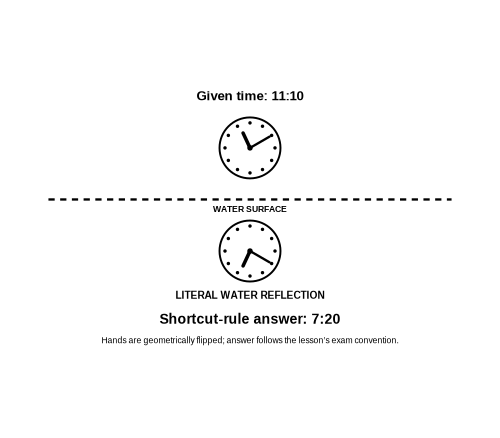
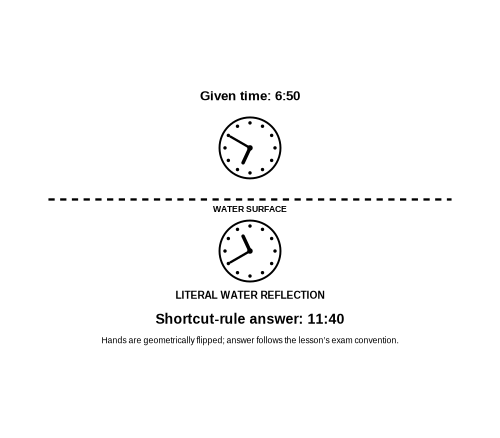
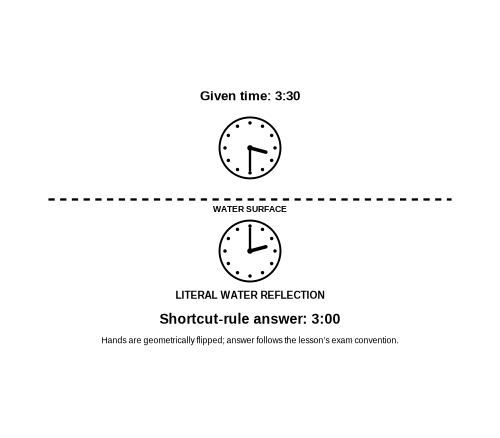
A Water Image is the reflection of an object seen in water. In reasoning, water image problems test your visual and spatial reasoning by asking you to determine how an object, letter, number, or figure looks when reflected across a horizontal plane placed directly underneath it.
1. Fundamentals of Water Images
The Core Principle: Vertical Inversion
The water surface acts as a horizontal mirror placed directly below the object.
Top and Bottom Interchange: The top part of the object appears at the bottom of the reflection, and the bottom part appears at the top.
Left and Right Stay the Same: The left side of the original object remains on the left side in the reflection, and the right side remains on the right side.
Proximity Rule: Any part of the object that is closest to the water line in reality will be closest to the water line in the reflection.
Water Image vs. Mirror Image
Beginners often confuse water images with mirror images. Here is the distinction:
Feature
Water Image (Horizontal Mirror)
Standard Mirror Image (Vertical Mirror)
Mirror Position
Placed horizontally below the object
Placed vertically to the left or right
Top & Bottom
Inverted (Flips upside down)
Unchanged (Top stays top, bottom stays bottom)
Left & Right
Unchanged (Left stays left, right stays right)
Inverted (Left becomes right, right becomes left)
The Common Beginner Mistake in Words
When a word is reflected in water:
The order of letters does NOT reverse.
The first letter stays in the first position, the second letter stays second, and so on.
Each individual letter flips upside down in place.
(Reversing the letter sequence from right to left only happens in vertical mirror images, not water images.)
Symmetrical Characters (No Change in Water Image)
Some characters possess horizontal symmetry. When placed above water, their reflection looks identical to the original:
Capital Letters (8 letters): C, D, E, H, I, K, O, X (Note: In standard, strictly symmetric geometric fonts, these letters do not alter their appearance when flipped vertically.)
Numbers: 0 (and 8 if both upper and lower loops are drawn identical in size).
2. Types of Water Image Questions
In competitive reasoning, questions fall into five primary categories:
Letter and Word-Based
Number-Based
Alphanumeric Combinations
Figure and Pattern-Based
Clock-Based (Time Reflection)
Type 1: Letter and Word-Based
Each letter is inverted upside down while remaining in its original left-to-right sequence.
Example 1: Single Letter 'A'
Original: Horizontal base at the bottom, pointed peak at the top.
Water Image: The pointed peak moves to the bottom, and the horizontal crossbar moves to the upper section. It looks like an upside-down 'V' with a line across it.
Example 2: Single Letter 'M'
Original: Flat base at the bottom with two legs, central 'V' pointing downwards from the top.
Water Image: Flips vertically to look like the letter W.
Example 3: Word 'TOP'
Analysis:
T: The top horizontal bar shifts to the bottom; the vertical stem points upward.
O: Symmetrical; remains O.
P: The loop was at the top-right; it moves to the bottom-right.
Resulting Sequence: Each letter flips vertically in place. The order remains T, then O, then P.
Example 4: Word 'FROG'
Analysis:
F: Horizontal arms move from top-right to bottom-right; vertical line stays on the left.
R: Rounded loop moves to bottom-right; diagonal leg points up-right; vertical stem stays left.
O: Remains O.
G: Curved opening and inward horizontal line move from bottom-right to top-right.
Resulting Sequence: Inverted F, Inverted R, O, Inverted G.
Example 5: Word 'KICK'
Analysis:
K: Symmetrical across the horizontal midline; remains K.
I: Symmetrical; remains I.
C: Symmetrical; remains C.
K: Symmetrical; remains K.
Resulting Sequence: KICK remains visually identical in its water image.
Type 2: Number-Based
Digits invert vertically. Pay special attention to curved digits like 6, 9, 2, and 5.
Example 1: Digit '7'
Original: Horizontal bar across the top; diagonal stroke descends toward the bottom-left.
Water Image: Horizontal bar moves to the bottom; diagonal stroke ascends toward the top-left.
Example 2: Digit '4'
Original: Vertical stem on the right; horizontal crossbar and triangle opening in the upper half.
Water Image: The horizontal bar and pointed intersection shift to the lower half; the vertical line extends through it.
Example 3: Digit '9'
Original: Closed loop at the top-right; downward stem on the right curving slightly left.
Water Image: Closed loop moves to the bottom-right; stem points upward.
(Note: It does not turn into a standard '6' because a 6 has its loop on the bottom-left. In a water image, right stays right, so the loop stays on the right side).
Example 4: Digit '5'
Original: Horizontal bar at the top; short vertical drop on the left; curved semi-circle at the bottom-right.
Water Image: Curved semi-circle moves to the top-right; short vertical drop on the left; flat horizontal bar moves to the bottom.
Example 5: Multi-Digit Number '8462'
Analysis:
Order remains: 1st digit is 8, 2nd is 4, 3rd is 6, 4th is 2.
8: Remains 8.
4: Flips vertically (stem stays right).
6: Loop moves from bottom-left to top-left; tail curves downward.
2: Base horizontal line moves to the top; curve moves to the bottom.
These combine letters, numbers, and sometimes case variations (upper and lower case). The evaluation rule is identical: keep positions fixed from left to right, and flip every single element upside down.
Example 1: 'U4P15B'
Analysis:
U: Opening moves from top to bottom (looks like an inverted arch).
4: Inverts vertically.
P: Loop moves to bottom-right.
1: Top small slant moves to bottom-left; bottom base line moves to top.
5: Loop moves to top-right; flat bar moves to bottom.
B: In standard fonts, the upper loop is slightly smaller than the lower loop; in the water image, the smaller loop appears at the bottom.
Order: Maintained left-to-right as 1st through 6th positions.
Example 2: 'R9E3T'
Analysis:
R: Loop at bottom-right, leg up-right.
9: Loop at bottom-right, tail pointing up.
E: Symmetrical; remains E.
3: Symmetrical horizontally; remains 3.
T: Horizontal line at bottom; stem pointing up.
Example 3: 'M7K3J'
Analysis:
M: Becomes W.
7: Top bar moves to bottom; stem points up-left.
K: Symmetrical; remains K.
3: Symmetrical; remains 3.
J: Top bar moves to bottom; hook curves upward on the left.
Example 4: 'b8z4A' (Mixed Case)
Analysis:
b: Vertical stem goes downward on the left; loop moves to the top-right (resembles a 'p').
8: Symmetrical; remains 8.
z: Top horizontal bar moves to bottom; bottom bar moves to top; diagonal orientation preserves left-to-right integrity.
4: Inverts vertically.
A: Inverts upside down.
Example 5: '96FSH2'
Analysis:
9: Loop shifts to bottom-right.
6: Loop shifts to top-left.
F: Arms move to bottom-right.
S: Top curve flips to bottom; bottom curve flips to top.
H: Symmetrical; remains H.
2: Base line shifts to top; curve shifts to bottom.
Type 4: Figure and Pattern-Based
In figure-based questions, an abstract design containing shapes, shading, and arrows is given.
Example 1: Upward-Pointing Triangle with a Dot
Original: A triangle standing on its flat base with its apex pointing Up. A solid black dot is located inside the top apex.
Water Image:
The apex now points Down.
The flat base is at the Top.
The black dot moves to the bottom apex.
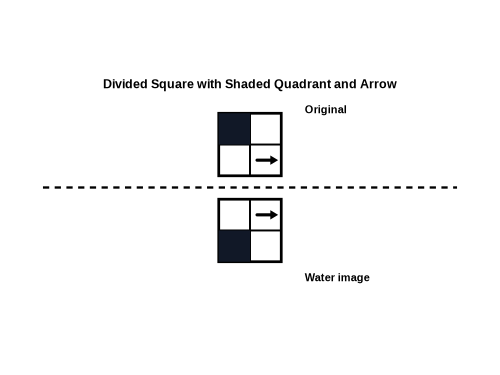
Example 2: Divided Square with Shaded Quadrant and Arrow
Original: A square divided into four equal quadrants. Top-left quadrant is shaded black; bottom-right quadrant contains an arrow pointing Right.
Water Image:
Top-left shaded quadrant shifts to the bottom-left quadrant.
The bottom-right arrow shifts to the top-right quadrant.
The arrow continues to point Right (horizontal direction does not change).
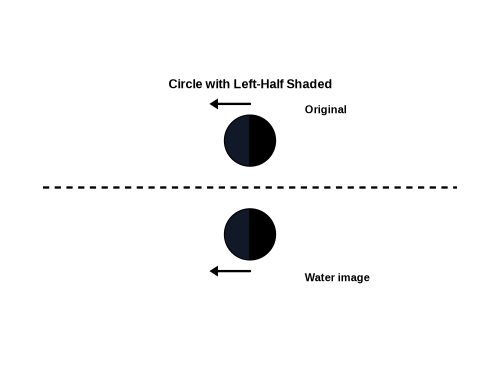
Example 3: Circle with Left-Half Shaded
Original: A circle with a vertical diameter. The left half is painted black; the right half is white. At the top edge, an external arrow points Left.
Water Image:
The left half remains black and the right half remains white (left/right unchanged).
The external arrow moves to the bottom edge, still pointing Left.
Example 4: Flag on a Pole
Original: A vertical flagpole on the left side, with a triangular pennant flying to the right from the top of the pole.
Water Image:
The vertical flagpole remains on the left side.
The triangular pennant moves to the bottom of the pole, still pointing towards the Right.
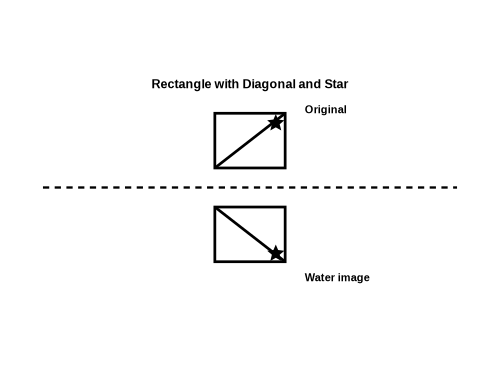
Example 5: Rectangle with Diagonal and Star
Original: A rectangle with a diagonal running from bottom-left to top-right. A star symbol is positioned in the top-right corner.
Water Image:
The bottom-left end of the diagonal flips to become the top-left.
The top-right end flips to become the bottom-right.
The diagonal now runs from top-left to bottom-right.
The star symbol shifts from the top-right corner to the bottom-right corner.
Type 5: Clock-Based (Time Reflection)
In non-verbal reasoning, questions frequently ask for the time shown in the water image of a clock without numbers (only dot markers).
The Standard Formula
Because water reflection is symmetric across the horizontal axis through the 9 and 3 positions, the reference base is 18:30 (or 6:30):
If the given minute value is 30 or less (minutes ≤ 30):
Water Image Time = 18:30 - Given Time
If the given minute value is greater than 30 (minutes > 30):
If the resulting hour is greater than 12, subtract 12 (convert to 12-hour format).
If the resulting hour is 0, it represents 12 o'clock.
Example 1: Given Time = 8:20
Minutes are 20 (less than 30), so subtract from 18:30:
Hours: 18 - 8 = 10
Minutes: 30 - 20 = 10
Water Image Time: 10:10
Example 2: Given Time = 2:45
Minutes are 45 (greater than 30), so subtract from 17:90:
Hours: 17 - 2 = 15
Minutes: 90 - 45 = 45
Convert 15:45 to 12-hour clock: 15 - 12 = 3
Water Image Time: 3:45
Example 3: Given Time = 11:10
Minutes are 10 (less than 30), so subtract from 18:30:
Hours: 18 - 11 = 7
Minutes: 30 - 10 = 20
Water Image Time: 7:20
Example 4: Given Time = 6:50
Minutes are 50 (greater than 30), so subtract from 17:90:
Hours: 17 - 6 = 11
Minutes: 90 - 50 = 40
Water Image Time: 11:40
Example 5: Given Time = 3:30
Minutes are 30 (equal to 30), so subtract from 18:30:
Hours: 18 - 3 = 15
Minutes: 30 - 30 = 00
Convert 15:00 to 12-hour clock: 15 - 12 = 3
Water Image Time: 3:00
3. Quick Elimination Strategy for Multiple-Choice Questions
When solving water image questions under tight time limits:
Check the first and last characters first: In water images, the first character must remain in the first spot, only flipped upside down. Any option that puts the last character first is a mirror image trick; eliminate it immediately.
Track a unique asymmetry: Look for a single distinct feature (like an arrow, a dot, or an open loop). Check where that element goes (top to bottom, left stays left). This typically eliminates 2 to 3 incorrect options in seconds.
Ready to Test Your Skills?
Put your visualization and calculation tricks to the test with real exam drills.